Custom silicone pads are flat, solid silicone rubber components that sit between two surfaces to damp vibration, insulate heat, seal out dust and moisture, or keep a finished surface from being scratched. FromRubber compression molds and die-cuts them to your drawing or sample — in 20 to 80 Shore A hardness, thicknesses from 0.5 mm to 25 mm, and tolerances down to ±0.15 mm (ISO 3302-1 Class M2) — with optional 3M adhesive backing, and conductive or thermally conductive compounds.
Send us a drawing or a physical sample. We will review the geometry, verify the mounting requirements, and come back with a material recommendation and a detailed quote within 2 hours.
A silicone pad is a flat elastomer part made from solid silicone rubber (VMQ). It is placed between two surfaces — or against a single surface — to perform one or more of these core functions:
Vibration damping — absorb mechanical energy before it reaches a PCB, sensor, or structural housing.
Thermal or electrical insulation — block thermal transfer from hot assemblies, or isolate electrically conductive parts with dielectric breakdown resistance (≥ 20 kV/mm).
Sealing — close a joint against dust ingress, water spray, or low-pressure air leakage.
Friction and protection — stop equipment from sliding, or prevent metal and plastic edges from marking finished surfaces.
Silicone is selected over nitrile, EPDM, or natural rubber because it retains its elasticity across an extreme temperature range of -60°C to +220°C. A pad that remains pliable in sub-zero environments and resists compression set at continuous elevated heat continues working through repeated thermal cycling. This makes solid silicone pads the preferred solution for outdoor enclosures, automotive electronic modules, and high-heat appliances.
1.1 Two ways we make them
Die-cutting from sheet or roll stock — for flat pads with uniform wall thickness and simple or 2D contours, we die-cut directly from precision-calendered or compression-molded silicone sheets. This approach requires minimal upfront tooling cost and delivers fast turnaround.
Custom compression molding — for pads featuring raised lips, interlocking alignment ribs, countersunk holes, or stepped geometries, we precision mold the parts using CNC-machined steel tooling.
If you are unsure which manufacturing route fits your annual volume and tolerance requirements, send us your 2D or 3D drawing. The difference in upfront tooling investment and unit cost is substantial, and our engineering team will evaluate the optimal approach before you commit.
2. Which Silicone Pad Fits Your Application?
The mechanical and environmental demands of your assembly dictate every design variable — including compound durometer, profile thickness, surface texture, and adhesive system. We manufacture solid silicone pads tailored to four functional categories.
2.1 Vibration Damping Pads
Engineered to isolate mechanical energy and shock before it transmits to sensitive internal assemblies. The pad's durometer and thickness are calculated so that it operates within its linear spring rate under static load.
Hardness range: 40 to 60 Shore A
Typical thicknesses: 2.0 mm to 15.0 mm
Compression at working load: 15% to 25%, which prevents premature fatigue and bottoming out
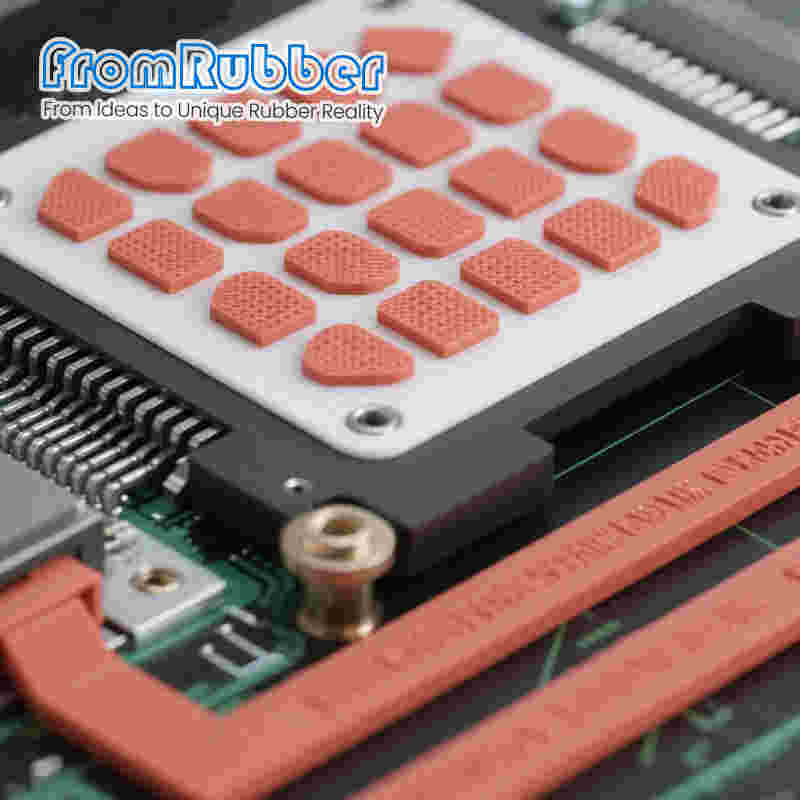
Typical applications: compressor mounts, motor base isolation, pump damping pads, robotic arm joint buffers, and PCB stand-off pads
2.2 Thermal & Electrical Insulation Pads
Formulated to decouple high-temperature components or protect chassis assemblies from electrical breakdown.
Operating temperature: -60°C to +220°C continuous
Dielectric strength: ≥ 20 kV/mm
Thermal conductivity: 1.5 to 6.0 W/m·K using specialized thermally conductive ceramic fillers
Typical applications: power supply insulators, EV battery cell separators, LED driver thermal isolation, and industrial inverter mountings
2.3 Sealing Pads (Dust & Moisture)
Used as flat, solid profile gaskets to seal mating flanges against dust ingress (IP65 to IP67) and moisture spray. Sealing efficiency relies on proper bolting force and controlled deflection.
Target compression range: 20% to 30% of nominal thickness
Typical thicknesses: 1.0 mm to 6.0 mm
Compression set: ≤ 20% at 22 hrs / 23°C, ≤ 35% at 22 hrs / 175°C
Typical applications: control box cover seals, junction box face gaskets, outdoor lighting lens pads, and telecom enclosure access panels
2.4 Anti-Slip & Surface Protection Pads
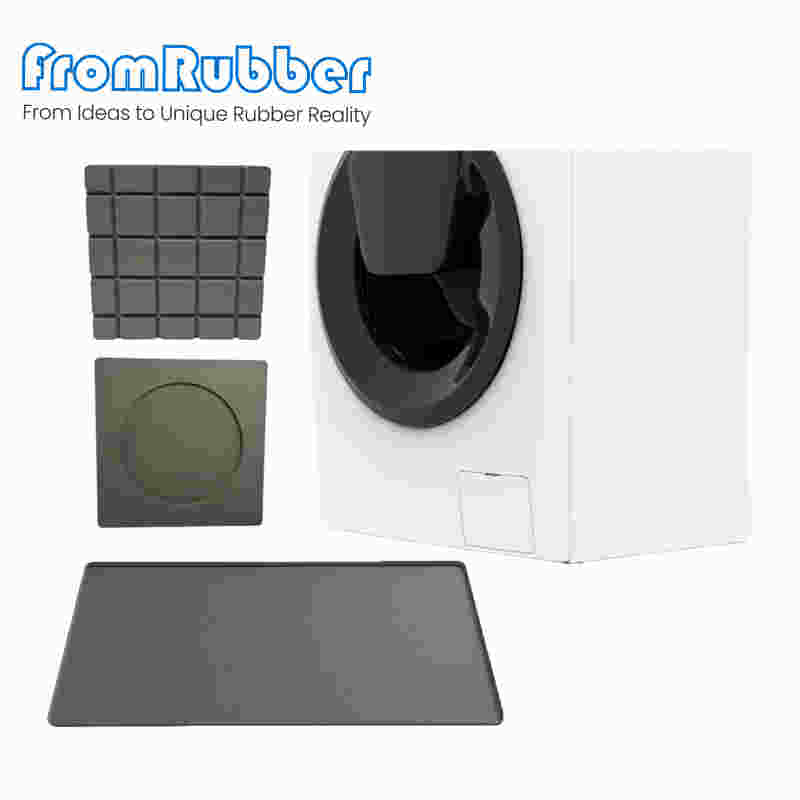
Applied to the underside of desktop or industrial equipment to prevent lateral movement, or placed between stacked parts to protect delicate finishes during assembly and transport.
Dielectric strength (≥ 20 kV/mm) and max temperature
0.5 – 3.0 mm
Power electronics, transformers, inverters
Sealing pad
Blocks water, oil spray, and dust
Compression set (≤ 20%) and joint torque
1.0 – 6.0 mm
Electrical cabinets, outdoor housings
Protective pad
Prevents skidding and cosmetic wear
Surface finish and abrasion resistance
0.8 – 5.0 mm
Appliance bases, instrumentation chassis
2.6 Where Solid Silicone Pads Are Not the Right Choice
Solid silicone maintains volumetric shape under clamping force. While this provides high dimensional stability and superior long-term recovery under load, it also means solid silicone requires measurable compressive force to deflect.
If your enclosure or delicate plastic casing can tolerate only minimal clamping pressure — a lightweight handheld device passing a drop test, for example, or micro-gap filling that needs under 10% deflection force — solid silicone is often too rigid. In such low-closure-force scenarios, sponge or microcellular foam materials may be technically better suited. We will review your assembly load specs during the quoting stage and flag it explicitly if your application sits outside what solid silicone can do.
3. Adhesive Backing Options
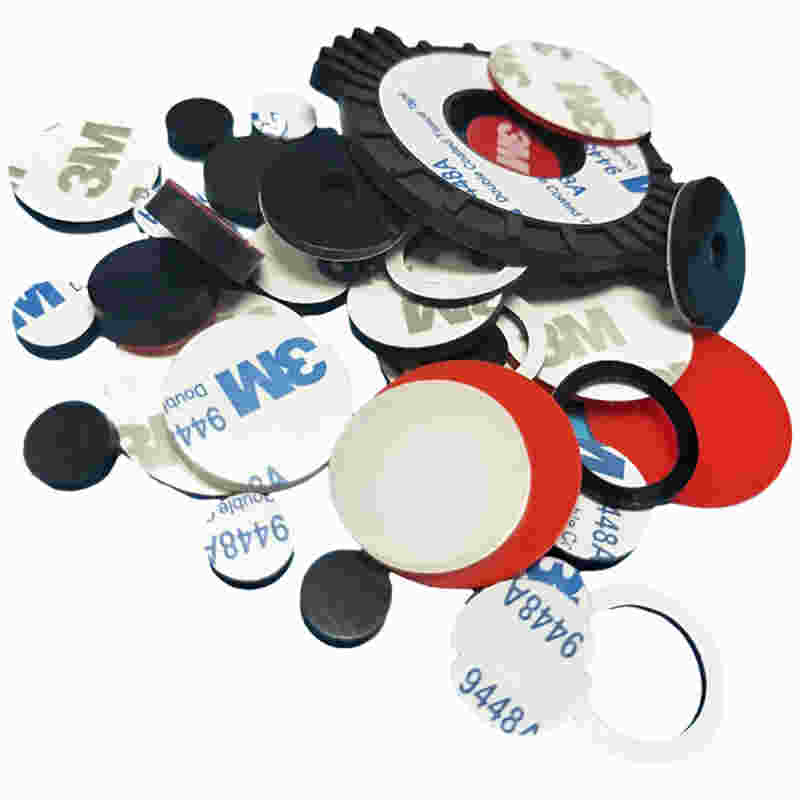
Most pads we manufacture are backed with pressure-sensitive adhesives (PSA), allowing operators to peel and place parts directly on the assembly line without liquid glue, screws, or secondary clips.
3.1 Where PSA Bonds Fail in Practice
Edge overhang — the adhesive face extends over an internal cutout, stepped recess, or bezel edge, where it collects dust.
Surface contamination — the substrate carries residual mold release agents, machine oil, or fine shop dust.
Tension during placement — the assembler stretches the flexible pad while sticking it down, creating latent internal stress that pulls the bond loose over time.
Repeated repositioning — the pad is partially placed, peeled back, and re-stuck while aligning, which destroys the initial adhesive wet-out.
3.2 Four Application Rules We Share With Every Customer
Confirm alignment before liner removal. Use mechanical registration pins or a visual jig to position the part before the adhesive film is exposed.
Degrease the substrate. Clean the bonding surface with a 50/50 isopropyl alcohol (IPA) and water blend, then let it dry completely.
Lay flat without stretching. Never pull or tension the silicone pad during assembly.
Apply definitive seating pressure. Roll down firmly — PSA adhesives need uniform pressure (roughly 15 psi) to initiate proper contact wet-out.
3.3 Standard PSA Options
Option
Description
Recommended substrate and thermal limits
Best for
3M 9448A
Double-coated tissue tape with high-tack acrylic adhesive
Metals, painted panels, high-energy plastics. -40°C to +90°C, short-term 150°C
Standard indoor equipment, general-purpose housing pads
3M 467MP
High-performance 200MP transfer adhesive, pure acrylic film
Smooth bare metals, aluminum, glass, high-temperature plastics. -40°C to +150°C, short-term 200°C
High-temperature operating enclosures, precision metal chassis
3M 9472LE (300LSE)
Specialized adhesive for low surface energy (LSE) materials
Mechanically retained in a machined groove, or held under constant fastener pressure
Assemblies needing non-destructive teardown, field rework, or service above 200°C
Not sure which adhesive matches your casing? Tell us the substrate material and the operating temperature it sees, and our engineers will recommend the correct 3M bonding grade.
4. Specifications
Parameter
Specification
Engineering / compliance notes
Base material
100% solid silicone rubber (VMQ)
Optional conductive or thermally conductive formulations
Hardness range
20 to 80 Shore A (±5 Shore A)
Standard stock durometers: 40 A, 50 A, 60 A, 70 A
Thickness range
0.5 mm to 25 mm
Die-cut parts down to 0.5 mm; molded parts up to 25 mm
Dimensional tolerance
ISO 3302-1 Class M2 (precision) / M3
Down to ±0.15 mm on critical molded features
Maximum finished size
Up to 500 mm × 500 mm
Custom tooling layouts tailored to order volume
Operating temperature
-60°C to +220°C (-76°F to +428°F)
Unbacked silicone; PSA versions are capped by the tape rating
Compression set
≤ 20% at 22h / 23°C; ≤ 35% at 22h / 175°C
Fully cured with secondary post-cure baking
Dielectric strength
≥ 20 kV/mm
Tested per ASTM D149
Adhesive backing
3M PSA, single-sided or double-sided
Standard grades: 3M 9448A, 467MP, 9472LE (300LSE)
Surface finish
Smooth, matte, or textured (mold-tech)
Formulated for non-slip or low-friction requirements
Color options
Translucent, black, or custom Pantone matched
Formulated with high-stability silicone pigments
Manufacturing process
Compression molding / high-speed die-cutting
Selected based on 3D geometry and production quantity
Minimum order quantity
500 to 1,000 pcs for molding; flexible for die-cut
Low-volume engineering pilot runs supported
Sample lead time
3 to 5 business days
From CAD drawing approval or tool readiness
Production lead time
15 to 25 calendar days
Dependent on tool cavitation and quantity
Quality and environmental
ISO 9001:2015, IATF 16949, RoHS, REACH, FDA
Material test certificates provided with the initial sample delivery
5. Materials & Options
5.1 Compound Selection
Standard solid industrial silicone (VMQ) — balanced general-purpose formulation for damping, spacing, and environmental sealing. Standard durometer 50 ±5 Shore A, black or translucent.
Food-contact grade silicone — fully post-cured and compliant with FDA 21 CFR 177.2600 and LFGB food contact safety standards, formulated without toxic plasticizers.
Electrically conductive silicone — filled with silver-plated aluminum, nickel-graphite, or conductive carbon black. Volume resistivity down to < 0.008 Ω·cm for EMI/RFI shielding and grounding.
Thermally conductive silicone — compounded with high-purity ceramic dielectric fillers, offering thermal conductivity from 1.5 W/m·K to 6.0 W/m·K.
5.2 Finishing & Integration
Custom color matching — precise matching against Pantone Formula Guides and RAL standards.
ISO 9001:2015 and IATF 16949:2016 for automotive quality management
Measurement and inspection
In-house dimensional and material inspection on every production batch
Frequently Asked Questions
What is the minimum order quantity for custom silicone pads?
For custom die-cut pads where raw sheet materials are in stock, our MOQ starts as low as 500 pieces. For compression-molded pads that require new tooling, production MOQs typically start at 500 to 1,000 pieces depending on part dimensions. We fully support smaller prototype batches during your initial pilot run.
Can you produce silicone pads directly from my drawing or sample?
Yes. We accept 2D CAD files (.DWG, .DXF, .PDF) and 3D engineering models (.STEP, .IGS). If you do not have CAD drawings, send us a physical sample. Our engineering lab can reverse-engineer the geometry, measure durometer, and prepare complete manufacturing drawings for your sign-off.
Can I specify exact 3M adhesive tapes for the backing?
Yes. We regularly process genuine 3M converting tapes, including 3M 9448A for general-purpose tissue bonding, 3M 467MP and 468MP for high-temperature acrylic bonding, and 3M 9472LE (300LSE) for low surface energy plastics. We can also source grades from Nitto, Tesa, or Avery Dennison to meet your corporate BOM specifications.
What dimensional tolerances can your factory hold?
For compression-molded silicone pads we hold tolerances in accordance with ISO 3302-1 Class M2 (precision), typically achieving ±0.15 mm to ±0.25 mm on critical dimensions. Precision die-cut parts hold positional tolerances down to ±0.20 mm.
What are your lead times for tooling, prototypes, and production?
Die-cut prototypes: 2 to 3 working days
Molded prototype samples, including tooling: 5 to 7 calendar days
Mass production runs: 15 to 20 calendar days following sample approval
Do you provide material test reports and compliance certificates?
Yes. Every production batch can be accompanied by an inspection certificate (COA), a dimensional First Article Inspection (FAI) report, and material compliance certificates for RoHS, REACH, FDA 21 CFR 177.2600, and LFGB.
Can you produce pads with sponge or foam silicone structures?
We specialize in solid silicone pads (VMQ) for structural damping, firm environmental sealing, and dielectric insulation. If your product requires an open-cell sponge or low-density foam pad designed for extremely low closure forces, tell us during the inquiry — we will tell you honestly at the quoting stage if your application falls outside what solid silicone can do, rather than quote a part that fails your functional test.
Send us your drawing. We will send back a quote.
A 2D engineering drawing, a 3D CAD model, or a physical sample is all we need to start. Before quoting, our engineering team evaluates four technical variables: part geometry, dynamic compression load, chemical and temperature exposure, and the mating surface substrate. You receive a clear material recommendation, a tooling quote, and piece-part pricing.
How our rapid quoting works
Send your file — upload your 2D or 3D drawing, or mail a physical reference sample.
Design and material review — we verify wall thickness, tolerance stack-ups, hardness, and adhesive selection.
Receive your quote — tooling lead time and unit pricing within 2 hours.
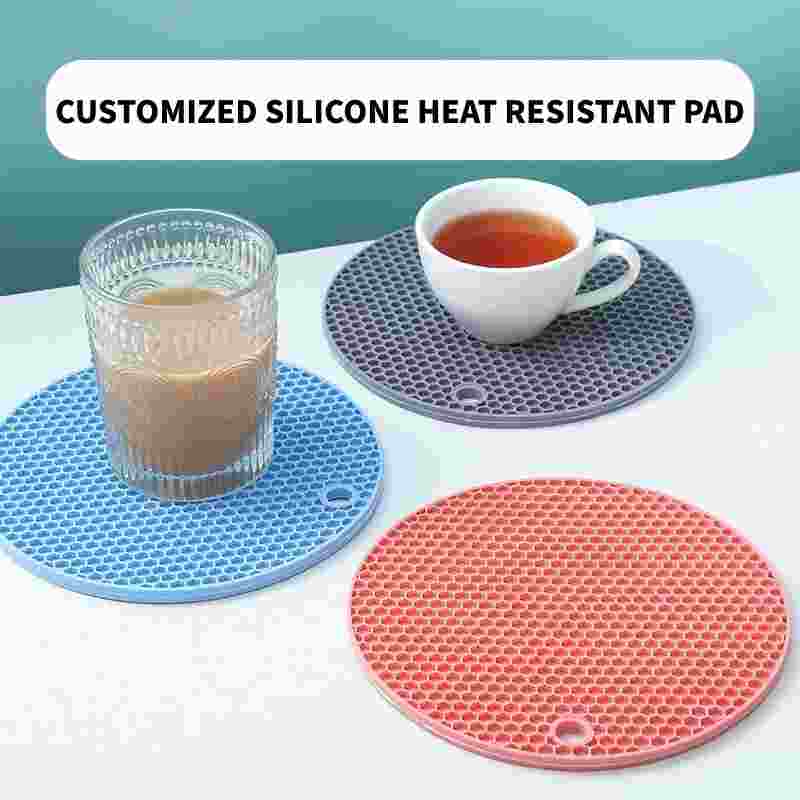
Specially designed for curling irons, flat irons, and other hot tools. With high-temperature resistance, anti-slip texture, and branding options, these pads are ideal for hair salons, beauty brands, and travel kits.
High quality custom insulation silicone pad, high temperature resistant/environmentally friendly/easy to clean. Explore our factory to meet your specific needs.