
Custom 3M Back Adhesive Silicone Gaskets: Waterproof, Durable Seals for Electronics & Automotive




| Share | |
|---|---|
| Categories | Custom Silicone Pad |
| Brand | FromRubber Silicone & Plastic OEM Manufacturer |
| Application | Electronics, auto, industrial |
| Tape Model | 3M 9448A / 467MP / 9080 / VHB |
| Material | Solid silicone rubber |
| Hardness | 30-80 Shore A |
| Compression Set | Max 20% (150C x 22h) |
| Compression Ratio | Static 15-30% / dynamic 10-20% |
| Temperature | -50C to +230C |
| Pressure | 0.5-5 MPa (10 MPa max) |
| Sealing Class | IP67 / IP68 |
| Section Tolerance | 0.8 mm min, +/-0.05 mm |
| Dimension Tolerance | ISO 3302-1 Class M2 |
| MOQ | 1,000 pcs (100 pcs trial) |
| FOB port | Shenzhen |
| Terms of Payment | L/C, D/A, D/P, Western Union |
| Download |  |
What an Adhesive-Backed Silicone Gasket Does
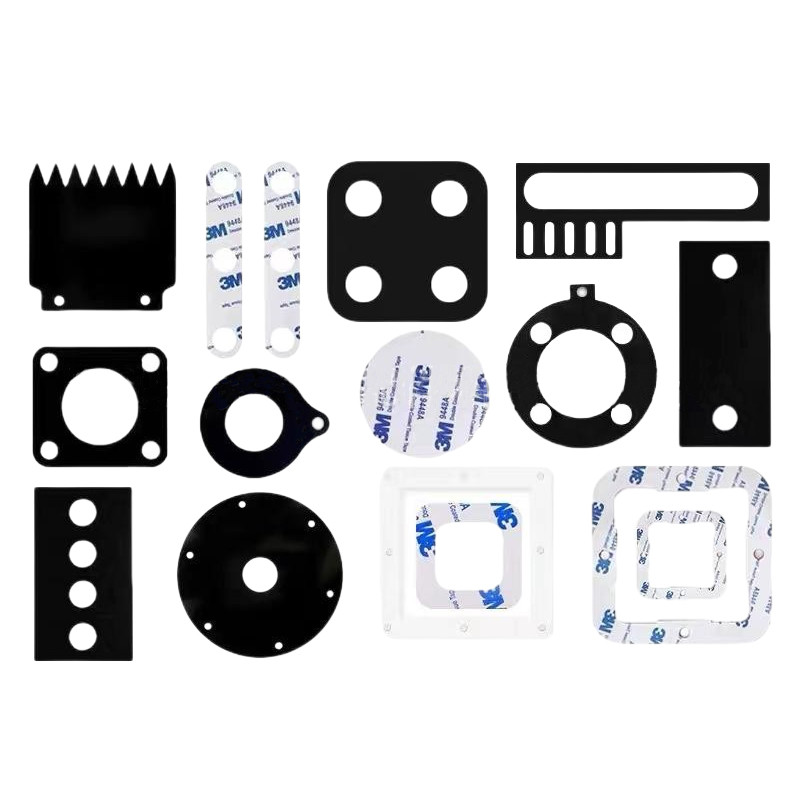
An adhesive-backed silicone gasket is a molded silicone seal with a pressure-sensitive adhesive film laminated to one face. It seals the joint and holds itself in place while the housing is closed — no screws, no clips, no fixturing jig on the line.
- It seals. It fills the gap between two mating surfaces against dust and water.
- It damps. It absorbs vibration between the parts instead of passing it into the housing.
- It positions itself. The tape holds the gasket flat while the mating part comes down.
We mold the gasket and laminate the tape in the same factory, so the shape and the bond stay one supplier's responsibility. Send a drawing or a worn sample and we build the tool, mold the part and bond the tape to it.
Specifications You Can Set Before Tooling
Every value below is fixed at the drawing stage, not discovered at the first shot. The two that get argued about most are compression ratio and compression set — they decide whether the joint still seals after a season on the machine.
| Parameter | What we build to | Why it matters on the line |
|---|---|---|
| Hardness | 30–80 Shore A (±2.5°) | Harder compound gives more sealing force per mm of compression |
| Thickness | As drawn, molded | Thickness sets how far the gasket can compress before it stops sealing |
| Section / cord | Ø0.8 mm minimum, ±0.05 mm | Thin sections leak at the corners if the tolerance is loose |
| Compression ratio | Static 15–30% · dynamic 10–20% | Too little leaks; too much takes a set and stops recovering |
| Compression set | ≤20% at 150 °C × 22 h | The number that predicts whether the seal still works after a hot season |
| Temperature | Silicone −50 °C to +230 °C | The adhesive layer, not the silicone, usually sets the ceiling |
| Pressure | 0.5–5 MPa (10 MPa+ on gas seals) | Higher pressure needs a harder compound and a deeper groove |
| Sealing class | IP67 / IP68 achievable | Tied to the housing design as much as to the gasket |
| Adhesive | 3M 9448A / 467MP / 9080 / VHB | General double-coated, thin high-tack, low-surface-energy or high-load |
| Back-face treatment | Primer sprayed on the bonding face | Decides whether the tape bonds or just sits on the surface |
| Lamination | Fixture-guided, position held to drawing | Every piece goes on in the same place, not one in ten slightly rotated |
| Dimension tolerance | ISO 3302-1 Class M2 | Fits the groove without trimming |
| MOQ | 1,000 pcs, 100 pcs trial by approval | First build can start small |
Why Silicone Needs a Treated Surface Before the Tape Goes On
The mechanism
Silicone has a very low surface energy, and pressure-sensitive adhesive holds by Van der Waals wetting rather than chemical bonding. Bare silicone and 3M tape form what polymer chemists call a thermodynamically incompatible pair — the adhesive never truly wets the surface, so it stands on a thin, weak interface.
Water then works on that interface. Water molecules are small and strongly polar; they find the edge, get in between the adhesive and the rubber, and lift the tape from underneath. The gasket felt firm on the bench, then came off in the wash tank — and it is not because the tape was counterfeit.

Treat the back face
We spray a primer onto the bonding face of the silicone before any tape goes near it. The treatment activates an otherwise inert surface, so the adhesive has something to grip instead of sliding over it.
Laminate on a fixture
The tape is applied with the part held in a fixed locating fixture built for that drawing. Position is repeatable from piece to piece, with no hand alignment, no creeping and no wrinkles under the tape.
Why this matters for a custom part
Both steps run in our own plant on a fixture made for your gasket. That is the difference between a gasket that happens to have tape on it and one that was designed to be taped: the back face is prepared for the adhesive, and the position is held by tooling rather than by hand.
Five Calls We Settle on the Drawing Review
These are the points we lock down before a mold gets cut. Getting them wrong is what turns a good design into a leak at the customer's line.
Compression ratio
Target 15–30% on a static joint and 10–20% on a moving one. Under-compressed leaks; over-compressed takes a permanent set and stops recovering.
Groove fill
The groove has to leave room for the material to go when it is squeezed. Fill it completely and the gasket has nowhere to move, so the housing will not close down to torque.
Hardness against compression force
Hardness is not a quality grade. A harder compound seals better in a deep groove and worse on a thin flange. Pick the sealing force first, then let the durometer follow.
Thickness and tolerance
Compression is a percentage, so a ±0.1 mm thickness error on a 1 mm gasket is a 10% error in sealing force. Thin parts need the tolerance held tighter, not the same.
Tape ceiling before silicone ceiling
The silicone handles −50 to +230 °C. The adhesive does not. On a hot application, choose the tape grade first and the compound second — the reverse order is how gaskets fail at temperature.
Molded or Die-Cut: What Your Gasket Actually Needs
There are two ways to make a silicone gasket with tape on the back. Which one is right depends on the shape, the tolerance and the volume — not on which one is cheaper to quote.
| What it changes | Compression molded | Die-cut from sheet |
|---|---|---|
| Shape | Any 3D form — bosses, lips, ribs, variable section | Flat 2D outline at a single thickness |
| Thickness | Varies across the part as drawn | Fixed by the sheet gauge you can buy |
| Tolerance | ISO 3302-1 Class M2, flash ≤0.05 mm | Set by the blade and the sheet, generally looser |
| Sealing face | Molded lip or rib, compression ratio designed in | Flat face, compression set by the sheet thickness |
| Tooling | Steel mold: sample in 3–5 days, production in 10–12 | Cutting die, low cost, fast to a first part |
| Volume | Unit cost falls as volume rises | Economic at low and prototype volume |
| Best for | Complex outlines, locating features, tight compression control | Flat gaskets, prototype runs, very small batches |
We are a molding shop. Our own tool room cuts the mold, 30 vacuum presses run it, and the tape is laminated in the same building — so the sealing face and the adhesive face are one supplier's responsibility. Where a die-cut part is genuinely the better answer, we will say so instead of quoting a mold you do not need.
What Our Mold Shop Can Do With the Tape
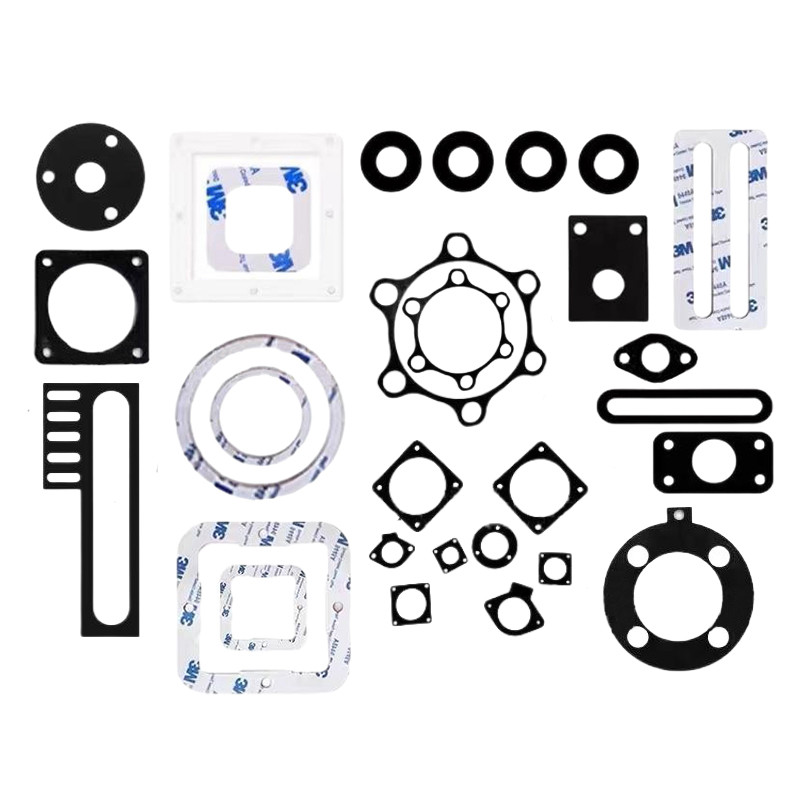
The gasket body is molded, not cut from sheet. That matters for two reasons: complex outlines come out in one shot, and the tape can be laminated to a flat face that was designed for it rather than to whatever the die happened to leave.
- Molded outlines. Finger shapes, multi-hole flanges, long slots and thin webs are molded in one cavity instead of assembled from strips.
- Vacuum molding at −0.095 MPa. Closed while under vacuum, so no trapped bubbles or short shots in thick sections.
- In-house trimming. Multi-station cutting with our own tooling patent; flash held to ≤0.05 mm so nothing sits proud of the sealing face.
- Treatment and lamination on site. The primer spray, the locating fixture and the tape all belong to the same process, so the bond is not somebody else's step.
The molding work runs on silicone compression molding across 30 vacuum presses. If the gasket families are new to you, the wider range sits under custom silicone seals and gaskets.
Where These Gaskets Go
Electronics
Power modules, DC-DC converters, LED drivers and enclosure flanges. The tape matters here because the gasket goes in after the board is mounted — there is no room to drive a screw and no access to the back of the joint.
Automotive
Lamp housings, control units and wiring pass-throughs. Vibration and thermal cycling are the failure drivers, so the compression set figure matters more than the initial seal.
Industrial equipment
Sensor faces, pump and valve interfaces, control cabinet doors. These get opened for service, which is exactly why the tape has to be specified for a limited number of open-close cycles — or why the part should use a mechanical retainer instead.
Samples in 3–5 Days, Tooling in 10–12
No drawing? We can still start
A worn gasket or the mating housing is enough for reverse scanning. The mold is built in our own tool room, which is why a sample can be cut in 3–5 working days instead of waiting on an outside shop.
Send us: STEP/IGS or DWG/DXF/PDF with tolerances marked, plus durometer, thickness, service temperature, the cleaning agents used on the machine, and estimated annual volume. The cleaning agent matters — it decides which tape grade and back-face treatment we use.
The mold is yours. Ownership transfers on full payment, with two years of free storage and warranty.
Frequently Asked Questions
Why did my adhesive-backed gasket come off after washing?
Because the tape went onto untreated silicone. Pressure-sensitive adhesive cannot wet a bare silicone surface, so it only stands on a weak interface and water gets under the edge. Treating the back face and holding the part in a fixture during lamination is what prevents it — it is an interface problem, not a tape quality problem.
Should I specify 9448A or 467MP?
9448A is the general-purpose double-coated tape and covers most housing seals. 467MP is thinner and holds better on low-surface-energy faces. If the joint is narrow or the part is thin, 467MP usually wins. Send the drawing and we will say which one.
Will the tape survive a high-temperature application?
The silicone will — it runs to +230 °C. The adhesive will not go that far, so on a hot application we pick the tape grade against your service temperature first. Tell us the temperature and the duty cycle.
Can you mold the gasket and add the tape in one order?
Yes — that is the normal way we ship this part. Tooling, molding, trimming, back-face treatment and lamination all happen here, so you get one drawing sign-off and one delivery date instead of coordinating a molder and a converter.
What is the minimum order quantity?
1,000 pcs for a standard run. A 100 pcs trial batch can be approved for a first build, so the gasket can be validated on a real machine before committing to volume.
When should I not use adhesive backing?
When the part has to be removed and refitted more than a few times, when the joint sees continuous heat above the tape rating, when the bonding face is strongly curved, or when the gasket has to seal high pressure on its own. In those cases use a mechanical retainer or a molded-in groove — we will say so before quoting.
Send the Drawing. We'll Spec the Tape First.
- Send a ZIP with your STEP/IGS or DWG files, or a photo of the old gasket
- Get a bonding review: back-face treatment, tape grade and compression ratio
- Quote back within 3 hours; sample tooling in 3–5 working days
- Checked by a mold engineer before quoting. NDA on request
- 加载中···


Start Your Project Today!
- Phone
- *Title
- *Content
Sign Up Out Newletter
