
Silicone Keypad Dome Geometry Sets the Feel
Dome height, wall angle and web thickness determine snap ratio and fatigue life. Changing one without the others produces a mushy or a stiff key.



| Share | |
|---|---|
| Categories | Custom Silicone Rubber Meter Instrument Keypad |
| Brand | FromRubber Silicone & Plastic OEM Manufacturer |
| Design | Follow 3D Drawing Or Physical Object |
| Printing | Silk Screen Printing,Laser Etching |
| Feature | Clear and Bright Characters,Backit |
| MOQ | 1000pcs |
| Application | According to Your Need |
| FOB port | Shenzhen |
| Terms of Payment | L/C, D/A, D/P, Western Union, MoneyGram, T/T, Paypal |
| Download |  |
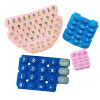
A high-elastic silicone keypad is a one-piece rubber membrane whose domes snap under finger pressure and return to shape. Three parameters define how it feels and how long it lasts: actuation force, travel, and the contact method underneath the dome.
Dome height, wall angle and web thickness determine snap ratio and fatigue life. Changing one without the others produces a mushy or a stiff key.
The contact layer decides resistance, tactile feedback and cost, and it decides the tolerance the assembly must hold.
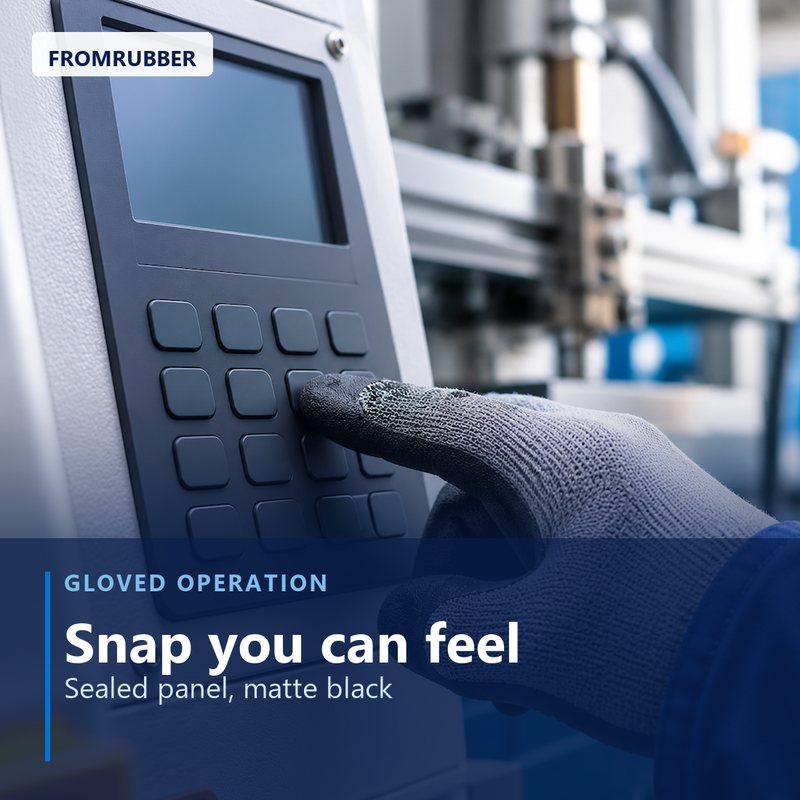
A matte black surface hides fingerprints on consumer and instrument panels, but it shows flash and sink marks more than any other color.
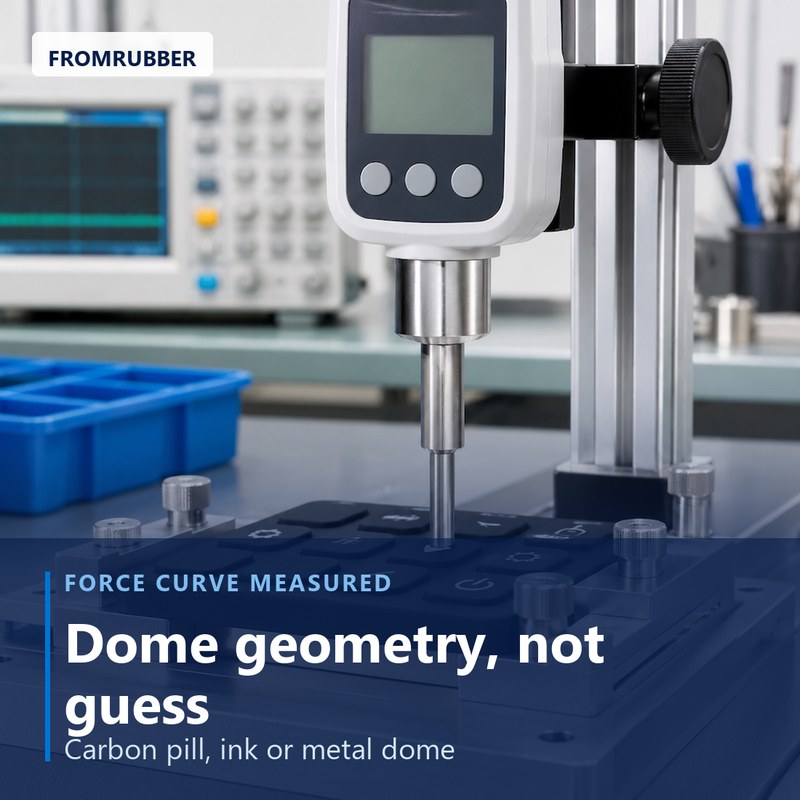
A keypad dome is a buckling spring made of rubber. As the finger presses, force rises to a peak, the dome buckles, and force drops before the contact closes. The ratio between peak and post-buckle force is the snap ratio, and it is what the user experiences as a click, even when there is no audible sound.
Designing that curve is a geometry exercise: dome height, wall angle, web thickness and the position of the contact pad all move the peak. A dome that is too shallow feels linear and vague; one that is too tall needs force the panel cannot take. The practical approach is to fix travel and force targets from the enclosure, then tune geometry to hit them.
Travel is set by the front panel and the PCB gap; force is set by the user population and by whether the key is pressed with a thumb or a tool.
A clear snap needs a defined peak and a defined drop. This is a tool dimension, not a compound choice.
The connecting web takes the bending cycles. Thin webs feel light but fatigue; thick webs last but stiffen the whole pad.
Typical configuration options for instrument, remote and control-panel keypads. Values are fixed per project against the enclosure and the PCB.
| Material | Silicone rubber, black or colored |
|---|---|
| Construction | One-piece membrane with molded domes |
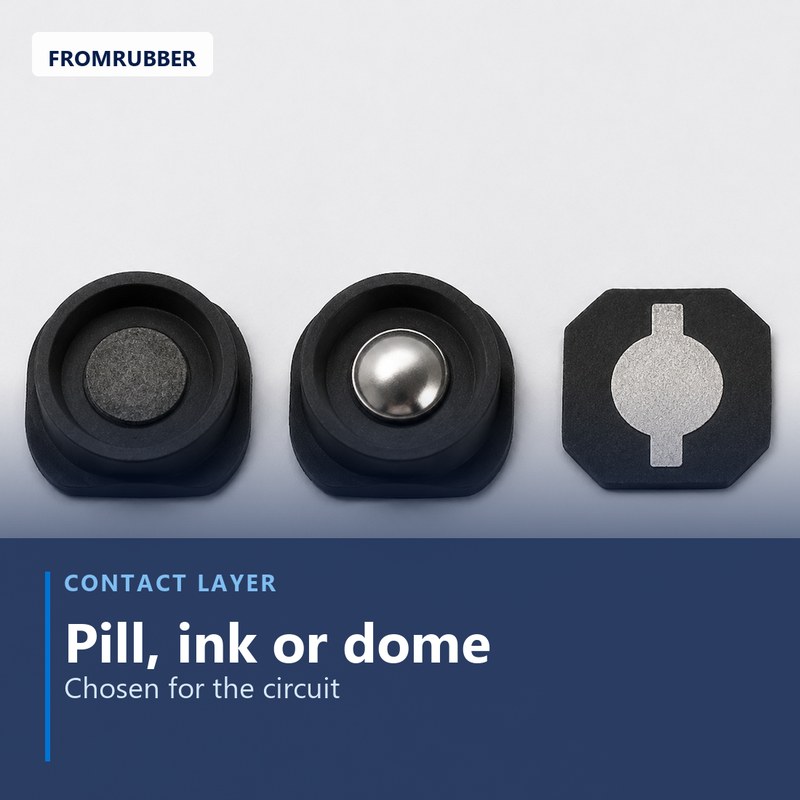
| Contact options | Carbon pill, conductive ink, metal dome or gold pill |
| Actuation | Force and travel targets agreed per key |
| Legends | Screen print with protective coat, laser etch or molded |
| Backlight | Translucent legends with LED pockets where required |
| Sealing | Perimeter seal and gasket features molded in |
| Life | Cycle target agreed and verified on the finished keypad |
Contact resistance and cycle life are measured on the finished part, because they depend on dome geometry and contact choice together, not on the compound alone.
Contact resistance and cycle life are checked on the finished keypad.
The contact layer is where cost and reliability trade off most visibly. A carbon pill is the workhorse: inexpensive, stable in humid conditions and tolerant of dust. Conductive ink is cheaper per key but more sensitive to wear and to the cure of the printing step.
Metal domes give the crispest feel and the longest life, at the cost of an extra component and an assembly step. Gold plating is reserved for low-current or high-reliability circuits where contact resistance has to stay tight over time. The choice is usually dictated by the circuit, not by the keypad itself, and our custom keypad program covers all four routes.
Stable contact resistance across temperature and humidity, with good tolerance to surface contamination.
Lower tooling and material cost, but the printed layer is the wear point and the process window is narrower.
Chosen for tactile definition or low-current circuits. Both add cost and constrain the assembly stack.
The front panel and the PCB are the fixed inputs; the keypad is designed to fit between them.
Panel opening, PCB height and contact layout define travel and force targets for each key.
A soft tool produces domes at several geometries so the feel can be chosen in hand.
Force curves, contact resistance and legend wear are checked on the prototype before production tooling.
Production molding, legend printing and any backlight or metal dome assembly run to the approved sample.
The target is agreed per project and then verified on the finished keypad. It depends on dome geometry, contact type and how far the key is over-traveled in use, so a single number quoted without context is not meaningful.
Yes. Legends are printed in translucent ink and LED pockets are molded into the pad. The pocket depth and the ink density are tuned together, or the legend will look uneven.
A front panel drawing or sample, the PCB contact layout, the key force target and the legend artwork. With those four inputs a tooling proposal can be issued without a meeting.
Send the panel drawing, PCB layout and the force you want under the finger. We will return a dome geometry proposal and a prototype plan.
Related capabilities: Custom silicone keypads · Instrument keypads · Silicone molding


