
Industrial Grade Silicone Keypad – OEM Wholesale for Medical & Kiosk Equipment




| Share | |
|---|---|
| Categories | Custom Silicone Rubber Meter Instrument Keypad |
| Brand | FromRubber Silicone & Plastic OEM Manufacturer |
| Product Specifications | BH-industrial keypad |
| Design | Follow 3D Drawing Or Physical Object |
| Process | Molding |
| Feature | for Extreme Temperature Range, Shockproof |
| MOQ | 2000pcs |
| Application | industrial, medical & automotive applications |
| Download |  |
A hospital device and a public kiosk fail in completely different ways
Both are called industrial-grade, and the label hides two different duty cycles. A medical panel is wiped with aggressive disinfectant several times a day and pressed with gloved hands a few hundred times; a kiosk panel is pressed tens of thousands of times a week by the public, in all weathers, and cleaned rarely and roughly. One fails at the legend and the bond, the other at the contact and the key web.
Buying one specification for both is how programmes end up over-paying for one and under-specifying the other. The useful starting point is a written duty profile: cleaning agents, press count, environment, and who is pressing.
Medical: the cleaning agent is the specification
What actually degrades a clinical panel
Alcohol wipes are the mild case. Quaternary ammonium disinfectants leave a residue that builds up in a textured surface; chlorine solutions attack printed ink and some coatings; repeated wiping with a lint-free cloth is a mild abrasive that wears a legend long before the silicone wears out.
Three things follow. Specify the actual products from the hospital's protocol, not a generic "disinfectant". Put the legend under a moulded or laser-etched surface where possible. And keep the surface smooth enough to wipe clean, because a texture that traps residue is a hygiene problem before it is a cosmetic one.
Kiosk: the press count is the specification
Public hands are harder on a key than gloved ones
A ticket machine or a self-service terminal can see more presses in a month than a bench instrument sees in its life. Add wet hands, gloves, keys held in the other hand, and the occasional deliberate abuse, and the key web becomes the critical part rather than the electronics.
That shifts the design: a more robust web, a legend that does not sit proud, a key top that resists a fingernail, and a force that stays consistent across the panel so that one tired key does not become the one everybody avoids.
Hygienic design is geometry, not a material claim
Flush surfaces
A key that stands proud of the panel creates a ledge where residue collects. A flush or gently domed key wipes clean in one pass.
Radiused gaps
A sharp gap holds liquid by capillary action. A radius lets a cloth reach the bottom of it.
No hidden seam
The bond line between panel and housing is a seam. Keep it continuous and out of the wiping path, or it becomes the place cleaning cannot reach.
None of these is a certificate. They are drawing decisions that a hygiene reviewer can see, and they matter more in practice than a material datasheet claim about "antibacterial" additives.
What OEM supply actually requires
Four documents, agreed before the first batch
A first-article report with the dimensions that matter, not every dimension. An inspection plan for incoming lots. A change-control agreement covering material, tool and subcontractor changes. And a packaging specification, because a panel that arrives scuffed has failed before it is fitted.
Those four are what separates a supplier from a vendor. They also remove the most common dispute at scale - a silent material substitution that changes the feel or the colour between batches.
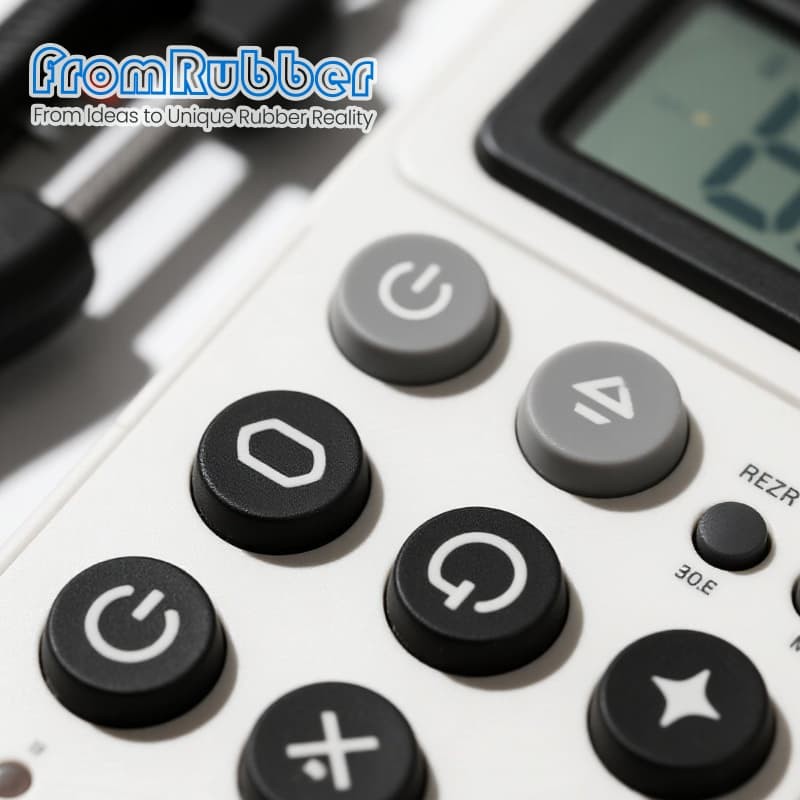
Specification on this series
- Construction
- Moulded silicone keypad with conductive pills or metal domes, sealed or unsealed
- Legend
- Moulded, laser-etched or printed with hard coat; selected for the cleaning protocol
- Duty profile
- Press count, cleaning agents and environment agreed in writing before tooling
- Sealing
- Perimeter bond and tail exit specified where the panel must resist liquid ingress
- Typical applications
- Medical devices, self-service kiosks, ticketing terminals, laboratory and industrial equipment
- Minimum order
- 2,000 pieces per design
The membrane-panel alternative is covered in keypad versus membrane switch, and press-cycle expectations in press cycle limits. For kiosk keypads with a printed legend, see the POS keypad.
Questions from OEM buyers and design teams
Is there a "medical grade" silicone?
There are grades with supporting documentation for skin contact and for cleaning, and there are standards a device must meet. "Medical grade" on its own is a marketing phrase; ask which document covers which requirement, for which market.
Can one panel serve both a medical device and a kiosk?
It can share a tool, but the legend and the coating usually differ: medical needs chemical resistance, kiosk needs abrasion resistance. Treat them as two variants with different acceptance criteria.
How is the press count verified?
By cycling a sample to the specified number and re-measuring force and contact resistance at the end. The pass criterion is a number, not "still works".
What changes between batches?
Colour and feel are the two that drift, through material lot and cure variation. A retained first-article sample plus a colour standard is the cheapest control; a change-control clause is the other half.
Send the duty profile, not the product name
Cleaning agents, press count and environment decide the legend, the web and the seal. Send those three with the key layout, and we will return a specification and a first-article plan that can be inspected.
Request an OEM quote See instrument keypads- 加载中···




Start Your Project Today!
- Phone
- *Title
- *Content
Sign Up Out Newletter
