

Molded-In Color for Silicone Buttons
Pigment compounded into the rubber cannot chip or wear off. The limitation is color range: strong solids yes, fine gradients no.



| Share | |
|---|---|
| Categories | Custom Silicone Rubber Meter Instrument Keypad |
| Brand | FromRubber Silicone & Plastic OEM Manufacturer |
| Product Specifications | BH-button |
| Design | Follow 3D Drawing Or Physical Object |
| Printing | Silk Screen Printing,Laser Etching |
| Feature | Clear and Bright Characters,Backit |
| MOQ | Any quantity you need |
| Application | Electrical equipment/home controllers |
| Material | Silicone |
| Shore hardness | 60H |
| Craftsmanship | Compress+Printing+processing+Packing |
| Color | Green/Red/White etc |
| Conductive method | Conductive Pills |
| FOB port | Shenzhen |
| Terms of Payment | L/C, D/A, D/P, Western Union, MoneyGram, T/T |
| Download |  |
Colored silicone buttons fail in two places: the legend rubs away, or the color fades where the finger lands. Which of the two you get is decided by the coloring and legend method, not by the silicone itself.
Pigment compounded into the rubber cannot chip or wear off. The limitation is color range: strong solids yes, fine gradients no.
A contrasting surface layer is removed by laser, leaving a legend that does not depend on ink adhesion.
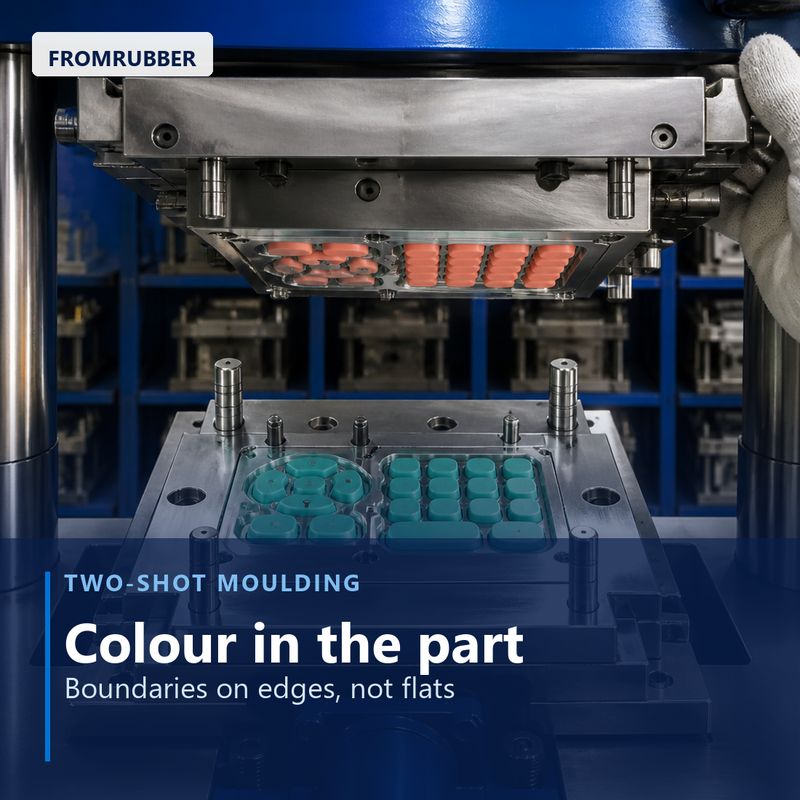
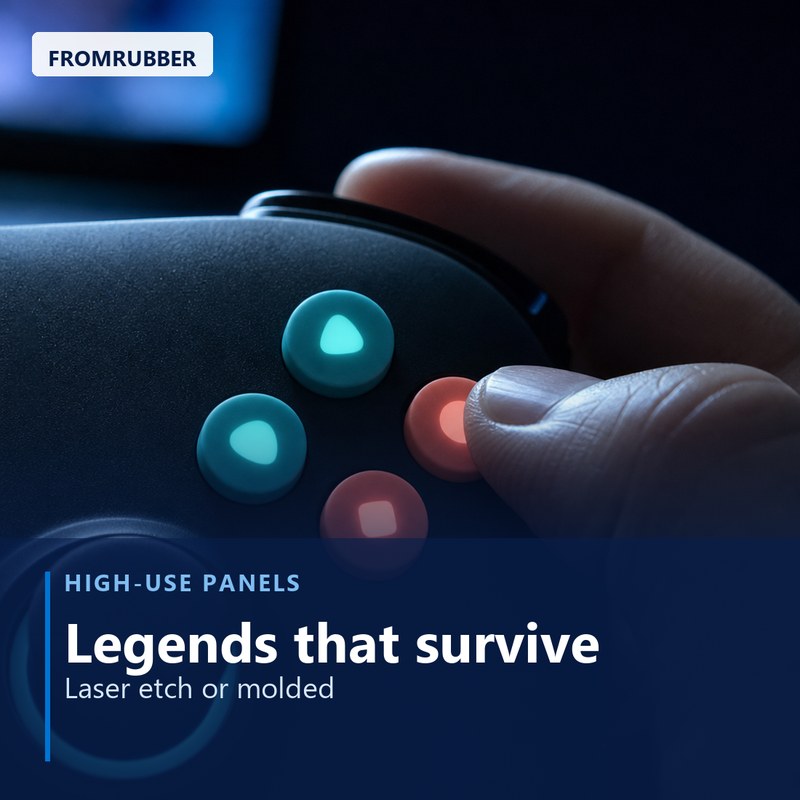
Two or three colors can be co-molded in a single keypad, which is how game and instrument panels get colored keys without a painting step.
The rubber outlasts the ink by a wide margin. A keypad dome can take hundreds of thousands of presses while the printed legend above it wears through in a fraction of that, especially when the same key is used constantly and the user has rough or contaminated hands.
That is why long-life keypads usually move the legend below the surface or into the material. Laser etching removes a thin top layer to expose a contrasting one, so there is no ink interface to fail. Printing remains the right answer for complex multi-color artwork, where the trade-off is a shorter legend life that should be stated openly.
Suitable for complex artwork. A clear coat extends life, but the ink interface is still the wear point.
No ink, no adhesion failure. Best for single-color legends and for backlit symbols.
The legend is a molded feature, filled with a second color where the tool allows. The most durable route and the most tooling-intensive one.
Options for keypads, control panels and game controls. Color and legend method are chosen together with the expected press count.
| Material | Silicone rubber, molded-in color |
|---|---|
| Color range | Solid colors and matched custom shades |
| Multi-color | Two or three colors co-molded in one keypad |
| Legend methods | Screen print with coat, laser etch, molded legend |
| Contact | Carbon pill, conductive ink or metal dome |
| Backlight | Translucent legends with molded LED pockets |
| Surface | Gloss, matte or soft-touch |
| Assembly | Locating pins, adhesive frame or clamp features |
Molded color is matched against an approved physical sample, not a screen preview. Metallic and pearlescent effects are possible but reduce the achievable color consistency between batches.
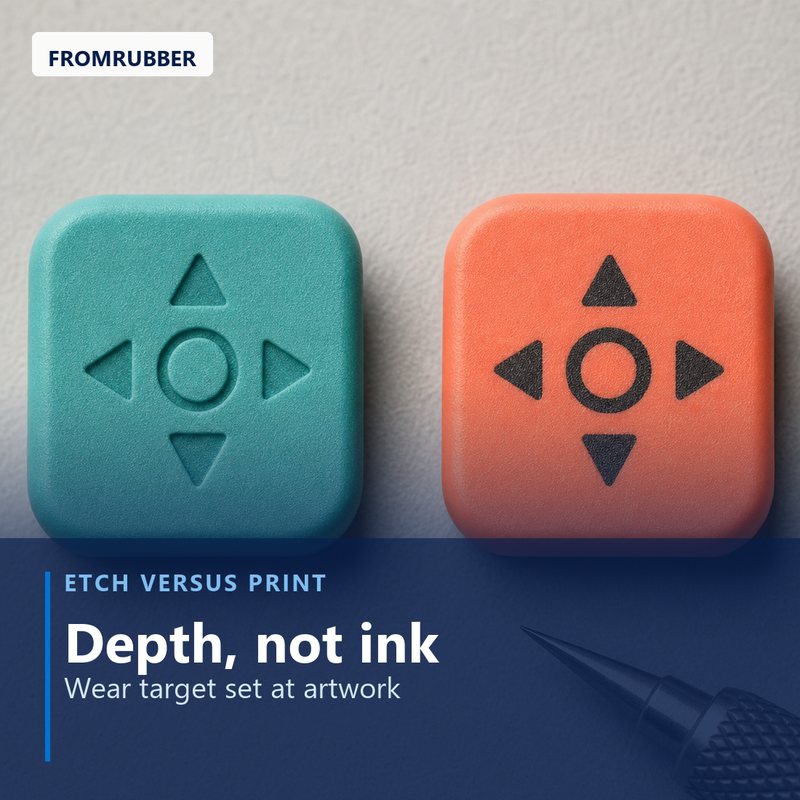
Molded colour cannot chip; printed ink can wear.
Co-molding removes the two weaknesses of painting: no coating to chip, and no masking step to drift. The cost is tooling. Each additional color needs its own cavity shut-off, and the boundary between colors becomes a mold feature that has to be controlled to a few tenths of a millimeter.
The design rule is to place color boundaries on a geometric edge rather than across a flat surface. A boundary on an edge is hidden by the geometry; a boundary across a flat face shows every variation in shut-off. Our multi-color molding program covers both co-molded and assembled approaches.
Colour boundaries are placed on edges or steps where a shut-off can be machined accurately.
The harder, higher-melting compound is molded first so the second shot does not displace it.
Locating features in the tool hold the first shot in position for the second, which is what keeps a two-color key aligned.
Legend life and color method are decided before artwork is finalised, because both are tooling decisions.
Expected cycles and the cleaning regime determine whether print, laser or molded legend is appropriate.
Colors are matched to physical standards, and boundaries are placed on geometry rather than on flat faces.
A prototype is rubbed and cleaned to compare legend wear against the target life.
Co-molding or single-color tools are cut, and production runs to the approved color and legend standard.
Closely, not exactly. Pigment in rubber reads differently from ink on paper, so the match is approved as a physical sample under the intended lighting rather than as a numeric value.
A molded or laser-etched legend outlasts a printed one because there is no ink layer to wear. Printing wins on artwork complexity, so the choice is a trade-off rather than a single best answer.
Standard silicone can shift under prolonged UV and heat. Where color stability matters, a grade with better resistance is selected and the trade-off in cost is stated up front.
Send the artwork, expected press count, cleaning regime and color standards. We will recommend a legend method and a color route before tooling.
Related capabilities: Multi-color silicone molding · Laser etching · Custom silicone keypads


