
Customized Silicone Buttons for Industrial Equipment


| Share | |
|---|---|
| Categories | Custom Silicone Rubber keyboards |
| Brand | FromRubber Silicone & Plastic OEM Manufacturer |
| Product Specifications | Industrial Equipment Silicone Keypad |
| Application | Industrial equipment |
| Product Type | Silicone button / keypad |
| Material | Solid silicone, FDA grade |
| Hardness | 30-80 Shore A |
| Actuation Force | 80-500 g |
| Key Travel | 0.3-2.0 mm |
| Key Life | 0.5-5 million cycles |
| Legend | Screen / etch / double-shot |
| Backlight | Optional, 90% transmission |
| Tooling | Owned by customer |
| Certification | IATF 16949, ISO 9001, 14001 |
| MOQ | 1,000 pcs (100 pcs trial) |
| Unit Price | US $ 0.15 / piece |
| FOB port | Shenzhen |
| Terms of Payment | L/C, D/A, D/P, Western Union, MoneyGram, T/T, Paypal |
| Download |  |
What We Mold for Industrial Equipment
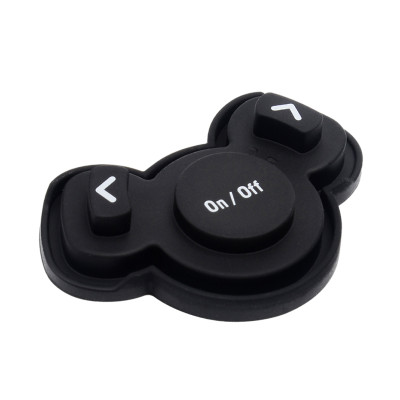
We mold silicone buttons for industrial equipment — machine control panels, handheld instruments, pendant stations, medical devices and self-service terminals. The button is what your operator touches every shift, so it has to survive oil, gloves, cleaning agents and a few million presses.
We are the factory, not a trading company. Our own tool room cuts the mold, our presses run it, and printing, laser etching and backlight assembly all happen under one roof. When something needs changing, there is no third party in the middle of the conversation.
To quote, we need one of two things: a STEP file, or the physical button you are replacing. Send either and you will have a price the same day.

Specifications We Set Before Cutting the Mold
These are the numbers an industrial button lives or dies by. We lock them down at drawing review, not after the first shot — change a durometer or a stroke once the tool is cut and you are buying a new mold.
| Parameter | What we hold | What it changes downstream |
|---|---|---|
| Hardness | 30–80 Shore A (±2.5°) | Sets the feel, and along with the webbing, the press force |
| Actuation force | 80–500 g (±15–30 g) | Gloved operation needs a heavier key; bare-hand panels do not |
| Key travel | 0.3–2.0 mm | Long travel plus a guide rib is what stops accidental presses on a vibrating machine |
| Key life | 500,000–5,000,000 cycles | Precipitated silica lands at 0.5–1 M; fumed silica reaches 3–5 M |
| Legend wear | RCA 175 g, ≥300 cycles, no wear-through | Separates a legend that lasts from one that rubs off in a year |
| Contact resistance | Carbon ≤200 Ω · nickel ≤5 Ω · gold ≤0.5 Ω | Carbon for logic-level input; gold for low current and sulfide-prone sites |
| Backlight transmission | ≥90% on translucent compound | Decides how well the legend reads on a dim shop floor |
| Light blocking | 100% at 1000 Lux on masked areas | No bleed between keys, so one function reads as one lit shape |
| Etch line width | ±0.03 mm | Fine detail survives on small function icons |
| Dimensional tolerance | ISO 3302-1 Class M2 | Drops into the housing groove without trimming |
| Flash | ≤0.05 mm | Keeps the parting line out of the finger contact area |
| Operating temperature | −50 °C to +230 °C | The compound holds; the limits usually come from the housing, not the rubber |
| MOQ | 1,000 pcs, 100 pcs trial by approval | A first build can start small and scale after validation |
How a Custom Button Is Made
Send a STEP file or a sample
STEP or IGS for 3D; DWG, DXF or PDF for 2D with tolerances marked. Out of drawings? Mail the button you are replacing, or the housing it sits in, and we scan it back into a model.
DFM review, then a quote
An engineer checks wall thickness, webbing angle, draft and the sealing face before anyone prices it. Single parts are quoted within 3 working hours; multi-process assemblies take up to 24.
Sample tool, first shots
Sample tool in 3–5 working days, then 5–10 pcs shipped so you can fit them on the real housing. Fit and feel are settled here, before production tooling is cut.
Production tooling and run
Multi-cavity production mold in 10–12 working days, mass delivery 7–10 working days after confirmation. Existing molds can sit here between runs.
Four Questions Worth Asking Before You Order
They come up in almost every first call. The answers usually decide whether there is a second order.
Are you a factory, or a trading company?
A factory. 12,000 m² in Qiaotou, Dongguan, 220 staff, 32 compression molding presses, 8 injection machines and 7 CNC centers — plus our own tool room, which is why a sample mold takes 3–5 days instead of three weeks. Come and see it, or ask for a live video tour of the line before you order.
I have no drawing. Can you still give me a price?
Yes, but not from a photo. A photo carries no dimensions and no surface geometry, so anything we quote from one is a guess that comes back to bite both of us three or four weeks later.
To price the part properly we need one of two things: a STEP or IGS file, or the physical button — worn, broken, or the housing it fits into. We scan it and rebuild the model.
Send either and the quote is straightforward. Send neither and all we can give you is a rough range, and chasing the missing dimensions is exactly what stretches these projects into months.
Who owns the mold, and who pays for it?
You own it. Ownership transfers on full payment, and you can move it, transfer it or retire it whenever you like — we just store and maintain it. Sample tooling and production tooling are quoted separately and priced to the actual cavity layout, so you are not paying for cavities you will never run. Storage and warranty run two years.
What happens if the parts are wrong?
We answer within 2 hours and remake or replace at our cost within 48, freight included, when the defect is on us. First-pass yield on molded parts runs at 92%, and outgoing lots are sampled to AQL 0.65 / 1.0 before they ship.
Inside the Plant

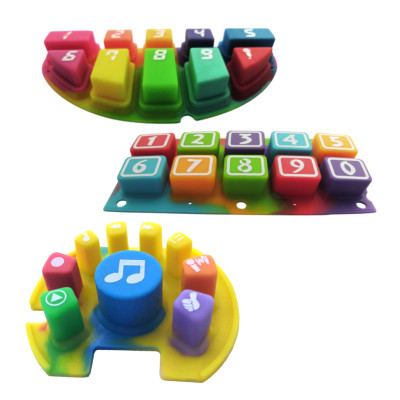
Everything here came off our own presses: multi-color keypads, bilingual legends, icons molded in rather than stuck on, and guide ribs for gloved hands.
Tooling, molding, trimming, printing, laser etching, backlight assembly and packing all sit under one roof. That is what makes a 3-hour quote and a 3–5 day sample realistic rather than optimistic.
| Floor area | 12,000 m² |
| Staff | 220 |
| Compression molding presses | 32 (30 vacuum, 2 platen) |
| Injection molding machines | 8 (90T–380T) |
| CNC machining centers | 7, in-house tool room |
| Molds in storage | 7,254 |
| Quality systems | IATF 16949 automotive, ISO 9001 quality, ISO 14001 environmental |
The certificates are not decorative. Raw material arrives with a COA per batch and is re-tested for hardness and tensile strength before it reaches a press — details under raw material certification, with the full set available to download before you order.
Where These Buttons Are Used

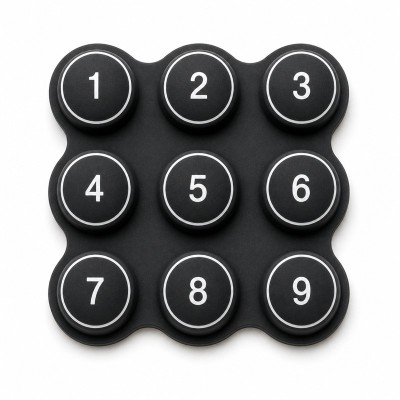
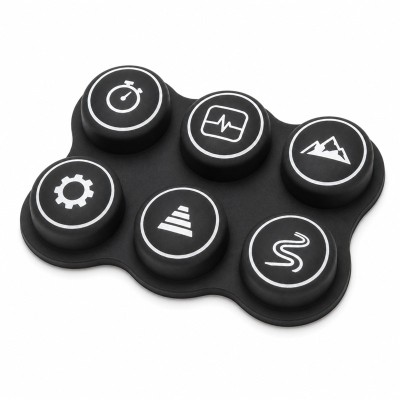
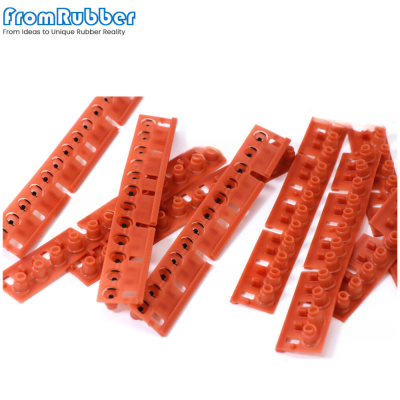
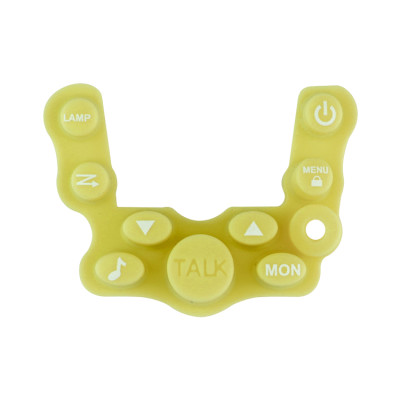
All of these came out of the same process. What changes is the tool, not the material — numeric pads, function clusters, curved keycaps and bilingual legends are driven by the housing, not picked from a catalogue.
Machine control panels
Machine tools, packaging lines, woodworking equipment. Coolant and chips are what kill a legend, so it gets etched, and the panel gets a sealing skirt instead of a flat gasket.
Handheld instruments
Meters, analyzers, calibration tools. Low press force and a short stroke, because the operator is working one-handed with a thumb.
Construction and agricultural machinery
Pendant stations, joystick overlays, dash panels. Vibration and gloves set the spec: long travel, a guide rib, and a 3–5 million cycle rating.
Medical devices
Diagnostic equipment and patient-handling controls. Cleanability matters more than force, so the surface gets a PU or matte coat that stands up to repeated wipe-down.
POS and self-service terminals
Payment terminals, kiosks, access control. Public use means the legend has to survive thousands of presses a day from people who do not care about the machine.
Home appliance controls
Coffee machines, ovens, air treatment. Color and backlight carry more weight than cycle count here, and P+R is often the right construction.
Samples in 3–5 Days, Tooling in 10–12
What to put in your first message
With a drawing: STEP or IGS, or DWG/DXF/PDF with tolerances marked. Without one: mail the button you are replacing, or the housing it fits into. A photo on its own will not produce a price — we need something we can measure.
Also useful: durometer if you know it, the cleaning agents the machine sees, whether the operator wears gloves, and your annual volume. Missing details are fine — we will ask.
Frequently Asked Questions
30 Shore A or 70 Shore A — which do I need?
Start with the press force you want, then let the durometer follow. On a fixed webbing thickness, every 5° of added hardness raises peak force by roughly 15–25%. Below 40 A the key recovers slowly and feels sluggish. Above 70 A on a thin web, the edge turns brittle.
Should the legend be laser etched or silk screened?
Etch it when the panel sees oil, coolant, solvent or heavy thumb traffic — the legend sits inside the coating instead of on top of it. Silk screen is cheaper and fine for decorative color on a clean, dry panel.
Will the button survive the cleaning agents on my machine?
The silicone body handles common shop chemicals, but the coat and the housing seal decide the answer. Tell us which agents are used and we will match the finish before tooling, not after the first complaint.
Can different keys on one panel light up in different colors?
Yes. Masked channels block completely at 1000 Lux, so a single panel can show a green run state next to a red fault state without light bleeding between them.
Can I run a small trial batch first?
1,000 pcs is the standard minimum, but a 100 pcs trial run can be approved so you can fit the part on real machines. That is usually cheaper than finding a fit problem after a full run.
What makes a key feel crisp instead of mushy?
The webbing angle and thickness, not the durometer alone. A click ratio between 40% and 55% reads as crisp on a control panel. Flatten the web angle and the snap disappears, even at the right hardness.
Send a STEP File or a Sample. Either Gets a Price.
- With a drawing: STEP or IGS, or DWG/DXF/PDF as a ZIP
- Without one: mail the old button or the mating housing — we scan it and rebuild the model
- A photo alone will not produce a price. We need something we can measure
- Quote within 3 working hours. Sample tool in 3–5 days. The mold is yours
- 加载中···
Start Your Project Today!
- Phone
- *Title
- *Content
Sign Up Out Newletter
