How Does Silicone Keypad Hardness Affect Industrial Controller Button Force?
A controller key that is too heavy is a productivity problem before it is a comfort problem. Operators on a production line press the same key thousands of times per shift, and a key that needs two newtons more than the one it replaced will be reported as fatigue, then as missed inputs, then as a machine fault that nobody can reproduce on the bench.
The reflex is to drop the durometer. That works sometimes, and it fails often, because hardness is only one of three things that decide how a key presses. The other two are structure and rate.
Reviewed by FromRubber keypad engineering · November 2026
Why Does Silicone Keypad Hardness Matter for Industrial Controllers?
Industrial controllers are operated through gloves, in a cabinet that may be warm, by people who are watching a machine rather than the panel. The key has to announce itself through the fingertip without requiring a deliberate push, and it has to do that on the ten-thousandth press as well as the first.
Hardness is the property most often written into a purchase specification because it is simple to measure and simple to compare. It is also the one that answers the least about the actual press.
Hard Buttons May Require More Force During Repeated Operation
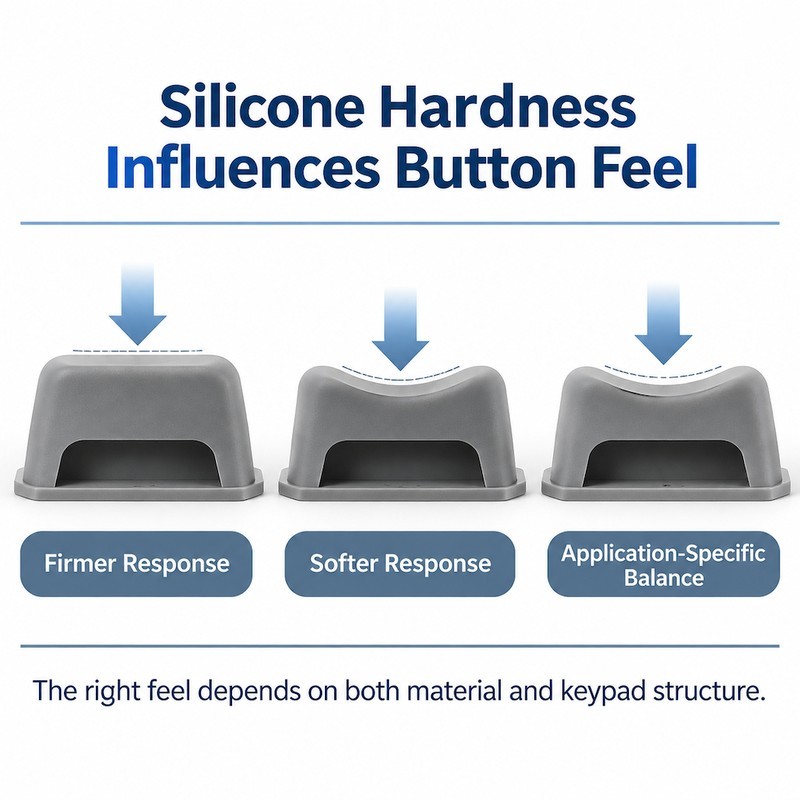
A harder compound needs more stress to reach the same strain, so the initial breakaway force rises. On a key with a short stroke the whole press feels heavy, because there is no soft region to absorb the first part of the movement. The operator compensates by pressing faster, which increases the impact at the bottom of the stroke and shortens the life of the legend and the dome.
Soft Buttons May Feel Unstable During Pressing
A soft compound deflects early and easily, so the key starts moving before the finger expects resistance. On a flat pad that feels vague; on a domed key it can feel like the key is collapsing sideways. Soft material also carries less lateral stability, which matters on a narrow key pressed off-centre.
Inconsistent Hardness Can Create Different Button Feels Across the Panel
Two batches of the same nominal compound can differ by a few points of Shore A, and a panel moulded from a blend of both will show it. The keys at the start of the run and the keys at the end feel different, and the difference is large enough for an operator to notice without being able to describe it.
How Does Silicone Hardness Affect the Force Needed to Press a Button?
Higher Silicone Hardness Can Increase Resistance During Pressing
Force is stress multiplied by area, and stress for a given deflection rises with modulus. Raising hardness from 40 to 60 Shore A increases the modulus by a factor that is larger than most people expect, because the relationship is not linear. That is why a small change in the specification produces a large change in feel, and why the difference is more noticeable on keys with thick webs, where there is more material resisting.
Lower Hardness Does Not Always Mean a Better User Experience
A softer key is easier to start moving, but it is also easier to bottom out. Once the web bottoms against the PCB, further force goes into the switch and the housing, and the press stops feeling progressive. Operators describe this as a key that "gives up". It also removes the tactile confirmation that the input registered.
Button Force Depends on Both Material Hardness and Keypad Geometry
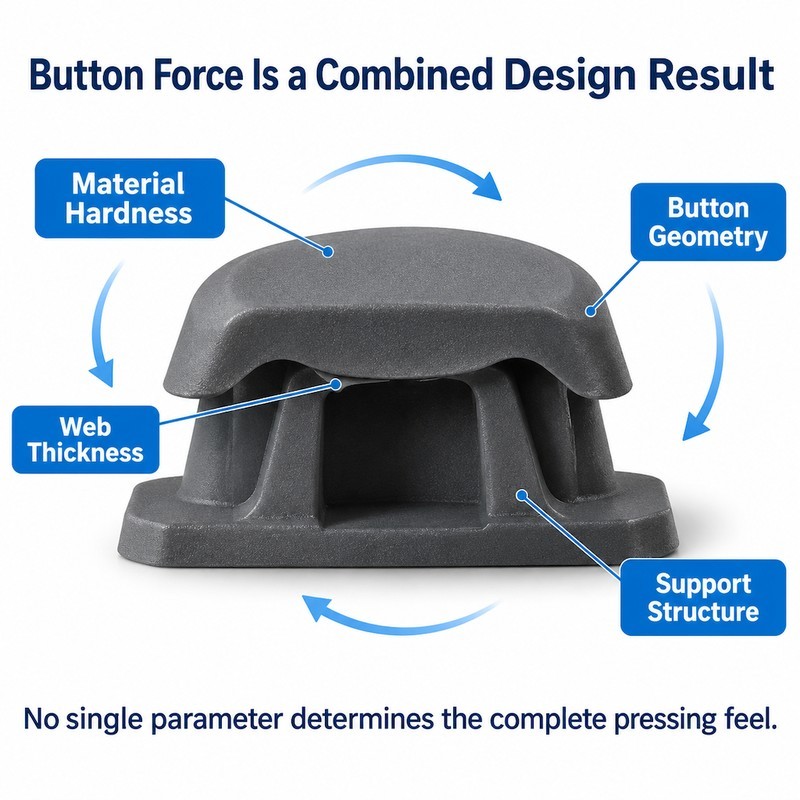
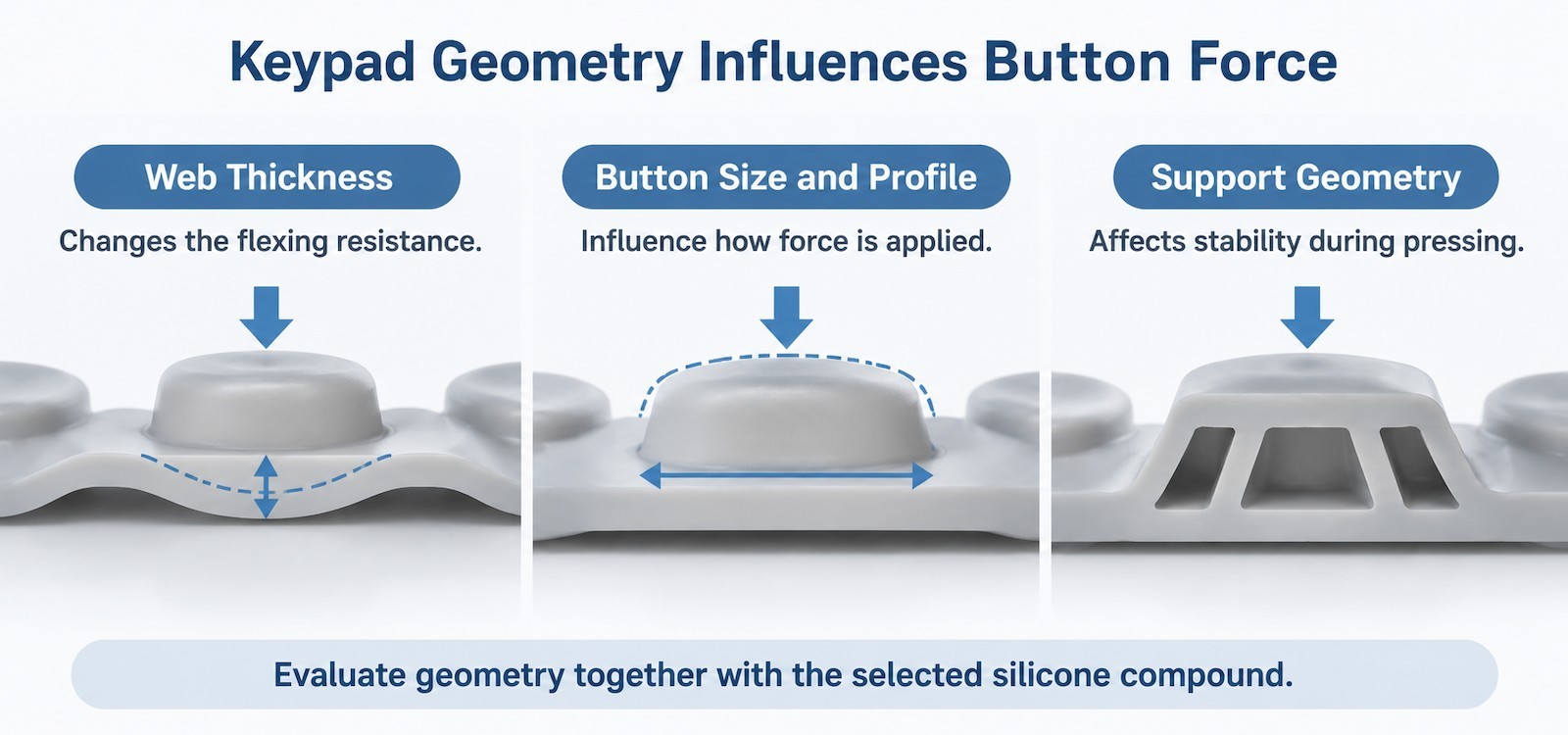
The web is the spring. Its section and length set how much force is needed per millimetre of travel, and the compound sets the modulus that fills that section. A thin web in a hard compound and a thick web in a soft compound can produce the same force curve, which is why quoting only one of them is not a specification.
For a worked comparison of two common hardness levels, see 40 Shore A versus 60 Shore A.
- State the force range at the actuation point, with press speed and temperature.
- Ask for lot data on hardness, tensile and tear properties, not a single certificate.
- Tune the web on moulded samples before changing the compound.
- Keep one approved sample as the reference for every later production run.
Which Silicone Keypad Design Factors Change Button Force?
Web Thickness Changes the Resistance of the Button Structure
Web thickness is the most powerful single lever on force, and the least visible on a drawing. Doubling the web section does not double the force; it changes the shape of the force curve, making the initial rise steeper and the snap more abrupt. Thin webs give a softer, more progressive press but are harder to mould consistently.
Button Diameter and Height Affect the Pressing Behavior
A larger key spreads the load over more web, so the same deflection needs more total force but feels softer per square millimetre under the finger. Height adds leverage: a tall key pressed off-centre transfers a moment into the web, which the operator feels as a slight tilt rather than as force.
Internal Support Geometry Influences Button Stability
Support ribs, a moulded pillar under the key, or a raised platform around the web all change where the load goes. A pillar shortens the effective web span and stiffens the key; a relieved base lets the web move further. Both are legitimate, but neither is captured by a durometer figure.
How Should Manufacturers Choose Silicone Hardness for Industrial Controller Keypads?
Match Hardness to the Expected Operating Frequency
High-frequency panels favour a lower force with a clear snap, so the operator gets confirmation without effort. Low-frequency panels, such as setup or maintenance keys, can tolerate a firmer press and benefit from the resistance that prevents accidental actuation.
Consider the Working Environment and Long-Term Use
Silicone stiffens as it cools. A compound that feels right at 20 °C will feel heavier in an unheated plant in winter, and a controller mounted near a heat source will feel softer than it did at approval. Compression set also accumulates: a key held down by a fixture or a cover will not return to its original height. ISO 815-1 describes how that property is measured.
Evaluate Hardness Together With Button Force and Travel
The three belong in one specification. Hardness sets the material, travel is set by the switch and the web, and force is the outcome. Record all three on the sample report, and record the test speed, because silicone is viscoelastic and a slow press reads lighter than a fast one.
How Can Manufacturers Control Button Force in Custom Silicone Keypads?
Adjust Web Geometry to Fine-Tune Button Force
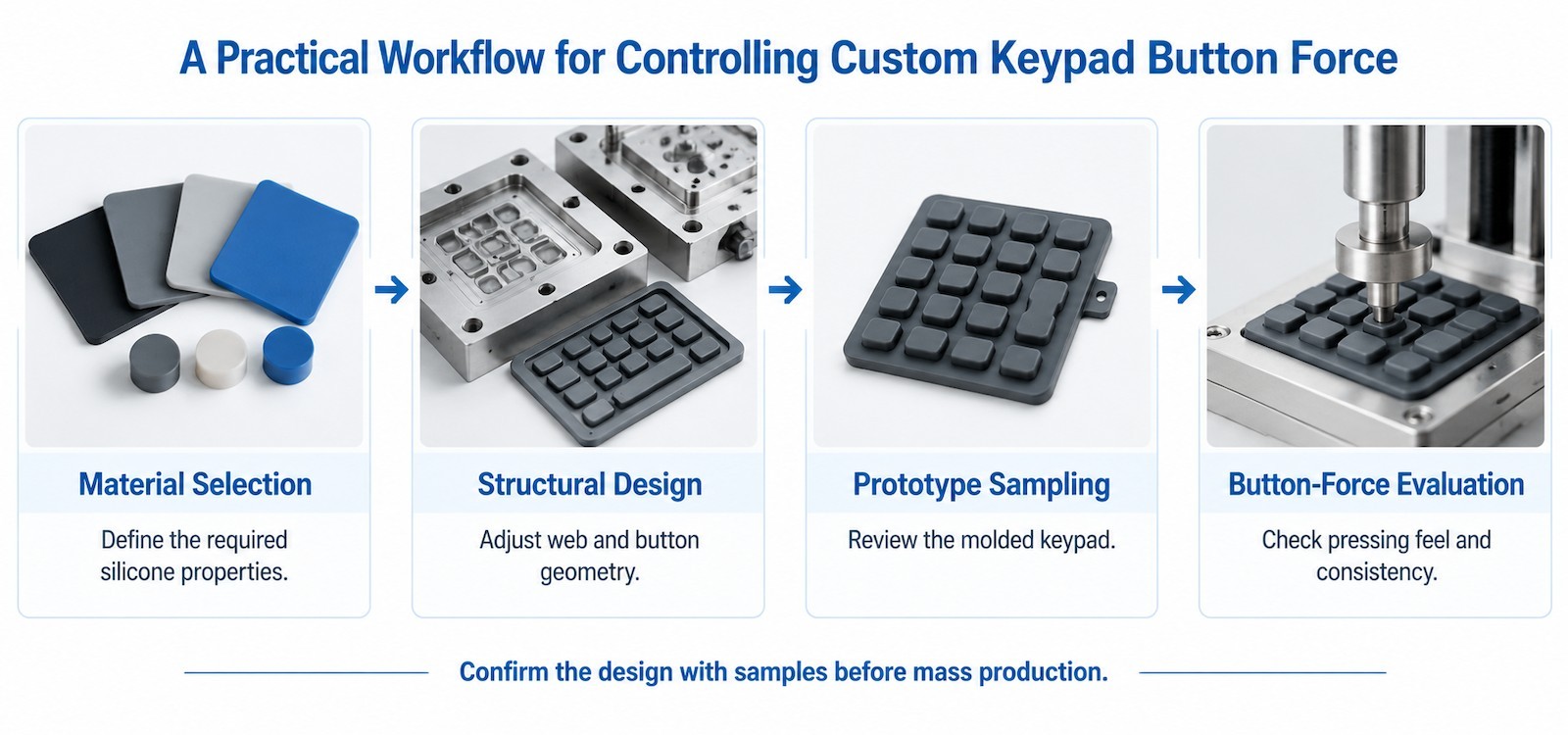
Once a compound is chosen, force is tuned by moving the web: thickness in small steps, then free length, then the angle at which the web meets the key. Each change has a side effect on return speed, so the two are adjusted together rather than in sequence.
Keep Silicone Material Properties Consistent Across Production Batches
Compound consistency is a purchasing decision as much as a process one. Incoming inspection should check hardness, tensile strength and tear resistance on every lot, not only on the first. ISO 37 covers tensile properties, ISO 7619-1 covers indentation hardness. A supplier who cannot show lot data is asking to be trusted rather than verified.
Test Button Force on Samples Before Finalizing the Mold Design
Test on a sample that matches the production cross-section, at the production cure, and at the temperature the machine will see. A force curve measured on a 3D-printed or cast surrogate is not a prediction; it is a different part.
| Layer | What it controls | How it is measured |
|---|---|---|
| Material | Stiffness and elastic recovery | Shore A per ISO 7619-1, tensile per ISO 37 |
| Structure | Force per millimetre of travel | Force-deflection curve on a moulded sample |
| Rate and temperature | How the press feels in use | Same curve at the operating temperature and press speed |
What Should Industrial Equipment Buyers Specify When Ordering Custom Silicone Keypads?
Provide the Required Button Force and Operating Feel
Give a target force range at the actuation point, and say whether the panel is used with gloves. Vague words such as crisp or soft cannot be inspected and cannot be quoted against.
Share Keypad Drawings and Internal Switch Specifications
The switch defines the actuation point and the over-travel available. Without it, the keypad can only be designed to a travel assumption. The standard force and travel figures for silicone keypads are a starting point, not a substitute for the switch data.
Confirm Material Hardness and Button Performance Through Samples
Approve a sample by pressing it, not by reading its certificate. Then keep that sample as the reference for the production run.
Which Variable Should Be Changed, and What It Costs?
Force can be moved by six variables, and they are not interchangeable. Each one also changes return, behaviour at temperature, or the tool. The table is the order we work through when a target force has to be met without restarting the design.
| Variable | Effect on force | Side effect to expect | Tooling consequence |
|---|---|---|---|
| Compound hardness | Direct, and larger than most people expect | Return speed and low-temperature feel move with it | None |
| Web thickness | Strong, and it steepens the early part of the curve | Too thick removes progression, too thin moulds poorly | New tool or insert |
| Web free length and angle | Moderate, and it reshapes the curve | Travel and snap ratio change together | New tool |
| Button diameter | Moderate, spreading load over more web | A larger key needs more total force for the same deflection | New tool |
| Button height and profile | Small on force, large on leverage | Off-centre presses tilt the key | New tool |
| Support rib or pillar | Local, stiffening one area of the panel | A step in feel between neighbouring keys | Insert change only |
Work down the table, not across it. Two or three rows are usually enough to hit a target, and stopping at the first one that works keeps the tool and the timeline intact.
Questions we are asked most often
Will a softer compound always reduce button force?
It reduces the force needed to start the deflection, but it can also let the key bottom out earlier, which feels heavier at the end of the stroke. Structure has to be adjusted with it.
Why do two batches of the same hardness feel different?
Because hardness is one property and the force curve depends on modulus, hysteresis and crosslink density. Batch variation in any of them changes the feel while the durometer reading stays inside tolerance.
What is snap ratio and why does it matter?
It is the difference between the peak force and the force needed to hold the key down, expressed as a proportion. A low snap ratio feels mushy even when the force is correct.
Can button force be changed without a new tool?
Sometimes. Small changes can be made by adjusting the compound or the cure. Anything that changes web section needs a tool change.
How is force specified on a drawing?
As a range at the actuation point, at a stated press speed and temperature, measured on a moulded sample. Without those conditions the number is not repeatable.
Reference standards, cited as documents rather than links: ISO 7619-1, Rubber, vulcanised or thermoplastic, Determination of indentation hardness, Part 1: Durometer method. ISO 37, Rubber, vulcanised or thermoplastic, Determination of tensile stress-strain properties. ISO 815-1, Rubber, vulcanised or thermoplastic, Determination of compression set, Part 1: At ambient or elevated temperatures.
Related reading on this site: improving a keypad that feels too hard, and actuation force ranges for instrument keypads.
Hardness is a material number, force is a structural number, and feel is a rate-dependent experience of both. Specifying all three, at the temperature and speed the machine actually runs at, is the difference between a panel that is approved once and a panel that is approved every batch.
FromRubber moulds tactile rubber buttons for industrial control panels and runs incoming compound checks on hardness, tensile and tear properties before a lot enters production. Panels for machine builders, including tractor control panels, are developed from the switch data rather than from a durometer alone. Target force curves and switch drawings can be discussed at +86 186 7621 0913 (WhatsApp and WeChat), or through the custom silicone rubber keypads page.
FromRubber is the brand of Dongguan Bohao Electronic Technology Co., Ltd. (Qiaotou, Dongguan, Guangdong), certified to IATF 16949:2016, ISO 9001:2015 and ISO 14001:2015, and moulding custom silicone keypads since 2010.