Custom Your Smart Home Style: Trends in Silicone Keypad Color, Legend, and Backlight Design
You spent six months refining a smart home panel's industrial design, and then the keypad arrived looking like a generic grey rubber rectangle. The buttons work, but the colour misses the housing finish, the legends wash out the moment the backlight is warm white, and the whole product photographs like a prototype. If that sounds familiar, the problem is not the rubber — it is that colour, legend, and backlight were treated as afterthoughts instead of as a design system. This article breaks down how silicone keypad colour, legend, and backlight choices are actually made on custom smart home projects, and where the trend lines are heading.
Why the keypad became the styling surface of smart home devices
Smart home gear has moved out of the utility closet and onto bedside tables, kitchen counters, and entryway walls. A thermostat, scene controller, or intercom keypad now has to sit next to furniture, lighting, and wall finishes for a decade. That changes the job of a silicone keypad: it is no longer only an input device, but a visible surface whose colour, gloss, and legend style either reinforce the product language or quietly fight it.
Most OEMs start the conversation with a colour sample or a Pantone reference and expect a close match. A lesser-known part of the work is managing the finish. Matte keypads hide fingerprints and blend into soft-touch housings; gloss finishes read as more premium on glass-front panels but show dust. For a family of devices — say, a scene switch, a thermostat, and a door lock that share one visual identity — the same masterbatch and the same surface finish must be held across multiple tools, which is a moulding discipline as much as a colour one. We have written before about the practical failure modes that appear when styling meets production, including glossy silicone finishes done by mirror mould versus coating and multi-colour keypad misalignment in overmoulding — both are cases where the "look" failed at the tooling stage, not the drawing stage.
Colour: matching is only the first 30 percent
Colour consistency in silicone is set by the masterbatch, and it drifts with cure temperature, mould steel surface, and batch-to-batch pigment dosing. When a device family uses the same keypad colour across several housings, we lock the masterbatch with the customer and then control it through incoming material tests rather than by eye at the press.
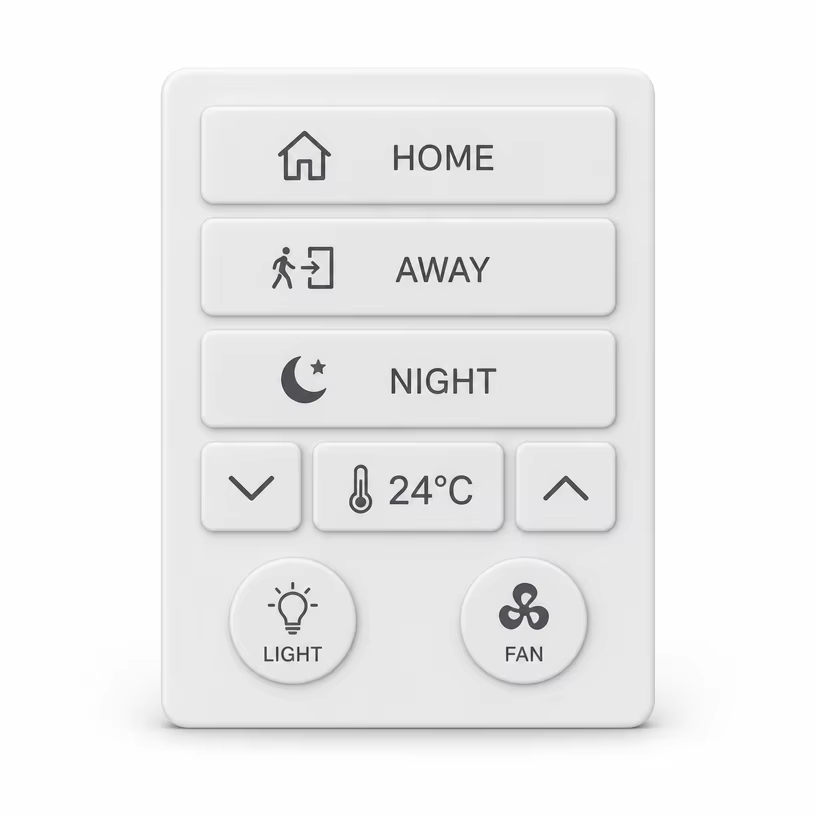
One trend worth watching is colour as a status language rather than decoration: white or grey pads for everyday scenes, a single warm accent colour for the panic or away key, and darker pads for devices that should disappear visually when idle. Silicone makes this cheap because pigment is added in the compound, so a two-key accent costs the same per part as a full-colour pad. Before choosing very light colours on a smart home keypad, check the material's yellowing behaviour in warm, sunlit rooms — white silicone masterbatch quality decides whether the pad still matches the wall switch after two years. Our notes on white keypad yellowing and anti-yellowing masterbatch explain what to ask for in the compound data sheet.
Legend design: the difference between a logo and a label
Legends on smart home keypads fail in three public ways: they wear off on the most-used key, they are invisible in daylight because they only exist for backlight, or they are invisible at night because the backlight is too weak. All three are preventable, but each points to a different process choice.
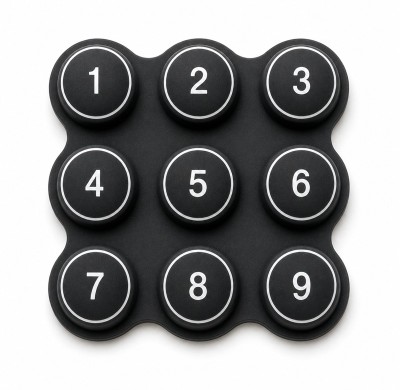
Silk-screen printing is the economical default and handles fine line art well, but printed legends sit on the surface and are the first thing to wear on a frequently pressed key. Laser engraving cuts through a top colour coat to reveal a contrasting underlayer, which makes the legend part of the key rather than a coating on it — the right choice for keys that take daily punishment, such as door lock digits. Two-shot or overmoulded legends are the most durable option and the most expensive, and they are increasingly chosen for hero keys on premium panels. The practical trade-offs between legend wear after repeated use and the option of mixing legend processes on one keypad matter more than which process is "best" in isolation.
Mekoprint, a European HMI manufacturer, describes the same logic from the design side: colour matching by co-moulding, painting, or screen printing for visual separation, and laser engraving to remove the top layer and reveal a contrasting or translucent layer beneath for high-contrast legends and precise backlighting effects. We keep that layering rule in mind on every smart home project: decide first what the key must look like with the light off, then choose the process that survives the light on.
Backlight: the layer most projects get backwards
Backlight design is usually specified last, and it shows. The common mistakes are a legend layer that blocks the light path, a keypad wall that is too thick for the LED to punch through, and a single LED placement that leaves the top row dim. The construction order matters: translucent silicone body, then an opaque top coat, then the legend area opened by laser so light escapes only through the character.
White and warm-white LEDs dominate smart home gear because they match residential lighting better than the old blue or green glow. Tunable fixtures have pushed OEMs toward neutral legend whites that stay legible from 2700 K to 6500 K, and RGB is appearing mostly as an accent halo around a key rather than as the legend itself — colour-changing legends confuse the scene-setting function they sit next to. Light bleeding through the pad edge, uneven glow between keys, and dim legends on thin designs are the recurring field complaints; our guides on backlight keypad and light-guide design, high-transparency material selection for backlit keypads, and the specific case of backlight failure in thin smart home keypads cover the failure physics in detail.
What is actually trending in 2025 and 2026 projects
Looking across recent custom silicone keypad programmes for smart home clients, four directions keep coming up:
- Dead-front styling. The keypad surface looks like a clean matte panel until the backlight lifts the legend. This requires a carefully matched top-coat opacity and laser depth, and it is the fastest way to make a keypad disappear into a premium housing.
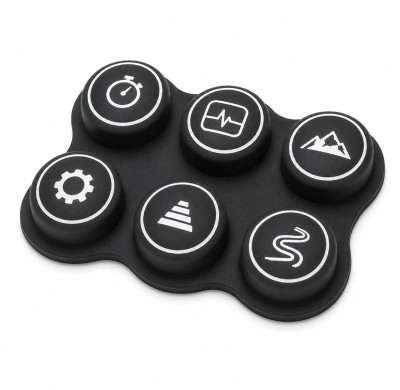
- Fewer, better keys. Scene and automation panels are shrinking to four to eight keys instead of full telephone layouts, which upgrades legend size, spacing, and durability per key.
- Finish consistency across device families. A switch, a hub, and a sensor panel sharing one pad finish and legend grammar, so the "custom" feel survives across a product line.
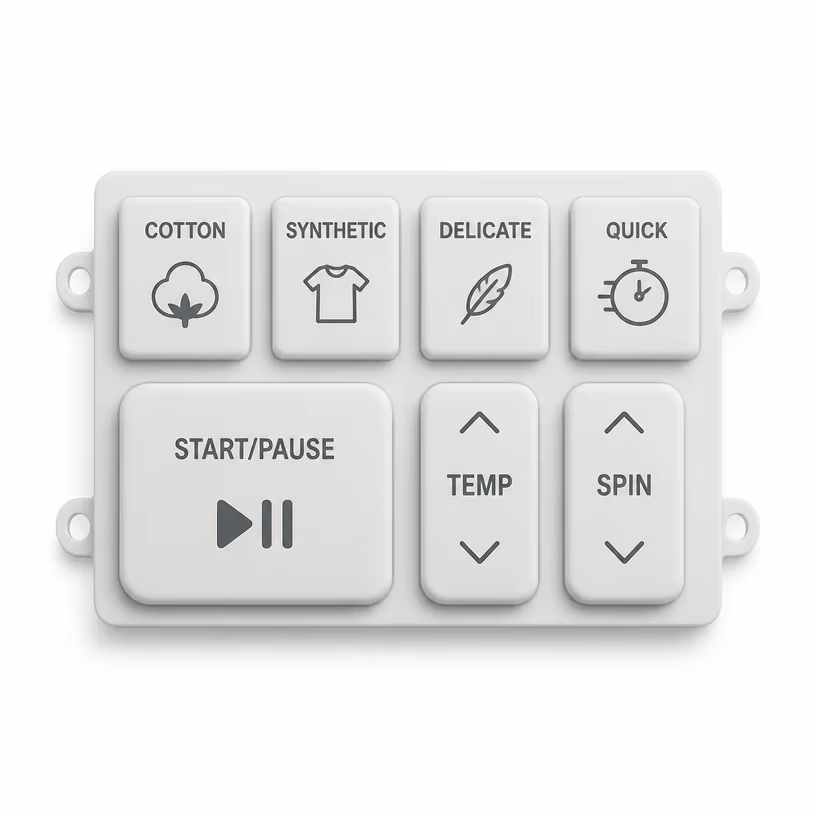
- Symbols over words, with one labelled exception. Icons age better across markets, but power and scene keys still get a printed word on the first version for usability testing.
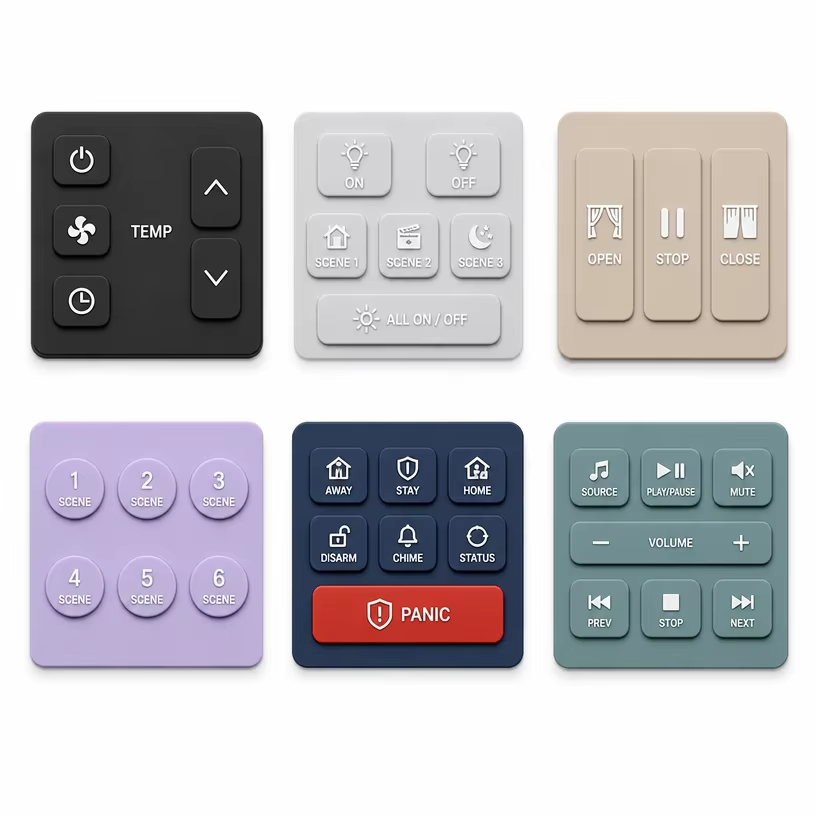
How a multi-device family gets one consistent look
A recent project illustrates the process. A wellness-brand client launched three devices — a scene controller, a thermostat, and a wall-mounted humidistat — and wanted them to read as one family despite different housing sizes. We fixed one masterbatch white and one matte texture across three tools, used laser-etched legends on the two most-used keys of every pad, and backed the legends with the same white inner coat so backlight colour stayed identical device to device. What looked like a colour problem was really a specification problem: the same compound, the same finish, and the same legend layer structure documented in one control plan.
None of this requires exotic tooling. It requires deciding the colour, legend process, and backlight layer structure before the mould is cut, because every one of those choices is cheap on paper and expensive after steel. On your next smart home pad, start with the dead-front test: write down what the device must look like powered off, then design colour and legend to survive that test before anyone talks about LED brightness.
Sources and further reading:
- Mekoprint — Silicone rubber keypads for HMI (colour matching, co-moulding, painting, screen printing and laser engraving for legends and backlighting)
- Rubber-Keypad.com — Differences between silkscreen printing and laser etching (legend process trade-offs and backlight combinations)
- SiTech — Rubber and silicone elastomeric keypad terminology (legend, durometer, and keypad process terms)
About FromRubber. FromRubber is a full-process silicone keypad and silicone parts manufacturer in China. We handle compound formulation, mould design, moulding, legend printing and laser engraving, and backlight assembly in one facility, which is why colour, legend, and backlight decisions can be locked before tooling starts. If you are specifying a smart home keypad and want the styling language to survive production, send us your housing drawing and colour samples — we will return a DFM check on colour matching, legend durability, and backlight layer thickness before you cut steel.