Friction Wear on Silicone Keypad Legends After Repeated Glove Use
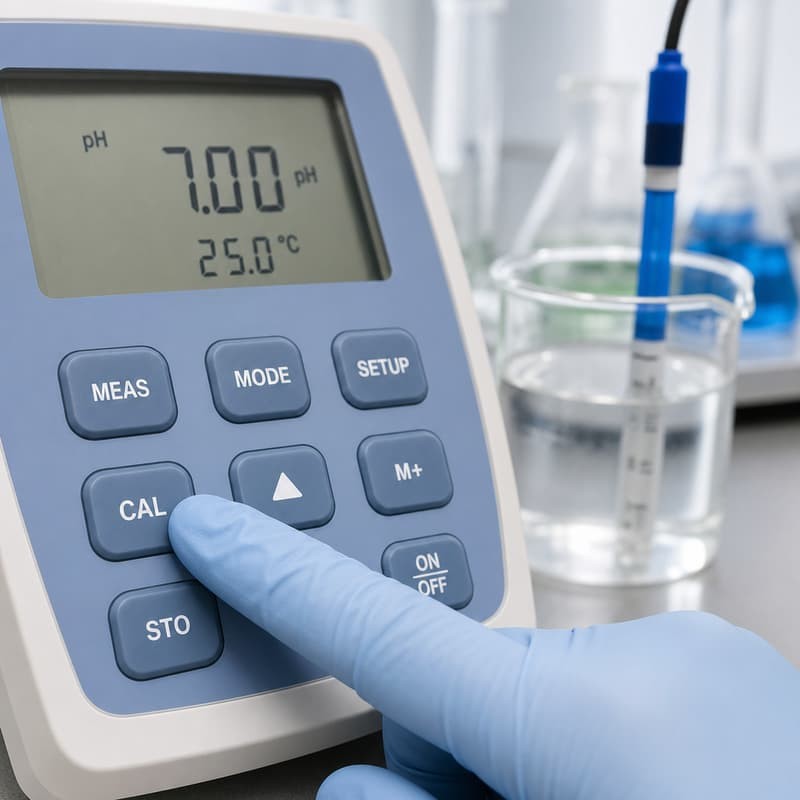
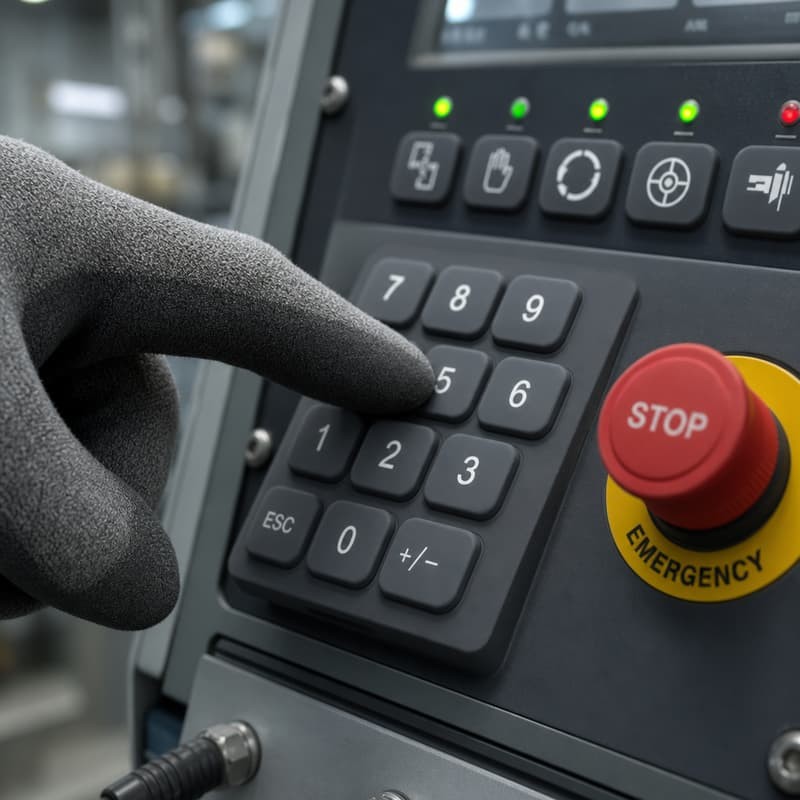
Operators who wear gloves — nitrile in labs, knit work gloves on the shop floor, cold-weather gloves outdoors — are the hardest environment a silicone keypad legend will ever face. A gloved finger does not just press the key; it drags across it, abrading the legend with a rough, chemically laden surface hundreds of times per shift. Over months, perfectly legible "CAL" and "MODE" legends fade into blank keys, and a $50,000 instrument starts failing basic usability. This article explains the mechanics of friction wear on silicone keypad legends, compares the three legend processes for glove-heavy use, and details how to test and specify legend durability that survives the glove.
Why Glove Use Is the Hardest Abrasion Test for Silicone Keypad Legends
Legend wear under gloved operation is worse than bare-finger use for three compounding reasons. First, glove surfaces — nitrile texture, knit loops, leather grain — act as an abrasive medium with far higher friction coefficient against silicone than skin. Second, gloves concentrate force: operators press harder through a glove because tactile feedback is reduced, multiplying normal force at the contact point. Third, gloves carry chemicals: lab gloves carry solvent and disinfectant residues that soften the legend ink before the abrasion removes it.
The combination means a legend that survives 100,000 bare-finger actuations can fail at 10,000 glove actuations. The failure is gradual — first a sheen, then fading corners, then a blank key — which is why it often escapes warranty review and shows up instead as a customer-complaint pattern that is hard to quantify.
How Legends Are Made: Printed, Etched, and Molded Options Compared
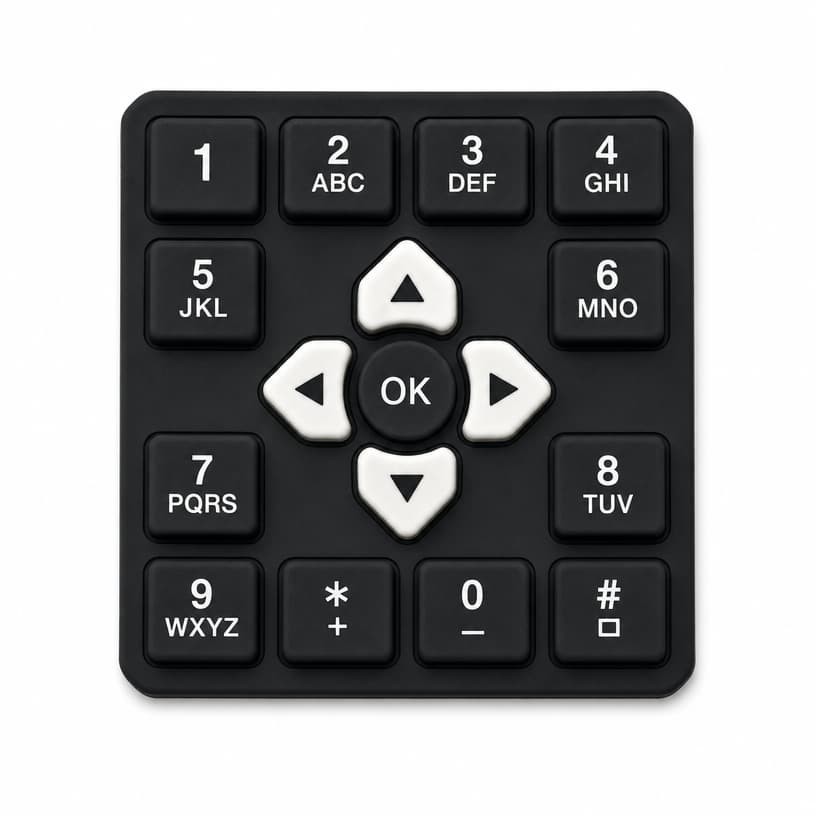
Every silicone keypad legend belongs to one of three process families, and each has a different wear profile under glove abrasion:
| Legend process | Wear resistance | Glove-use suitability | Trade-offs |
|---|---|---|---|
| Silk-screen printing (silicone ink) | Good with protective overcoat | Medium — needs coating | Lowest cost; fast to iterate; ink sits on the surface |
| Laser etching | Excellent | High — damage penetrates below the surface | Needs painted/contrast silicone; higher setup cost |
| Two-shot / molded legends | Highest | Highest — legend is molded material, not a coating | Highest tooling cost; limited fine detail |
For glove-heavy products, the industry's own guidance points in the same direction: laser etching is recommended for long-lasting legends because the mark is cut into the material rather than deposited on it, while screen-printed legends need an abrasion-resistant coating to reach comparable life.
The Physics of Legend Wear: Abrasion, Micro-Cutting, and Solvent Attack
Legend wear on a silicone keypad is not a single mechanism. In gloved operation, three act at once:
1. Abrasion. The glove's surface texture acts as fine sandpaper; each press removes a microscopic layer of ink or coating. This is the dominant mechanism and the one accelerated by high friction coefficient.
2. Micro-cutting. Dirt and particles trapped between glove and key — common on shop floors — scratch through the legend in a single hard swipe. A single contaminated glove can do more damage than a month of clean use.
3. Solvent attack. Alcohol wipes, disinfectants, and hand-cream residues soften silicone ink. Once softened, the ink is removed by the same abrasion that would barely mark a cured legend. This is why legend wear complaints cluster on medical and lab devices where disinfection is routine.
The practical consequence: a legend system that survives abrasion but not solvents, or vice versa, will still fail in the field. The test program has to combine both, which is exactly what the industry's standard legend tests do.
Case: Legend Fading on a Glove-Operated Lab pH Meter
A laboratory-instrument OEM reported that CAL and MODE legends on their pH meters became unreadable after roughly 14 months in a busy lab. The units were operated with nitrile gloves and wiped with 70% IPA after every shift — a textbook glove-plus-solvent environment.
- Inspection: the failed legends showed edge-fading typical of abrasion plus surface crazing typical of solvent attack — both mechanisms present.
- Root cause: the original legends were single-layer screen-printed ink with no protective overcoat, chosen to hit a cost target.
- Fix: the molder switched to a two-layer system — a pigmented ink layer plus a clear abrasion-resistant overcoat — and added an IPA soak test to the first-article inspection.
- Result: the revised keypad passed 100,000-cycle actuation and repeated IPA wiping with no visible legend wear, and has been in production without a single legend complaint.
The engineering lesson is that legend durability is a system property: ink, overcoat, and cleaning protocol must be specified together. The same conclusion appears in our guide on alcohol wipes and legend loss on medical and lab instruments, and the mechanical side is covered by the 3M tape test and surface treatment guide for silk-printed silicone keypads.
Reading the Wear Pattern to Find the Root Cause
The wear pattern on a faded legend is a diagnostic fingerprint. Uniform edge-fading points to abrasion; localized scratches point to trapped particles; a sticky, smeared appearance points to solvent attack; and a shiny flattened key top points to high-friction rubbing without enough normal force to abrade. Photographing the failed keypad before discarding it is the cheapest root-cause tool in the box.
Testing Legend Durability the Way the Industry Does
Legend durability testing for silicone keypads uses three standard families of tests, and a complete qualification runs all of them:
- Abrasion testing. The RCA abrasion tester is the industry reference for measuring ink and coating wear resistance on silicone keypads; the test counts cycles to legend failure under a controlled abrasive tape.
- Adhesion testing. The 3M tape test (apply, press, peel) checks that the ink actually bonds to the silicone — a legend that fails adhesion will fail everything else.
- Chemical resistance testing. Alcohol-abrasion machines rub the legend with a solvent-soaked cloth for a defined number of strokes, simulating IPA wipe-downs over the product life.
Manufacturers with in-house test labs add a fourth: the Norman abrasion tester for key-top artwork, which evaluates the combined effect of wear and environmental attack. When you ask a supplier for "legend wear test data," ask which of these tests produced the number — they are not interchangeable.
The process comparison — laser etching, screen printing, and dome printing on silicone keypads — shows that the choice of process dominates the achievable wear life, and the hidden yield traps in spray coating and laser engraving explain why process control matters as much as the process choice.
Choosing the Right Legend Process for Glove-Heavy Environments
For a product operated with gloves, our recommendation order is: molded legends or laser etching for the highest durability, and screen printing with a clear abrasion-resistant overcoat when cost or design flexibility wins. In every case, specify the test, not just the process:
- State the abrasion target (for example ≥ 50,000 RCA cycles with no legend removal).
- State the solvent protocol (for example 10,000 IPA wipes with no legend fading).
- Require the 3M tape adhesion test on the first article and per production lot.
- Simulate the glove: run a glove-material abrasion test with the actual glove type when the environment is known.
Design for the Glove, Not the Finger
Finally, consider the button geometry itself. Larger keys with a shallow radius reduce the operator's tendency to drag across the legend; recessed legends (laser-etched or molded) are physically protected from direct glove contact. These design choices cost nothing at tooling time and can double the effective legend life in gloved operation.
Sources and further reading:
- EPEC — Improving Abrasion Resistance for Silicone Rubber Keypads (coating options for key-top artwork)
- Silicone Keypad Factory — Abrasion, Salt Fog & Color Matching Tests (RCA abrasion method)
- Rubber-Keypad — How to Test Silicone Rubber Button Legends and Coating (alcohol abrasion machine)
- PRINTEC — Rubber Keypad Product Design and Abrasion Testing (Norman abrasion tester)
About FromRubber (FrmRubber). FromRubber is a full-process silicone and plastic OEM manufacturer for laboratory, medical, and industrial instruments. We print, coat, and laser-etch legends in-house, and every glove-sensitive keypad design is qualified with RCA abrasion, IPA wipe, and 3M tape tests before release. If your legends are fading in the field, send us a failed sample — our lab will identify the wear mechanism and return a legend process recommendation with test data.