Four hazards, and the moulding answer to each
Every point below is a design decision, not an inspection step. If it is designed in, inspection has nothing to catch.
01
Small detachable parts
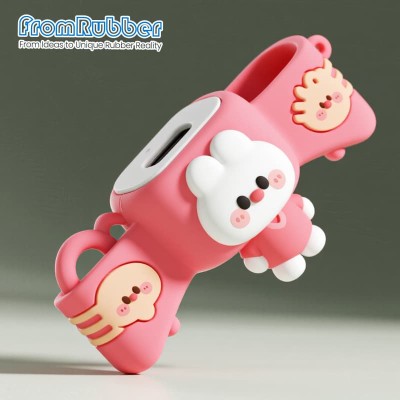
The classic failure is an eye, nose or charm that is a separate moulded piece pushed into a socket. Under pull, it comes out at exactly the size a small child puts in their mouth.
Design answer: mould the feature into the shell, or bond it during cure so it becomes one part. Where a charm must be separate, treat it as its own product with its own pull test and its own warning.
02
Hard inserts and backing plates
A polycarbonate plate inside a soft cover makes the case feel premium and turns it into a hard object with edges when the cover is removed or chewed.
Design answer: all-silicone construction, with stiffness coming from wall geometry rather than from a second material.
03
Sharp flash and parting lines
Flash at the parting line is the defect children notice first, and the one a reviewer photographs. It comes from tool wear, not from the design.
Design answer: parting line placed on a non-contact face, with a defined deflash step and a visual standard agreed at sample approval.
04
Coatings in mouth-contact areas
Spray coats and printed layers can be abraded or mouthed. On a device a child handles constantly, a coating is a wear surface that eventually exposes a different colour underneath.
Design answer: through-colour compound on any area likely to be handled or mouthed, with print reserved for surfaces a child does not put in their mouth.