
Precision Piston Rubber Parts for Engine Efficiency


| Share | |
|---|---|
| Categories | Custom Silicone Seals |
| Brand | FromRubber Silicone & Plastic OEM Manufacturer |
| Product Specifications | BH-auto15 |
| Product Name | Piston Rubber Parts |
| Material | Rubber Silicone |
| Color | Black,Custom |
| Shape | Customise |
| Feature | Precision |
| Application | Engine Efficiency |
| Sales Method | Molded Custom |
| Consultation Email | Suey@fromrubber.com |
| FOB port | Shenzhen |
| Terms of Payment | L/C, D/A, D/P, Western Union, MoneyGram, T/T, Paypal |
| Download |  |
Custom Silicone Seals / Engine and Hydraulic Sealing
Precision Piston Rubber Parts for Engine Efficiency: Leakage, Friction and Extrusion
Rubber parts inside a piston or rod assembly do two jobs at once: hold pressure at the moving interface, and keep friction low enough that the actuator does not spend its force on its own seal. Efficiency is lost in three places: leakage past the sealing lip, friction under pressure, and extrusion of the seal into the clearance gap.
Precision molding fixes the third problem directly. The first two are decided by section geometry and installed squeeze, which is why a seal review comes before a tooling quote.
- Squeeze 8-20%
- Ra 0.2-0.8 µm counterface
- ±0.02 mm critical dims
- NBR, FKM, VMQ, PTFE
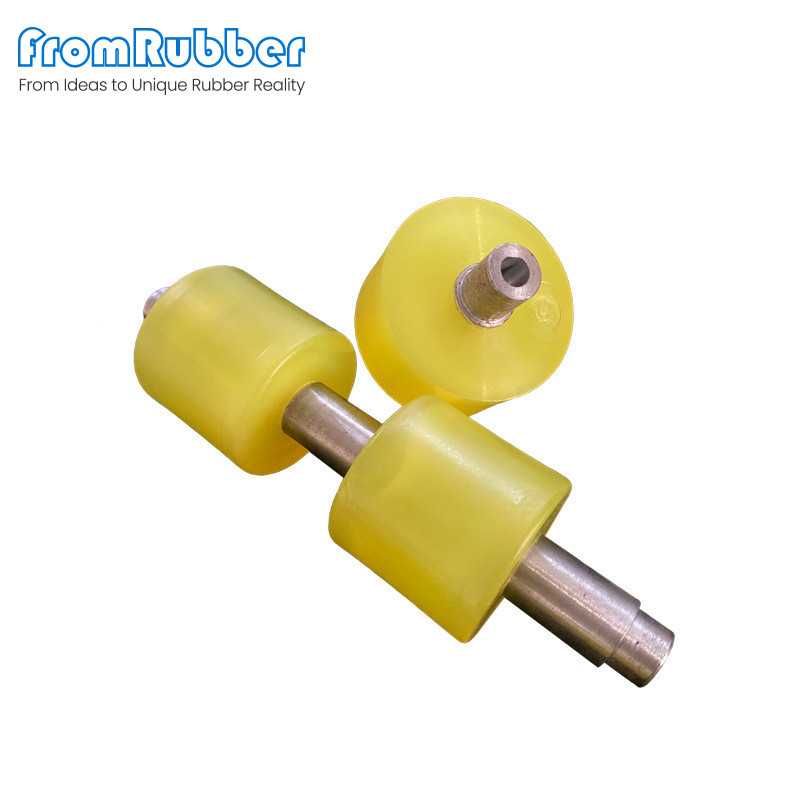
Three loss paths, three different design answers
When a cylinder loses force or weeps, the cause is usually one of these. They look alike on a bench and are fixed in completely different ways.
- 01
Leakage past the lip
If contact stress at the lip is lower than the pressure behind it, fluid migrates. Causes: too little squeeze, a lip that has taken a permanent set, or a counterface too rough to keep an oil film.
- 02
Friction and stick-slip
Every extra point of squeeze adds sealing force and drag. In low-speed actuators the result is stick-slip: the rod moves in steps, the cylinder chatters and position accuracy disappears.
- 03
Extrusion into the gap
High pressure plus a wide clearance plus a soft compound nibbles the seal edge. The debris travels through the system, blocks orifices, and the seal leaks where nothing looked wrong.
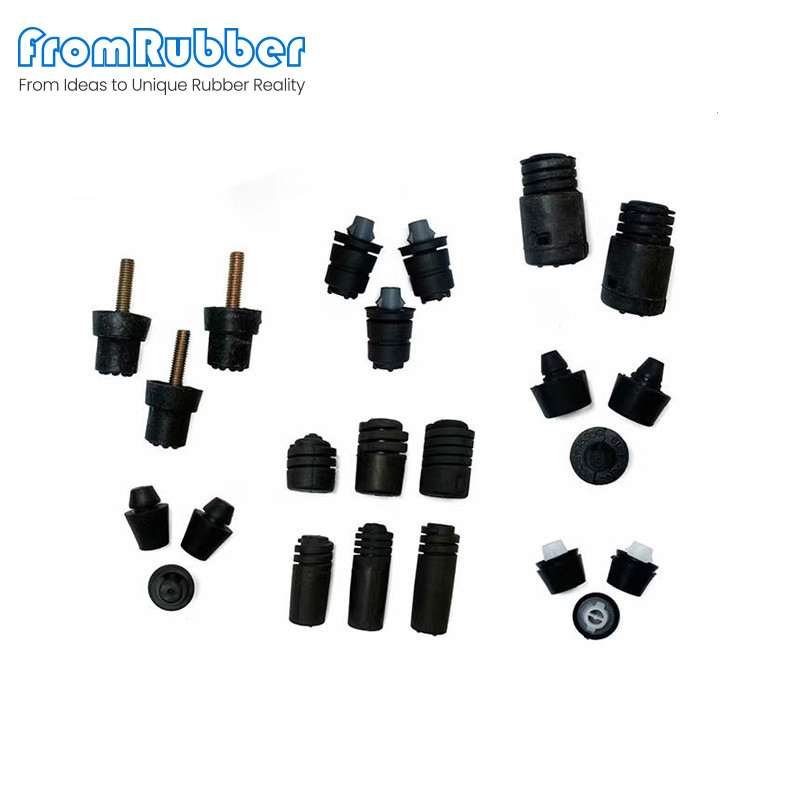
Seal section numbers to agree before tooling
| Parameter | Typical design window | Effect on efficiency |
|---|---|---|
| Radial squeeze | 8-15% for dynamic lip seals, up to 20% static | Sets contact stress; too much costs friction |
| Extrusion gap | 0.2-0.3 mm at rated pressure with 70 Shore A | Beyond this, pressure needs a back-up ring |
| Counterface finish | Ra 0.2-0.8 µm, no spiral lead | Keeps a film without wearing the lip |
| Hardness | 60-80 Shore A for NBR and FKM lip seals | Higher hardness resists extrusion, raises breakaway force |
| Molded tolerance | ±0.02 mm on seal ID and OD where the drawing calls for it | Holds installed squeeze from cavity to cavity |
| Media temperature | NBR to about 100 °C, FKM to about 200 °C, VMQ to about 200 °C in dry heat | Decides which compound survives the duty cycle |
Values are starting windows for a design review, not guarantees. Installed squeeze is measured on the assembled part, and acceptance is by the drawing, the compound TDS and first-article measurement.
Choosing the compound for a piston or rod seal
Compound choice follows the fluid first and the temperature second. Where those two conflict, geometry usually has to change.
- 01
NBR
General hydraulic and pneumatic duty with mineral oil. Good abrasion and extrusion behaviour at moderate temperature, and the lowest cost of the oil-resistant options.
- 02
FKM
Heat, fuel and aggressive oil resistance where NBR hardens or swells. Higher cost and a tighter processing window, so it is specified rather than assumed.
- 03
VMQ silicone
The best dry-heat range and low compression set, but it swells in many hydrocarbon oils, so it belongs in air, brake-adjacent and speciality-fluid duties rather than mineral-oil hydraulics.
- 04
PTFE lip or back-up
Not an elastomer, but often the right answer at high pressure and low speed: a PTFE lip with an elastomer energiser cuts breakaway force while the elastomer body does the sealing.
For systems that must also hold fluid at a static flange or cover joint, see silicone seals and gaskets: types, standards and applications.
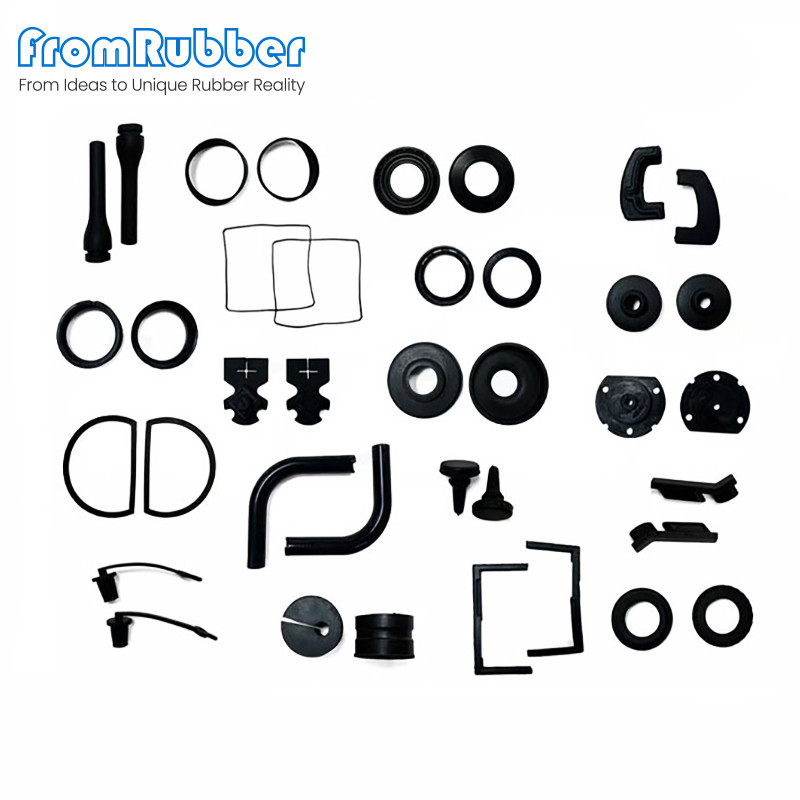
What is controlled before the seal reaches your bench
At lip dimensions, flash is a leak path. A parting line sitting on the sealing edge will pass a cold bench test and weep once the fluid is warm, so flash position belongs in the drawing review, not in finishing.
We mold under IATF 16949 and ISO 9001 quality systems with ISO 14001 environmental management, and report seal ID and OD, hardness and compression set per batch. Cavity identity is retained through the batch, so a drift in one cavity is visible before it becomes a field return.

From drawing to sealed assembly
Most piston and rod projects fail at the section review, not at molding. We run the section review first.
Send the seal section
A 2D section with squeeze and groove dimensions, a 3D model, or the housing and piston so the gland can be reconstructed.
Section and squeeze review
We check squeeze, extrusion gap, lip angle and counterface finish against the pressure and speed the part will see.
Prototype in the production compound
Samples molded in the intended compound, not a substitute, so friction and compression-set data mean something.
Production with reports
Dimensional report, hardness and compression set by batch, with cavity traceability through the run.
Piston seal questions engineers ask us
Direct answers for specification work and for failure review after a leak.
Lip seal or Y-profile: which holds pressure better?
A Y or U profile holds more pressure because the pressure itself energises the lips. A plain lip seal is simpler and runs with less friction at lower pressure. The choice follows the pressure curve, not the drawing style.
How much squeeze should a dynamic seal have?
8-15% radial squeeze covers most dynamic lip seals. Below that, leakage risk climbs; above that, friction and breakaway force climb quickly and stick-slip appears.
Can silicone be used for hydraulic piston seals?
Only where the fluid is compatible. VMQ swells in many mineral oils, so NBR or FKM is the safer route for oil hydraulics; silicone is reserved for air, dry heat and speciality fluids.
Why does a new rod seal leak after replacement?
Usually the counterface, not the seal: a worn or scratched rod, a spiral lead left by machining, or a seal installed lip-side in. Check the rod finish before blaming the part.
Send the section drawing for a seal review
Include the pressure, speed, fluid and temperature band. We come back with the squeeze, compound and lip geometry that fit, plus the tolerances that genuinely need to be on the drawing.
- 加载中···


Start Your Project Today!
- Phone
- *Title
- *Content
Sign Up Out Newletter
