

Custom Rubber Bracelets: Debossed Color Fill
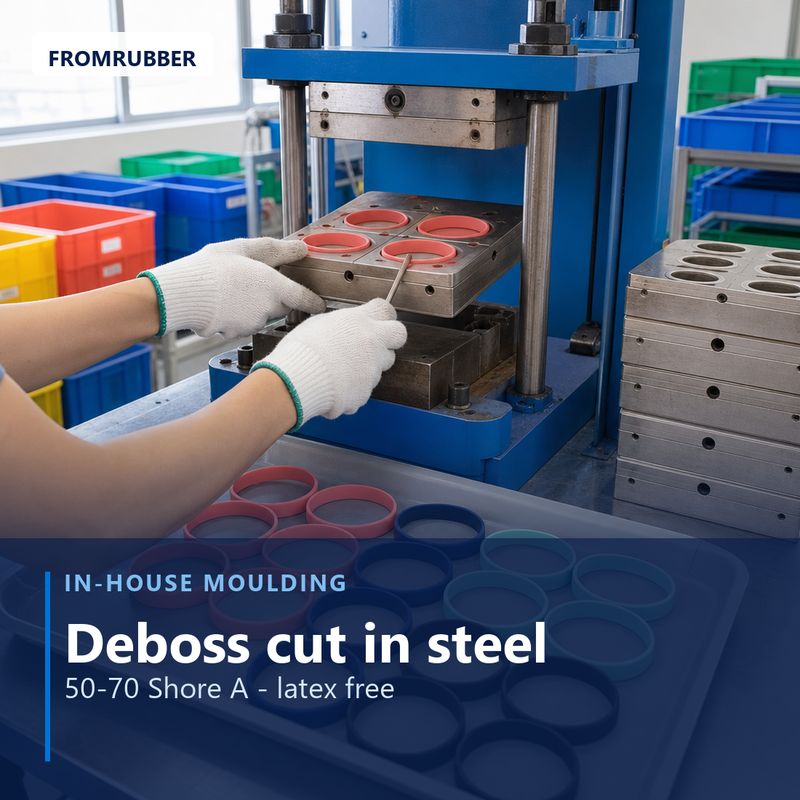
The lettering sits below the surface, so the message survives abrasion. Color fill lifts contrast, but narrow strokes and long words are where fill quality shows.


Custom rubber bracelets are silicone wristbands decorated with a brand, event or campaign message. The decoration method rather than the silicone decides legibility, surface feel and unit cost, and it decides which artwork still reads after a year of daily wear.
The lettering sits below the surface, so the message survives abrasion. Color fill lifts contrast, but narrow strokes and long words are where fill quality shows.
Embossing gives a tactile edge that wears well on grip-driven products, and it hides shallow sink marks that would show on a flat band.
Printing carries gradients, illustrations and multi-color logos that molding cannot, at the cost of a surface layer that has to be specified honestly.
A wristband is read at arm length, at an angle, in motion. That single fact rules out a lot of artwork: thin serif fonts, tight letter spacing and fine detail disappear once they are molded into a 2 mm band and viewed on a moving wrist. The practical rule is to design the message as a mark, not as a paragraph.
Molding and printing fail in different ways, which is why the choice is usually made on wear conditions rather than on appearance in a sample photo. A debossed band keeps its shape and its contrast even when a printed band would have lost ink at the highest point of the curve.
Strokes below roughly half a millimeter and gaps below the same order stop reproducing cleanly in a mold. We adjust the artwork before cutting steel rather than after.
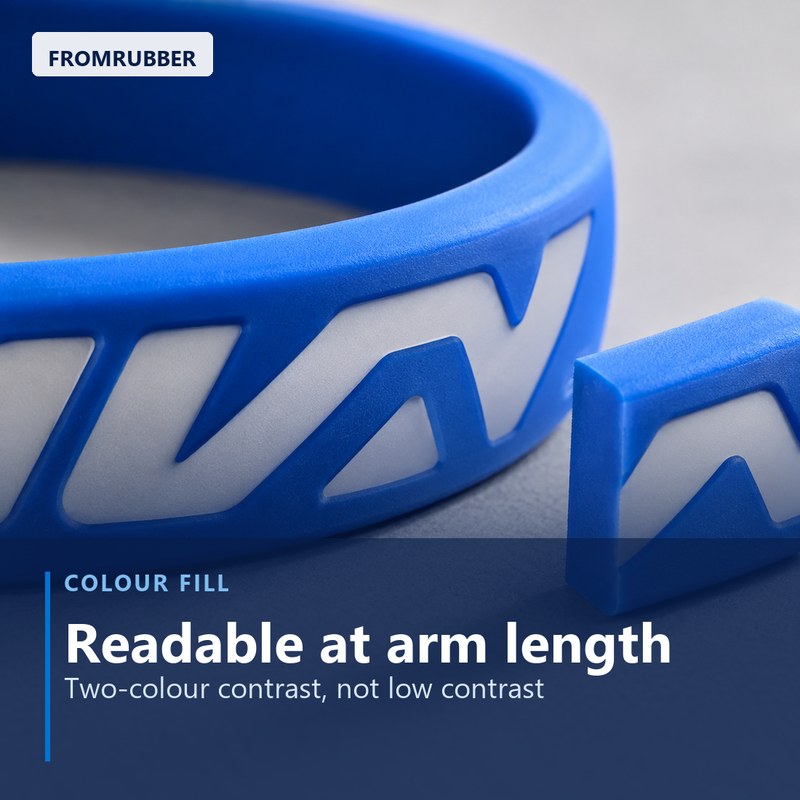
Fill works best as a two-color contrast, light on dark or dark on light. A low-contrast fill looks refined in a photo and unreadable on a wrist.
Laser etching exposes the stock beneath a surface color, so it needs no second material and no fill step. It produces a permanent, low-contrast mark suited to subtle branding.
Standard builds below cover most event, retail and campaign programs. Sizes and decoration are confirmed against the artwork.
| Material | Silicone rubber, latex free |
|---|---|
| Hardness | Typically 50-70 Shore A for wrist comfort and shape retention |
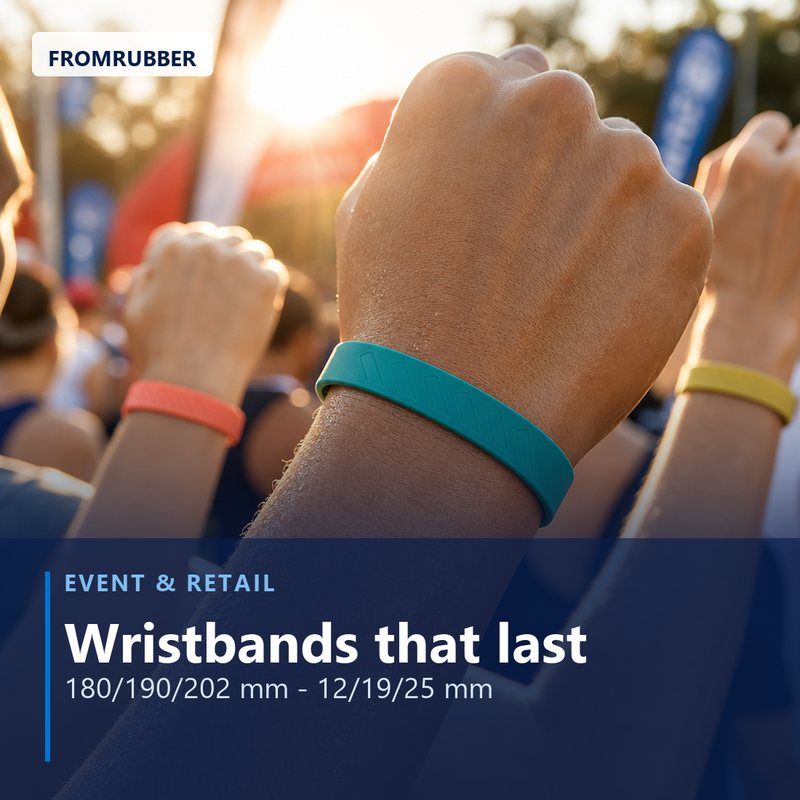
| Circumference | 180, 190 and 202 mm standard, custom on request |
| Band width | 12, 19 and 25 mm standard |
| Thickness | Typically 2.0-2.5 mm |
| Decoration | Deboss with color fill, emboss, screen print, laser engraving |
| Color | Solid stock colors and custom matching |
| Packing | Bulk carton, poly bag or individual header card |
Hardness and thickness are agreed per program. A softer band is more comfortable for long wear; a firmer band holds a crisp deboss and a defined edge.
A printable logo and a moldable logo are not the same file.
A 500-piece order and a 50,000-piece order fail for different reasons. Small runs usually fail on artwork that cannot be molded; large runs fail on color consistency between batches and on a size run that was never defined. Both are settled before production, not during it.
Where a deadline is fixed by an event date, the critical path is sample approval, not molding. Our quick proofing service exists to compress that step when the artwork is already final.
Events usually need two or three sizes and two or three colors, not one size in five colors. Defining the mix early keeps the pack count and the pallet plan accurate.
Pigment is weighed per batch. When a program runs across months, we keep a retained sample so the second batch is matched to the first, not to a Pantone chip.
Header cards, barcodes and poly bag sizes change the packing line, so they are confirmed with the sample rather than after production.
The process is deliberately front-loaded on artwork, because a printable logo and a moldable logo are not the same file.
We check stroke width, spacing and color count against the chosen decoration method and return a marked-up proof.
A physical sample is checked for fit, edge feel and legibility on the wrist, including the color fill depth.
Bands are molded to the approved hardness and thickness, with pigment weighed per batch and retained samples kept.
Fill, print or laser steps run after molding, followed by counting and the agreed packing format.
It depends on the decoration. A debossed tool is a one-time cost that only makes sense above a certain quantity, while a printed band can start lower. Send the target quantity and we will tell you which method is viable at that volume.
Yes. They are molded from silicone rubber, not natural rubber latex, which is why they are the usual choice for hospital, school and allergy-sensitive programs.
Yes, but the mix has to be defined before molding so the packing and the carton count stay correct. Mixed programs are quoted as a set rather than as separate lines.
Send the artwork, target quantity, size mix and deadline. We will recommend the decoration method that survives the wear conditions and quote it as one program.
Related capabilities: Custom rubber patches · Silicone molding · Quick proofing service