
Compression Set Governs Silicone Seal Leakage
A seal that takes a permanent set loses contact stress and leaks without any visible damage.


A precision silicone seal protects an enclosure by staying compressed, not by being tight. Service life depends on compression set, tear resistance at the lip, surface finish and the tolerance stack around the groove.
A seal that takes a permanent set loses contact stress and leaks without any visible damage.
Thin sealing lips tear during assembly far more often than they fail in service.
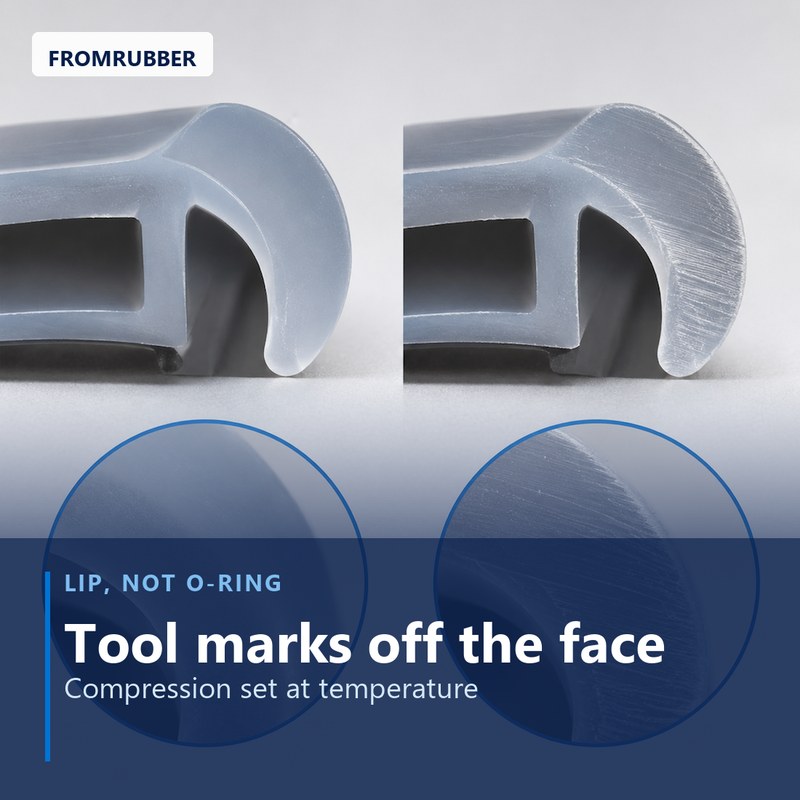
A tool mark across the sealing face creates a leak path that no amount of clamp force will close.
A seal works by maintaining contact stress against a mating surface. Hardness tells you the initial stress; compression set tells you how much of it remains after months under load and heat. Two seals at the same Shore A can behave completely differently after a year in a warm enclosure, and only one of them still seals.
Compression set is a compound and cure property. It is measured by compressing a specimen by a defined percentage, holding it at temperature for a defined time, releasing it and measuring the recovery. Because it is a property of the vulcanised material, it has to be confirmed on the actual production compound rather than assumed from a generic silicone datasheet.
The seal has to keep pressing after relaxation. Set is the number that predicts whether it will.
Hardness sets the initial force and the fill percentage. A groove that is under-filled cannot compensate for set.
Set accelerates with temperature. The service window, not the room temperature, is the test condition.
Typical build values for enclosure, panel and shaft seals. The groove and the mating surface are part of the specification, not background information.
| Material | Silicone rubber, grade selected for the service temperature |
|---|---|
| Hardness | Selected against groove fill and clamp force |
| Compression set | Confirmed on the production compound at service temperature |
| Tear resistance | Specified for thin lips and assembly-stressed sections |
| Surface finish | Sealing face controlled, no tool marks across the leak path |
| Tolerance | Set against the groove stack, not a generic table |
| Media | Water, dust, air and cleaning agents confirmed per project |
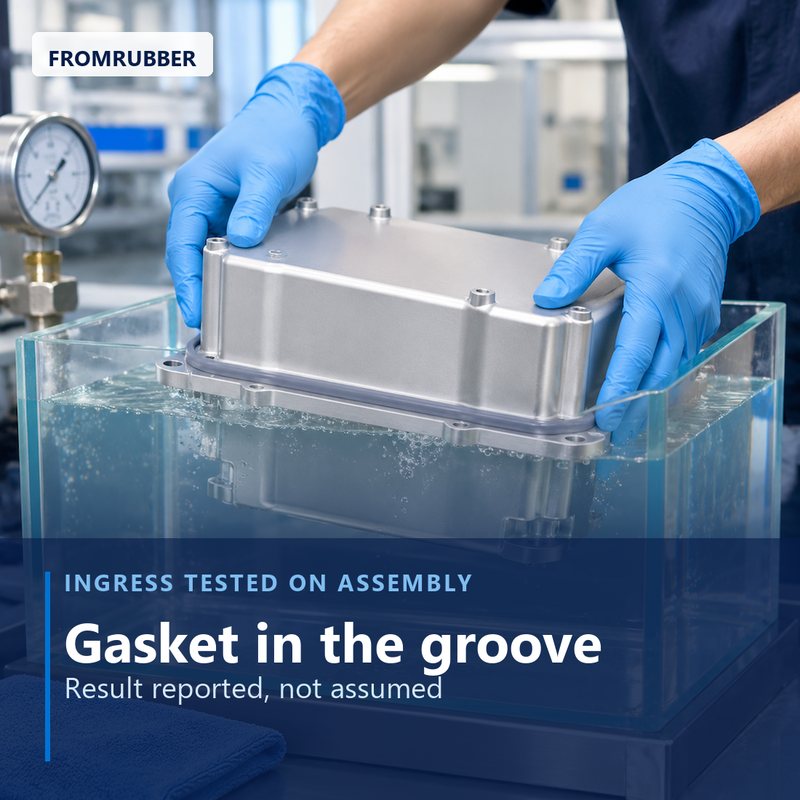
| Testing | Ingress verified on the assembled enclosure |
A silicone seal is not the best choice for high-abrasion sliding contact. Where wear resistance dominates, we say so and propose an alternative material rather than force silicone into the application.
Half of every leak is a groove or clamp problem.
Silicone is excellent at temperature range, compression recovery and cost, and it is poor at abrasion and at resistance to oils and fuels. A rotating shaft seal in an oily environment is usually better in FKM or nitrile; a high-wear slider is usually better in TPU. Recommending silicone for those duties produces a seal that passes the first test and fails in the field.
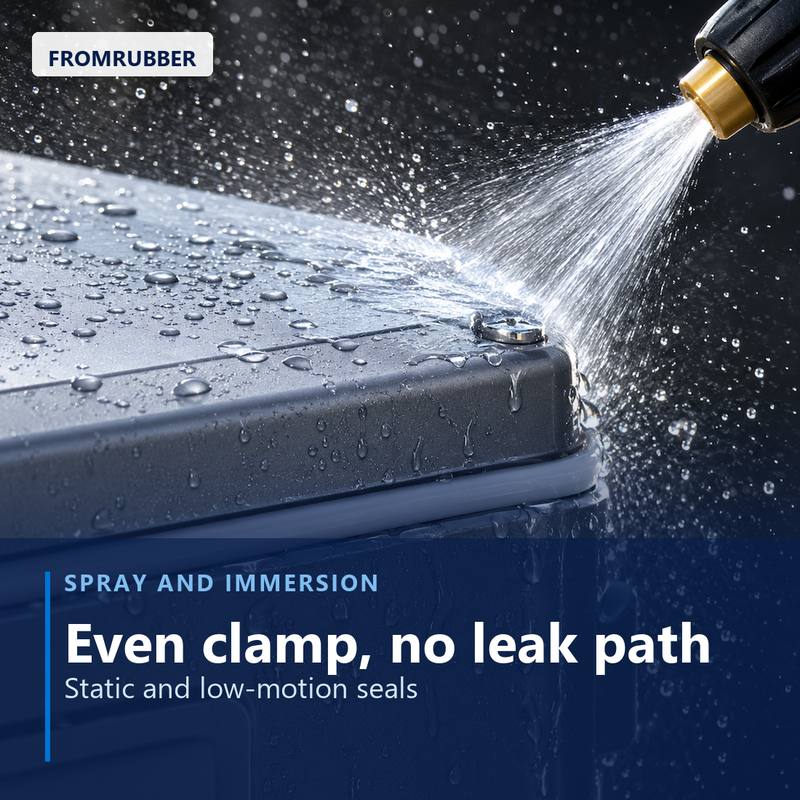
The honest split is: static and low-motion sealing at temperature, silicone; aggressive chemistry, a fluorocarbon; abrasion, a polyurethane. Our silicone seals range is built around that boundary, and projects outside it are quoted in the material that fits.
Silicone suits static and low-motion sealing. Continuous sliding contact generates heat and wear that silicone tolerates poorly.
Silicone swells in hydrocarbon media. Where oil is present, a fluorocarbon or nitrile is the starting point.
Grit between sealing faces destroys silicone quickly. A harder, tougher elastomer is the correct answer.
The seal is designed with the groove, because half of every leak is a groove problem.
Groove depth, width, fill ratio and mating surface flatness are checked before the seal profile is chosen.
Hardness, set behaviour and lip geometry are chosen against the service temperature and motion.
Seals are assembled on the real housing to check lip roll, pinch and closure force.
The assembled enclosure is tested to the agreed ingress level, and the result is reported rather than assumed.
The rating belongs to the assembled enclosure, not to the seal. We design and test the seal within your housing and report the verified result for that assembly.
It depends on the groove and the material. As a starting range, static silicone seals are usually designed within a moderate compression band, then confirmed on the assembly rather than fixed by rule of thumb.
Most often a torn or rolled lip, a tool mark across the sealing face, or a groove that is over-filled so the housing cannot close. All three are visible at first-article inspection.
Send the housing drawing, groove dimensions, service temperature and the media involved. We will propose a profile and compound, and tell you if another elastomer is the better answer.
Related capabilities: Silicone seals range · Custom silicone parts · Material selection