
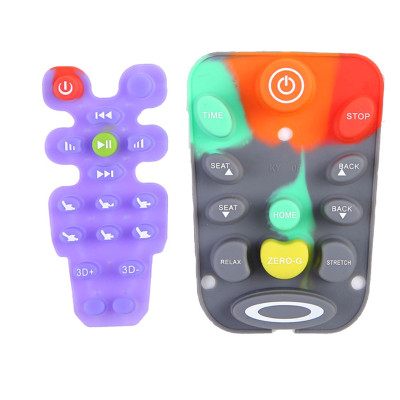
FromRubber High Quality Silicone Backlit Keypad Solution for Live Streaming Equipment


| Share | |
|---|---|
| Categories | Custom Silicone Rubber Remote Keypad |
| Brand | FromRubber Silicone & Plastic OEM Manufacturer |
| Design | 3D Drawings or Objects |
| Printing | Laser Etching |
| Conduction Mode | Backlit |
| MOQ | 1000pcs |
| Application | Live Streaming Equipment |
| FOB port | Shenzhen |
| Terms of Payment | L/C, D/A, D/P, Western Union, MoneyGram, T/T, Paypal |
| Download |  |
Backlit Silicone Keypad for Live Streaming Equipment: Uniform Light, No Bleed
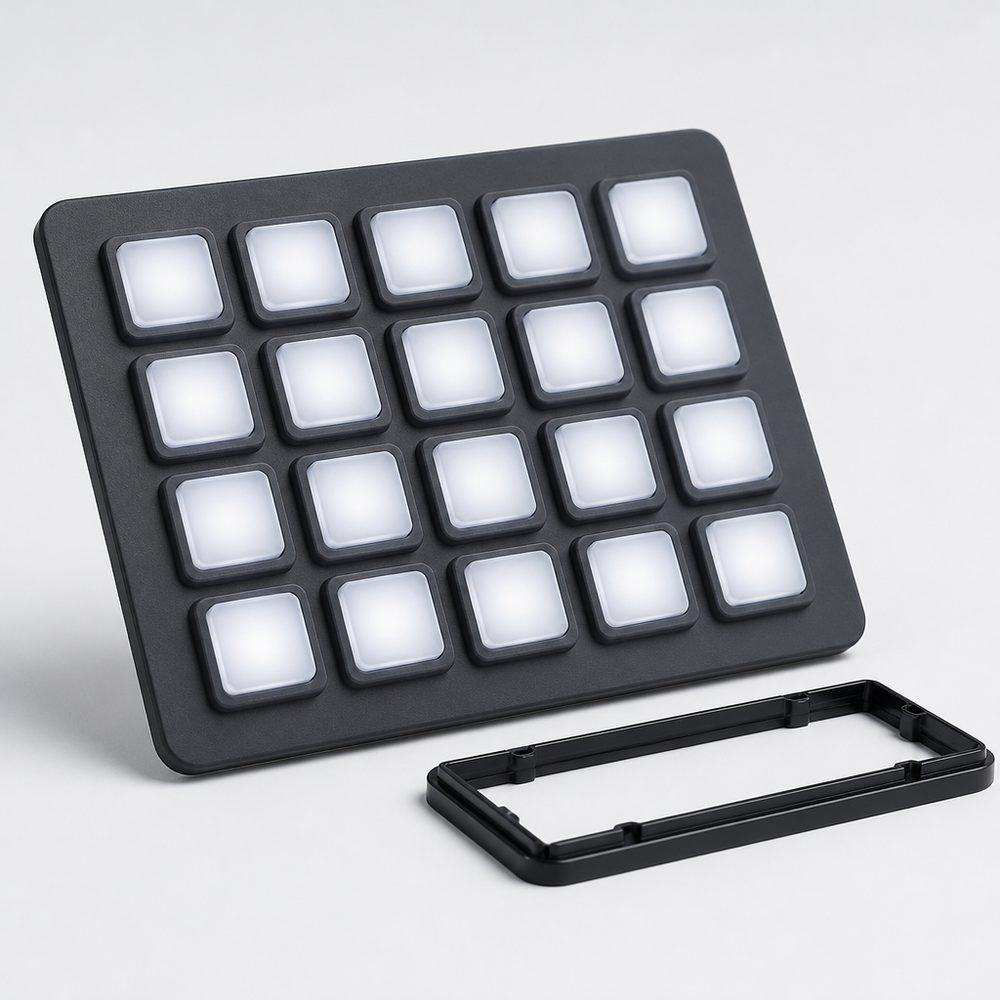
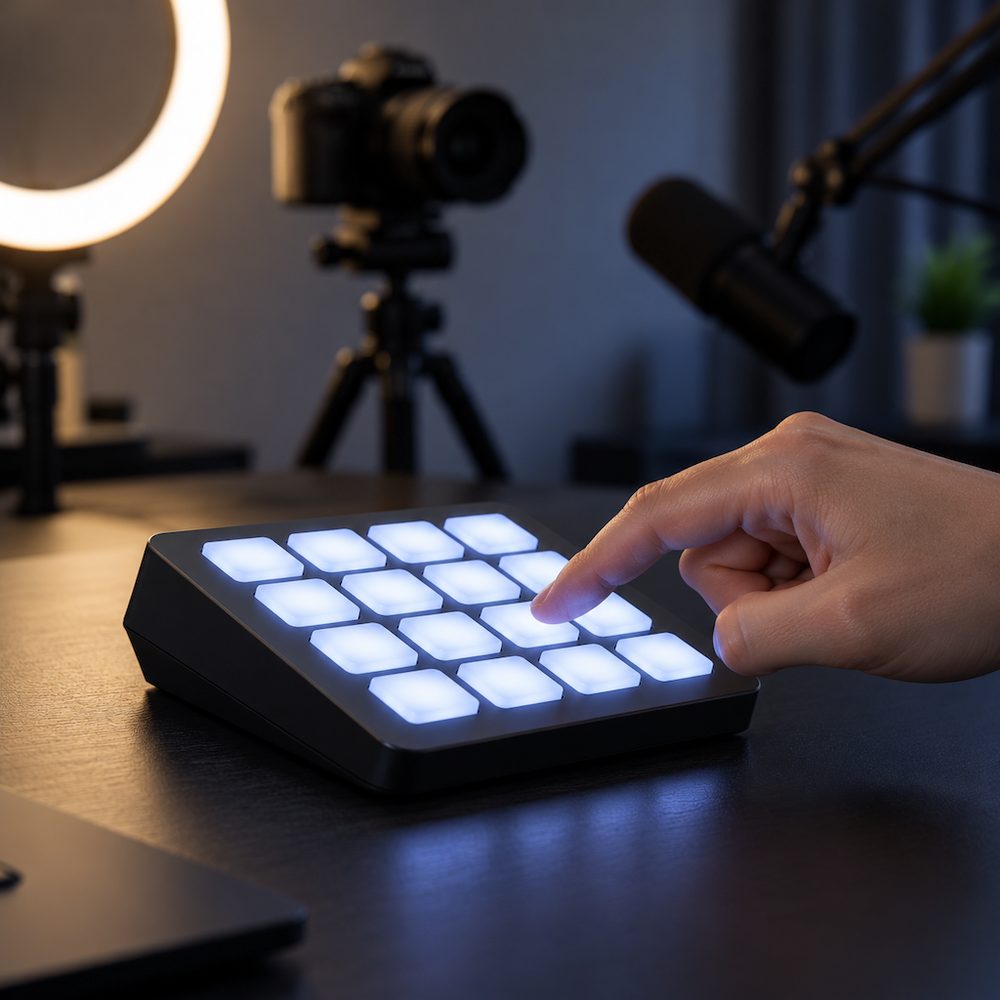
In a streaming studio the keypad is used in low light and seen on camera. That combination rules out the usual compromises: a bright hotspot on one key and a dim one beside it, light leaking between keys into a grey halo, and a PWM dimming frequency that shows as banding on a mirrorless camera at a fast shutter. A backlit silicone keypad for streaming hardware is an optical design problem before it is a moulding problem.
The parts of the design that matter are the light path from LED to legend, the isolation between adjacent keys, and the electronics driving the LEDs. Get those right and the moulding is straightforward; get them wrong and no amount of moulding quality hides it on camera.
- Legend brightness variation held within a tight band across the key field
- Opaque light barriers between keys prevent bleed and halo
- Diffusion geometry that hides the LED image from the viewer
- Dimming method chosen so cameras do not pick up flicker
The Light Path From LED to Legend
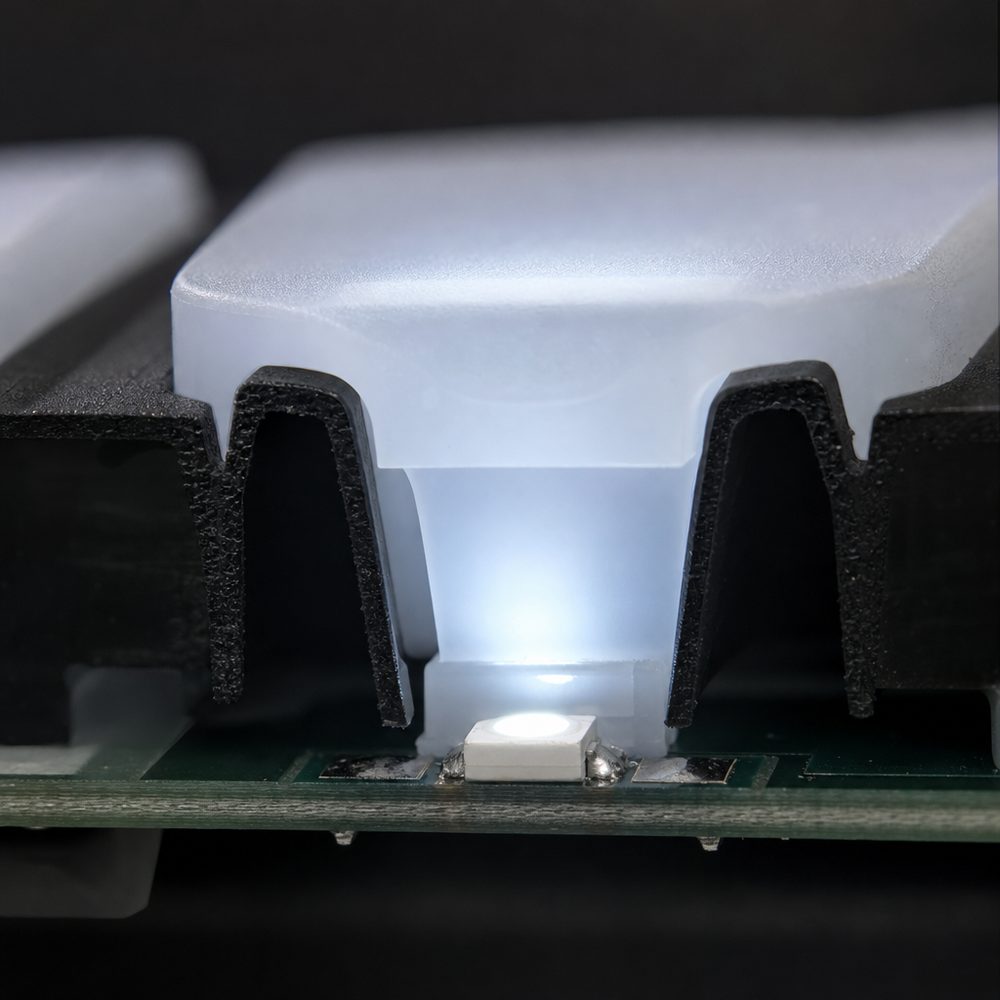
Every backlit keypad is a short optical system. The LED emits a narrow cone, the silicone guides it, and the legend either diffuses it or lets it through. Uniformity is a geometry decision.
Guide Cavity Depth and LED Placement
The LED sits below the key, and the distance to the legend sets how much the light spreads before it reaches the surface. Too close and the legend shows a bright core with a dark ring; too far and efficiency drops and neighbours receive more light. A shallow well with a diffusing step above the LED is the usual compromise. Where the key field is large, the centre keys are naturally brighter than the corners, so the LED layout follows the uniformity target rather than a regular grid.
Legend Geometry and Etch Depth
A laser-etched legend works by removing the opaque top layer to expose a translucent one. Etch depth consistency is the single biggest factor in legend-to-legend brightness variation. Too shallow and the legend is dim and patchy; too deep and it cuts into the translucent layer unevenly. Depth is set and monitored per production batch, not only at first article. Common backlighting methods are compared in Can silicone keypads be backlit, and what are the common.
Barriers Against Bleed
Light travels sideways through silicone. Without a barrier, an illuminated key lights its neighbour and the whole panel glows. The barrier is either an opaque moulded wall, an opaque second material in a two-shot construction, or a physical gap - and it has to run the full depth of the light guide. Partial barriers produce the halo that looks worst on camera.
Specification Envelope for a Backlit Streaming Keypad
The table is the starting envelope for a two-layer backlit silicone keypad. The LED circuit and the camera requirement set the final numbers.
| Parameter | Typical envelope | Why it drives the result |
|---|---|---|
| Construction | Two-layer opaque skin over translucent core | Consistent etch depth and clean light barriers |
| Legend etch depth | Controlled per batch | The main cause of key-to-key brightness variation |
| Brightness uniformity | Target within a narrow band across the key field | The visible defect on camera is unevenness, not absolute level |
| Light barrier | Full-depth opaque wall or gap | Partial barriers produce a halo |
| Actuation force | As required by the key function | Backlight structure must not change the feel |
| Dimming | DC or high-frequency PWM | Low-frequency PWM shows as banding on camera |
| Surface | Matte texture, cleaning-resistant | Gloss shows smears under studio lighting |
Ranges describe a typical design envelope. Legend brightness, etch depth and dimming method are agreed against the customer's electronics and camera test conditions.
Flicker, Gloss and What the Camera Sees
A panel that looks fine to the eye can flicker on camera, and a surface that feels fine in the hand can look greasy under a key light. Both are predictable from the design.
PWM Dimming and Shutter Speed
LED brightness is usually controlled by pulse-width modulation. At low duty cycles and low frequencies, a camera with a short shutter captures the LED in the off state for some frames, producing banding or a flickering key. DC dimming, or PWM well above the audio and camera bands, removes the problem. This is an electronics decision that the keypad supplier should raise early, because it cannot be fixed by the moulding.
Legend Contrast and Colour
On camera, a black keypad with a white legend has far more contrast than the eye suggests, and a warm white legend shifts colour once the camera white balance locks. Specifying the legend colour against the camera's rendering, not only against a colour chip, avoids the mismatch. Where the product is filmed close up, matte legends photograph more evenly than gloss.
Surface Gloss After Cleaning
Streaming equipment is wiped often. A high-gloss silicone shows every smear under a softbox; a matte finish hides it but wears smoother over time. Choosing the texture with the cleaning regime in mind is more useful than choosing it from a sample board.

Two-Layer Construction and Colour Control
Backlit silicone keys are normally built as two layers: an opaque top skin and a translucent core. The process choice determines how consistent the legend brightness is from key to key.
Two-Shot and Laminated Construction
Two-shot moulding bonds the layers in the tool and gives the most consistent etch depth and the cleanest barrier. Laminated construction is cheaper for low volume but the bond line is a variable that shows up as uneven brightness. Where the design includes a barrier wall, two-shot handles it in one cycle. Backlight failures in thin designs are analysed in backlight failure in thin keypad designs.
Colour Matching Under Illumination
A key that is deep black unlit can read dark grey when lit from below. The colour target has to be set under both conditions, and the translucent layer's pigment loading controls the difference. This is agreed with limit samples, because a numeric target alone does not capture the appearance.
Prototype and Verification
Optical verification is a photograph, not an opinion. We light the prototype at the production current, photograph the panel at a fixed exposure, and measure brightness across keys. That produces a uniformity number the customer can accept or reject before tooling. Trends in backlit keypad design are summarised in 2026 StairClimber Silicone Keypad Design Trends.
Backlit Keypad Questions From Buyers
Why is one key brighter than the others?
Usually etch depth variation, LED distance variation, or light bleed from a neighbour. Etch depth is the most common and is controlled by monitoring depth per batch rather than only checking the first sample.
Can the keypad be dimmed without flicker on camera?
Yes, with DC dimming or PWM above the range where a camera shutter can catch it. This is an electronics specification, but it has to be agreed with the keypad design so the legend can be tuned at the real operating current.
Does backlighting change the key feel?
It can. The light guide adds material and changes the wall section at the legend. The force curve is checked after the optical structure is added, not before, otherwise the production part feels different from the prototype.
Send the Key Field and the Lighting Spec
Send the key layout, the LED circuit including the dimming method, and the camera condition the product is filmed under. We will propose layer construction, barrier geometry and etch depth, and supply a lit prototype for a uniformity photograph. Related: backlighting methods and backlit keypad design trends.
Request a backlight design reviewFromRubber moulds backlit silicone keypads for OEM equipment programmes. We do not sell retail.
- 加载中···


Start Your Project Today!
- Phone
- *Title
- *Content
Sign Up Out Newletter
