You Submitted the IP67 Report, but It Leaks on Site – Lab Pass ≠ Field Pass for Industrial Instrument Silicone Keypads
The IP67 report for your industrial instrument silicone keypad says the enclosure passes. On site, the first heavy rain finds its way in past the buttons, and the customer sends back a photo of water inside the bezel. The report was not forged and the test was not faked. The problem is that an IP67 rating, as defined by IEC 60529, is a snapshot of a new, clean, stationary sample — and an instrument keypad spends its life being pressed, heated, cooled and wiped.
What IP67 actually certifies
Under IEC 60529 (adopted in China as GB/T 4208), IP67 means two things: complete protection against dust ingress, and protection against the effects of temporary immersion — in practice, 30 minutes in water at one meter depth. Two details of the test procedure matter for keypads. First, the water temperature must be within about 5 K of the sample temperature, so the test deliberately avoids the thermal shock that creates pressure differences. Second, the sample is tested at rest: the buttons are not pressed during immersion, and the sample is new. The rating answers "does this enclosure keep water out while it sits in a tank?" It does not answer "does this keypad keep water out after a year of thermal cycling and daily pressing?"
None of this makes the IP67 report wrong. It makes it narrow. Treating a static immersion rating as a lifetime sealing guarantee is where the field leak comes from.
Why field conditions break the static assumption
Three mechanisms turn a passing lab sample into a leaking field part:
- Pressure cycling from temperature. Outdoors, the instrument heats in the sun and cools at night. Air inside expands and contracts, and each cycle pumps air and water vapor through the smallest gaps. Immersion testing with matched water temperature never creates this pressure differential.
- Actuation fatigue of the seal zone. Every press flexes the keypad's diaphragm around the key. The flex zone is the thinnest, most-stressed sealing material in the instrument, and after thousands of presses its recovery weakens — a slow process measured by compression set rather than by an immersion pass.
- Gasket squeeze that fades. The IP seal depends on the housing squeezing the keypad's gasket bead hard enough to close the interface. Over time and heat, that squeeze relaxes. A rating tested on day one cannot see the squeeze after month six.
The parts of the test the report never mentions
Most IP67 test reports describe the sample condition in one line. For a keypad, the condition details decide everything: whether the sample had been pressed before the test, whether it was a prototype with hand-applied adhesive or the production gasket, whether the mounting torque matched the field assembly, and whether the test water was the same temperature as the part. One OEM we know shipped an IP67 product whose production sample was tested with the screws torqued to spec, while the field assembly used a lower-torque driver; the gap was enough to let water walk in under the gasket. The material was the same. The squeeze was not.
Before you accept an IP67 report for a keypad product, check five things: (1) was the tested sample molded with the production compound and gasket geometry; (2) was it pressed or actuated before and during immersion; (3) was the water temperature within 5 K of the sample — i.e., was the thermal pressure test skipped; (4) how much gasket compression does your housing actually deliver versus what the seal design assumes; (5) what happens after 1000 hours of heat aging — will the squeeze still exist?
Sealing a keypad is not the same as sealing a box
An enclosure is sealed with static gaskets that never move. A keypad is a moving seal: the same elastomer that keeps water out has to flex under every press, which makes the design fundamentally different. The practical consequences:
- The gasket bead and the key diaphragm must be one continuous molded structure, because a separate glued gasket adds a second interface that ages, outgasses and peels differently than the rubber itself.
- The bead geometry — its height, width and compression ratio — must be specified for the housing's actual tolerance stack, not for an ideal drawing. Too much squeeze and the keys become stiff; too little and the rating is fiction.
- The compound must hold its compression set at the operating temperature, because a bead that flattens is a bead that stops sealing. This is the same ASTM D395 property discussed in our article on keypads that pass cycle tests but fail system aging.
Field sealing is a system property
The keypad is one half of the seal; the housing, the screws, the venting and the assembly torque are the other half. An instrument that breathes because it has no pressure-equalizing vent will pull water past even a perfect gasket during thermal cycles. A housing whose locating groove is too shallow will squeeze the bead unevenly and leave a low-pressure zone where water enters. If your product leaks in the field, the fastest diagnosis is not another immersion test on a clean sample — it is a thermal-cycling test with actuation, at the production torque, with the production keypad. That is the test the IP67 report does not include, and the one that predicts field behavior.
One case: the outdoor instrument that leaked at month eight
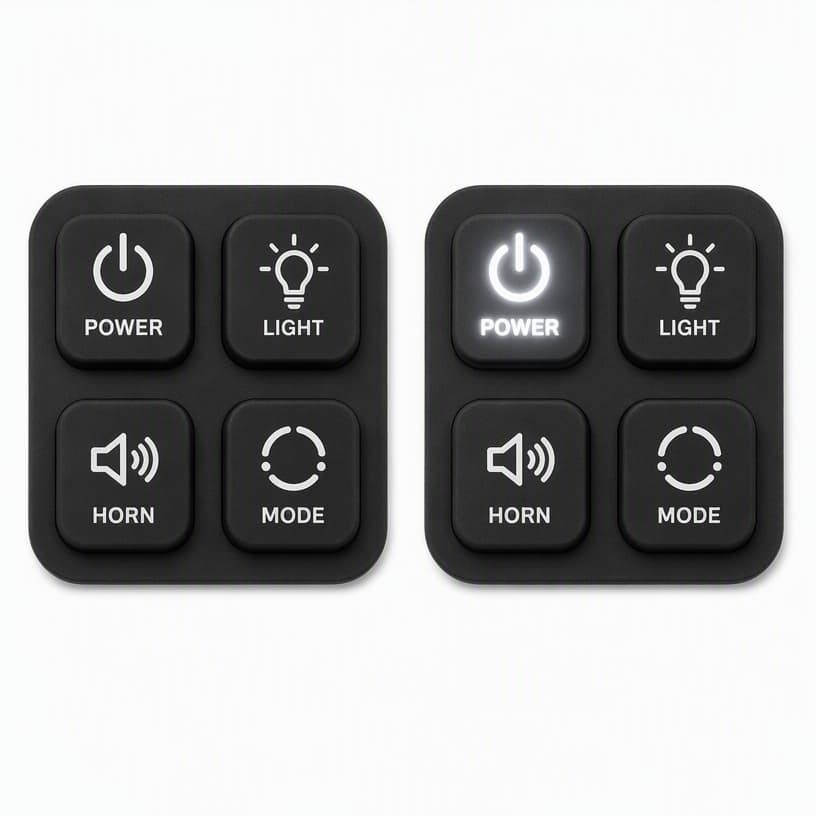
A customer's outdoor instrument keypad passed its IP67 lab test and leaked at an installation site eight months later, around the upper row of keys. The keypad was a single molded pad with an integral gasket bead, and the report was valid for day one. We reproduced the failure with a simple setup: production keypads mounted at production torque, cycled between hot and cold while being actuated periodically, then immersed. Water entered at exactly the keys that flexed most. Two problems surfaced: the bead's compression set at the site's peak temperature was higher than the lab's room-temperature data suggested, and the upper keys sat on a section of housing with a slightly shallower groove, so the bead there started with less squeeze. We adjusted the bead height in the shallow zone and switched to a lower-compression-set compound. The reworked pad survived the cycling-plus-immersion profile that the original failed. The lesson: the leak was never visible in the IP67 report because the report tested a condition the field never provides.
Test every key, not just the pad's outline
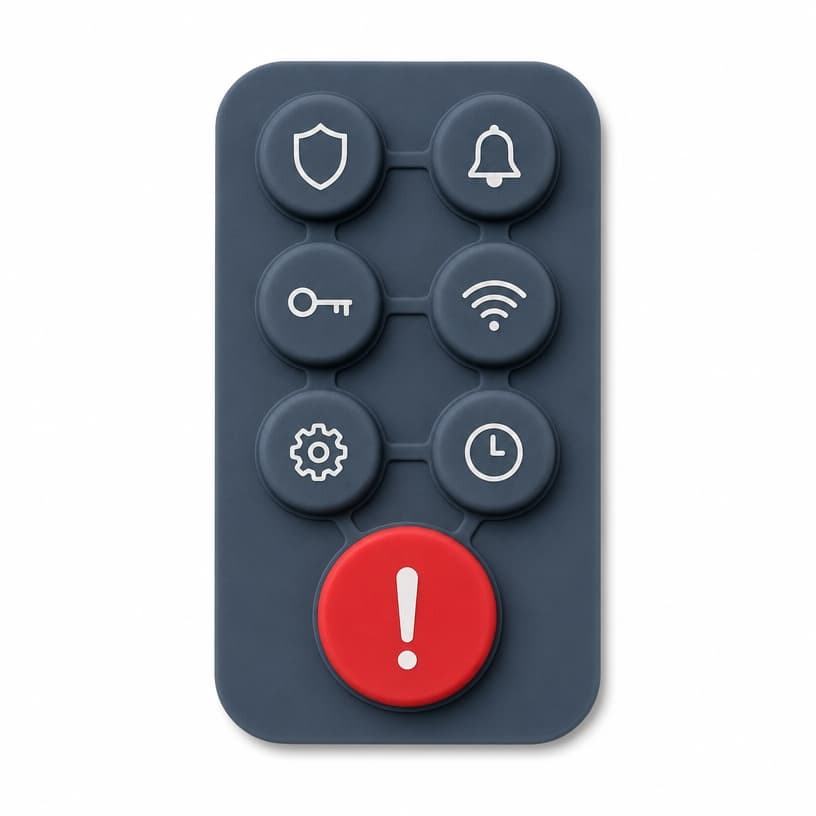
An immersion report is usually written for the whole enclosure, which passes or fails as one sample. For keypads, the interesting data is per-key: which flex zone degrades first, which bezel gap draws water. A simple per-key check — press each key a set number of times, then immerse with the pad mounted at production torque — will expose the weak key long before the field does. Add it to your qualification and the IP67 report stops being the only waterproof evidence you have.
Related reading
In short
An IP67 report is evidence that a particular sample, in a particular condition, kept water out for 30 minutes. It is not a guarantee that a pressed, heated, cooled, aged keypad keeps water out for years. Add thermal cycling, actuation and aged-gasket checks to your qualification, and read every report for what the test actually did — sample state, water temperature, torque, production tooling. That is how "lab pass" stops being different from "field pass."
This article was written by the molding engineering team at FromRubber, a custom silicone keypad manufacturer in Dongguan, China. We qualify keypads and their integral gaskets against field-style tests — thermal cycling, actuation and immersion — for industrial instruments and outdoor equipment.
Sources
- IEC 60529 / GB/T 4208, Degrees of protection provided by enclosures (IP code) — IP67 definition: dust-tight, 30 min immersion at 1 m, water temperature within 5 K of sample. https://www.xkt58.com/hangyedongtai/467877.html
- IP67 test procedure and meaning under IEC 60529, including immersion conditions. https://m.11467.com/product/d49053481.htm
- IP67 test flow: dust test, immersion depth and duration, and sample handling notes. https://shenzhen0153099.11467.com/m/news/12648544.asp
- ASTM D395-16, Standard Test Methods for Rubber Property — Compression Set (gasket squeeze retention). https://www.astm.org/d0395-16.html