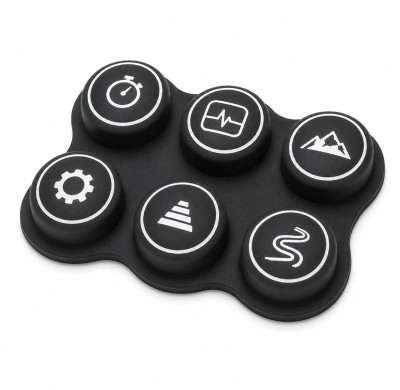
Forklift Silicone Keypads Got Spongy After 2000 Hours. What Happened?
The forklift worked fine for 1800 hours. At 2000, the keys started feeling soft — no click, no return, sometimes a double press. The operator calls it "spongy." The engineer calls it compression set plus web fatigue. Both are right, and neither is fixed by replacing the keypad with the same design. This article is what actually happens inside a forklift keypad at 2000 hours, and what to change so the next one stays crisp.
What "spongy" actually means in force-travel terms
A spongy key is not a vague complaint — it has a precise force-travel signature. The peak actuation force drops, the return force drops faster, and the snap ratio (return force divided by peak force) collapses below 30%. The key goes down but does not come back with a clear transition; it feels like pressing into soft rubber. A new key measures 140 g peak with a 50% snap ratio; a spongy key at 2000 hours can measure 100 g peak with a 20% snap ratio. The operator does not see these numbers — the operator feels the missing click, and the missed second presses that follow [1].
Compression set in vehicle environments
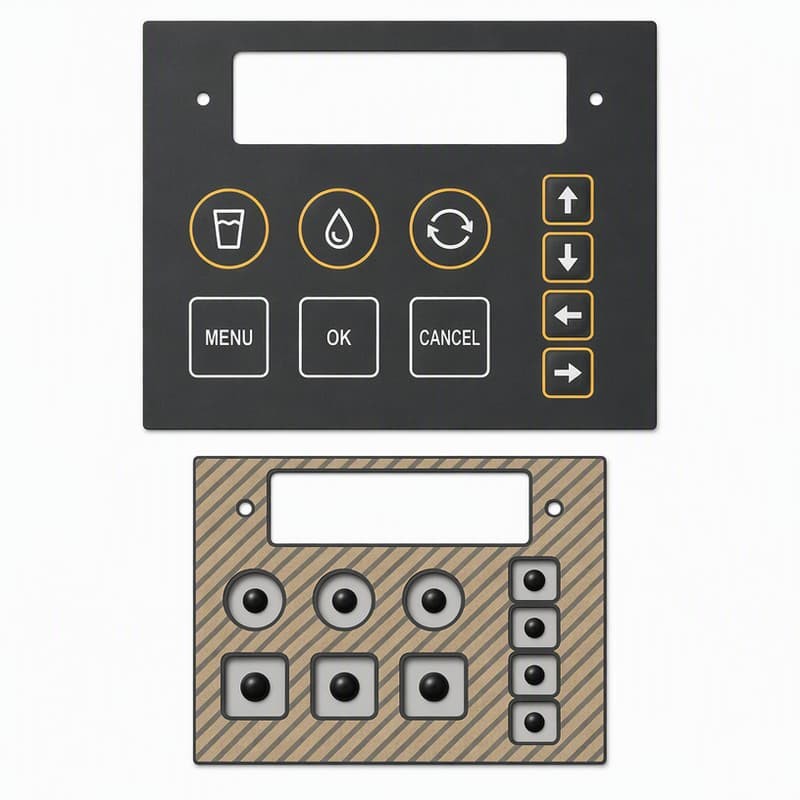
The first cause of sponginess is compression set. A silicone keypad is under a sustained preload from the housing and the key return force. In a vehicle, that preload is combined with heat — engine compartments, cabs in summer, and hydraulic systems nearby can raise the keypad temperature well above room temperature. Under sustained load at elevated temperature, silicone takes a permanent compression set: the web and dome do not fully return to their original height.
Compression set is measured per ISO 815-1 (room and elevated temperature) and ISO 815-2 (low temperature), with the specimen compressed for a defined time and the residual set measured after recovery [2]. A keypad that takes 15% compression set has lost 15% of its dome height, and that lost height is exactly what removes the snap. In a forklift cab that sees 50–60 °C in summer, compression set is not a theoretical risk — it is the expected mechanism.
Web fatigue from vibration and repeated presses
The second cause is web fatigue. A forklift keypad is pressed constantly — lift, lower, tilt, side-shift — and it is vibrated continuously by the engine and the hydraulic system. The web ring flexes on every press and micro-flexes on every vibration. Over 2000 hours, that is millions of flex cycles. The web material fatigues: the storage modulus drops, the web takes a small permanent bend, and the force curve flattens. Web fatigue is cumulative and irreversible, and it is the reason a keypad that felt fine at 1000 hours can feel spongy at 2000 — the fatigue curve is not linear, it accelerates once the web has lost enough modulus.
Oil and grease absorption
The third cause is one that indoor keypads never see: oil. Forklifts leak hydraulic oil, engine oil, and grease. The operator's gloves carry it. A silicone keypad exposed to hydrocarbon oils does not stay the same size — silicone is permeable to nonpolar oils, and the oil penetrates the elastomer, causing swelling and softening. A pad that has absorbed 5–10% of its weight in oil is measurably larger and softer, and the web geometry that was designed for the original dimensions no longer produces the same force curve.
The fix is material selection. A standard silicone compound swells significantly in mineral oils and hydraulic fluids; a fluorosilicone or an oil-resistant silicone compound swells far less. If the keypad lives in an oil environment, the material has to be specified for oil resistance, not just for temperature. This is a specification decision that has to happen before tooling, because the material affects the shrink rate and the tool dimensions [3].
Temperature exposure in cabs and engine compartments
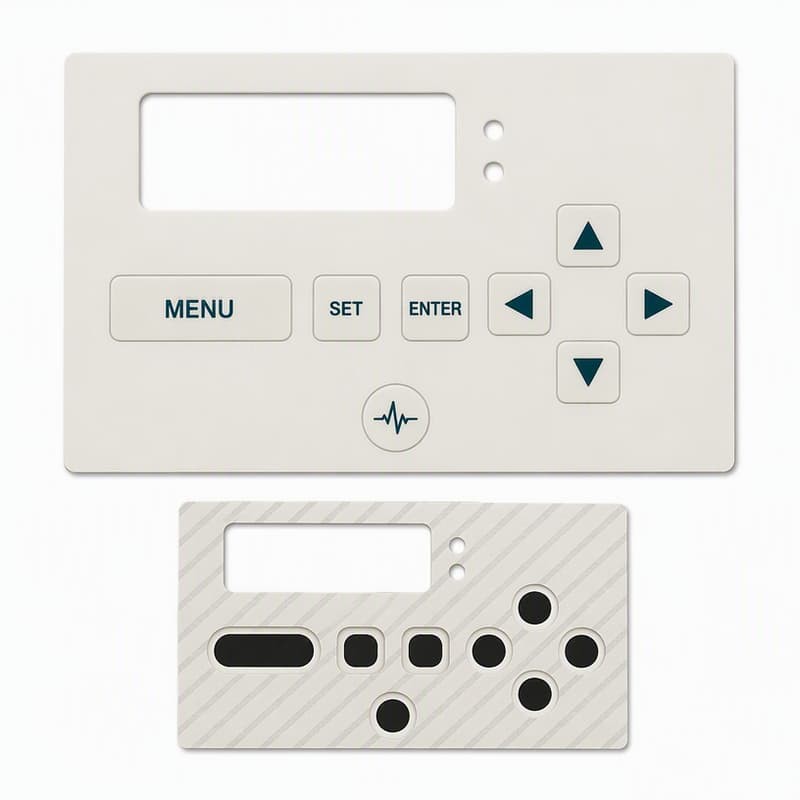
Forklift keypads see temperatures that bench keypads do not. A cab in direct sun can reach 60 °C; a keypad mounted near a hydraulic valve can see 70 °C or more. At these temperatures, silicone does not fail — its glass transition is near −120 °C [4] — but the modulus drops, the recovery slows, and the compression set rate accelerates. A keypad specified for 25 °C use will feel different at 60 °C, and the difference accumulates over hours. The honest specification for a vehicle keypad includes the operating temperature range and a force-travel-snap requirement measured at the upper end of that range, not just at room temperature.
Case — the 2000-hour forklift keypad
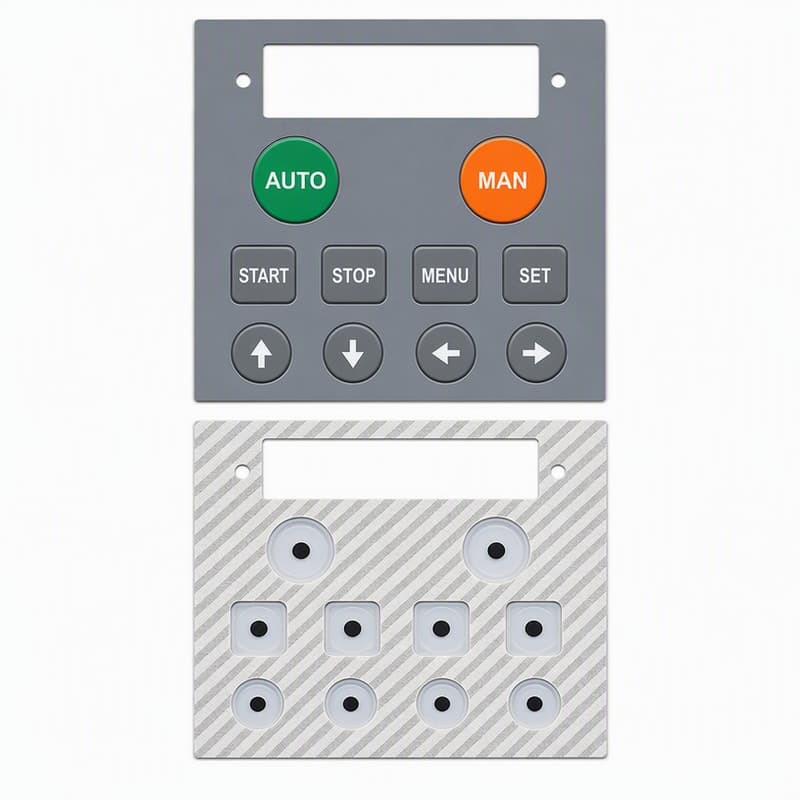
A forklift manufacturer reported that their control panel keypads were going spongy at around 2000 operating hours. The pads were a standard 60 Shore A silicone, specified for indoor industrial use, mounted in the operator cab above the hydraulic control valve. We pulled a used pad and measured it. The dome height had dropped by 12% (compression set), the web had taken a visible permanent bend (fatigue), and the pad had absorbed 7% of its weight in hydraulic oil (swelling). The force-travel curve showed a snap ratio of 18% — well below the 40% threshold for a crisp key.
We changed three things. First, we switched the compound to an oil-resistant silicone with a higher compression-set resistance at 70 °C. Second, we thickened the web from 0.4 mm to 0.55 mm and increased the dome radius to slow fatigue. Third, we added a sealing boot between the keypad and the hydraulic valve to reduce oil exposure and heat soak. We ran a 2000-hour equivalent test: 1 million key cycles at 60 °C with periodic oil exposure, followed by force-travel measurement. The revised pad measured 130 g peak with a 44% snap ratio after the test — still crisp. The revised design has been in field forklifts for over a year without a sponginess complaint. The original pad was not a bad part — it was a part specified for the wrong environment.
How to specify a forklift or vehicle keypad that stays crisp
- Specify the operating temperature range and require force-travel-snap measured at the upper temperature.
- Require compression set per ISO 815-1 at the maximum operating temperature, with a maximum set (10–15% is a reasonable target).
- If oil or grease is present, specify an oil-resistant or fluorosilicone compound; require volume swell data in the actual fluid.
- Design the web and dome for the expected cycle count at vehicle vibration levels; consider a slightly thicker web.
- Run an accelerated life test: cycles + temperature + oil, followed by force-travel verification, not just a "still works" check.
- Consider a sealing boot or heat shield if the keypad is mounted near a heat or oil source.
FromRubber builds custom silicone keypads for vehicle and off-highway use, with compound selection for oil and temperature, compression-set verification per ISO 815, web geometry designed for high-cycle vibration use, and accelerated life testing that combines cycles, heat, and oil exposure. We do not build PCBs — we build the pad that has to survive the cab, the engine bay, and the operator's gloves. If a vehicle keypad is going spongy, send us the used part and the operating environment — we will tell you whether it is compression set, web fatigue, oil swelling, or all three.
Sources and test references used in this article:
- Diamond HMI, Rubber Keypad Design Guide: snap ratio 40–60% for crisp tactile feel; below 30% reads as linear/mushy.
- ISO 815-1, Rubber, vulcanized or thermoplastic — Determination of compression set at ambient or elevated temperatures; ISO 815-2, Determination of compression set at low temperatures.
- Silicone elastomer oil resistance and volume swell in hydrocarbon fluids per material property references (2024–2025); fluorosilicone for oil-resistant applications.
- Revisiting the Thermal Transitions of Polydimethylsiloxane Elastomers, Macromolecular Materials and Engineering, 2025, DOI 10.1002/mame.202500075: glass transition of silicone elastomers ≈ −120 °C.