Why Industrial Silicone Panels Crack Around the Edges?
The panel looks fine on the bench. Then, after a season of temperature swings or a few thousand key presses, a hairline crack appears at the corner of a key window. It is not a random material defect — it is a stress concentration that was designed in, and it will come back on every unit until the geometry changes. This article is where cracks actually start, why they start there, and what to change so the next panel does not crack.
Where cracks actually start (and where they do not)
Edge cracks in silicone panels almost never start in the middle of a flat key top. They start at three locations: the corners of key windows, the transition between the web ring and the base, and the mold parting line. These are the places where stress concentrates when the pad flexes, and they are the places a drawing usually leaves unspecified. A crack at a key-window corner is not bad luck — it is a sharp internal corner with a stress concentration factor several times higher than the surrounding material.
Stress concentration at sharp corners
When a key is pressed, the web ring deflects and the corner of the key window sees the highest local stress. A sharp internal corner concentrates that stress; a radius distributes it. The difference between a 0.1 mm corner and a 0.5 mm corner can be a factor of two or more in local stress, and in fatigue that difference is the difference between a panel that lasts ten years and one that cracks in six months.
The rule is simple: every internal corner in the pad — key windows, web-to-base transitions, alignment rib roots — gets a radius. The minimum working radius is 0.3 mm, with 0.5 mm preferred on high-cycle keys. Sharp corners in a molded silicone part are a crack waiting for a cycle count.
The web ring and over-flexing
The web ring is the thin membrane that connects each key to the base. It is also the part that flexes on every press. If the web is too thin, it flexes beyond its elastic limit and develops fatigue cracks at the root. If the web is too thick, the key is stiff and the stress shifts to the dome. The working band for web thickness on a tactile industrial keypad is roughly 0.3–0.8 mm, tuned with the dome profile and the target actuation force [1]. Cracks at the web root usually mean the web was too thin for the cycle count, or the travel was too long for the web geometry.
Housing interference and binding
A silicone panel does not crack only from key presses. It can crack from being squeezed. Silicone expands and contracts about two to three times more than the engineering plastics around it — roughly 190–255 × 10⁻⁶/K for silicone versus 60–90 × 10⁻⁶/K for typical ABS and PC housings [2]. If the pad is force-fit into a tight pocket with no freedom to move in the plane, it binds in the cold and bulges in the heat. The binding loads the edges, and the edges crack.
The fix is to leave the pad freedom to move in the plane and control position with ribs and locating features, not with interference everywhere. A pad that is located but not constrained will survive thermal cycling; a pad that is clamped will crack at the edges regardless of material quality.
Thermal cycling and fatigue
Outdoor and industrial panels see temperature swings that indoor panels do not. A panel mounted on an exterior pump controller can swing from −20 °C at night to 50 °C in the sun, and every swing loads the edges through the CTE mismatch described above. Thermal fatigue is cumulative: the crack does not appear on the first cycle, it appears after several hundred, and by then the field units are already deployed. The test that catches this is thermal cycling (typically −40 °C to 85 °C, 100–500 cycles, per IEC 60068-2-14) followed by a visual and dimensional inspection [3]. A panel that passes a bench feel test but is never thermally cycled can still crack in the field.
Material tear strength and how it is measured
Not every silicone compound resists tearing equally. Tear strength is measured per ASTM D624 (Die C) or ISO 34, and it is the property that determines whether a small nick propagates into a crack [4]. A compound with low tear strength will crack from a mold flaw or a handling nick that a higher-tear compound would survive. When edge cracking is a known risk, specify the tear strength in the material requirement and verify it on the production compound, not just on the datasheet. Material selection is the last line of defense; geometry is the first.
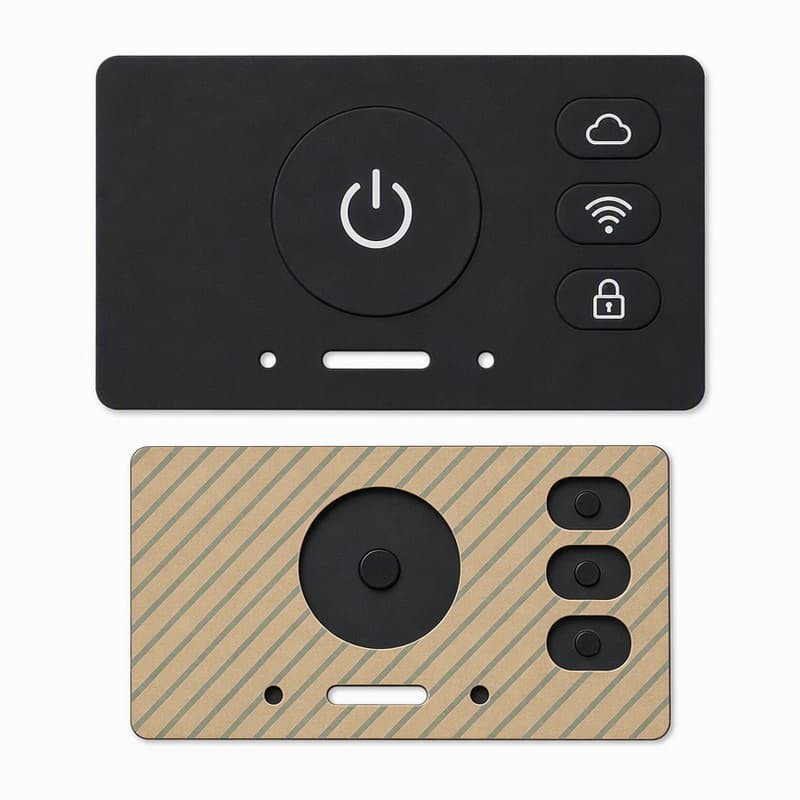
Case — an outdoor pump controller that cracked
An outdoor pump controller shipped with a silicone panel that passed every incoming inspection. After one winter, field units came back with hairline cracks at the corners of the two most-used key windows. The cracks were all at internal corners with a measured radius below 0.2 mm, and the pad was force-fit into a housing pocket with no plane freedom.
We changed two things. First, we opened the key-window corners to a 0.5 mm radius and added a radius at every web-to-base transition. Second, we relieved the housing pocket so the pad could move in the plane, with locating ribs controlling position instead of interference. We also ran a 200-cycle thermal cycle test on the revised design before release. The revised panel has been through two winters without a crack report. The material was never the problem — the geometry and the housing fit were.
Design rules to prevent edge cracks
- Radius every internal corner: key windows, web roots, rib roots. 0.5 mm preferred, 0.3 mm minimum.
- Keep web thickness in the 0.3–0.8 mm band, tuned with dome and force target.
- Locate the pad with ribs, not interference; leave plane freedom for CTE movement.
- Run thermal cycling per IEC 60068-2-14 on outdoor and high-swing panels.
- Specify tear strength (ASTM D624 / ISO 34) and verify on the production lot.
- Keep the parting line away from high-stress edges; specify flash at the dome edge.
FromRubber builds custom silicone keypads and panels with geometry reviewed for stress concentration, web fatigue, and housing fit — including thermal cycle testing on outdoor designs and tear-strength verification on the production compound. We do not build PCBs; we build the pad that has to survive the housing and the environment around it. If a panel is cracking at the edges, send the cracked part and the housing drawing — we will tell you whether it is the corner radius, the web, the housing fit, or the material.
Sources and test references used in this article:
- Web thickness working band 0.3–0.8 mm for tactile silicone keypads per keypad engineering references (Jasper Electronics silicone rubber keypad design guide; Diamond HMI rubber keypad design guide).
- Coefficient of thermal expansion: silicone elastomers 190–255 × 10⁻⁶/K; ABS and PC engineering plastics 60–90 × 10⁻⁶/K (material property references, 2024–2025).
- IEC 60068-2-14, Environmental testing — Part 2-14: Tests — Test N: Change of temperature.
- ASTM D624, Standard Test Method for Tear Strength of Conventional Vulcanized Rubber and Thermoplastic Elastomers; ISO 34, Rubber, vulcanized or thermoplastic — Determination of tear strength.