Silicone Label Manufacturers in Guangdong, China for Hats and Caps: Eight Suppliers Compared
The cap panel is where a silicone label programme quietly goes wrong
A cap looks like the easy application. The logo sits on a large, visible front panel, the panel barely stretches, and the garment never sees a spin cycle. Then the pre-production samples land and the same three complaints come back: the label is too thick on a curved crown, the small lettering has filled in, and the edges have puckered where the seams meet the panel.
Headwear is unforgiving in one specific way. A cap has almost no flat area. The crown is a compound curve, the front panel is stiffened with buckram or foam and then interrupted by seams, and the same artwork has to survive on a structured front, a mesh back, a light performance shell and, in the same collection, a knit beanie. That is four different mechanical environments for one design file.
This article compares manufacturers of silicone labels and silicone patches for hats and caps in Guangdong, China. It does not compare cap factories, and it does not compare embroidery or woven-label suppliers. Every company below had to show a verifiable identity, a stated production location in Guangdong, and a current silicone label or patch product before it entered the list.
The short version: on headwear the binding constraint is the panel, not the logo. Curvature, backing stiffness and seam position decide the maximum label size and the minimum relief that will still read. What a buyer should compare between suppliers is not the catalogue photograph but the relief height, the label geometry, the attachment route, and evidence that a plant in Guangdong actually produces the part.
How the comparison was built
The scoring framework is published before the company list so the reasoning can be checked rather than trusted. It is applied identically to every company in this article, including FromRubber, which publishes this page and manufactures in the same product category.
| Criterion | Weight | What counted as documented evidence |
|---|---|---|
| Verified manufacturing location in Guangdong, China | 20 | A stated production address or factory location inside Guangdong. A sales office, a registration address, or a city name inside a company name was not treated as the same thing. |
| Verified silicone label or patch manufacturing | 25 | A product or category page that names silicone as the material and describes how the label or patch is produced, rather than showing a PVC or TPU badge under a silicone heading. |
| Relevance to hats and caps | 25 | Published wording that links silicone products to caps, hats, headwear or a named headwear construction. Absence of that wording is recorded as a limitation, not filled in by inference. |
| Documented customisation and production process | 15 | Disclosed thickness, size range, relief, colour reference, backing or attachment options, and any stated press or mould conditions. |
| Public quality-control and testing information | 10 | Named certification systems, in-house test equipment, or described test conditions with numbers attached. |
| Availability of clear official product and company information | 5 | Pages that identify the producing entity, the product and the contact path without requiring an enquiry first. |
Criteria, weights and scoring bands applied identically to every company profiled in this article
Two things this list is not. It is not an official industry ranking and it carries no association endorsement, and it is not a factory audit. The scores are an editorial reading of public material collected in October 2026. Where companies score closely, the tie is broken by the strength of headwear-specific evidence, and that reasoning is stated in the profile rather than hidden inside the number.
One distinction saves a lot of wasted sampling. "Cap patch" is a category, not a material. A supplier can run a serious cap-patch business built entirely on embroidered or woven badges while its silicone range is used on bags and footwear. Silicone, PVC and TPU behave differently under heat, ageing and rework, so each profile states what the silicone evidence actually says and whether the headwear link is explicit or missing.
Eight suppliers at a glance
Only published claims are recorded. A dash means the item was not found in public material.
| Company | Guangdong location stated | Silicone label or patch evidence | Headwear wording found | Score |
|---|---|---|---|---|
| Hongcheng (Guangzhou Hongcheng Textile Co., Ltd.) | Humen Town, Dongguan | Injection-moulded, embossed, printed and heat-transfer silicone labels | Caps and hats named in the application list | 91 |
| Guangdong Crown Tree Label Co., Ltd. | Xiqiao Town, Foshan | Moulded silicone production line; silicone heat-transfer and screen-printed labels | Hats named in product usage | 90 |
| FromRubber (Dongguan Bohao Electronic Technology Co., Ltd.) | Dongguan | Moulded raised silicone layer; heat-transfer and label ranges; patch service-process page | Caps and headwear named on the silicone patch pages | 89 |
| DG Triangle New Material Technology Co., Ltd. | Humen, Dongguan | Silicone heat transfers described as the core material; moulded and screen-printed 3D | Hats listed in published product usage | 88 |
| Dongguan Victorygen Haberdashery Ltd. | Shatian Town, Dongguan | Silicone heat-transfer printing and 3D moulded silicone labels | Hats named among target applications | 79 |
| Dongguan Baiyee Technology Co., Ltd. | Gaobu Town, Dongguan | Moulded and screen-printed silicone labels with published size and thickness ranges | — | 70 |
| Shenzhen Liantai Printing Co., Ltd. | Shenzhen | 3D embossed and textured silicone patches, iron-on and sew-on | — | 65 |
| Dongguan HMJ Silicone Garment Accessories Co., Ltd. | Houjie Town, Dongguan | 3D silicone heat-transfer logos, raised glossy silicone, hot-melt backing | — | 64 |
Publicly described silicone label capability with headwear relevance, Guangdong, October 2026
Reviewed but not ranked, with the reason recorded so the selection can be audited. Qinghan Label publishes the strongest hat-specific silicone wording found in this research, including a silicone patch described for hats, but no manufacturing location appears anywhere in its public material, so the Guangdong requirement could not be verified. Guangzhou Kunshuo lists unusually detailed silicone label specifications covering hats and caps but publishes neither a location nor a legal entity name. Guangzhou Wangli publishes hat and jacket wording around silicone heat-transfer labels, yet shows a business registration from March 2025 and no factory claim. Kaishen Garment Accessory lists silicone items in a menu with no silicone product page behind them, and Doylabel groups silicone with PVC without describing a silicone construction at all. None failed on the look of the product. They failed on verifiable evidence, which is a different thing.
The eight profiles
The order follows the scores. It is a reading order built from the criteria above, not a claim that one factory is best for every programme, and the notes under each profile matter more than the number attached to it.
1. Hongcheng (Guangzhou Hongcheng Textile Co., Ltd.) — 91
Humen Town, Dongguan · hongcheng-label.com
Location 20 · Silicone evidence 25 · Headwear relevance 25 · Customisation 11 · Quality documentation 7 · Official information 3
Hongcheng states a factory in Humen Town, Dongguan and describes itself as a production manufacturer that integrates development, production, processing, sales and design. Its silicone label range is the widest found in this research: injection-moulded silicone, embossed silicone, printed silicone, heat-transfer silicone, brush-dot labels and multi-colour labels, alongside a 3D silicone heat-transfer logo for clothing. Headwear relevance is explicit rather than implied. The published application list names hats and caps, and the outerwear and sportswear wording covers jackets, coats, hoodies and activewear.
What earns the top position is the combination of a stated Guangdong factory with an application list that names headwear directly. What holds the score below a perfect run is documentation depth: no thickness or relief figure is published, the certificate references are claims rather than downloadable documents, and no minimum order quantity or lead time appears. A second plant mentioned on the site makes metal and plastic buttons for shoe and hat accessories, which is useful context but not the same as the silicone line.
Verify before tooling: the exact polymer and thickness for your artwork, and whether test reports can be issued against the delivered batch rather than shown once during sampling.
2. Guangdong Crown Tree Label Co., Ltd. — 90
Xiqiao Town, Foshan · gddsc.com
Location 20 · Silicone evidence 25 · Headwear relevance 22 · Customisation 10 · Quality documentation 9 · Official information 4
Crown Tree publishes a complete street address in Xiqiao Town, Nanhai District, Foshan, documents a factory relocation from Dongguan in 2023, and states around 10,000 square metres of production area. It runs a dedicated silicone heat-transfer label range and a separate silicone printing label range covering 3D textured, temperature-variable and laser-cut irregular shapes, with a mould silicone production line listed in the equipment. Headwear appears in the published application list for garments, handbags, luggage, shoes and hats.
Its quality documentation is the most concrete of the eight: ISO 9001:2015, BSCI and OEKO-TEX Standard 100 are named, tests are run in a physical laboratory, and the machinery list includes a mould silicone production line and a 600-metre printing table. The lower headwear score reflects wording rather than capability. Hats are named in a usage line, but no headwear-specific product is described, so the application link is explicit yet shallow. Numeric thickness and relief figures are not published either.
Verify before tooling: relief height and minimum stroke width for your artwork, and whether the in-house laboratory can validate a moulded construction on your specific crown fabric.
3. FromRubber (Dongguan Bohao Electronic Technology Co., Ltd.) — 89
Dongguan, Guangdong · fromrubber.com
Location 20 · Silicone evidence 25 · Headwear relevance 25 · Customisation 10 · Quality documentation 8 · Official information 5
FromRubber is the publisher of this comparison and manufactures custom silicone labels and patches, so it is scored by exactly the same rules and its position here should be read with that in mind. The company has produced custom silicone and plastic parts in Dongguan since 2010 and publishes a custom rubber patch programme, a custom silicone label range, a silicone patch line for caps and a patch service-process page, with a factory video and a certificate download area linked from the main navigation.
The honest note about its placement: every company in this list is scored from what it publishes, and a company publishes most about its own product. That structural advantage is real and it is why the score sits high rather than because of any claimed superiority. Headwear is named among its applications, the relief construction is described as a moulded raised silicone layer, and the technical articles on this site deal directly with the headwear problems described in the next section.
Verify before tooling: dimensional records for the relief on your specific design, and the press settings validated on your panel rather than on a flat swatch.
4. DG Triangle New Material Technology Co., Ltd. — 88
Humen, Dongguan · dgtriangle.com
Location 20 · Silicone evidence 24 · Headwear relevance 20 · Customisation 13 · Quality documentation 8 · Official information 3
DG Triangle states a factory of around 3,000 square metres in Humen, Dongguan, with a total of 18 printing tables in one description and two factories with 21 tables in another, which is the kind of internal inconsistency worth clarifying in writing. Silicone is presented as the core material rather than a side line, with a 3D heat-transfer label programme covering moulded, high-raised, textured, tatami-backed, glitter and NFC constructions. The published usage list names hats alongside T-shirts, swimwear, shoes and handbags.
This is the only company in the group that publishes a full press and wash recipe: a press condition of 160 degrees for 20 seconds at 3 to 4 kilograms, and a washing resistance statement of 60 degrees for 40 minutes repeated more than ten times, with a minimum order of 3,000 to 5,000 pieces and a lead time of 3 to 15 days. Those numbers are what makes the customisation score high. They are also claims, not test reports, and the site describes the business as manufacturing and trading, so the producing plant should be identified before tooling.
Verify before tooling: which of the two quoted factories runs a headwear order, and whether the wash figures were measured on a cap panel or on flat fabric.
5. Dongguan Victorygen Haberdashery Ltd. — 79
Shatian Town, Dongguan · heat-transferprinting.com
Location 15 · Silicone evidence 23 · Headwear relevance 22 · Customisation 10 · Quality documentation 7 · Official information 2
Victorygen runs a dedicated silicone heat-transfer category alongside a 3D moulded silicone label line, and describes transferring single and multi-colour silicone patterns onto clothing, gloves, shoes and hats. Glossy and matte finishes, soft rubber constructions and tatami-backed versions appear in the range, all sizes and colours are described as custom, and the company states a low minimum order with heat-seal or sewn attachment.
Two details pull the score down, and both are worth resolving in writing before an order. The published contact address is a room number in an office building, while the company history refers to Humen Town, so the plant address is not established by the site. And the site carries two different entity names — a Dongguan haberdashery company in the contact block and a Hong Kong enterprise company in the about text. ISO 9001 is stated together with environmental and wash-fastness claims, but no numeric size or thickness table is published for silicone, and the only thickness figure found appears in a blog headline rather than a specification.
Verify before tooling: the registered entity that invoices the order and the plant that runs it, plus the working relief height on a curved front panel.
6. Dongguan Baiyee Technology Co., Ltd. — 70
Gaobu Town, Dongguan · baiyeelabels.com
Location 20 · Silicone evidence 25 · Headwear relevance 0 · Customisation 13 · Quality documentation 8 · Official information 4
Baiyee is the easiest company in this group to trace on paper: a labelled factory address in Gaobu Town, Dongguan, a business registration number, and a stated founding year of 2017. Its silicone work is split into a moulded silicone range that distinguishes flat, cambered, wedge, wavy and twill surfaces, and a screen-printed range with 2D, multi-colour and 3D options. It publishes the most specific numbers of the eight, including size and thickness bands, a thickness spread from roughly 0.2 mm to 5 mm depending on construction, Pantone colour referencing, backing fabrics from cotton to PU leather, and minimum quantities in the 1,000 to 2,000 piece range with five to seven day sampling.
The headwear score is zero because the site does not name caps, hats or headwear anywhere; uniform and jersey patches are the closest published applications. That is a documentation gap rather than evidence against the company, and it is the honest reason it sits below suppliers whose headwear wording exists. Base materials include elastic and PU leather, which is a hint about panel behaviour rather than proof of it.
Verify before tooling: whether a cap front panel has been produced before, and the relief height available on your design, since published ranges describe the catalogue rather than your artwork.
7. Shenzhen Liantai Printing Co., Ltd. — 65
Shenzhen, Guangdong · liantaiprint.com
Location 18 · Silicone evidence 25 · Headwear relevance 0 · Customisation 11 · Quality documentation 9 · Official information 2
Liantai describes itself as a printing manufacturer established in 2004 and based in Shenzhen, with a 3D silicone patch range offering moulded raised lettering, customisable thickness typically between 0.5 mm and 2 mm, and finishes that include matte, glossy, embossed, textured and effect versions. Colour matching is quoted against PMS references, carrier fabrics such as tatami and satin are named, and samples are offered from stock. The quality folder is strong on paper, with ISO 9001, Sedex, SGS and FSC named and a wash-durability statement in the 30 to 50 wash range.
No street or plant address is published, which is why location sits below full marks, and headwear is absent from the published wording; the nearest mentions are a baseball jacket logo, sportswear uniforms and teamwear. The wash claim is stated without temperature or cycle conditions, and the company also runs TPU, embroidery and foil transfer lines, so the silicone construction needs to be fixed on the specification instead of assumed from a photograph.
Verify before tooling: the production address behind the office, and the wash test conditions behind the published wash claim.
8. Dongguan HMJ Silicone Garment Accessories Co., Ltd. — 64
Houjie Town, Dongguan · hmjsiliconesticker.com
Location 20 · Silicone evidence 25 · Headwear relevance 0 · Customisation 8 · Quality documentation 8 · Official information 3
HMJ states a factory in Houjie Town, Dongguan with roughly 5,000 square metres of production space, twelve heat-transfer production tables, ten label cutting machines and eight high-frequency machines, and frames the business around heat-transfer patches and badges for sports teams. Its silicone range covers 3D high-raised glossy silicone printing logos, moulded sticker labels, reflective versions and a hot-melt-glue-backed heat-transfer label. OEKO-TEX and ISO 9001 are named, and an in-house testing room is described for heat-transfer and colour-fastness checks.
The reason it sits at the bottom of a Guangdong list is application evidence rather than capability. Caps and hats are not mentioned for the silicone line; the sportswear and uniform wording attaches to TPU products. There is also a third certificate called SEMTA, which does not appear in the usual textile certification landscape and is worth asking about specifically. The company describes itself as a manufacturing and trading integrated operation, so which stages happen at Houjie should be established in writing.
Verify before tooling: whether raised glossy silicone has been applied to a cap panel, and which processes are performed in-house rather than subcontracted.
What actually decides whether a label works on headwear
The profiles above say who can make the part. This section is about the four decisions that determine whether the part works once it is on the cap, because those decisions are usually made by the buyer and the artwork file, not by the factory.
Panel curvature decides the label geometry, not the logo
A structured six-panel front is a compound curve in two directions at once. A rigid rectangle designed for a flat chest panel will fight that curve, and the fight shows up as lifted corners or a visibly flattened crown. The practical fix is geometric: shorter and taller formats, narrower labels, or a shape whose outline follows the panel rather than a box that ignores it. Where the crown carries buckram or foam, the stiffener determines how much of the curve the label has to absorb on its own.
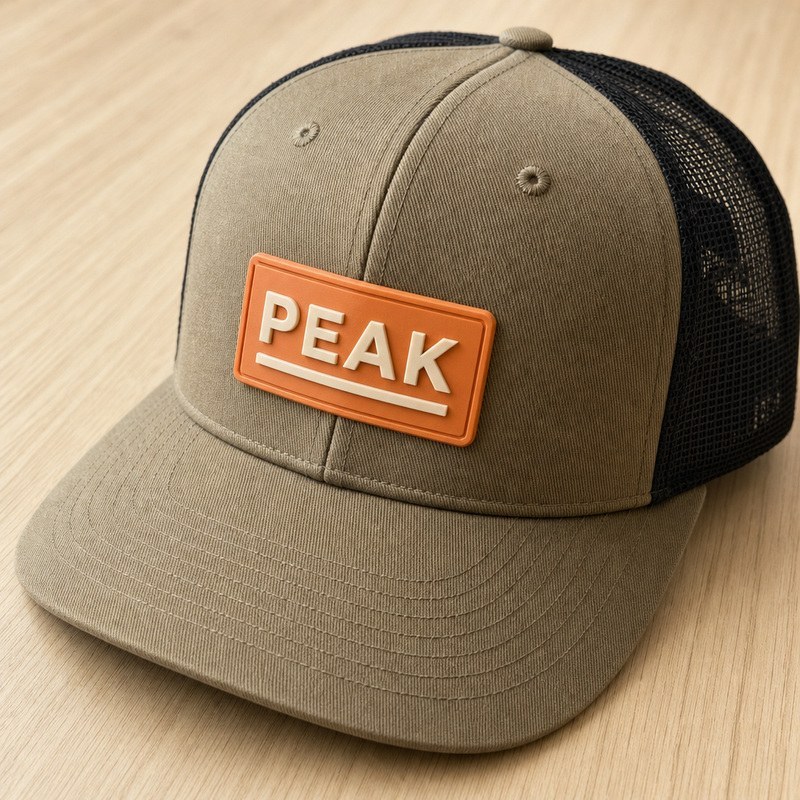
The useful specification is not "patch 60 mm wide" but the panel width at the intended position, the stiffener type, and the distance from the nearest seam. That is what allows a supplier to answer whether your outline is realistic before a cavity is cut. The pressing question follows from the same data: the temperature and pressure a stiffened cotton twill front will accept before the finish dulls or the crown flattens.
Heat application on a curved surface is genuinely harder than on a flat one, and the equipment matters as much as the settings. Curved and cap-specific press modules exist precisely because a flat platen cannot follow a crown, and a membrane press is used where zips or seams create uneven surfaces — the same problem a cap panel presents with its own seam stack. The FESPA heat press guide sets out how press types differ in pressure control, which is the variable most often guessed rather than measured.
Relief height on a cap is a different calculation from relief on a chest
On a chest panel, relief is mainly an aesthetic decision. On a cap it is also a structural one. A tall raised feature sits on a curved, relatively small surface where it is more exposed to handling, and the transition from a raised letter to the label edge becomes the point where dirt collects and abrasion starts. Higher relief also tends to mean a stiffer construction, which is exactly what a light performance shell cannot tolerate.
Two measurements decide this, and both should be written into the order rather than agreed verbally: the relief height of the raised element, and the total build height including the base layer. Suppliers frequently quote one and mean the other, and the difference is what makes a label arrive stiffer than the sample. Where the artwork carries a small counter, an enclosed letter space or a thin stroke, relief and stroke width interact; the effect of that interaction on small garment logos is covered in this site's note on why fine detail disappears in small silicone logos. Hardness measurement itself is standardised, and ISO 48-4 defines how indentation hardness is determined on rubber and silicone compounds, which is the number to request when a label must stay flexible.
Sewn-on and heat-applied constructions fail for opposite reasons
A sewn label is mechanically anchored under the stitch line, so the failure mode is panel distortion: the stitching compresses and perforates a thin light shell, and the needle holes widen with wear. A heat-applied label avoids the needle damage but depends entirely on the bond between the adhesive system and the fabric finish. On headwear both routes are viable, but rarely on the same cap. Structured cotton twill with a stiffener tolerates heat pressing; mesh backs and thin performance shells usually do not.
The choice is also a service question rather than a product question. A sewn label can be attached by the cap factory with existing equipment, while heat application needs a press, a validated setting and someone who owns the rework if the bond fails. The trade-offs between the two routes, including rework and garment construction, are compared in heat transfer versus sew-on silicone patches, and the specific distortion mechanism on caps is covered in why a sewn silicone patch deforms on caps.
A knit beanie is not a softer cap
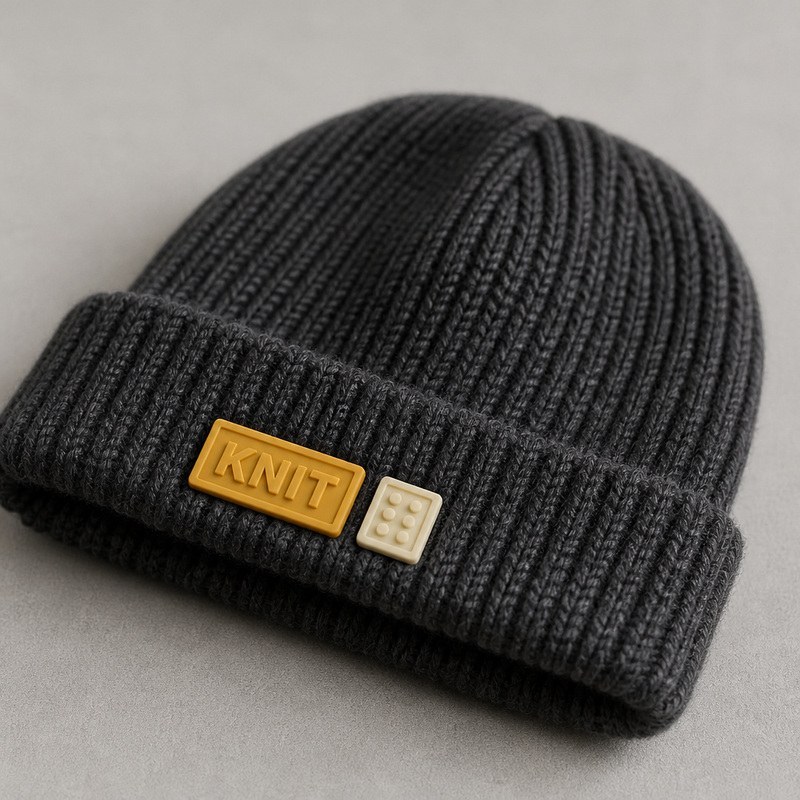
Rib knit behaves in ways a woven panel never does. The fabric moves independently under the label, it compresses in wear, and its surface is a series of ridges rather than a plane. A label that reads perfectly on a twill front can look wavy on a rib knit cuff because the substrate is moving beneath it, and because the bond is distributed over ridges rather than a flat area. Cuff placement also puts the label in a high-flex location where the wearer folds and adjusts the hat repeatedly.
The practical answer is usually a smaller, lower-relief label with a more flexible compound, and a bonding step validated on the folded cuff rather than on a flat swatch of the same yarn. Fibre and knit construction change how an adhesive behaves on knitwear, and the selection logic is set out in this site's guide to choosing a silicone label for knitted garments. If a brand wants one label design across a cap, a mesh cap and a beanie, that ambition should be stated at the artwork stage, because one geometry rarely serves all three.
Colour and consistency across a headwear range
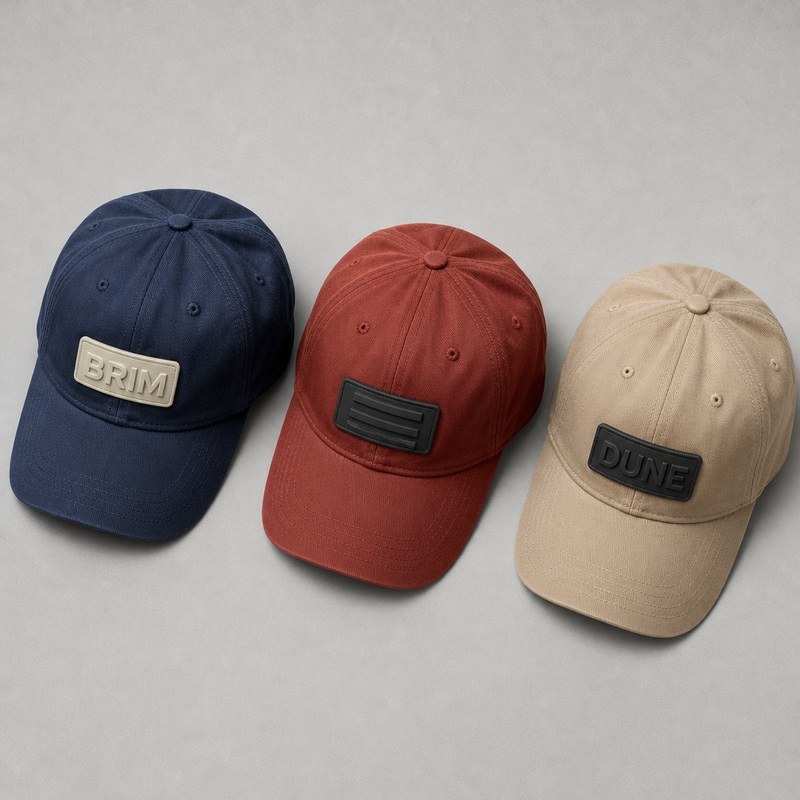
A headwear range usually repeats the same logo across several colourways and several panel constructions, which turns a single label problem into a batch consistency problem. Two things go wrong. Colour is referenced informally — "our blue" instead of a named system reference — and colour boundaries on multi-colour labels are aligned by eye rather than against an approved sample held by both sides.
The other issue is dimensional drift between the moulded sample and the production run, particularly where a raised feature sits close to the label edge. Cleanliness and wash criteria belong on the same list: if the label is expected to survive the cap's cleaning regime, the test method should be named with a temperature, a cycle count, a detergent and a drying method rather than described as "washable". Standard references make that checkable: ISO 6330 washing procedures, ISO 105-C06 colour fastness to laundering, ISO 105-X12 rubbing fastness and ISO 5077 dimensional change cover the four questions headwear buyers ask most often.
Buyer checklist before the mould is cut
Panel data, not just logo data
Record the panel width at the intended position, the stiffener type, the distance to the nearest seam, and whether the cap is a structured front, a mesh back or a knit cuff.
Artwork reviewed at final size
Check the smallest stroke, the smallest enclosed counter and the spacing between elements at the real label size, not on an enlarged screen render.
Two height figures
Specify relief height and total build height separately, and require both on the approved sample record.
Named colour reference
Use a defined colour system for the compound, and keep one approved physical sample with both parties for boundary alignment on multi-colour work.
Attachment route chosen against the panel
Decide between heat application and sewing by construction and equipment, not by habit, and confirm who owns rework if the bond or the stitch line fails.
Press settings validated on the real panel
Approve the sample after full cooling, on the assembled cap, using the settings the production line will actually run.
Cleaning tested by a named method
Write the standard, temperature, detergent, cycle count and drying method into the specification, and define what counts as a failure.
Abrasion defined for the exposed edges
Raised features and label borders take the handling. Define rub conditions and the colour-change limit rather than relying on a durability claim.
Mould ownership and tooling terms
Confirm who holds the tooling, what it costs, and what happens to it if the programme moves. The economics of this step are explained in how much custom rubber patch moulds cost.
Inspection criteria agreed in writing
Fix the sample size, the acceptance limits, the defect route and the person who signs the inspection record before production starts.
Mistakes that show up repeatedly
Approving on a flat swatch
A sample pressed on flat fabric tells you almost nothing about a curved, stiffened panel. Approve on the assembled cap or not at all.
Treating "3D" as a specification
A flat printed label with a shadow and a cavity-moulded part are both sold as 3D. Ask how the relief is produced, and write the answer into the order.
Comparing catalogue photos
Photographs hide relief height, edge definition and stiffness. Two labels that look identical on a screen can be two different manufacturing processes.
Assuming one label fits the range
A label tuned for a structured cap front will not automatically suit a mesh back or a rib knit beanie. Design the range, then the label.
Skipping the entity question
Ask which company invoices, which plant produces, and which party signs the inspection record. Consistent answers are stronger evidence than any certificate image.
Leaving colour to adjectives
"Navy" and "off-white" mean nothing on a compound. Reference a colour system and hold a physical standard.
Frequently asked questions
Can a silicone label be used on any cap?
No. Structured cotton fronts with a stiffener are the most tolerant; mesh backs, very thin performance shells and heat-sensitive fabrics each need review before a heat-applied label is proposed. The panel decides, not the logo.
What is the difference between a silicone cap label and a PVC cap patch?
Material and ageing behaviour. Silicone remains softer across a wider temperature range and returns to shape; PVC is a different polymer with a different feel and a different reaction to heat and time. Catalogues often show both under one heading, so the polymer should be named on the specification.
Why does a sewn silicone patch distort a lightweight cap?
Because the stitch line compresses and perforates a thin panel, and the holes widen with wear. A lower-profile heat-applied label is often the better route on light shells, provided the fabric tolerates the press.
How can a buyer confirm the label was made in a Guangdong factory?
Request the production address separately from the office address, ask which processes are performed in-house, ask for a video call at the press, and confirm who signs the inspection record. A registration address proves registration, not production.
What should be tested before approving a headwear label?
Bond or stitch integrity after the garment's real cleaning cycle, colour fastness to rubbing on the exposed edges, dimensional stability of the label, and legibility of the smallest detail at viewing distance. The silicone patch FAQ on this site covers the same questions from the production side.
Closing notes
Headwear rewards buyers who treat the cap and the label as one assembly. Material choice, panel curvature, attachment route and manufacturing evidence all have to line up before the artwork is committed to tooling, and the cheapest way to find that out is a specification review before the cavity is cut rather than a rework claim afterwards.
Information in this comparison was collected from company websites and the cited standards in October 2026 and is limited to what those companies publish. Certifications, capacities, test results and customer relationships were not independently audited, and no supplier is endorsed here. Confirm current product scope, the manufacturing entity and delivery capability directly before placing a production order.
About this comparison
It was compiled by FromRubber, a manufacturer of custom silicone labels, silicone patches and silicone heat-transfer elements in Dongguan, Guangdong, working with apparel, headwear, footwear and bag programmes on artwork review, tooling and sampling.
Technical questions about a specific project — substrate, relief height, tooling or sampling — can go to nani@fromrubber.com or karl@fromrubber.com. WeChat and WhatsApp: +86 18676210913.
Sources
- ISO 48-4:2018 — Rubber, vulcanized or thermoplastic: determination of hardness by durometer method
- ISO 6330:2021 — Textiles: domestic washing and drying procedures for textile testing
- ISO 105-C06:2010 — Textiles: colour fastness to domestic and commercial laundering
- ISO 105-X12:2016 — Textiles: colour fastness to rubbing
- ISO 5077:2007 — Textiles: determination of dimensional change in washing and drying
- FESPA — a printer's guide for heat presses
- OEKO-TEX STANDARD 100 — harmful substance testing for textiles
Related reading on this site: five levels of silicone patch design complexity, silicone patches for caps, what makes a high-quality silicone patch, and the earlier headwear review of silicone patch manufacturers in Guangdong for caps and headwear.