How to Choose a Silicone Label for Knitted Garments?
The knit decides more about your silicone label than the artwork does
A silicone label for knitted garments is approved twice. The first approval happens on a flat swatch on a table, where almost anything looks workable. The second happens on a worn garment after a few washes, when the fabric has stretched, recovered and been pulled over a shoulder a few dozen times — and that is where a stiff edge, an oversized outline or a heavy construction starts to show.
Knitwear is not one material. A single jersey and a rib cuff can share the same fibre and still behave nothing alike under a label, because the loop structure, the stretch direction and the recovery behaviour are different. Selecting a silicone clothing label without working from the actual fabric is the most expensive shortcut in this process, because the mistake stays hidden until sampling or, worse, until bulk.
This guide walks through the knit structures that matter, the label decisions they influence, and the information a manufacturer needs to recommend something that will survive wear rather than just photograph well.
Read the knitted structure before you choose the label
Single jersey and light single knits
These are flexible, relatively thin and prone to curling at cut edges. A label that is fine on a woven cotton panel can feel heavy here, and a large outline can make the fabric pull. The size of the mark and the way it is applied should be evaluated on the garment panel, not on a flat sample held by hand.
Rib structures
Rib knits stretch and recover more aggressively than plain jersey, and they are usually found exactly where the label is least welcome: cuffs, neckbands, waistbands and hems. A label on rib has to move with a structure that is constantly opening and closing. Applying the mark to a relaxed piece of rib and calling it validated ignores the condition the garment will actually be worn in.
Interlock and other double knits
These fabrics are generally thicker and more dimensionally stable, which makes them more forgiving. They are still not interchangeable with wovens: weight, surface texture and the amount of stretch in the panel all affect how a heat transfer label behaves. The fabric name alone is not enough to predict the outcome.
Fine-gauge and lightweight fabric
On a fine-gauge knit, a thick or stiff label can change how the garment drapes, leave a visible ridge through the outer layer, or concentrate stress around its own outline. Where the label sits on a visible panel, an eight-tenths-of-a-millimetre difference in profile is noticeable in a way it never is on a hoodie.
Stretch sportswear knits
Repeated extension, recovery, sweat and frequent laundering define this category. The right question is not whether the label adheres on the first day but whether the label and the fabric deform in a compatible way after fifty wear-and-wash cycles. Industry test methods reflect this reality: ASTM D2594/D2594M separates momentary stress from prolonged stress and measures fabric growth in knitted fabrics, precisely because a knit that holds when pulled for a second may not return to shape after being worn in a seated position for two hours.
Capsule shapes are the default neck label for a reason
A low, wide capsule with raised lettering sits flat on a curved neckline, covers a limited area, and gives the perimeter a continuous smooth curve instead of corners that can catch. It is also the shape that most easily accommodates mixed requirements: flat border for bonding, raised centre for brand presence.
The detail that most often gets missed is the border width. Trim it too far and the perimeter has very little area to hold on to; leave it generous and the same logo becomes noticeably more stable on a knit.

Seven factors that decide whether a silicone label suits knitwear
Flexibility, expressed as a behaviour rather than a number
How stiff a finished label feels depends on hardness, thickness, dimensions, geometry and the fabric supporting it. The trade-off is between keeping the logo crisp and letting the garment move. Judge the finished label on the actual knit; a hardness value on its own says very little about how a small label will feel on a light single jersey.
Thickness and overall footprint
A large or thick label affects drape and comfort on lightweight fabric. The relationship that matters is between label dimension and the flexibility of that garment area, which is why the intended placement belongs in the conversation before the dimensions are fixed. Published conversion-supplier ranges put silicone transfer label thickness at roughly 0.2–1.0 mm, with 0.5 mm a frequent middle choice (published industry thickness range).
Attachment method and fabric compatibility
Heat transfer, sewn constructions and other options are not ranked; they suit different fabrics. Knit texture, stretch, surface finish and heat sensitivity all influence the choice, and the bonding system has to be validated on that specific fabric rather than on a similar one.
Stretch and recovery of the pair, not the part
The label and the fabric can deform at different rates, which is where edge lifting, wrinkling and local stress begin. The realistic check is repeated extension and recovery with the label applied, not a static pull on a loose patch.
Logo detail and relief
Small text, thin lines and multi-level relief affect legibility, mould design and the flexibility of the finished piece. Precise minimum line widths depend on the artwork, the mould and the construction, so they are best established on a sample. If legibility of fine lines is the main worry, the practical levers are covered in keeping thin lines visible in small silicone logo design.
Comfort and placement
Edge profile, stiffness and position matter most on close-fitting garments, and especially at the neck, waist and any area in continuous contact with skin. These are judged on a worn or representative sample. A loose patch on a table cannot demonstrate comfort.
Washing and care conditions
Laundering and drying conditions should be known before approval, because appearance retention, adhesion, deformation and edge condition are all evaluated after washing. ISO 6330 sets out domestic washing and drying procedures for textile testing and notes that machine type, detergent and dryer choice affect results; the care symbols defined for ISO 3758:2023 describe the treatment classes a garment may legally be labelled for. AATCC TM61 states that one 45-minute accelerated laundering test roughly approximates the effect of five typical hand or home launderings, which is a useful equivalence to have in writing when a wash protocol is turned into a cycle count.
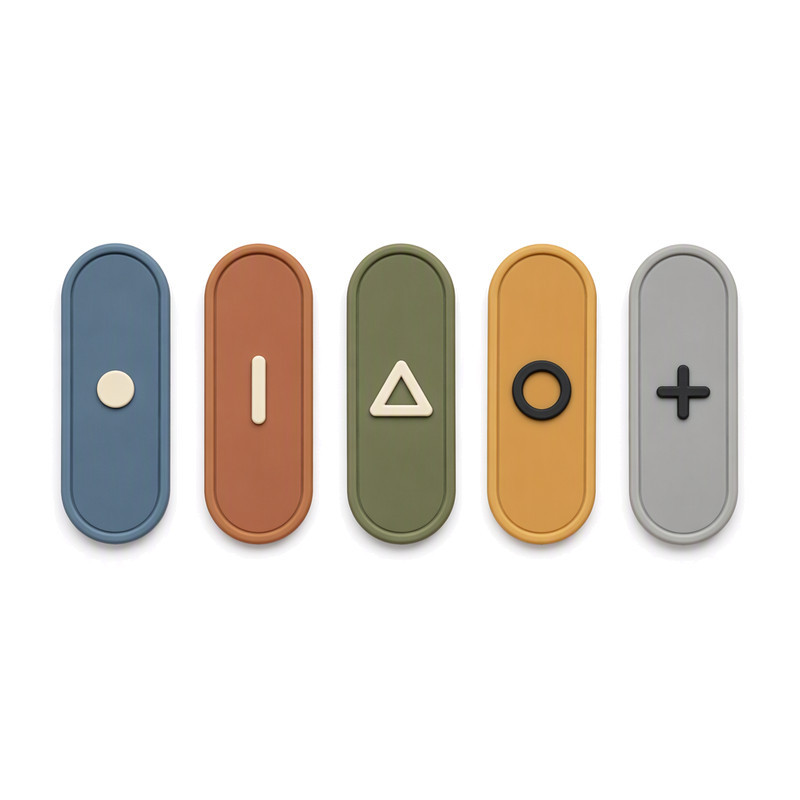
Minimal labels change the question from strength to presence
Slim capsules with a single small glyph are chosen when the mark should be almost invisible at a glance. Because the label is light and shallow, the bonding conditions needed are less aggressive, which is helpful on heat-sensitive knits.
The compromise is legibility: a very small raised symbol is harder to keep crisp than a bold one. When a design is heading in this direction we normally look at whether the glyph can be simplified without losing its meaning.
Label priorities differ by knitted garment type
The rows below are starting points for a specification conversation, not rules. Almost every category contains exceptions, and a fabric that behaves differently from its neighbours should be treated as its own case.
| Garment type | Typical fabric considerations | Label design priorities | Validation focus |
|---|---|---|---|
| T-shirts and casual tops | Single jersey, light gauge, moderate stretch | Low profile, generous border, simple outline | Neck-area comfort, edge condition after washing |
| Sweaters and knitwear | Thicker structures, textured surfaces, possible loose fibres | Pattern that suits texture, robust outline | Bonding onto textured surface, appearance retention |
| Stretch leggings and yoga wear | High elongation, high recovery expectation | Compact outline, flexible construction, rounded edges | Repeated stretch and recovery, washing durability |
| Performance sportswear | Elastane blends, moisture management finishes, frequent laundering | Small footprint, secure perimeter, finish that resists change | Adhesion and appearance after repeated wash and wear cycles |
| Underwear and close-fitting garments | Very light fabric, continuous skin contact | Minimal thickness, soft edge profile, small size | Skin-contact comfort on a worn sample, wash durability |
| Cuffs, waistbands and rib sections | Pronounced stretch and recovery in two directions | Compact, low-relief, outline matched to the rib direction | Stretch-recovery behaviour of the label and fabric together |
Rounded geometry is not a style choice on knitwear
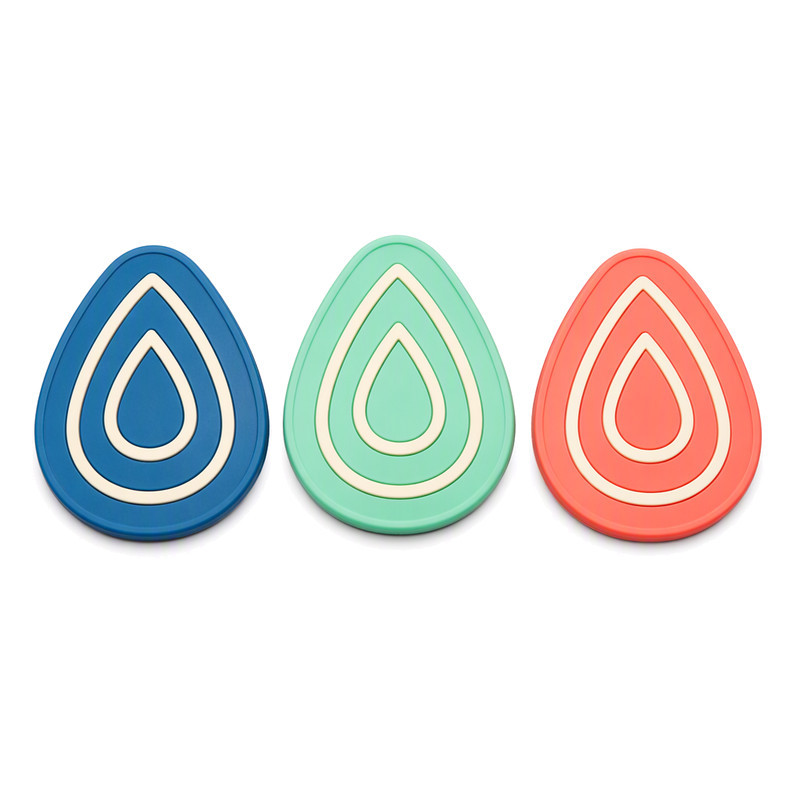
Teardrop and rounded shapes distribute the perimeter load evenly around the outline. A sharp corner concentrates the same force into a small area, and on a knit that flexes constantly, that corner is where lifting usually begins.
Rounded outlines also sit better over a curved seam. When the artwork permits it, we suggest softening the geometry at the design stage — it is far cheaper than reworking the mould after sampling.
How to specify a custom silicone garment label
- Send the exact fabric information. Composition, weight, knit structure, stretch and recovery behaviour, surface finish and a physical swatch.
- Define the functional and visual requirements. Dimensions, thickness preference, flexibility expectation, colours, logo detail and placement. Say whether the label must move with the fabric or stay dimensionally stable within its area.
- Choose the attachment method against the garment. Heat transfer, sewn construction or another approach — selected for that fabric rather than by habit.
- Confirm the application process. For heat transfer, that means temperature, pressure and dwell time validated on the fabric; for sewn labels, edge design, stitch placement and the risk of local distortion.
- Approve a production-representative sample. Intended fabric and garment construction, inspected for appearance, flexibility, attachment, stretch recovery, comfort and washing performance.
Five selection mistakes that show up again and again
Choosing on appearance alone
An attractive sample can still be too stiff for a fine knit. Aesthetics and mechanics have to be judged in the same review.
Evaluating the label on flat fabric only
Knitwear is worn stretched and moving. A flat-swap assessment hides exactly the behaviour that matters.
Using one label across every fabric
Different knit structures may need different dimensions, thicknesses or attachment systems. Standardising the artwork is sensible; standardising the construction is not.
Going thicker than the design needs
Extra thickness adds presence in a photograph and stress on the garment. On light knits it can affect drape and comfort without improving durability.
Skipping the wash and stretch tests
Both conditions are part of normal wear. Testing one and assuming the other is the most common gap in an otherwise careful development.

Small round marks suit light knits — if the edge is right
A compact circle carries little weight and rarely affects drape, which makes it a natural fit for light single jersey and fine-gauge tops. The limitation is the small bonded area: a circle has the shortest perimeter per unit of surface, but it also leaves less room for error in application.
For designs like these, the print or mould depth of the line motif has to be matched to the thickness available, otherwise the detail flattens during bonding.
Frequently asked questions
Can silicone labels be used on knitted garments?
Yes, when the fabric structure, the attachment method, the label design and the validated performance all line up. The fabric is the variable that most often decides the outcome.
What type of silicone label suits stretch sportswear?
There is no universal answer. Flexibility, thickness, stretch behaviour and bonding compatibility have to be weighed together and then confirmed on the actual garment fabric by testing.
Why does a silicone label feel too stiff on knitwear?
Perceived stiffness comes from the combination of thickness, dimensions, hardness, design geometry and how flexible the underlying fabric is. Reducing any one of them without considering the others rarely solves it.
Are heat transfer silicone labels suitable for ribbed fabric?
They can be, but rib demands its own application and stretch-recovery testing because of how strongly it extends and returns. Results from a plain jersey panel do not transfer.
What should I send a custom silicone label manufacturer?
Fabric swatches, garment type, label dimensions, logo artwork, intended attachment method, washing requirements and how the garment will be used. The more of these that are real rather than estimated, the more useful the recommendation.
Sources and further reading
- ASTM D2594/D2594M-21 — Standard Test Method for Stretch Properties of Knitted Fabrics Having Low Power: store.astm.org — ASTM D2594/D2594M-21
- ISO 13934-1:2013 — Textiles — Tensile properties of fabrics — Part 1: Determination of maximum force and elongation at maximum force using the strip method: iso.org/standard/60676.html
- ISO 139:2005 — Textiles — Standard atmospheres for conditioning and testing: iso.org/standard/35179.html
- ISO 6330:2021 — Textiles — Domestic washing and drying procedures for textile testing: iso.org/standard/75934.html
- GINETEX — care symbols and treatment classes under ISO 3758:2023: ginetex.net — care symbols
- AATCC TM61 — Test Method for Colorfastness to Laundering: Accelerated (one 45-minute test approximates five hand or home launderings): members.aatcc.org — TM061 test method
- Silicone transfer label thickness range published by industry converters: cusmytrims.com — silicone heat transfer labels
Matching the label to the knit structure
Fabric construction, stretch and recovery behaviour, label flexibility, thickness, attachment method, comfort and washing performance are one decision set, not six independent ones. Change one and the others usually need re-checking. The dependable habit is to evaluate everything on the actual production fabric, including the washing and stretch conditions the garment will meet.
FromRubber (Dongguan Bohao Electronic Technology Co., Ltd.) develops custom silicone labels and silicone patches for apparel and works from fabric swatches and design requirements during sample development. If you are specifying a label for a knitwear style, the most useful first step is to send the fabric swatch together with the artwork and the intended washing conditions: nani@fromrubber.com or karl@fromrubber.com, WeChat and WhatsApp +86 18676210913. Construction and size options are shown on the custom silicone label page, and practical limits for small marks are discussed in how small a small silicone logo can be on clothing.
Related reading in this series
Why Does a Silicone Heat Transfer Label Peel After Washing? · How Does Pressing Temperature Affect a Silicone Heat Transfer Label? · How to Check Silicone Heat Transfer Patch Adhesion After Pressing? · Silicone Patch for Seamless Sportswear: What Design Factors Matter?
About the figures and the review behind this article
Figures quoted here are published industry references rather than measurements from our own production: care and treatment classes follow the ISO 3758:2023 symbol system, the laundering equivalence comes from AATCC TM61, the peel geometry from ISO 2411, and the application and thickness ranges from published conversion-supplier documentation.
Editorial review by FromRubber engineering. FromRubber (Dongguan Bohao Electronic Technology Co., Ltd.) has moulded silicone components in Dongguan since 2010, runs 32 compression moulding machines across two plants, works to ISO 9001:2015, ISO 14001:2015 and IATF 16949:2016 certified systems, and has operated a dedicated silicone fabric-label and heat transfer label division since 2023.