How to Design Silicone Rubber Keypads for Large Buttons Without Tilting or Jamming?
Scaling a good small key up to a large one is the most expensive shortcut in keypad design. The drawing looks like the same part at twice the size, the tool is cut, and the first sample tilts when it is pressed near the edge, jams against the housing, and closes the contact only when pressed dead center. Nothing was designed wrong at the small size. The physics changed with the size.
A large button silicone rubber keypad behaves as a plate on a flexible ring, not as a scaled column. The load path depends on where the finger lands, the cap can rotate around its first contact point, and the dome underneath sees only part of the force. This article works through what that means for structure, clearance and tooling.
Why Large Silicone Keypad Buttons Are More Likely to Tilt or Jam
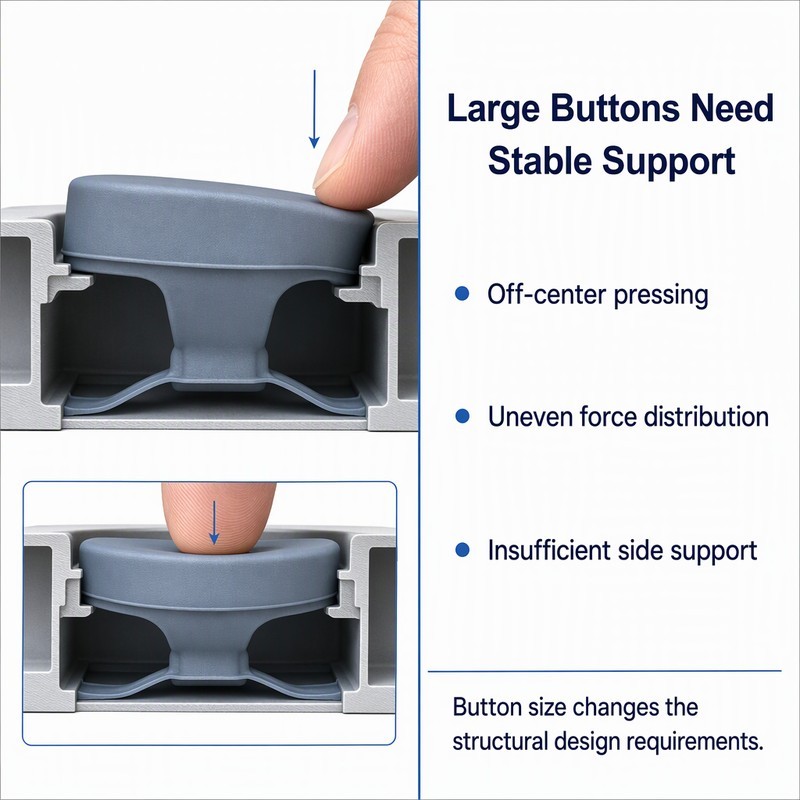
Two things grow faster than the button does. The first is the offset between the finger and the support ring: a 5 mm error on a 10 mm button is a small fraction of the cap, and the same 5 mm error on a 30 mm button is normal use. The second is the area over which the finger can apply force, because a large key invites a thumb, a palm edge or two fingers.
The result is a key whose behavior depends on how it is pressed. That is tolerable on a rarely used key and unacceptable on a start or emergency stop key, where the press is made in a hurry and never at the center.
| Press position | What the cap does | What to check |
|---|---|---|
| Centre | Compresses evenly into the dome | Press force and closure point against the drawing |
| Near one edge | Rotates around the first contact point, skirt bulges outward | Clearance on the loaded side and contact with the support wall |
| Two fingers or a palm | Loads the cap in bending rather than compression | Whether the contact closes before the breakover |
| Thumb at the rim, panel vertical | Adds a gravity component to the return stroke | Return time with the panel at its working angle |
Large button surfaces are more sensitive to uneven pressing
On a small key, an off-center press is a small eccentric load. On a large key, the same absolute offset produces a much larger overturning moment, because the lever arm from the support ring to the contact point is longer. The button responds by rotating before it compresses, and the rotation is what the operator feels as a soft or vague press.
The difference between center and edge pressing is therefore not a matter of degree. At the center, the load goes straight into the dome and the skirt compresses evenly. At the edge, part of the load goes into the skirt on one side, which bends outward instead of compressing, and the dome is loaded asymmetrically or barely loaded at all.
This is why a large button needs support that a small one does not. The support is not there to make the key stiffer; it is there to keep the load path vertical when the finger is not in the middle.
Insufficient support allows the button to tilt during operation
Tilt begins at the first contact point. When the cap is pressed off-center, the near side of the skirt touches its support first and acts as a pivot, and the rest of the cap rotates around it. The further the finger is from that pivot, the greater the rotation for the same travel.
Support geometry changes where the pivot is and how much of the cap is held. A continuous support ring close to the cap edge shortens the unsupported span and limits rotation. A single central dome with a wide free skirt gives the cap nothing to lean on, so it rotates until the skirt folds or the cap meets the housing.
The relationship that matters is the span between the support and the point of load, relative to the height of the cap above the support. A tall cap on a wide unsupported span will tilt even if the material is firm, and a short cap on a narrow span will stay flat even with a softer compound.
Limited clearance causes friction during button movement
A tilting cap consumes clearance along one side of the opening. On a large button the sideways movement at the cap edge is proportionally larger than on a small one, so a radial gap that is comfortable at rest can be closed by rotation alone.
The opening is also deeper relative to the button on large panels, because the housing wall around a big button is usually thicker. That means the guided section is longer, the contact area is larger, and the friction from a small interference is higher.
Large buttons on industrial control panels are often mounted on a sloped or vertical face, which adds a gravity component to the return stroke. A button that returns reluctantly when the panel is flat can hang when the panel is vertical, particularly if the skirt is in contact with the opening.
Uneven wall thickness creates inconsistent deformation
Wall thickness variation is more damaging on a large button because the wall is longer. A thickness difference that is negligible over a 4 mm skirt becomes significant over a 20 mm skirt, and the thin side deforms first, which biases the tilt in one direction.
The bias is often built into the tool without anyone noticing: a draft added for ejection on one side, a rib that runs along part of the perimeter, a gate mark that stiffens one section. On a small key these are invisible in the finished part. On a large key they determine which way the cap leans.
Which Structural Designs Help Keep Large Silicone Buttons Stable?
Adjust the dome structure to distribute pressing force
In custom rubber keypad design, a single central dome works when the cap is small enough that every press is effectively central. On a large cap, a central dome leaves the perimeter unsupported, so an edge press loads the dome through the cap's bending rather than directly. Two structural responses are common: a larger dome that reaches closer to the cap edge, or a dome with a defined shoulder that transfers load from a wider ring.
A third option is a set of smaller domes or a dome ring under the cap, which gives multiple load paths and keeps the cap flatter. It costs more in tooling and changes the feel, because the operator may perceive several breakovers instead of one. That trade should be decided against the key's function: a large start key benefits from one clear action, a large membrane-style panel key may accept a distributed feel.
Dome height and diameter still set the travel and the return. Increasing diameter softens the dome and lengthens the ramp; increasing height adds travel but reduces the return force. On a large button the travel is often limited by the housing rather than by the dome, so the dome should be designed to work within that limit rather than to reach it.
Add appropriate supporting walls around large buttons
A support ring is the raised section of the base that holds the skirt, and the distance between that ring and the cap edge sets how far the cap can rotate.
A support wall works by shortening the free length of the skirt. It can be a raised ring outside the button, a step in the base, or a short internal rib that runs along part of the perimeter. What matters is that the wall is close enough to the cap to limit rotation before the skirt folds.
The wall should not be continuous in a way that traps the button. Interrupted support, with gaps at the points where the skirt needs to move, gives stability without creating a seal that resists the return stroke.
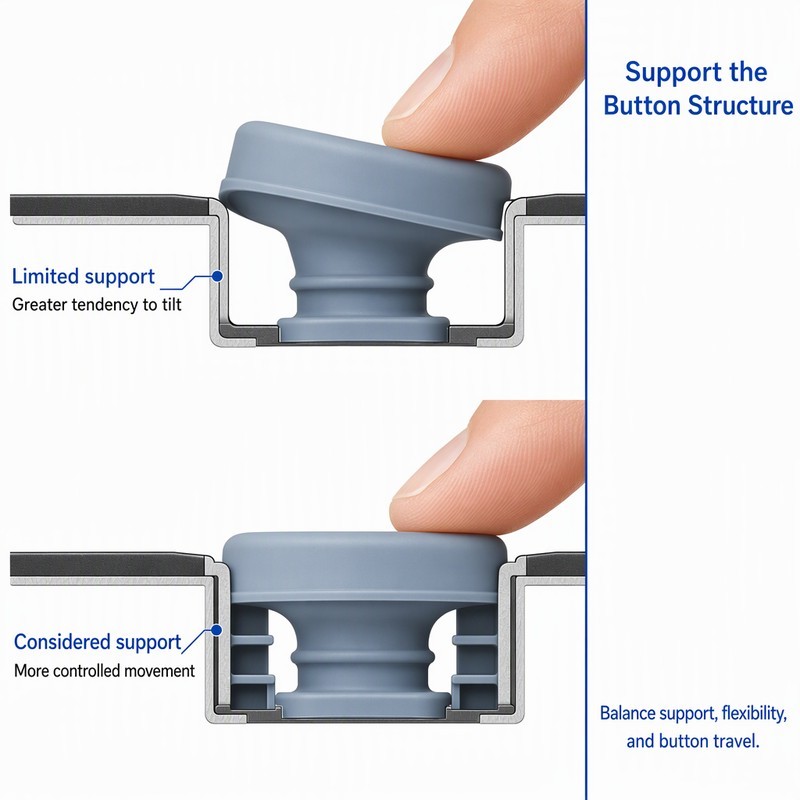
The balance is between stability and flexibility. A fully enclosed support makes the key rigid, raises the press force and can prevent the dome from inverting at all. An open support leaves the cap free to tilt. The workable arrangement usually holds the skirt near the cap on two or three sides and leaves the remaining sides open for deformation.
Control button height to reduce unwanted tilting
The question of how to prevent large silicone buttons from tilting is mostly a question of height, which is the cheapest fix and the one designers resist most, because a tall cap looks more like a deliberate button. The mechanical argument is simple: reducing cap height reduces the lever arm from the support to the finger, and the rotation for a given sideways load falls with it.
On a large button, a useful target is to keep the cap height small relative to the cap diameter, so the button reads as a raised pad rather than a tower. Where the design needs visible height for ergonomics or for a legend, the extra height should be paired with support close to the cap edge.
Optimize the contact area for reliable electrical switching
On a large button, contact closure is a separate problem from feel. The carbon pill sits at one point under the cap, and if the cap tilts, that point moves laterally as well as down. The pill can land partly off its pad, which reduces the effective contact area and makes closure position-dependent.
Two design responses help. A larger pill with a matching pad gives margin for lateral movement. A pill positioned under the centroid of the pressing area, rather than under the geometric center of the cap, puts it where the load usually goes. On keys that are pressed from one side by design, for example a key at the edge of a panel, that distinction is worth checking on the drawing.
Mechanical movement and electrical closure should be tested as two results from one press. The force-displacement curve with the circuit connected shows where closure happens in the travel, and whether that point changes when the key is pressed off-center. A closure point that moves is a sign of tilt that the feel alone may not reveal.
How to Prevent Jamming Between Large Buttons and the Enclosure
Design sufficient clearance around the button perimeter
Silicone rubber keypad button jamming usually starts with clearance that was sized for translation only. The clearance around a large button has to cover rotation as well. That means the required gap depends on cap diameter, cap height and how far off-center the key is expected to be pressed. A practical approach is to calculate the lateral movement at the cap edge for the worst realistic press, and add the molding tolerance to that figure.
The tolerance direction matters too. A button at the top of its diameter tolerance in an opening at the bottom of its tolerance is the worst case, and on a large button that combination is more likely to occur simply because the circumference is longer and the probability of a high point is higher.
Avoid excessive deformation near the button edges
Edge deformation is where jamming starts. When the cap tilts, the skirt on the loaded side compresses and bulges outward, which increases the effective diameter exactly where the clearance is smallest. If the skirt is free to bulge into the opening wall, the button wedges.
Reducing the bulge is a matter of geometry: a shorter skirt, a stepped base, or a small undercut that gives the material somewhere to go other than outward. All three are tooling decisions, and all three are much cheaper before the tool exists.
Check clearance under different pressing positions
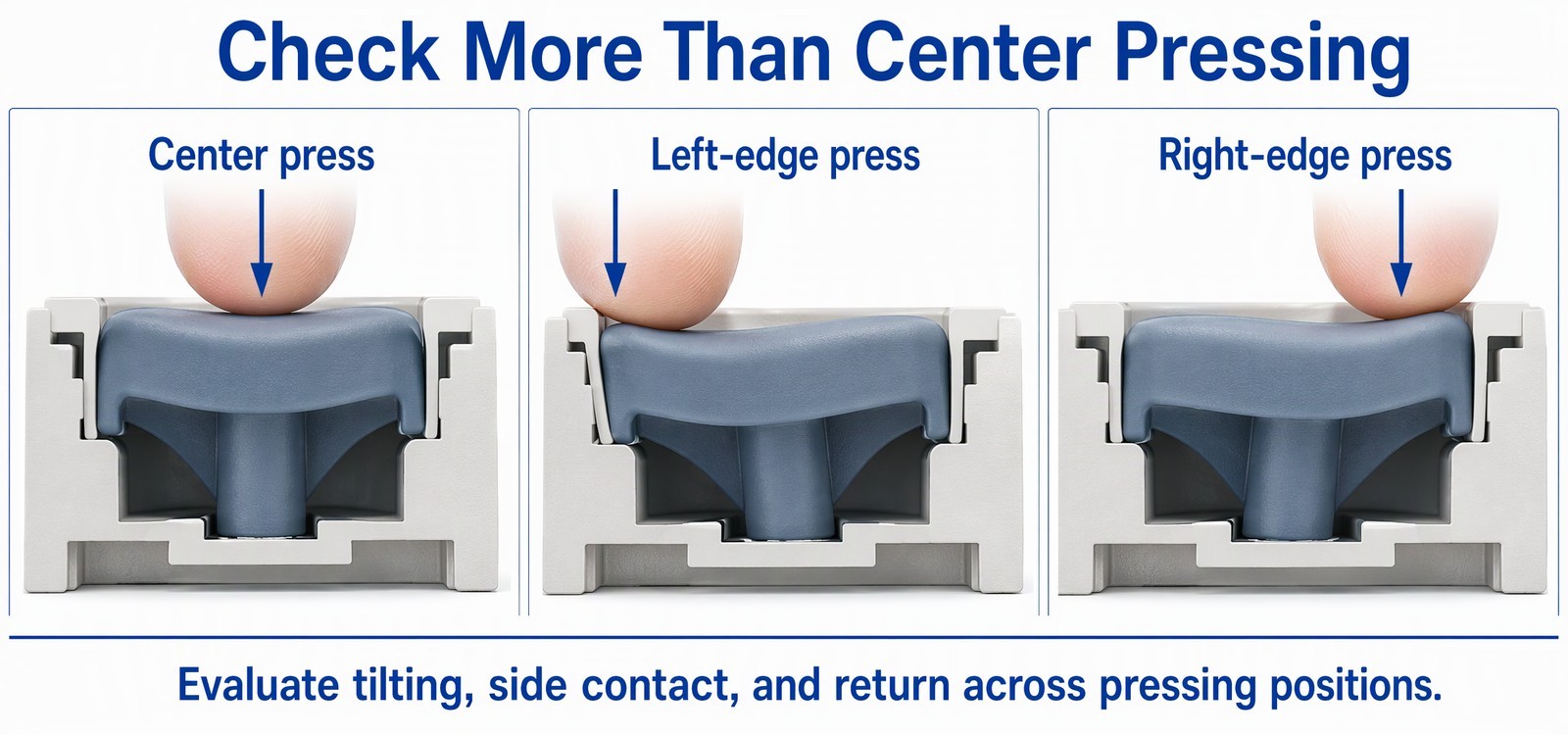
Center, left edge and right edge are the minimum test set, and on a very large key the four quadrants are worth adding. The comparison should record whether the key returns at the same speed in all positions, whether the travel feels the same, and whether the contact closes at the same point.
The test is more informative when the panel is mounted as it will be used. A large key on a sloped control face behaves differently from the same key lying flat on a bench, because gravity acts along the button axis rather than across it.
How Silicone Hardness and Material Selection Affect Large Button Performance
Understand the trade-off between flexibility and structural support
Softer material makes a large button easier to press and easier to deform sideways. On a small key that trade is acceptable, because the sideways movement is small. On a large key the sideways movement is the problem, so softness buys press comfort at the cost of stability.
The usual instinct is to go harder, which is not automatically better. A hard compound raises the press force across the whole cap, including the center where the key was already comfortable, and it can make the dome reluctant to invert at the edge where the load is lowest. The result is a key that is stiff in the middle and dead at the edge.
Match material hardness with button dimensions and geometry
Silicone button structure design treats hardness, wall thickness and dome geometry as one system. For a given cap diameter, a thicker support wall allows a softer compound without losing stability, and a larger dome allows a thinner wall without losing return force. Choosing any one of the three in isolation usually forces a compromise in the other two.
It helps to define the requirement in mechanical terms rather than in material terms: the press force at the center, the acceptable force at the edge, the required return time, and the maximum lateral movement at the cap edge. With those four, a hardness and a structure can be selected together and checked on a sample.
Strength matters most where a large cap concentrates load. The 70 Shore A summary published by FromRubber lists tensile strength at 5.0 MPa required with 5.7 MPa achieved, and elongation at break at 150 percent required with 266 percent achieved. Those margins are what allow a wide skirt to be bent by an off-centre press many times without tearing at the transition, which is the section that carries the highest strain on a large button. The figures describe the compound, not the design: a support ring still has to be positioned so the skirt bends over a short span rather than a long one.
Maintain consistent material properties during production
Large keypads have more material in them, so differences in compound preparation show up more clearly. A batch that is slightly under-cured or unevenly warmed flows differently across a large plate, and the keys at the far end of the plate end up with slightly different density from the keys near the gate.
That difference is enough to change how a large button returns, because the return depends on the material's stored energy, and stored energy depends on how much material is actually doing the work. Batch consistency checks should include hardness and compression set, not only appearance and dimensions.
What Should Manufacturers Check When Developing Large Silicone Keypads?
Review the 3D structure before mold opening
Large button rubber keypad design review should look at cap diameter against support ring diameter, cap height against support height, skirt thickness at four quadrants, and the position of the dome relative to the pressing area. A section through the worst-case press position is more useful than a top view, because tilt is a section problem.
Potential interference points should be identified on the housing model rather than on the keypad alone: bosses, ribs, label recesses, and the screw positions that will pull the board toward the panel.
Evaluate mold layout and cavity consistency
A large keypad occupies more of the tool, so cavity layout and material flow matter more. The parting line should avoid the guided section of every button, and the gate position should not create a flow path that fills one side of a large cap before the other.
Cavity dimensions should be measured before production and checked against the drawing at the same points used for inspection, so that tool wear and process drift can be separated later.
Validate the keypad through prototype assembly
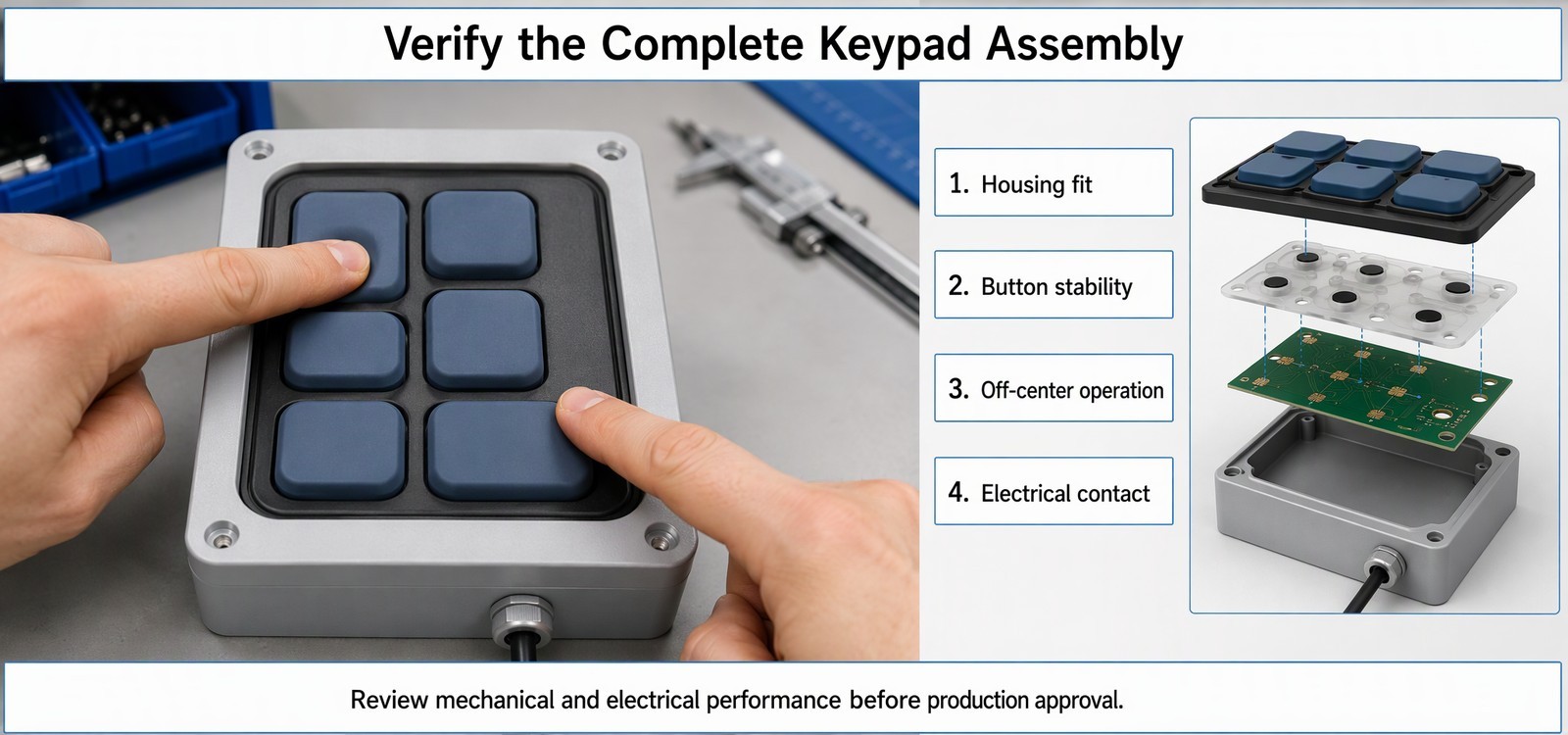
Install the prototype in the real enclosure with the real board and press every large key at the center and at both edges. Watch the cap for rotation, listen for contact with the housing, and confirm that the contact closes at a consistent point in the travel.
If the panel has more than one large key, check them as a group. Two large buttons close together share the silicone plate, and pressing one can lift the other enough to change its clearance. That interaction is invisible when keys are tested one at a time.
What changes when a button gets large
The load path stops being vertical, the cap starts to rotate around its first contact point, the skirt bulges toward the tightest clearance, and the dome sees only part of the force. Every one of those is a structure question, and none of them is answered by changing the silicone hardness alone.
Frequently Asked Questions About Large Silicone Rubber Keypads
Why do large silicone buttons tilt when pressed near the edge?
Because the press creates an overturning moment around the first point of contact, and a large cap has a longer lever arm from that point to the finger. The cap rotates before it compresses, so the travel is used up in rotation rather than in dome inversion.
Can increasing silicone hardness prevent large buttons from tilting?
It can reduce the amount of tilt, but it raises the press force everywhere and can leave the edge of the key too stiff to actuate cleanly. Stability on a large button is better addressed with support geometry and cap height than with hardness alone.
Should large silicone keypad buttons use thicker support walls?
Thicker is not the same as better supported. What matters is how close the support is to the cap and how much of the perimeter it holds. A thin wall placed near the cap edge can be more effective than a thick wall placed far away, and it keeps the press force lower.
How can manufacturers prevent large rubber buttons from jamming inside the housing?
By sizing the clearance for rotation rather than translation, by giving the skirt somewhere to deform other than outward, and by verifying both on an assembled sample pressed at the edges. The worst-case tolerance combination should be calculated, not assumed.
Designing for size rather than scaling for it
A large silicone keypad is a different structure from a small one, not the same structure enlarged. The cap needs support close to its edge, the height should stay modest relative to the diameter, the dome should match the pressing area rather than the geometric center, and the clearance should be calculated for rotation.
FromRubber (Dongguan Bohao Electronic Technology Co., Ltd.) molds large-button silicone keypads and control panel assemblies for industrial equipment, including designs with support rings, stepped bases and multi-dome structures. Tooling is produced in-house, which allows cap height, support geometry and dome layout to be revised at the prototype stage rather than after production starts. Quality systems: ISO 9001:2015 and IATF 16949:2016.
For a large-button panel that tilts or jams, send the section through the worst-case press position and the housing drawing: contact the FromRubber engineering team. Large tactile buttons for panel use are shown under tactile rubber buttons for industrial control panel keypads. WhatsApp and WeChat: +86 18676210913.
Sources and supporting reading
A large key that only works when pressed in the middle?
Send the cap diameter, the support geometry and the worst-case press position. The review covers support span, cap height, dome placement and clearance for rotation.
Request a structure review