
How Thick Should a Silicone Patch Be for Embossed Clothing Logos?
There is no single correct thickness for an embossed silicone logo, and the question usually hides five different numbers. For ordinary apparel work, industry-published specifications for this product family cluster in a practical band: around 1 mm for a 3D patch intended to balance flexibility with a pronounced relief, up to a 1.5 mm limit for printed silicone, and 1.5 mm and above for moulded silicone where the visual effect is the priority.
Those figures tell you where the industry normally works. What they do not tell you is the right value for your logo on your fabric, because that depends on how much relief the mark needs, how narrow the thinnest stroke is, and how much the garment moves.
Five dimensions hiding behind one word
| Dimension | What it controls | Why it matters |
|---|---|---|
| Overall patch thickness | The tallest point on the part | How proud the patch sits and how it feels through the fabric |
| Base web thickness | Bending stiffness of the whole patch | How the patch moves with the garment |
| Relief height | Visual and tactile depth of the raised logo | The 3D effect, and the size of geometry transitions |
| Emboss or deboss depth | Contrast within the logo face | Creates the thinnest sections in the part |
| Edge section | Contact and flow at the perimeter | Where a peel front can start |
When a drawing says "1.5 mm", ask "1.5 mm of what?". The answer changes the quotation, the mould and the durability. Getting all five onto the drawing before tooling is the cheapest quality improvement available in this process.

Overall thickness is the tallest point. It is rarely the number that decides wearer comfort.
Is a thicker embossed silicone patch a better one?
For a plate, bending stiffness rises steeply with thickness, roughly with the cube rather than in proportion. Halving the base web thickness reduces resistance to bending by something close to eight times, depending on construction. That is why a base web thicker than the design needs is a liability rather than margin.
Relief height adds a second penalty. A raised element behaves as a stiff beam on a flexible base, and its stiffness grows steeply with height while its contact with the fabric does not grow at all. The result is a patch that resists bending most strongly exactly where the stress transitions are sharpest. There is also a quieter cost: deep embossing and tall lettering create the smallest wall sections in the part, and those are the first places to craze under fatigue.
Material data frames the trade-off usefully. A typical 70 Shore A silicone rubber datasheet lists hardness of 70 ± 5, tensile strength of 5.0 MPa as the requirement with 5.7 MPa achieved, and elongation at break of 150 percent required with 266 percent achieved. Silicone is a low-modulus, high-elongation material, which is exactly why it feels right on a garment, and exactly why adding thickness works against its natural advantage.
The aspect ratio that decides whether the mould fills cleanly
For any raised or recessed feature, the relationship that matters most in production is the ratio of relief height to the width of the narrowest stroke.
A stroke that is wide relative to its height fills easily, releases easily and has enough material to carry repeated bending. The same relief height on a much narrower stroke is harder to fill, prone to incomplete detail at the corners, more likely to tear on demoulding, and thinner in section once formed. Two logos with identical relief height can be entirely different manufacturing problems because their minimum stroke widths differ.
Colour count interacts with the same constraint. Peer specifications for printed silicone recommend no more than six colours, and no more than two on moulded silicone, because more colours raise production difficulty and the failure rate. A brand asking for five printed colours over deep relief is asking for two difficult things at once.
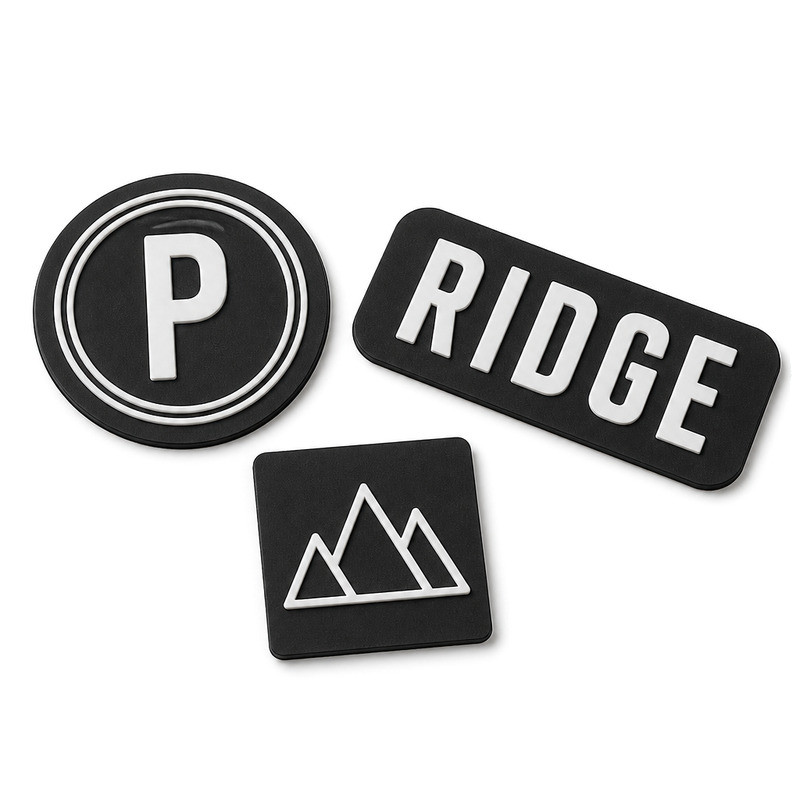
Fine strokes and tall relief together cause most production difficulty.
Surface finish is part of the same decision
Silicone patches are normally supplied with a matte surface, and a glossy finish usually requires an additional coating layer. That matters beyond appearance. A texture that adds relief, whether a matte grain, a ridge pattern or a fine grid, adds small geometry transitions across the whole face. That is normally harmless because the transitions are shallow and evenly distributed, but combined with deep embossing the two effects stack at the deepest points. Wherever printed colour is used, colour boundaries add another line where fatigue can begin.
The practical rule: decide relief first, then decide whether texture or gloss is worth adding on top of it, rather than specifying all three at maximum and discovering the combination at sample stage.
How does patch size change the thickness decision?
A base web thickness that feels right on a 20 mm label can be wrong on a 90 mm logo, even though the material is identical. The larger patch covers more fabric, so a greater length of knit is immobilised beneath it and the perimeter has to absorb the movement of a longer run of fabric. Bending stiffness also scales with span: a longer plate deflects more for the same applied force, so edge stress grows with size even at constant thickness.
The consequence is that large logos are usually where a cracking or lifting problem appears first, and where a modest reduction in base thickness buys the most improvement. Small logos fail for a different reason: proportionally more perimeter and less bonded area, so their problem is adhesion rather than stiffness. Two patches of the same construction can therefore need opposite corrections, which is why one house specification across a range rarely performs evenly.
Placement modifies it again. A small patch on a curved sleeve bends over a tighter radius than a large patch on a flat back panel, even if both are 60 mm wide. The relevant comparison is the ratio of patch size to the radius of the surface it sits on, not size alone.
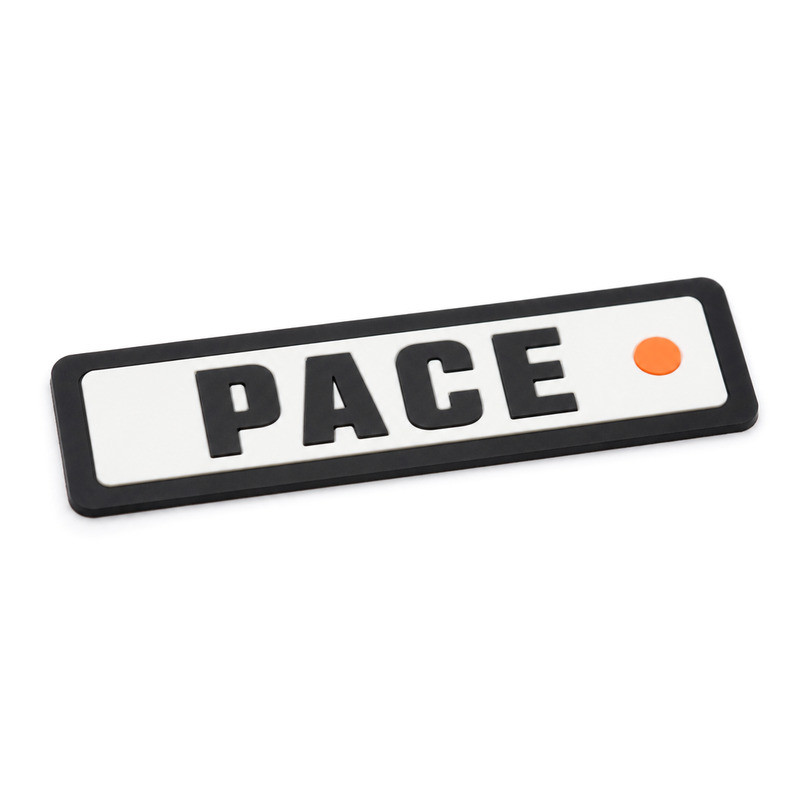
Measure the base web and the relief separately. One reading cannot represent both.
Choosing the numbers, in order
1. Describe the visual effect in words
Subtle, tactile, or strongly three-dimensional. This sets the relief range before any number is written.
2. Identify the fabric and its construction
Composition, weight, stretch direction and stretch level. Fabric tensile behaviour can be characterised with the strip method in ISO 13934-1:2013, applicable to fabrics whose stretch comes from an elastomeric fibre.
3. Check the smallest feature in the artwork
Minimum stroke width against intended relief height. This is where most drawings need adjusting.
4. Set base web thickness from flexibility
Start at the lower end of the practical band and add only where the mould or the relief requires it.
5. Agree tolerances and the measurement method
A gauge reading on raised lettering and a reading on the base land will not agree. Specify tolerances for base web, relief and overall height separately.
6. Sample, then bend, stretch and wash
Material data determined under ISO 37:2024 describes the compound. Only testing the finished patch on the garment describes the result.
Limits worth stating The thickness bands quoted here are the ranges published by manufacturers in this product family, not universal limits. Printed silicone is constrained by the printing process, moulded silicone by the mould. Very fine detail and deep relief together are the combination that most often forces a compromise, and the usual resolution is to reduce relief on the fine elements while keeping it on the bold forms. Brand recognition normally survives that variation better than expected, and the patch becomes both producible and durable. Where a garment must survive industrial laundering or a chemical wash route, thickness choices also have to be validated against that process rather than against a domestic cycle.
FromRubber is a custom silicone manufacturer in Dongguan, China: Dongguan Bohao Electronic Technology Co., Ltd., Jingcheng Road 122, Langxia Village, Qiaotou Town, Dongguan, Guangdong, China. Operating since June 2010, with 32 compression moulding machines across two sites and IATF 16949:2016, ISO 9001:2015 and ISO 14001:2015 certification.
If you have artwork and a fabric specification and want a view on what thickness is realistic, send both across. We will say where the drawing is likely to be difficult to mould or to keep bonded. Email nani@fromrubber.com or karl@fromrubber.com, or reach us on WeChat and WhatsApp at +86 18676210913.
Sources
- ISO 37:2024, Rubber, vulcanized or thermoplastic - Determination of tensile stress-strain properties: https://www.iso.org/standard/86892.html
- ISO 13934-1:2013, Textiles - Tensile properties of fabrics - Part 1: Determination of maximum force and elongation at maximum force using the strip method: https://www.iso.org/standard/60676.html
- ISO 6330:2021, Textiles - Domestic washing and drying procedures for textile testing: https://www.iso.org/standard/75934.html
- Custom Silicone Patches for Clothing Labels, Jin Sheu (thickness limit of 1.5 mm printed, 1.5 mm and above moulded, colour count guidance, matte surface as standard, backing options): https://www.jinsheu.com/en/category/custom-silicone-patches.html
- Custom 3D Silicone Patches, Custom Patch Factory (1 mm thickness described as the balance between flexibility and 3D effect, available size range, press parameters): https://www.custompatchfactory.com/product/patches/3d-silicone-patches
- Material Properties - Silicone Rubber, MEC (70 Shore A hardness, tensile strength, elongation at break, operating temperature range): https://mec-uk.co.uk/new-admin/uploads/pdf/Material%20Properties%20-%20Silicone%20Rubber.pdf
Are you looking for a rubber and plastic product customization solutions manufacturer?
We can quickly provide customers with market analysis, technical support and customized services.Sign Up Out Newletter
