
Custom Silicone Food Storage & Snack Bags – Leak‑Proof, BPA‑Free, Reusable


| Share | |
|---|---|
| Categories | Custom Silicone Case |
| Brand | FromRubber Silicone & Plastic OEM Manufacturer |
| Product Specifications | BH-parts |
| Product Name | Silicone Snack Bags |
| Material | Silicone |
| Color | Pink,Custom |
| Shape | Custom |
| Feature | Leak‑Proof, BPA‑Free, Reusable |
| Application | Food Storage & Snack |
| Sales Method | Molded Custom |
| Consultation Email | Suey@fromrubber.com |
| FOB port | Shenzhen |
| Terms of Payment | L/C, D/A, D/P, Western Union, MoneyGram, T/T, Paypal |
| Download |  |
The Leak Rating Is Decided by the Closure, Not by the Silicone
Two silicone snack bags can be moulded from the same 60 Shore A compound and still behave differently in the first week: one carries soup through a dropped bag, the other weeps along the zip rail as soon as the pouch is squeezed. The variable that separates them is not the durometer on the compound sheet. It is the closure geometry, the cure system, and how the film behaves where the bag folds. Those three items are what we quote against, and what this page documents.
- Cure system before durometer. Addition-cure (platinum) silicone leaves no peroxide decomposition byproducts, so it is the default for fatty foods and for anything that will be chewed or sucked. Peroxide cure is cheaper and more forgiving in a busy workshop, but its residues are a common source of taste transfer. Platinum cure also demands a clean cell: sulfur, amines and tin catalysts poison the catalyst, and a mould that previously ran a peroxide compound will contaminate the batch that follows.
- Seal on a land, not on a point. A press-to-close rail that meets on a sharp edge holds until the first overfill, takes a permanent set, and then leaks. We place a flat sealing land behind the interlock so closing pressure is distributed along a strip. The interlock keeps the bag shut; the land keeps it leak-proof. Land width, undercut and interference are tooling dimensions, so changing them later means a new insert rather than a new setting.
- Film behaviour at the gusset. A stand-up pouch stands because the base gusset folds on a controlled line. If the gusset film is thinner than the side wall, the pouch slumps when filled and the corner radius tears first. Wall thickness is therefore quoted per format, and the corner radius is kept larger than the wall thickness so the tear path has somewhere to go.

Five colours from one tool set. Colour is a masterbatch decision; the geometry is not.
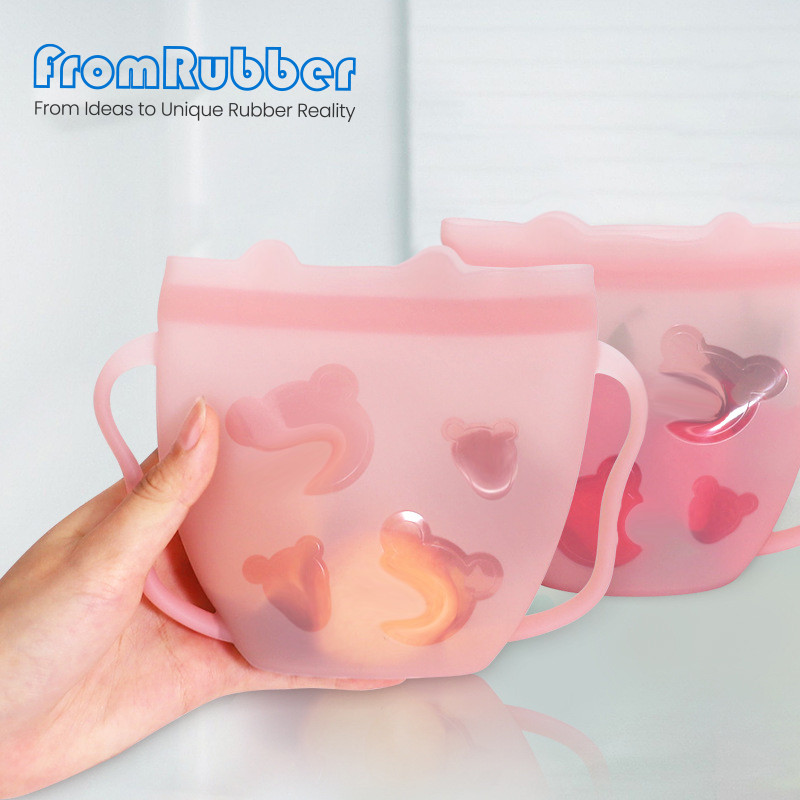
Translucent compound makes the wall visible. The fold above the flange is where hinge whitening appears first.
Where these products actually fail in service
Field returns cluster into five patterns. Each one traces back to a drawing decision, not to a material batch.
- Rail creep. Sealing force drops after a few hundred open-close cycles because the interlock deforms. Fix at design stage: land width, a low compression set compound, and a cycle test on the agreed protocol before tool release.
- Corner tear at the gusset. A sharp internal radius combined with thin film starts a tear that runs along the fold. Fix: radius larger than wall thickness, and a thickness step rather than a long taper.
- Print wear. Screen ink abrades in a dishwasher and fades first at the fold. A moulded-in deboss survives washing; two-pack ink is reserved for artwork that needs more than one colour.
- Hinge whitening. Folding on the same line works the surface and turns it white. Move the fold away from the weld line and keep the notch radius generous.
- Odour retention. Porous surfaces and peroxide residues hold food smells. Platinum cure plus a defined post-cure cycle removes most of it.
Specification starting points
The ranges below are what we quote from when a new mould is opened. Final values come from the compound datasheet and the test protocol agreed at T1; they are not measured results for an existing part.
| Parameter | Stand-up pouch | Snack cup or container | Why it is set this way |
|---|---|---|---|
| Wall or film thickness | 1.0 - 1.5 mm side wall, gusset +0.2 mm | 1.2 - 2.0 mm body | Below 1.0 mm the pouch slumps when filled; above 2 mm it stops folding cleanly |
| Hardness | 55 - 70 Shore A | 50 - 65 Shore A | Softer compound seals at lower force but loses dimensional stability in a hot dishwasher |
| Closure | Press-to-close rail, slider, or roll-top with clip | Slotted flexible lid, screw lid, or snap lid | Every closure style needs its own sealing land and its own cycle test |
| Dimensional tolerance | ISO 3302-1 class M2 | ISO 3302-1 class M2 | Tighter classes are quoted per feature, not per part |
| Seal verification | 24 h inverted fill plus manual squeeze | 30 min inverted shake | Fixed before tooling, so the first sample is judged by the same test as production |
| Service temperature | -40 to +220 C, compound dependent | -40 to +220 C, compound dependent | Confirm against the actual datasheet; repeated dishwasher cycles age the compound |
| Food-contact documents | FDA 21 CFR 177.2600, LFGB | FDA 21 CFR 177.2600, LFGB | Third-party migration report per compound, not per shipment |
| Branding | Moulded-in deboss, or post-baked screen print | Moulded-in deboss, or post-baked screen print | Deboss survives washing best; ink is for multi-colour artwork |
These ranges describe design intent for a new mould. They are not warranted performance figures: the approved drawing and the compound datasheet govern the delivered part.
How the tool and the batch are controlled
- Mould flow at the gusset and rail. Thin sections fill last, so fill pressure and weld-line position are checked before steel is cut. A rail that sits on a weld line leaks in the field regardless of compound.
- Retention instead of adhesion. Stiffening ribs and any inserted features are moulded in or mechanically retained. Glued joints creep under repeated load and fail at the seam.
- Segregated cure cells. Platinum and peroxide compounds are moulded and post-cured apart. A shared oven or a shared mould is the quickest route to a batch of tacky parts.
- Lot record. Compound lot, cure date, post-cure cycle, hardness per cavity and a dimensional sample are recorded per lot, so a complaint can be traced to a specific cure.
For the sealing side of the same problem, our note on silicone gaskets for food containers covers land width and lid preload in more depth. Buyers comparing formats also review stretchable silicone storage lids, which use a different seal principle again.

Stand-up pouches: the gusset radius, not the compound, decides whether the pouch still stands when full.
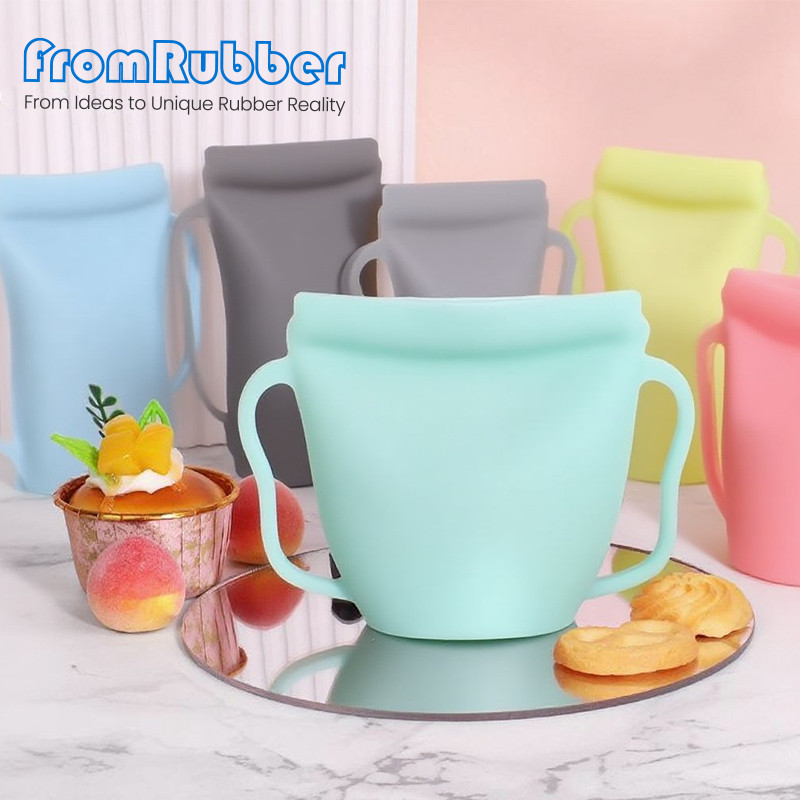
Cup and pouch formats share a compound family, but not the same seal land or the same cycle test.
What we need to quote, and what comes back
- Three inputs. Fill volume or a physical sample, the intended closure style, and the market whose food-contact rules must be met. A 3D file shortens the loop, but a hand sample is enough to start.
- What comes back. A DFM note covering wall thickness, gusset radius, rail interference and draft, a material shortlist with the cure system named, and a tooling and unit-cost split.
- Sample stage. T1 samples come from production tooling rather than a machined prototype, so the rail and the gusset behave as they will in volume.
- Volume ramp. Cavity count follows annual volume: a 2-cavity tool is often right for a brand test, an 8-cavity tool for a retail programme.
From brief to batch in five steps
The same sequence applies whether the format is a pouch, a cup or a container with a slotted lid.
Questions buyers ask before tooling
Is platinum-cure silicone necessary for a food bag?
Not always, but it is the safer default. Peroxide cure can pass the same migration limits and costs less, yet its decomposition byproducts are the usual explanation when a buyer reports a rubber taste in fatty food. If the bag will hold oil-based food, or will be used by children, specify addition cure.
What wall thickness should a 500 ml stand-up pouch use?
Most 500 ml pouches we tool sit at 1.0 - 1.5 mm on the side wall, with the gusset slightly thicker. Thinner walls fold more easily but slump when filled and tear at the gusset corner; thicker walls stand better and consume more compound per unit.
Will the logo survive the dishwasher?
A moulded-in deboss lasts far longer than ink. Screen print is workable for multi-colour artwork if it is post-baked, but abrasion at the fold and around the rail is where it disappears first. We usually quote deboss for the primary mark and ink only for secondary artwork.
Do you supply food-contact documentation?
Yes. The compound is supported through an FDA 21 CFR 177.2600 and LFGB route, and migration testing is carried out by a third-party laboratory per compound rather than per shipment. The report is issued with the sample submission so it can be filed before retail approval.
Send a sample or a fill volume
We return a DFM note on wall thickness, gusset radius and rail interference, with a material shortlist and a tooling quote. STEP, IGES, DXF or PDF drawings all work.
- 加载中···

Start Your Project Today!
- Phone
- *Title
- *Content
Sign Up Out Newletter
