
Two Faces of the Silicone Suction Pad
The wall side needs maximum contact area and a thin, compliant rim. The device side needs a smaller, flatter face that releases without peeling the case off.


A double-sided silicone suction mount is a molded pad with a smooth face on each side: one grips the mounting surface, the other holds the phone or its case. Holding force comes from contact area, pad durometer and surface condition, not from how hard the user presses.
The wall side needs maximum contact area and a thin, compliant rim. The device side needs a smaller, flatter face that releases without peeling the case off.
Silicone grip is restored by rinsing and air drying. No adhesive means no residue on glass, tile or a phone back.
The pad can be co-molded into a phone case back so there is no separate part to lose, at the cost of a more complex tool.
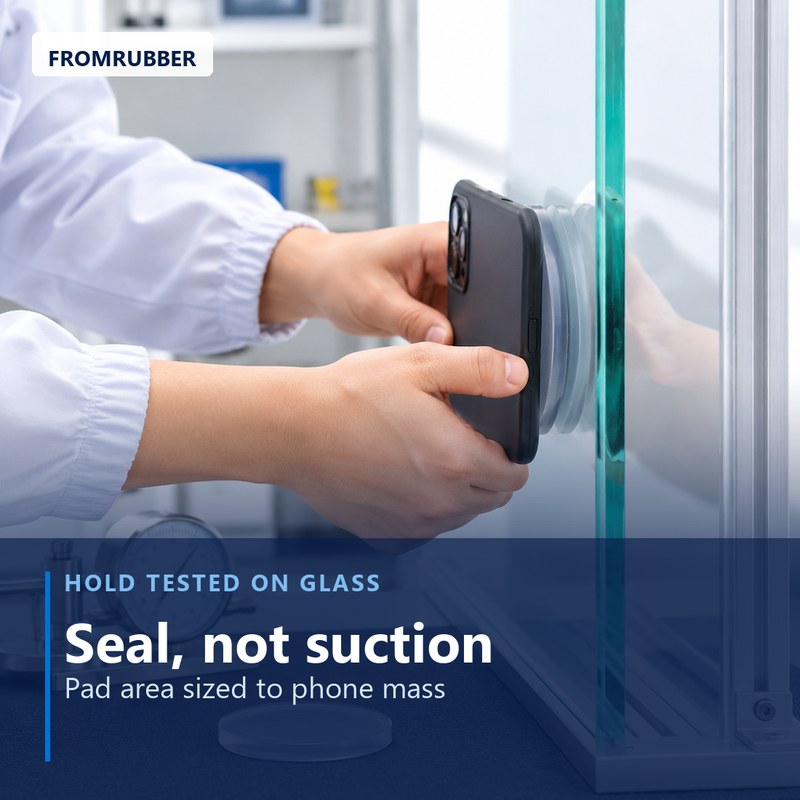
A suction cup works by removing air from a sealed cavity, so the seal, not the suction, is the engineering problem. Any dust, texture or curvature that lets air creep under the rim breaks the seal, which is why the same pad that holds for hours on glass drops in minutes on a textured wall.
Durometer determines how well the pad conforms. Too hard and it cannot seal against a slightly uneven surface; too soft and it creeps under a sustained load, so the phone slides down the wall overnight rather than falling off. The useful band for a phone-weight load is narrow and is fixed by test, not by guess.
A larger face carries more load but needs a flatter surface. Preload from pressing the pad distributes the seal; the part has to be thick enough to store that compression.
A pad that is too soft creeps under constant load. A pad that is too hard will not wet out the surface. Both failure modes look identical to the user: the phone falls.
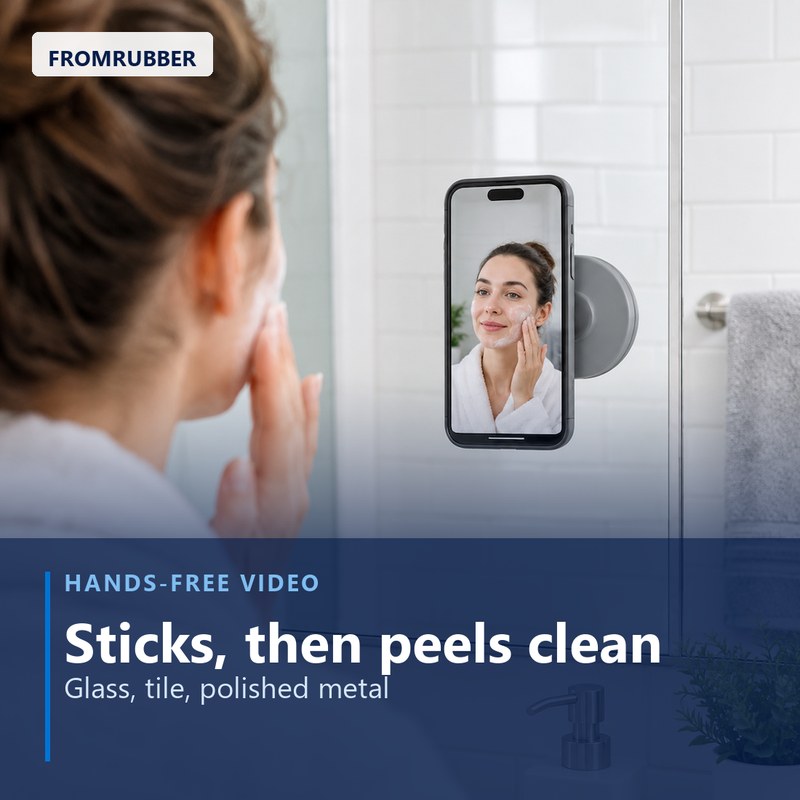
Glass, glazed tile and polished metal hold well. Painted plaster, fabric wallpaper and matte plastics are where buyers report failures, and where the product has to be specified honestly.
Build options for the pad and its integration into a case or a stand. Dimensions are set by the phone weight and the target surface.
| Material | Silicone rubber, smooth molded faces |
|---|---|
| Durometer | Selected in the soft-to-medium range for sealing and creep balance |
| Pad geometry | Round or rounded rectangle, diameter set by load |
| Integration | Standalone pad, case-back pad or insert over a rigid plate |
| Surfaces | Glass, glazed tile, polished metal, smooth plastic |
| Avoid | Textured plaster, fabric wallpaper, dusty or oily surfaces |
| Removal | Peel from the rim, no adhesive residue |
| Cleaning | Rinse with water, air dry, re-seat |
Holding time is a function of surface and load. We test the pad on the surfaces the buyer names, and we state where it should not be used rather than claim universal grip.
Holding time is measured, not assumed.
Integrating the pad into a case sounds simpler than a separate part, and it is easier for the user, but it moves the problem into the tool. The pad pocket has to be deep enough that the pad still contacts the wall when the case is on, and the case wall around the pocket has to resist the peel load the pad transmits.
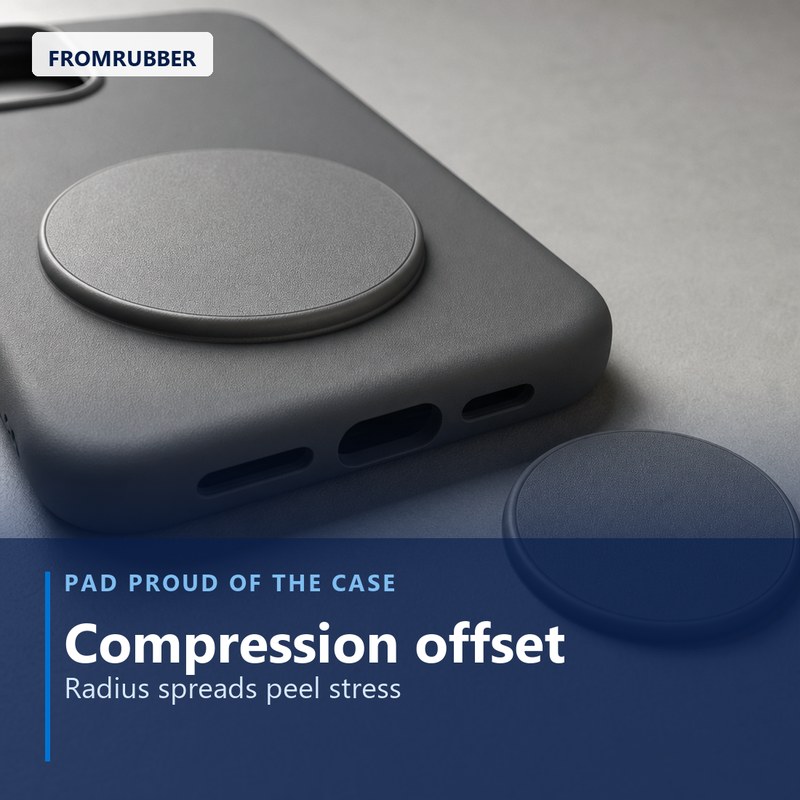
A common compromise is a case with a recessed pad and a slightly raised rim, so the pad sits proud of the case by the amount it compresses. Get that offset wrong and the case becomes the contact point, and the mount stops working on any surface that is not perfectly flat.
The pad must stand slightly proud of the case back so it, not the shell, touches the wall. The offset equals the working compression.
A generous radius at the pocket edge spreads peel stress and stops the pad tearing at the boundary after repeated use.
Pad thickness adds to the case profile, so it is planned against the camera bump and the wireless charging path.
The load case is defined first, because every dimension downstream depends on the phone mass and the mounting surface.
Phone plus case weight, target surfaces and expected mounting duration determine pad area and durometer.
A cast or machined prototype is tested on the named surfaces, including a 24-hour static hang where relevant.
The mold is cut to the validated geometry, with the sealing rim and face finish controlled.
Pads are assembled into cases or stands and checked for proudness and pull-off behavior before packing.
Usually yes, but the case adds mass and stands the pad further from the wall. The pad area has to be sized for the combined load, so we test with the target case rather than a bare phone.
Rinse the face with clean water, remove lint with a fingertip, and let it air dry before re-seating. Solvents and household cleaners degrade the surface and should not be used.
Yes. A pad on a sunlit dashboard reaches temperatures that soften the silicone and accelerate creep. The product is intended for indoor and shaded use, and we will say so in the specification.
Send the phone and case mass, the surfaces you expect, and whether the pad is separate or co-molded. We will size the pad and confirm where the product should not be used.
Related capabilities: Custom silicone case · Multi-color silicone molding · Backing adhesive