
Petal Candle Mold Wall of 2-4 mm
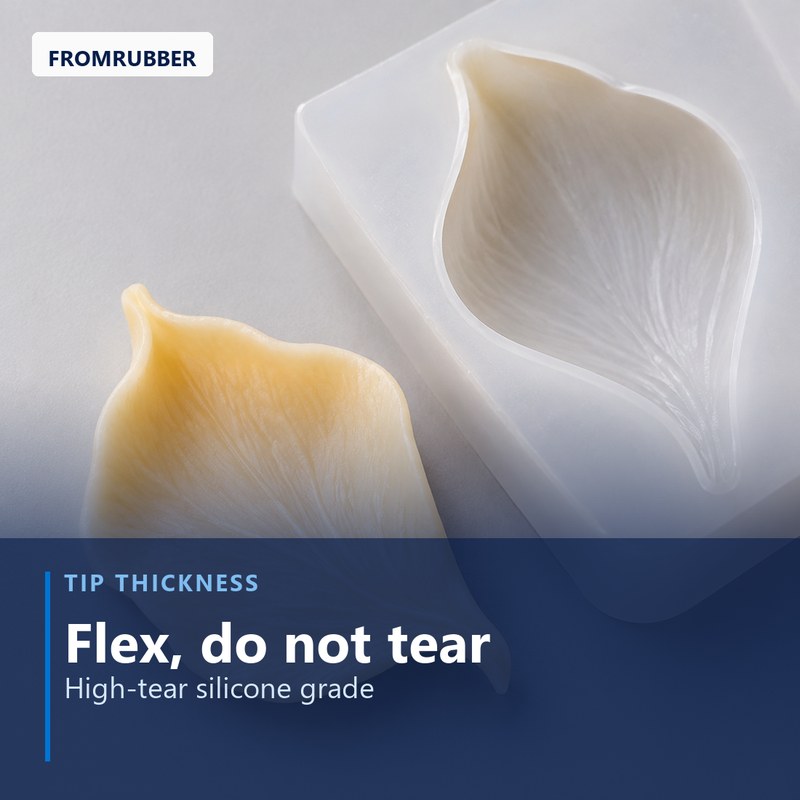
Thin walls peel away from fine detail but tear at the tips; thick walls hold shape but resist demolding. The useful band is narrow.


| Share | |
|---|---|
| Categories | Custom Silicone Case |
| Brand | FromRubber Silicone & Plastic OEM Manufacturer |
| Product Specifications | Candle Mold |
| Material | Food Grade Silicone |
| Shape | Petal |
| Application | Making Candles |
| Size Choice | S/M/L |
| specificities | used repeatly |
| customizable | Support for customized designs |
| FOB port | Shenzhen |
| Terms of Payment | L/C, D/A, D/P, Western Union |
| Download |  |
A petal candle mold is a flexible silicone cavity shaped like a flower petal or a layered bloom. Detail survives or fails on three numbers: working wall thickness, draft angle and the tear strength of the thinnest edge.
Thin walls peel away from fine detail but tear at the tips; thick walls hold shape but resist demolding. The useful band is narrow.
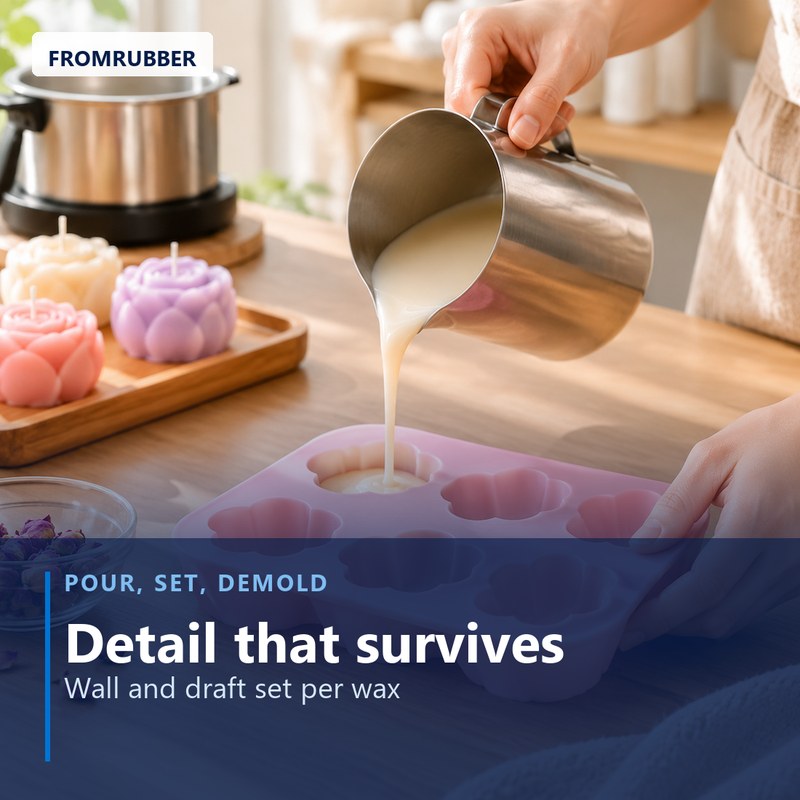
Petal faces are rarely vertical. A small draft on each face lets the casting release without dragging the surface.
One cavity suits sampling and photography; four to twelve cavities suit production, with spacing set for pour access.
A petal is a thin shell with a curled edge, and both features fight the mold. The thin edge needs low tear strength to release without splitting, while the curl needs enough stiffness to hold its shape while the wax sets. Those two requirements pull the wall thickness in opposite directions.
The usual failure is not a torn mold but a dull casting. If the silicone is too stiff or the cavity has no draft, the wax tears away from the surface during demolding and the petal loses the vein detail that justified the mold in the first place. Buyers see it as a wax problem; it is a tool problem.
The thinnest section is at the petal tip. Wall thickness there is set independently of the body so the tip flexes instead of tearing.
A small draft on each petal face lets the casting slide out. Without it, the surface drags and the veins smear.
Silicone grade and wall thickness are chosen together. A high-tear grade allows a thinner, more detailed mold without a short service life.
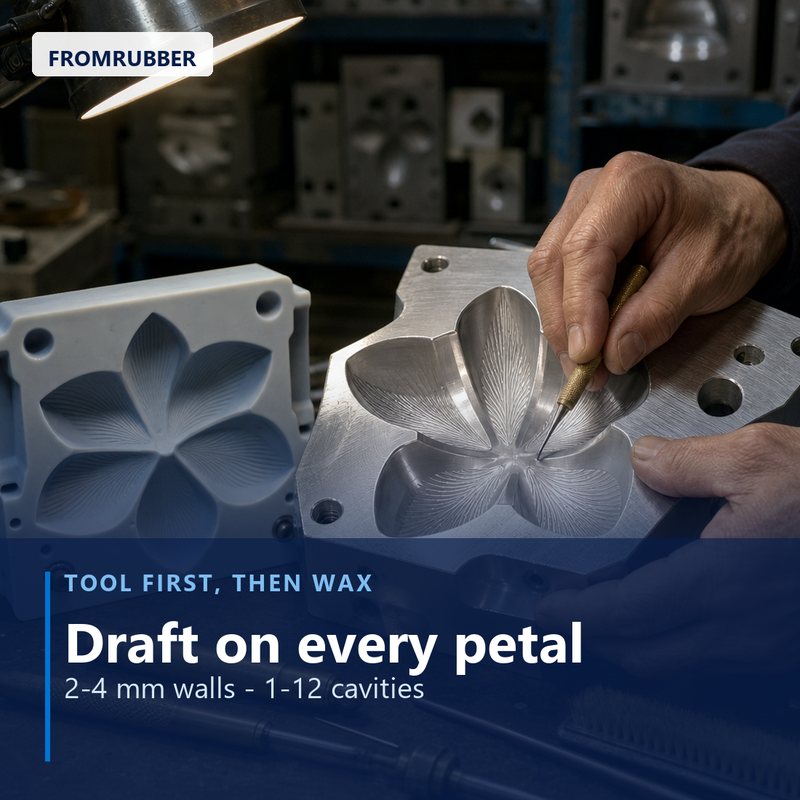
Typical build values for flower and petal candle molds. Final geometry follows the bloom you want to cast.
| Material | Silicone rubber selected for tear strength and release |
|---|---|
| Working wall | Typically 2-4 mm, thinner at petal tips |
| Draft | Small draft on each casting face, set by geometry |
| Cavities | 1, 4, 6 or 12, spaced for pouring and demolding |
| Bloom formats | Single petal, layered bloom, rose, peony, tulip types |
| Pour temperature | Confirmed against the selected silicone grade and wax |
| Release | Demolds without a release agent where geometry allows |
| Finish | Matte or gloss cavity surface |
Wax type, pour temperature and fragrance load are confirmed before the tool is cut. A mold validated on paraffin is not automatically validated on a high-oil-content soy blend.
A master pattern is kept so later cavities match the first bloom.
Most buyers start with a single cavity to prove the bloom, photograph it, and sell it. Once the shape is accepted, the same master is reused to build a production tool, which is why the master pattern matters more than the cavity count. Rebuilding from a photograph instead of the master is how shapes drift between orders.
For production, cavity spacing is set by hand access rather than by machine efficiency: someone has to pour, wait and demold each cavity. A twelve-cavity block that cannot be reached comfortably is slower than two six-cavity blocks. The full mold-making capability behind this work is described under mold making.
The pattern is kept so later cavities and repeat orders reproduce the same bloom rather than a re-interpretation of it.
Spacing is planned around pouring and demolding motion, not only around the press bed.
A single cavity proves the shape; a production tool adds repeatability, wall control and cavity numbering.
The sequence protects the detail: sculpt, cast, approve, then multiply.
A master petal or bloom is sculpted, or an existing candle is scanned and rebuilt as a castable form.
A silicone master is made and poured to check detail reproduction and demolding before committing to production.
A wax casting from the master is checked for vein detail, petal curl and weight consistency.
The production tool is built to the approved master, with cavity numbering and wall checks.
Paraffin, soy blends and most container blends cast well, but each behaves differently on shrinkage and demold. Tell us the wax and pour temperature and the tool is specified around it.
Usually not. A correctly drafted cavity releases cleanly, and a release agent can dull the surface detail. Where a difficult undercut demands one, we say so at approval.
Service life depends on wall thickness, wax temperature and how the mold is handled. Thin petal tips fatigue first, which is why tip thickness is set deliberately rather than left to the carve.
Send the bloom reference, wax type and target cavity count. We will return a wall and draft plan, a casting sample and a production mold quote.
Related capabilities: Mold making · Custom silicone case · Silicone molding