Molded Rubber: The Secret Hero in Our Everyday Lives.
Molded rubber is rubber shaped inside a closed mold under heat and pressure. The finished part reproduces the exact geometry of the tooling that made it.
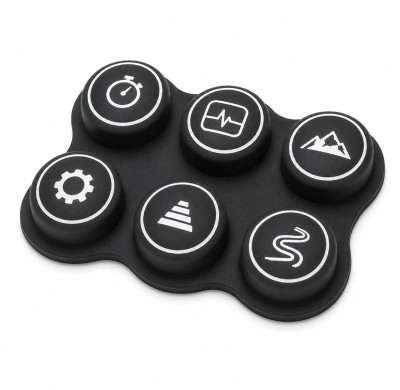
Unlike extruded or die-cut rubber, a molded part can carry sealing lips, ribs, conductive pads and multi-colour graphics in a single piece, with no secondary assembly.
That is why molded rubber appears wherever a component has to seal, damp vibration, or register a keystroke reliably over millions of cycles.
This guide covers what it is, how it is made, when a custom molded part justifies the tooling cost, and what to verify before choosing a supplier.
What Is Molded Rubber?
Molded rubber is rubber formed to shape inside a mold, rather than cut from sheet or pushed through a die. The cavity defines the outer geometry, and heat plus pressure cure the rubber so it holds that geometry permanently.
The same process covers a small keypad and a large industrial seal. It applies to both natural and synthetic grades.
Choosing the Right Rubber Grade
The material matters more than the process name, because each grade fails under different conditions:
- Silicone (VMQ) — the widest service temperature range of the common grades, plus weathering resistance, electrical insulation, and food-contact or medical options
- EPDM — strong resistance to ozone, UV and water, which is why it dominates outdoor, steam and automotive sealing
- NBR — resistance to mineral oils and fuels, used in oil seals and fuel-system parts
- Natural rubber (NR) — high resilience and tear strength where elasticity matters more than chemical resistance
How Molded Rubber Parts Are Made
The silicone rubber manufacturing process runs in four stages. Each one sets a limit on what the finished part can hold tolerance on.
Step 1: Compounding
Raw rubber is mixed with fillers, curing agents, colourants and process aids. This happens on a mill or in an internal mixer, until the compound reaches the required hardness and performance.
Step 2: Molding
The compound is placed into the cavity. Compression molding closes the mold onto a pre-formed blank. Injection molding forces the compound directly into a heated tool.
Step 3: Vulcanization
Heat cross-links the rubber molecules through sulfur or peroxide systems. This turns the soft compound into an elastic solid. The reaction is irreversible.
Step 4: Deflashing and Finishing
Flash is trimmed and parts may go through post-cure. Functional or decorative layers are added next: screen printing, spraying or laser etching. Final inspection comes last.
Custom Molded Rubber vs. Off-the-Shelf Parts
The decision usually comes down to volume against performance requirements. A standard part wins when tolerances are loose and a catalogue size is close enough.
A custom molded part wins when the component has to hit a defined compression force, seal against a specific surface, or carry branding and backlighting.
| Factor | Off-the-shelf part | Custom molded part |
|---|---|---|
| Dimensional fit | Closest standard size | Built to your drawing or sample |
| Tooling cost | None | One-time mold investment |
| Unit cost at low volume | Lower | Higher, tooling amortised |
| Unit cost at high volume | Higher | Lower |
| Design freedom | Limited to catalogue shapes | Multi-colour, conductive and backlit features in one part |
| Time to first part | Immediate | Includes tooling lead time |
Where Molded Rubber Parts Are Used
Industrial demand concentrates in applications where a failure is expensive, so repeatability matters more than unit price.
- Payment and POS terminals — keypads take continuous daily use
- Medical and diagnostic equipment — sealing and cleanability are functional requirements
- Automotive electronics — conductive rubber pills replace mechanical switches
- Industrial control and heavy machinery — ingress protection and abrasion resistance decide service life
- Instrumentation and metering — tactile feel is specified rather than optional
- Home appliances and consumer electronics — gaskets, feet and sleeves are molded rather than cut
These are the same industries that rely on custom silicone keypads.
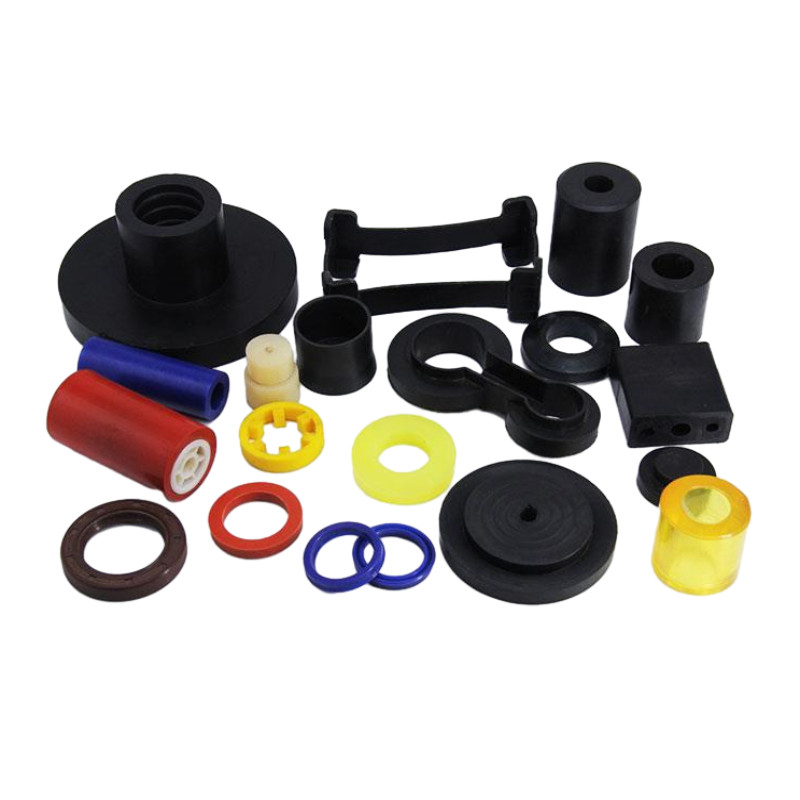
Representative parts produced on these lines include Verifone Vx520 silicone rubber keypads, conductive keypads for Yamaha PSR keyboards, silicone patches and garment labels, and 3M-backed adhesive silicone gaskets.
Choosing a Molded Rubber Supplier
The mold and the process determine the finished part. That makes supplier capability as important as the quotation. Five points are worth verifying directly:
- Whether the full sequence — compounding, molding, deflashing, post-cure, printing and final inspection — runs in-house or is subcontracted
- Whether the supplier owns its mold making capability, since design changes during sampling are normal
- Which test equipment is used for abrasion, keystroke life and hardness, and whether results are recorded per batch
- Which quality systems are certified rather than merely claimed
- How much project and tooling history sits behind the quotation
FromRubber (Dongguan Bohao Electronic Technology Co., Ltd.) has run custom silicone and plastic manufacturing in Qiaotou, Dongguan since 2010. The company operates two factories with 220 employees and more than 12,000 m² of workshop space.
Production is supported by 32 molding presses — 30 vacuum oil-hydraulic and 2 flat-bed oil-hydraulic — plus an in-house mold division. As of 2025 the company has developed 6,532 custom projects and holds 7,254 molds.
Typical lead times are 3–5 days for a sample mold and 10–12 days for a production mold, with quotations issued within three hours. The factories hold IATF 16949:2016, ISO 9001:2015 and ISO 14001:2015 certification.
Molded Rubber Limitations
Molded rubber is not the right answer for every rubber component. Knowing the trade-offs early avoids an expensive tooling mistake:
- Vulcanization is irreversible — once the compound is cured, the part cannot be reworked into a different shape
- Tooling is a front-loaded cost — very low volumes usually favour extrusion or die-cutting instead
- Material shrinkage affects tolerance — the compensation has to be built into the mold
- Deep undercuts and thin walls may require a design compromise or a more costly tool
- Each colour or material combination generally needs its own cavity or mold
- Hardness and colour are hard to change once production has started without re-tooling
Next Steps for a Custom Project
For a part that has to seal, switch or survive vibration, molded rubber is normally the practical route. For a simple flat gasket at low volume, it often is not.
If the right choice is unclear, a drawing or a physical sample is enough to run a feasibility review. Custom molded rubber products can be assessed against the in-house capabilities before any tooling is committed.
Enquiries with a drawing or sample receive a quote within three hours.