Electric Drill Silicone Keypad Designs Change as Tool Interfaces Become More Compact
A compact drill leaves the control panel barely wide enough for two gloved thumbs. That same panel is now expected to carry power, mode selection and battery status, three jobs that earlier generations spread across a mechanical collar, a trigger and a separate indicator lamp. Panel area did not grow when the function list did, and the part absorbing the difference is the silicone keypad.
Key facts
- Mode selection moved off the gearbox collar and onto the membrane with no increase in panel area.
- ISO 815-1 tests compression set at a constant strain of 25 percent on rubbers from 10 IRHD to 95 IRHD.
- In IEC 60529, the first digit of an IP code runs from 0 to 6, and 6 means no ingress of dust.
- OSHA 29 CFR 1926.1153 Table 1 requires a shroud and dust collection system on handheld and stand-mounted drills, impact and rotary hammer drills included.
- IEC 62841-2-1 covers hand-held drills and impact drills up to 3,700 W rated input and does not apply to rotary hammers.
The panel shrank. The function list did not.
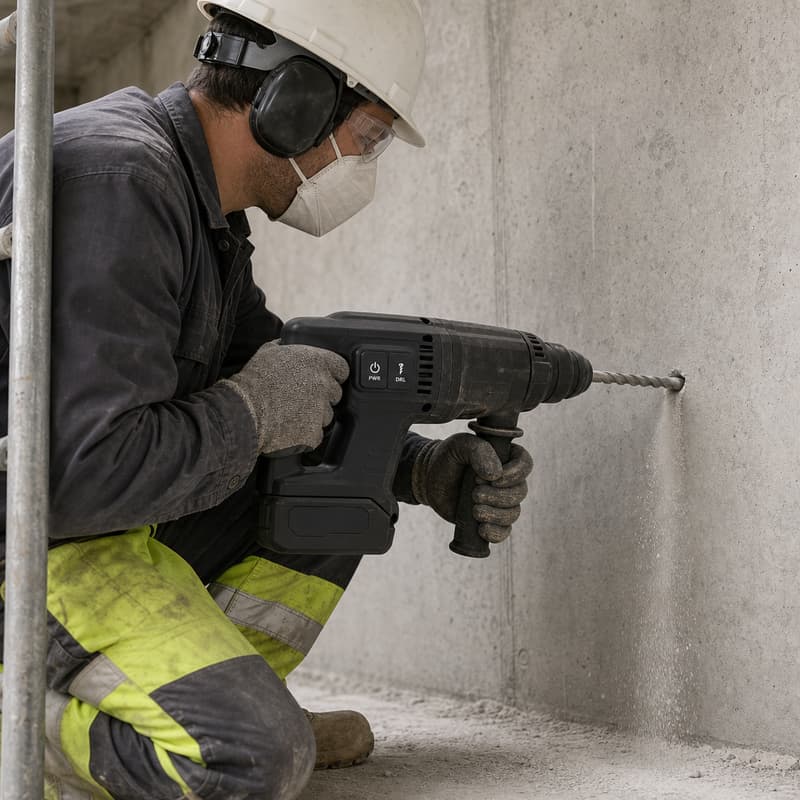
A rotary mode collar is the clearest example of what moved. Drill-to-hammer switching used to be a plastic ring around the gearbox, and it cost the panel nothing and the electronics nothing. Move that single choice onto the membrane, as the impact key on the tool below shows, and one function turns into one legend position, one dome, one pair of contact pads, one more aperture in the seal line, and one more place where a flat key web has to sit against a curved housing.
None of those costs is a problem taken alone. It becomes one because the housing height is already fixed by the battery platform and by the hand size the tool is built around. Every millimetre of key travel has to come out of the same depth budget as the switch board, the gasket and the wall thickness of the shell.
On the tool shown here, drilling into a concrete wall, the interface is two keys on the side of the body. The dust falling past that housing is the operating condition the seal has to survive for the life of the tool, not a worst case invented for a test report.
Three keys on a strip, four on a diamond
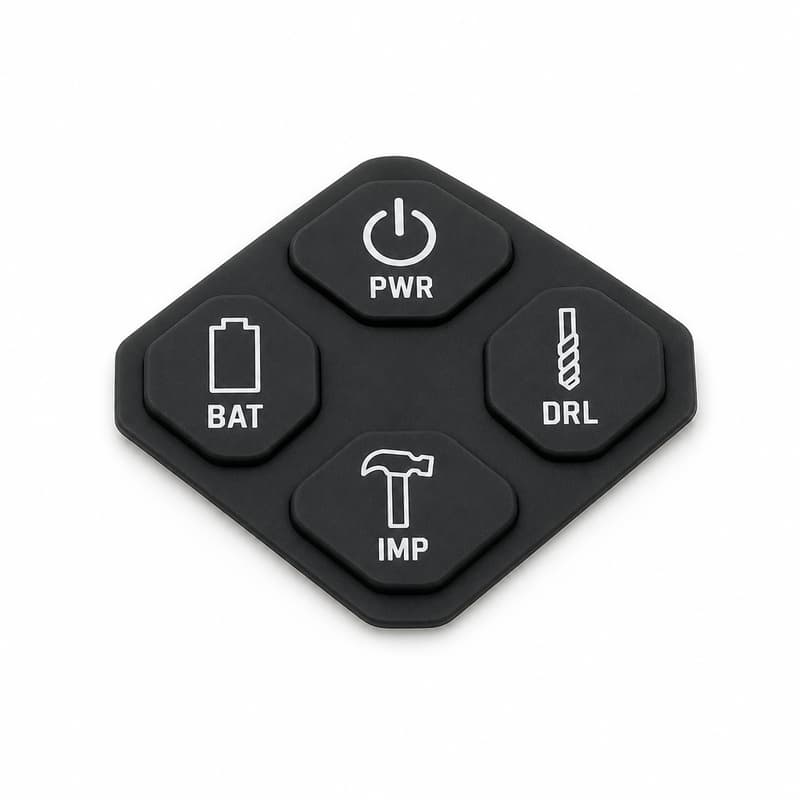
The two keypads below were tooled for drill interfaces at different function counts, and they show what one extra key does to the same panel rectangle.
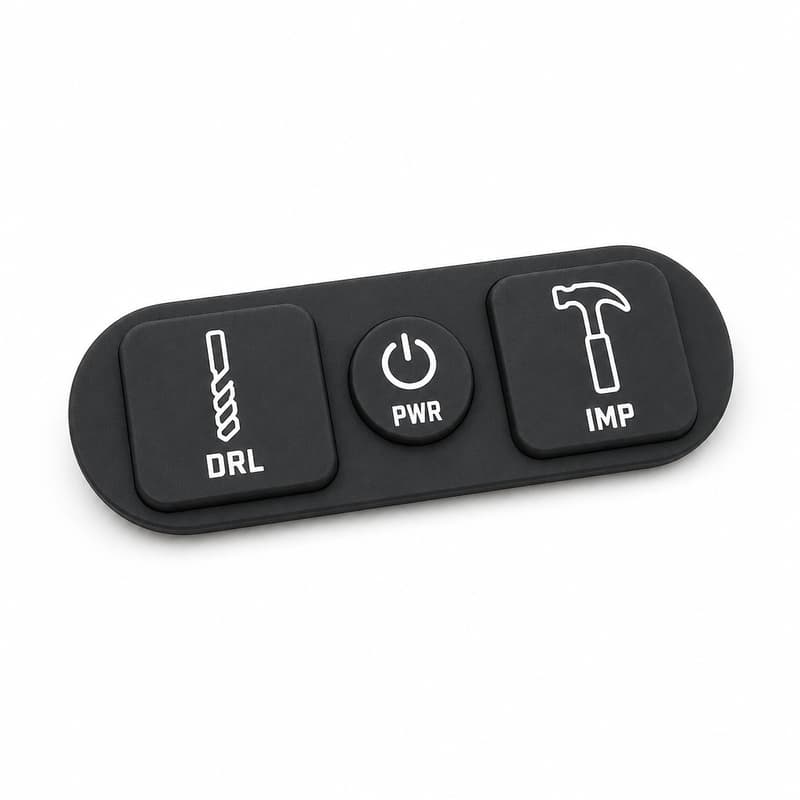
On the three-key strip the outer keys are the same size and the centre power key is a smaller circle. That is not proportion for its own sake. The top surface of a key sets how much force a gloved thumb can deliver before it slips, so a smaller key needs either a lower actuation force or a taller dome to stay usable in a glove. Moulding two key sizes onto one web also gives the web two stiffness regions, and the parting line has to run so that it crosses neither key top.
The four-key version runs into a different limit.
Four keys do not fit the strip outline at a key size a thumb can find without looking, so the corner keys rotate to hexagons and the whole outline becomes a diamond. Watch what that does to sealing. A diamond has a longer perimeter than a rectangle covering the same area, so there is more edge to seal against the housing, and the four points of the diamond are exactly where a compressed bead or gasket is least uniform. Adding a function costs a legend position on the drawing and real sealing performance on the moulding.
Compression set decides whether a key stays up
Ask what actually retires a tool keypad after eighteen months in a service van and the answer is usually compression set, not abrasion. ISO 815-1 defines the test at a constant strain of 25 percent for rubbers between 10 IRHD and 95 IRHD. A key that has taken set returns less than its full height, and the return of the dome is the only thing pulling the carbon pill off its contact pad. Lose a fraction of a millimetre of return and the key still feels correct on a bench, while sitting closer to the pad than the drawing allows.
Durometer is the number most drawings carry, and ASTM D2240 covers twelve hardness scales, of which only a couple apply to a keypad web. The number alone does not fix the behaviour either. Two silicones at the same Shore A can differ in compression set, tear strength and rebound depending on cure and post-cure, which is why a keypad specification that lists only hardness is not a specification. The same failure mode appears on other hand tools, and it was the subject of our earlier notes on angle grinder keypad failure under sustained high vibration.
Dust and vibration pick the material, not the colour sample
Masonry drilling produces respirable crystalline silica dust. OSHA's construction silica rule, 29 CFR 1926.1153, places handheld and stand-mounted drills, impact and rotary hammer drills among them, in Table 1, which requires a shroud and a dust collection system fitted with a 99 percent efficient filter. That is a fair indication of how much fine dust the tool is expected to work inside.
Ingress protection for the interface itself is defined by IEC 60529. The first digit of an IP code rates protection against solid objects on a scale from 0 to 6, where 6 means no ingress of dust. The wording matters. IP6X is a result from a dust chamber test, not a description of how tight a seal feels, and a tool carrying an IP5X interface claim has accepted some dust inside the enclosure.
Vibration is the second environment. NIOSH's power tool database lists 41.2 m/s² frequency-weighted hand-arm vibration for one hammer drill in its test set, and UK HSE guidance points to action where hammer action tools are used regularly for more than about 15 minutes a day. Vibration reaches the keypad two ways. It fatigues the adhesive or the mechanical retention holding the web to the housing, and it frets legend ink where a fingertip and grit meet. A legend applied as a surface print wears faster under that combination than a legend formed into the material.
The surrounding safety envelope rarely changes the keypad drawing, but it changes what the tool is tested against. IEC 62841-2-1 covers hand-held drills and impact drills up to 3,700 W rated input, and states plainly that it does not apply to rotary hammers. A tool sold as a hammer drill and a tool sold as a rotary hammer therefore fall under different clauses of the same family, and a programme that has not settled which one it is building will argue against the wrong test list. The 2014 edition of IEC 62841-1, the general part, added clarifications for soft materials in its clauses on mechanical strength and construction, treating elastomers as a distinct case rather than an afterthought.
Where the keypad sits in the drill bill of materials
One point is worth stating plainly, because it delays more drill programmes than any material decision: a silicone keypad is a mechanical part. It does not include the membrane circuit, the switch board, the tact switches, the battery, or any of the tool electronics.
On a recent 18 V drill interface refresh, FromRubber supplied the silicone keypad mouldings, the three-key DRL, PWR and IMP strip and the four-key diamond shown above, while the customer's own team kept ownership of the switch board, the firmware and the final assembly. That split is normal, and it only works when the two drawings are closed at the same time. Contact pad positions, available travel, actuation force and the flatness the web can hold are shared values, and neither drawing contains all of them.
The same split appears on other tool categories. The design questions repeat across cordless tools, which is why our notes on the design challenges of silicone buttons for angle grinders read like the same conversation with different part numbers. When the interface grows past a key strip into a full panel with windows and indicator areas, the tooling changes shape rather than principle, and the custom silicone rubber control panel format covers that larger case.
What to freeze before tooling is cut
Five values decide whether the first mould produces a usable part. They belong on the keypad drawing and on the circuit drawing at the same time.
- Compression set target for the actual durometer, not for the material family.
- Legend method, chosen against the grit the tool will meet: surface print, or a legend formed into the material.
- Key pitch at the smallest key, measured with the thickest glove the tool is rated for.
- Travel measured with the gasket compressed, never on a bare moulding.
- Retention under vibration, and a decision on which of adhesive or mechanical fixing the drop test is allowed to break.
Published numbers for key pitch and actuation force specific to power tool interfaces are thin. Most of that guidance sits inside the IEC 62841-1 clause set and the ISO 9241-400 ergonomics series, neither of which is free to read, so design reviews end up arguing from measured samples instead of from a table. Measuring five mouldings at both temperature extremes settles more arguments than a specification excerpt does.
The direction of travel on compact drills is not in question: more functions on the same panel area, and more of the panel's behaviour decided by the silicone. The useful question is no longer whether to specify the keypad early, but which values the keypad drawing and the circuit drawing are obliged to agree on.
Related reading
The companion piece on the screwdriver side of the same trend is cordless screwdriver silicone keypad applications expanding beyond basic start and stop controls. More on this topic in our technical notes: key design challenges of silicone buttons for angle grinders, angle grinder silicone keypad failure in high-vibration environments, and the custom silicone rubber control panel format. Further industry articles are collected under Industry News & Insights.
Sources and references
- [1]IEC 62841-2-1:2017, Electric motor-operated hand-held tools, transportable tools and lawn and garden machinery - Safety - Part 2-1: Particular requirements for hand-held drills and impact drills. Scope, rated input 3,700 W, rotary hammers excluded. https://webstore.iec.ch/en/publication/27770/
- [2]IEC 62841-1:2014, Part 1: General requirements. Listed technical changes include clarifications in respect to soft materials (elastomers) in Clauses 9, 19 and 13. https://webstore.iec.ch/en/publication/7448
- [3]IEC 60529, Degrees of protection provided by enclosures (IP Code). https://webstore.iec.ch/en/publication/2452
- [4]International Electrotechnical Commission, IP ratings. First numeral scale from 0 (no protection) to 6 (no ingress of dust). https://www.iec.ch/ip-ratings
- [5]ISO 815-1:2019, Rubber, vulcanized or thermoplastic - Determination of compression set - Part 1: At ambient or elevated temperatures. Scope covers 10 IRHD to 95 IRHD at normally 25 percent strain. https://www.iso.org/standard/74943.html
- [6]ASTM D2240-15(2021), Standard Test Method for Rubber Property - Durometer Hardness. Scope lists twelve durometer types. https://store.astm.org/d2240-15r21.html
- [7]29 CFR 1926.1153, Respirable crystalline silica, Table 1, row for handheld and stand-mounted drills including impact and rotary hammer drills. https://www.ecfr.gov/current/title-29/subtitle-B/chapter-XVII/part-1926/subpart-Z/section-1926.1153
- [8]NIOSH, database of sound power levels, hand-arm vibration levels and technical specifications of powered hand tools used in construction. https://stacks.cdc.gov/view/cdc/137475/cdc_137475_DS1.pdf
- [9]UK Health and Safety Executive, Hand-arm vibration: advice for employers. https://www.hse.gov.uk/vibration/hav/advice-to-employers.htm