Why Silicone Keypad Dome Collapse Happens on Medical Syringe Pumps
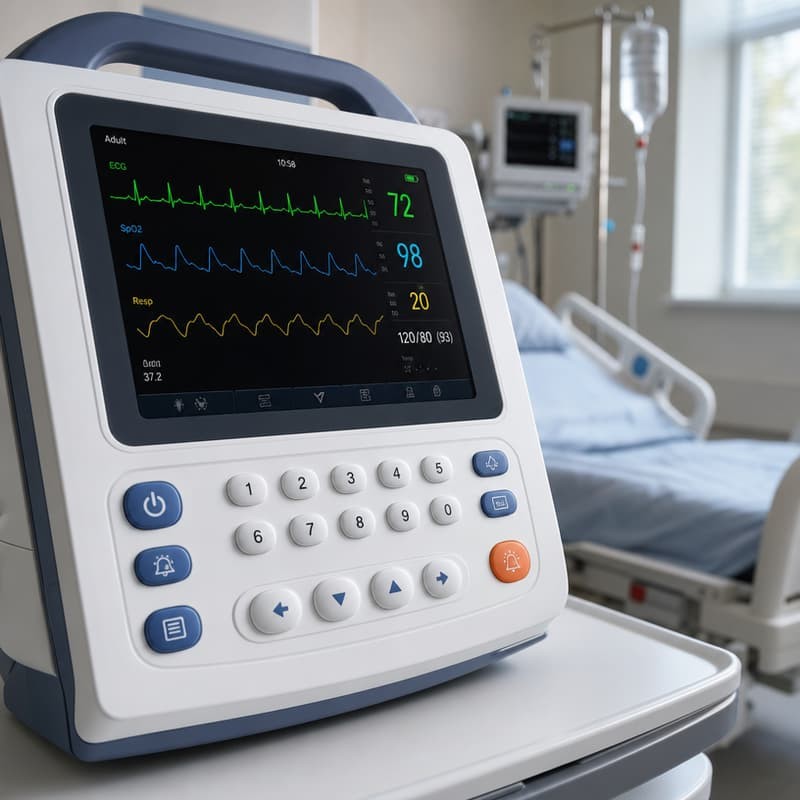
On a medical syringe pump, the silicone keypad dome is a safety-critical component. The dome's collapse — the snap that tells the thumb the button has engaged — also gates the tactile confirmation that a dose-rate change was actually registered. When a dome collapses permanently — flattens, loses its snap, or sticks in the down position — the clinician cannot tell whether the pump accepted the input, and that ambiguity is exactly the kind of failure a medical device cannot tolerate. This article explains why silicone keypad dome collapse happens on syringe pumps, the material science of compression set behind it, and the design and process controls that keep domes snapping for the life of the device.
What Dome Collapse Looks Like on a Syringe Pump Keypad
Dome collapse on a silicone keypad presents in three recognizable forms. The most obvious is a key that stays down after release — the dome has taken a permanent set. The subtler form is a key that still returns but lost its snap: the tactile breakover disappears, so the operator presses harder and longer, unsure whether the input registered. The third form is intermittent: the dome collapses fully at low temperature and returns at room temperature, creating a hard-to-reproduce "dead key" complaint that wastes engineering time.
All three forms share one root mechanism — the silicone dome has lost its elastic recovery — and that mechanism is measurable before the device ever ships if compression set is tested on the keypad compound.
Compression Set: The Hidden Driver of Silicone Keypad Dome Collapse
Compression set is the residual deformation a rubber keeps after being compressed for a period at a given temperature. For a silicone keypad dome, every press is a compression event, and over millions of presses the dome gradually loses the ability to return to its original height. The classic definition used in engineering references: if a material has high (poor) compression set, a large proportion of its original shape memory is lost upon prolonged compression — which in a keypad dome translates directly to lost travel, lost snap ratio, and finally a collapsed key.
Compression set is not a fixed material number; it depends on the formulation, the cure state, and the service temperature. Silicone compounds formulated for low compression set recover far better, which is why the compound choice, not the mold design alone, decides whether a syringe pump keypad still snaps in year five.
Mold Design and Material Mistakes That Accelerate Dome Collapse
Field returns and lab aging studies show that dome collapse in medical syringe pump keypads is usually a combination of several correctable mistakes:
1. Oversized or under-supported domes. A dome whose wall is too thin for its diameter buckles instead of snapping. The collapse point should be engineered at roughly 40–70% of the key travel, not left to chance.
2. Under-cured compound. A partially cured silicone dome has inferior elastic recovery. Cure time and temperature saved "to speed up the run" directly inflate the compression set number.
3. High-durometer compound chosen for feel. Harder silicone snaps crisply when new but has a higher compression set over time. The durometer must be balanced against the required cycle life.
4. Rib and skirt geometry that traps strain. Molding ribs that are too tall or too stiff hold the dome in a partially compressed state between presses, pre-loading the compression set.
5. Environmental soak. Syringe pumps are exposed to alcohol wipes, disinfectants, and occasional heat. Solvents that swell silicone change the compression set behavior and accelerate collapse.
Note that every mistake above is visible in the keypad's compression-set test data before production — none of them need to be discovered in the field.
Process Controls That Prevent Silicone Keypad Dome Collapse
Preventing dome collapse is a process discipline as much as a design discipline. The controls that matter, in order:
- Compound-level compression set testing. Require a compression set value (for example ≤ 20% at 150 °C / 22 h per the standard method) on the compound certificate for every lot.
- Cure-state verification. Shore A hardness plus specific gravity on every batch catches under-cure before molding.
- Cycle-life validation on the production tool. Run 500,000+ actuations on the first-article sample and measure travel loss, not just "still works."
- Solvent compatibility check. Soak samples in the actual disinfectant used in the target environment and re-measure dome height after recovery.
- Low-temperature snap test. Verify the breakover force at the minimum operating temperature — the coldest case is where collapse first appears.
Reading the Dome Geometry for Snap Potential
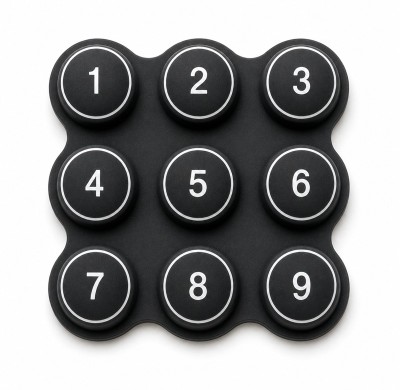
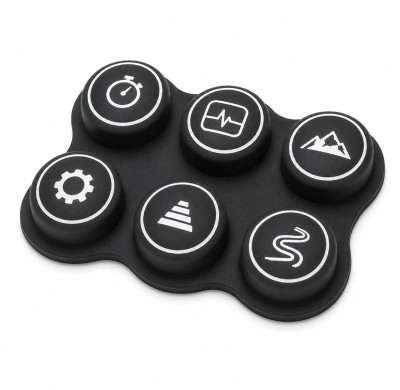
The geometry of a good snap dome is visible before any test: a shallow spherical cap with a controlled wall thickness, a smooth transition to the skirt, and a dome height that sits inside the key travel envelope. A dome that looks like a flat pancake on the print will collapse early, no matter how good the compound is. The relationship between force, travel, and snap ratio is covered in our deep-dive on silicone keypad tactile feel: force, travel, and snap ratio, and the structural remedies for weak rebound are in improving rebound feel through structural design.

Case: A Syringe Pump Recalled for "Stuck" Buttons
A syringe pump manufacturer faced a field pattern of START/STOP keys that felt mushy and, in some units, stayed down. The first reaction was to blame the front-panel assembly; the actual cause was in the keypad compound and the mold.
- Field data: complaints began at roughly 18 months of use; units in warm storage rooms failed earlier than units in cool rooms — a classic temperature-accelerated compression set signature.
- Lab finding: the production compound showed 34% compression set (150 °C/22 h) — well above the 20% target — because the supplier had substituted a general-purpose silicone to save cost. The dome wall was also 0.1 mm thinner than the approved drawing after a mold re-cut.
- Fix: reverted to the approved low-set compound, restored the dome wall thickness, added compression-set verification to the incoming inspection, and tightened the first-article cycle-life test to 500,000 actuations with travel measurement.
- Result: the subsequent production run passed 500,000-cycle validation with less than 10% travel loss, and the field complaint rate dropped to zero within one replacement cycle.
This case is the medical-device equivalent of the general lesson in compression set as the hidden killer of long-term silicone keypad reliability, and the "stuck or not returning" failure family is dissected in what causes a silicone keypad to stick or not return after being pressed. For the manufacturing side of medical keypads, our case study on medical infusion pump keypads covers the full production flow.
Specifying Collapse-Resistant Silicone Keypads for Medical Devices
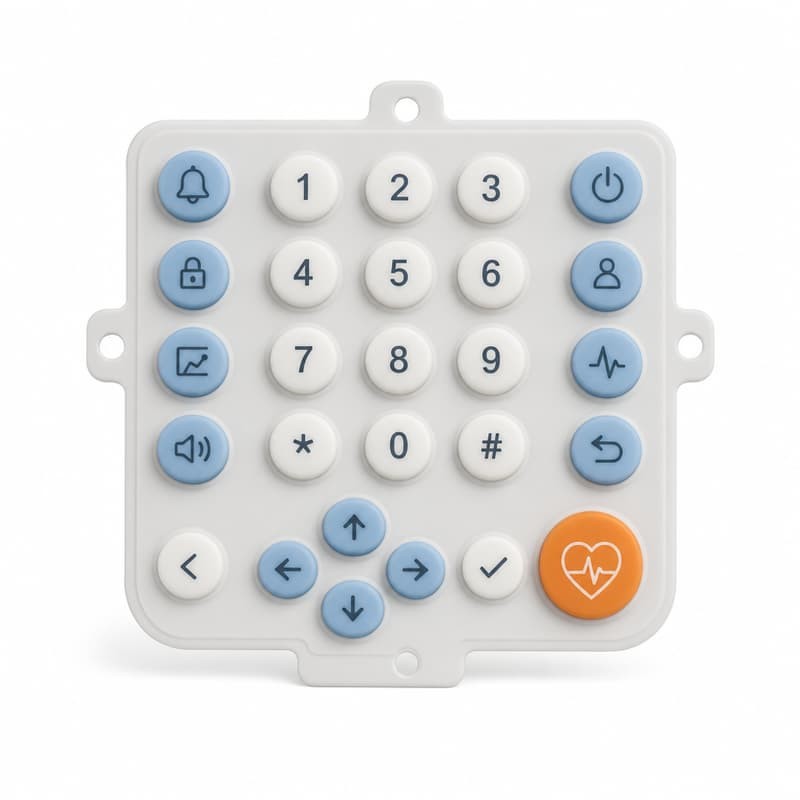
For a medical syringe pump or any device where a lost snap is a safety concern, the specification should make collapse resistance an acceptance criterion, not a hope:
- Compression set ≤ 20% at 150 °C / 22 h on the compound certificate, per lot.
- 500,000-cycle actuation with travel-loss measurement (accept ≤ 15% travel loss).
- Breakover force window stated at both ends of the operating temperature range.
- Solvent soak compatibility with the facility's disinfectant, verified on the actual compound.
- Dome geometry (wall thickness, dome height, snap point) frozen on the approved print with GD&T.
Design for the Decade, Not the Demo
A syringe pump sits in a hospital for five to ten years. The demo unit in your office will snap perfectly for years even with the wrong compound — the collapse shows up in the field, on the third shift, on the pump that has run continuously. Compression set testing, cycle-life validation, and solvent checks are the only way to see the decade of use in the first month of qualification.
Sources and further reading:
- JEHBCO — Low Compression Set in Silicone Rubber and Its Application in Seals (compression set mechanics)
- Xometry — Compression Set: Meaning, How It Works, and Why It Matters (loss of rebound and shape memory)
- Yuanyi — Understanding Silicone Rubber Keypad Complete Guide (keypad failure modes and elastomer damage)
About FromRubber (FrmRubber). FromRubber is a full-process silicone and plastic OEM manufacturer serving medical device OEMs with custom silicone keypads that must pass compression-set, cycle-life, and biocompatibility expectations. Our medical keypad projects ship with a complete material and test dossier, including compound certificates and 500,000-cycle validation reports. If your pump keypad has started feeling mushy, send us your current drawing and compound data — we will benchmark the compression set and return a corrective specification.