
Why Does a Silicone Hanging Drain Bag Sag? Design the Hanging Point and Bag Body Together
The bag hangs level in the showroom and hangs level in the photo, and then a customer fills it with potato peel and wet tea leaves, and by the end of the week the eyelet has gone oval and the top edge has cupped forward. Nothing tore. Nothing cracked. The product simply stopped looking like the sample, and the review says the silicone is too soft. It usually is not the silicone.
A hanging drain bag sags because three things are decided separately and then have to work together: how far the load sits from the anchor, how much material there is at the narrowest point of the strap, and how much the compound creeps under a load it never gets to rest from. Raising the hardness addresses the third and leaves the first two exactly where they were.
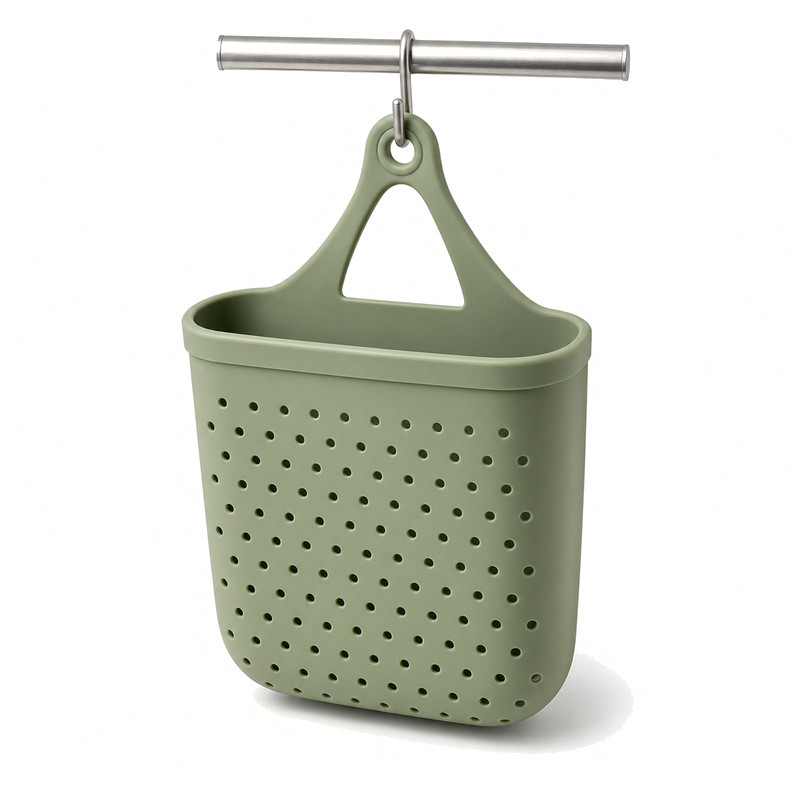
Look at where a hanging bag actually carries load. The contents sit in the body, the body hangs from the rim, the rim hangs from the strap, and the strap hangs from one hole. Everything the bag will ever hold passes through the wall of that hole.
That is a bracket, not a bag. Once you look at it as a bracket, the questions stop being about softness and start being about span, section and load line, which are answerable before a mould is cut.
Why Does a Silicone Hanging Drain Bag Sag During Use?
The hanging point may not support the weight of the filled bag
An empty bag puts a few tens of grams through the eye. A bag holding wet vegetable trim, a scrubbing brush and a couple of spoons can put a kilogram or more through the same few square millimetres, and it does it while hanging off one side of the anchor rather than straight down through it.
That offset is the part that gets missed. The anchor pulls up; the contents pull down behind it; the distance between those two lines is a lever arm, and the strap has to resist the bending that the lever creates. A strap that is 40 mm long and 8 mm wide is being asked to behave like a short beam, and short beams fail at their ends, not in the middle.
Widening the strap helps less than people expect, because width adds material close to the neutral axis. What resists bending is material placed away from that axis, which is why the depth of the section at the strap root, measured in the direction the bag swings, matters more than the strap's face width. This is the same relationship that governs any beam: resistance to bending scales with the second moment of area, and that quantity grows with the cube of the section's depth rather than linearly with its area. The reference note on second moment of area sets out the geometry if you want the arithmetic behind the intuition.
In service this shows up in a specific order. First the eye goes slightly oval. Then the strap's edges start to curl toward the load. Then the top edge of the bag, which was a straight line, becomes a shallow U. By the time a customer photographs it, the eye looks like the culprit, but the eye was only reporting what the strap could not resist.
A soft bag body can stretch and pull downward
The body is not a passive container either. Hanging load puts the upper wall in tension, and a wall in tension on a flexible material does what a rubber band does: it thins as it extends. The thinning is not uniform. It concentrates wherever the section is smallest, usually just under the rim where the wall turns from vertical to horizontal.
Once that band thins, the rim drops, the bag lengthens, and the bottom moves closer to the sink floor than the drawing said it would. Two consequences follow. The bag starts touching the cabinet door or the sink base, and the strap now carries load at a worse angle than it was designed for.
The practical answer is not uniform thickness. It is a thickness ladder that follows the load: heaviest at the eye and strap, still substantial around the rim, moderate down the upper wall, thinner at the lower wall and base where the material only has to hold contents rather than carry them. Adjacent sections should step rather than jump. The industry rule of thumb for moulded silicone parts is to keep neighbouring wall sections within about a 2:1 ratio and to put a fillet of at least 0.3 mm at the transition, a figure our own note on uneven walls, stress whitening and cracking sets out with the reasoning behind it. A strap at 3 mm meeting a rim at 1.2 mm is not a design decision, it is a hinge with a cosmetic cover.
Uneven weight distribution can make the bag tilt
Fill a hanging bag the way people actually fill it, all the heavy items at the front because the front is easiest to reach, and the centre of gravity moves forward and down. The anchor has not moved. The result is a slow rotation around the rail until something stops it: the rim touching the rail, the bag touching the wall, or the strap twisting.
Twisting is the damaging one. A strap in pure tension is comfortable; a strap in torsion is being asked to resist a force it has no section for, and it responds by folding along its length. That fold becomes permanent, because silicone under sustained load does not spring all the way back.
The design lever here is alignment, not strength. Put the eye in the same vertical plane as the loaded centre of gravity, even if that means the eye sits slightly forward of the bag's back face. A single eye that can rotate freely around the hook is more forgiving than two eyes on a wide tab, which fight each other the moment the load shifts to one side. And if the product is meant to hang on a rail rather than a hook, the eye should be a ring that bears on its lower arc, not a slot that bears on one corner.
How Should the Hanging Point Be Designed for Better Support?
Choose a hanging structure that matches the installation method
Four hanging structures cover most of this product category, and they are not interchangeable.
| Hanging structure | How it carries the load | Works on | Where it fails |
|---|---|---|---|
| Round eye | Around a ring of material, free to rotate | Rails and hooks that let the bag swing | An eye wall drawn thinner than the strap |
| Slot or keyhole | On one loaded edge | Fixed hooks that must not let go | The loaded edge deforms first |
| Hook-over tab | Over a broad contact area | Cabinet doors and thin panels | Nothing to press against on a round rail |
| Strap loop | In pure tension over the rail | Thick rails and temporary setups | Slides, twists, cannot be reinforced at the crossing |
The table is not a ranking. The question to settle with the buyer before any drawing is made is boring and decisive: what is this hanging on, and how thick is it? A 12 mm eye on a 20 mm rail will not hang at all. An eye sized for a 6 mm hook will sit on the rail's shoulder instead of its underside, and the bag will lean from day one. When one strap has to serve a family of bodies, the choice stops being engineering only and becomes a tooling decision; which hanging features are worth tooling sets out how to weigh it.
Reinforce the area around the hanging hole
Reinforcement around the eye should be a local boss, not a global thickening. The material wants to be thickest in the ring itself and taper into the strap over a distance of at least the strap's own width, so the load spreads before it reaches thinner sections.
Two details decide whether the reinforcement actually works. The first is that the eye's wall thickness in the direction of pull should be at least the strap thickness, not less. It is common to see a strap of 3 mm flowing into an eye of 1.8 mm because the eye was drawn last and sized to look delicate, and that eye is now the weakest section in the entire load path.
The second is demoulding. A thickened eye is usually formed by a core pin through the hole, and any reinforcement has to be on the outside face where the tool can open. Push the thickness inward and you create a shelf inside the ring that traps water and residue, which is a cleaning problem dressed up as a strength improvement. The relationship between a rim detail and the slot it creates is covered in more depth in designing a hanging drain bag so residue leaves with the water.
Avoid sharp transitions between the hanging point and bag body
The strap meets the rim at a change of plane: a flat vertical strap arrives at a curved horizontal rim. Where that change happens without a radius, the part has a fold line built into it, and folds concentrate stress at their ends.
Stress concentration is the reason the failure appears where it does rather than where the load is highest. A step, a sharp inside corner or a sudden change of width multiplies local stress well above the nominal value in that section, and the multiplier climbs as the radius shrinks. The general treatment of stress concentration is worth reading once, because it explains a whole class of complaints that get filed under "material failure".
As a working rule, the fillet where the strap meets the rim should be comparable in radius to the strap's thickness, and the strap should widen gradually into the rim rather than arriving at full width. Both changes cost nothing in material and nothing in tooling complexity. They cost a little in the drawing.
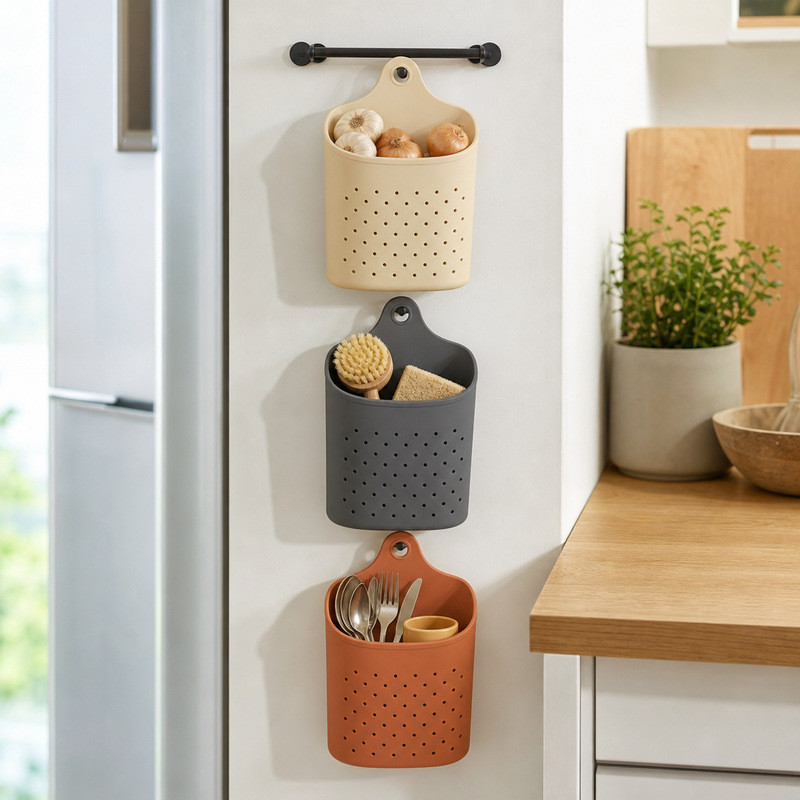
Products in a family are often tooled from one strap design and differentiated by body size. It keeps tooling cost down and it is reasonable, up to the point where the largest body in the range carries three times the load through an eye that was sized for the smallest.
If a range shares one hanging geometry, size that geometry for the heaviest member and accept that the smallest bag is over-built. The reverse, sizing for the average and hoping, is how a range acquires one bad SKU.
How Does Bag Body Design Affect Hanging Stability?
Match wall thickness to the size and intended load
A 1.2 litre bag and a 3 litre bag should not share a wall thickness, because the load scales with volume while the wall's ability to carry it scales with section. The bigger bag has longer spans, more contents and a lower centre of gravity, all of which increase the bending at the strap.
What stays constant is the logic: thick where the load passes, thin where it does not. The rim carries the body, so it needs depth. The upper wall carries tension, so it needs continuity more than bulk. The lower wall and base mostly hold contents, and making them as thick as the rim adds weight, cost and stiffness without improving the hanging behaviour.
Any specific number belongs to a specific part. Wall thickness has to be set against the bag's dimensions, the contents it is expected to hold and the compound chosen, and then confirmed on a moulded sample rather than argued on a drawing.
Use the bottom shape to distribute weight more evenly
The base is where a hanging bag either shares load or concentrates it. A flat base with a small corner radius creates a fold line where the floor meets the wall, and the floor then hangs from that line rather than from the whole perimeter. A continuous curve from wall into base spreads the same load across a much longer path.
The base also acts as a hoop. When the bag is filled, the walls try to spread, and the base resists that spreading by being in tension around its perimeter. A base that is too narrow lets the walls splay outward at the bottom, which pulls the rim inward at the top, which is the mechanism behind a bag that looks pinched at the opening once loaded.
Shape decisions also have a drainage consequence, because the lowest point of the inside surface is what decides where water leaves. That trade-off is worth working through separately, and it is covered in why a loaded draining basket changes shape.
Balance flexibility with shape retention
Hardness is the first thing everyone reaches for and the last thing that should be changed. On the Shore A scale the modulus does not move evenly: a 50 Shore A compound sits near 2.5 MPa, 60 Shore A near 3.6 MPa and 70 Shore A near 5.5 MPa, so the step from 60 to 70 adds more than half again to the stiffness. The figures are tabulated in the standard reference on Shore durometer hardness and its relation to elastic modulus, and they explain why a two-step hardness change often overshoots.
Stiffening the whole bag also moves the problem rather than solving it. A harder bag transmits more load into the eye and the strap, which are the sections least able to take it, and it makes the bag worse to squeeze into a small sink. The useful combination is a compliant body with a locally stiff rim and a properly sectioned strap: soft where the user's hand goes, stiff where the load goes. The rim is the harder half of that balance, because the opening has to resist ovalisation without turning rigid; why a soft rim lets the opening close up works through the section geometry.
Silicone also creeps. Under a sustained load it continues to deform slowly rather than reaching a fixed deflection and stopping, and part of that deformation does not come back when the load is removed. This is why a bag that passed a ten-minute load test can still be visibly longer after a month on a rail, and why the difference between elastic recovery and creep matters when you write an acceptance criterion. Our note on why a moulded silicone cup loses its shape after repeated use separates the two, and the distinction applies unchanged to a hanging bag.
What Should Be Checked Before Approving a Custom Silicone Hanging Drain Bag Sample?
Test the bag under realistic loading conditions
Do not sign off on an empty bag. An empty bag tells you the mould is complete; it tells you nothing about the product.
Load the sample to roughly 1.5 times the heaviest contents you expect, hang it on the rail or hook it will actually be sold for, and leave it for 24 hours. Measure three things before and after: the eye's internal diameter in the load direction, the distance from the anchor to the far bottom corner, and the straightness of the top edge. Those three numbers describe the whole failure mode, and they are cheap to record.
Check the hanging point after repeated use
Hang and remove the loaded bag fifty times in a row. This is not a fatigue test in any formal sense, it is a check for the two things that show up early: whitening at the eye, which means the material is yielding locally, and permanent elongation of the eye, which means the section is too thin for the load.
Then leave it loaded for another day and see whether the whitening spreads. A small white mark at the eye's inner edge after fifty cycles is a design note. A white band running the full width of the strap is a redesign.
Confirm the fit with the intended sink or hook
Fit is not only the hole. Check that the bag's back face clears the cabinet door through its swing, that the base clears the sink floor with a full load, and that the bag does not sit against the tap's arc. A bag that hangs correctly and blocks the tap is still a return.
Check the eye against the actual rail or hook too, not a nominal diameter. A rail with a bracket at each end often has a slightly larger effective diameter at the bracket, and a bag that slides freely in the middle will jam at the end.

A cabinet-door installation changes the load case more than it looks. The door is thin, the hook sits on its top edge, and the bag hangs against a vertical face that it is not allowed to touch, because touching means rubbing every time the door moves.
That rules out a narrow eye. It also means the strap cannot be too short: the rim needs to sit clear of the door's edge, or the hook will bear on the rim instead of the strap and the reinforcement is in the wrong place.
What should buyers confirm before requesting a quotation?
- Overall dimensions, capacity and the heaviest contents the bag must hold.
- The mounting method and the real thickness of the rail, hook or door it will hang on.
- Target hardness, and whether the bag should be squeezable or hold its shape.
- Whether the eye and strap need local reinforcement, and whether the reinforcement may show on the outside face.
- Colour, surface texture and whether the texture is allowed to run across the strap.
- Whether a new mould is needed or an existing body can be re-tooled at the strap only.
Conclusion: A Stable Hanging Bag Starts With Coordinated Structural Design
The eye, the strap, the rim, the wall and the base are one load path. Change any of them and the others feel it. A bag that sags is usually a bag where the strap was drawn to look right and the body was drawn to hold the right volume, and nobody checked the two against each other.
The cheapest time to fix that is on a section view, before tooling. Put the anchor point, the loaded centre of gravity, the strap's narrowest section and the fillet radii on one drawing, and the argument about hardness tends to disappear.
Why does my silicone hanging drain bag sag even though the silicone feels firm?
Because firmness at the surface is not the property that resists bending. A firm compound in a thin strap still flexes, and the eye still deforms. The section at the strap root and the distance between the anchor and the load matter more than the hardness reading.
Will a harder silicone stop the bag from stretching?
It will reduce the stretch and increase the load transferred into the eye and strap. If those sections are not reinforced at the same time, the bag stops stretching and starts cracking at the hanging point instead.
Can the hanging point be reinforced without a new mould?
Sometimes. If the reinforcement is added on the outside face and the change is inside the existing tool's clearance, the tool can be modified. If the eye's internal geometry changes, the core pin changes, and that usually means a new tool or a re-cut insert.
How long should a loaded sample hang before approval?
Long enough to see creep rather than elastic deflection. Twenty-four hours under 1.5 times the expected load is a practical starting point for a kitchen product, followed by a recovery check after the load is removed.
Sources and related reading
- Uneven walls, stress whitening and cracking in moulded silicone — the 2:1 adjacent-section ratio and fillet guidance used above.
- Elastic recovery versus creep in flexible silicone — why a loaded part keeps moving after the load stabilises.
- Why draining baskets deform under load — the same load path viewed from the base and handle.
- Second moment of area and stress concentration — the two geometric relationships behind strap depth and fillet radius.
- ASTM D2240, Standard Test Method for Rubber Property — Durometer Hardness — the method behind any Shore A figure quoted for a sample.
This article describes design geometry and general material behaviour. Deflection, creep and recovery vary with the actual compound, section and load, and should be measured on your own moulded sample against criteria agreed before tooling.
Discussing a hanging bag design?
Send the anchor type, the loaded weight, the bag's overall dimensions and a section view through the strap. Those four items usually settle the hanging geometry before a tool is quoted.
- Email: nani@fromrubber.com or karl@fromrubber.com
- WeChat / WhatsApp: +86 18676210913
- FromRubber, Dongguan Bohao Electronic Technology Co., Ltd. — custom silicone parts for kitchen and household products. Hanging bags sit alongside the baking and serving tools in our silicone kitchenware range.