
Why Do Silicone Draining Baskets Deform Under Load? Design Factors to Check Before Production
A draining basket can pass every dimensional check on the sample table and still disappoint the first customer who fills it. Filled with wet greens, the base bows downward, the two long sides lean out, and the basket no longer sits flat on the sink. Nothing was broken. The mould matched the drawing. What failed is the way load travels through a perforated shell, and that is a design question rather than a material one.
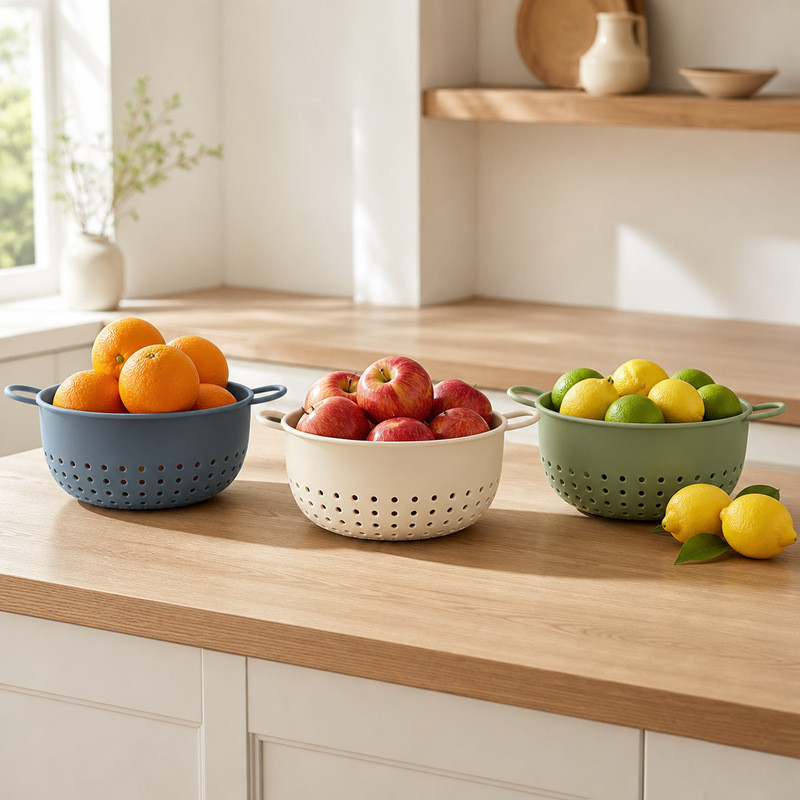
A basket photographed empty tells you almost nothing about its structural behaviour. The same basket photographed with fruit still only tells you how it behaves with that particular load, at that particular temperature, resting on that particular surface.
Buyers who understand the difference between those three states tend to approve samples faster, and they tend to spend less on tooling revisions later. This article is about the checks that separate the three states before a mould is cut.
Why Can a Silicone Draining Basket Lose Its Shape Under Load?
There are two different events that get described with the same word. The first is elastic deflection: the shell bends while it carries something and returns when the load is removed. The second is a permanent change of shape, where the basket stays distorted minutes or hours after it has been emptied. They have different causes and they call for different fixes, so the first diagnostic step is simply to notice which one you are looking at.
A Flexible Material Still Needs Enough Structural Support
Silicone is chosen for a draining basket because it does not chip, does not rattle in the sink, and can be squeezed into a crowded cupboard. That same flexibility is what allows the walls to move. A finished basket therefore has to earn its rigidity from geometry rather than from the material alone: the curvature of the base, the depth of the wall, the ring formed by the rim, and the amount of continuous material left between the drainage openings.
It is worth being precise here, because general statements about silicone being "flexible but strong" hide the actual variable. Behaviour depends on the compound, the hardness, the wall section, the geometry, the temperature of the water, and how long the load stays in place. Two baskets with the same durometer reading can behave quite differently if one has a dished base and the other has a flat one.
Wet Food Can Create More Stress Than the Empty Product Suggests
Water does two things at once. It adds mass, and it lubricates contact between pieces of food, so the contents settle into a denser, lower pile than dry produce would. A basket of wet leafy vegetables distributes that mass fairly evenly across the base. A basket holding a handful of dense roots or a pile of fruit does the opposite: it concentrates load into a small patch, usually slightly off centre, exactly where a person set it down.
The load is also not static. Lifting the basket by two ears converts the shell into a beam spanning between them, which is a very different loading case from a basket resting on the bottom of a sink. A design that looks stable when supported underneath can sag visibly the moment it is carried.
Temporary Flexing and Permanent Shape Changes Need Different Checks
When we review a sample, we look at it three times: empty and flat on the bench, loaded for a few minutes, and again twenty-four hours after unloading. The first look establishes the reference shape. The second shows where the deflection starts. The third shows whether anything stayed behind.
Permanent set is the name for the distortion that remains after unloading and after the part has had time to recover; it is measured, not estimated. On a draining basket it often starts at a few tenths of a millimetre and grows each time the same section is loaded again.
Persistent distortion after unloading points towards something different from simple stiffness: a section that was stretched beyond what it can recover from, a thin ligament between holes that has been drawn out, or a rim that has been asked to act as a beam when it was designed as a decorative edge. If the basket returns to shape but feels unstable while loaded, you are usually dealing with a stiffness problem rather than a material problem.
Mark the outside of the basket at four points on the rim and one at the centre of the base with a fine permanent marker before loading. Photograph the basket against a plain background, loaded and unloaded, from the same angle. A phone on a stand is enough. Measuring the printed photograph is faster and more honest than trying to remember how far the base seemed to drop.
The same distinction is set out in our note on why a silicone cup loses its shape after repeated use, which separates elastic recovery, creep and permanent set rather than treating shape loss as one problem.
Which Design Features Make a Silicone Draining Basket More Likely to Sag?
In a perforated shell, the holes are not holes added to a structure. The pattern of remaining material between them is the structure. Once you look at the basket that way, the usual list of suspects becomes easier to reason about.
A Wide Base With Too Little Support Can Bend in the Middle
The base is the widest unsupported span in the product. Its behaviour depends on how far the material has to travel between supported edges, and on whether that travel is flat. A gently dished base resists downward movement better than a flat one because the curvature has to be flattened before the centre can drop. A flat base with a large open span relies almost entirely on its own thickness.
Ribs, steps, and local changes in section can help, but they only help where they connect two supported areas. A short rib in the middle of a flat panel adds weight without adding much stiffness. When ribs are planned, it is worth reading our notes on rib design and sink marks first, because the same rib that stiffens the part can also leave a visible depression on the opposite face.
Thin Sidewalls May Spread Out When the Basket Is Filled
The contents push outward, so the walls are working in hoop tension. A shallow wall carries that tension comfortably. A tall wall with a thin section and a wide open top has very little to resist it, and the rim simply moves outward as the contents settle. This is why a tall basket often feels less stable than a shallow one of the same volume.
There is a real trade-off here that no drawing resolves on its own. The wall has to be thin enough to squeeze and to fold if the product is meant to fold, and thick enough that it does not flare when loaded. Deciding which of those two matters more is a product decision, and it should be made before the tooling, not after the first sample.
Drainage Holes Can Reduce the Material Available for Support
Hole diameter and hole spacing together determine the width of the ligament between openings. Narrow ligaments behave like a chain of small hinges. They are also where stress concentrates, and they are the first place a tear will begin if the base is pushed or the basket is dropped.
Two patterns can have the same total open area and behave completely differently. A pattern of many small holes leaves more continuous material and distributes stress, but it may blind over quickly with food and it slows drainage. A pattern of fewer, larger holes drains faster and cleans more easily, but it removes long runs of the material that was holding the base flat. The right answer depends on what the basket will hold, which is why we ask for the food type rather than only the drawing.
The Handle and Rim May Not Support the Load Evenly
Two ear handles concentrate the entire carried load into two small areas. If the handle joins the wall through an abrupt step, that step becomes the highest-stress point in the product, and it is usually where a basket first cracks or whitens. A continuous transition from handle into rim into wall spreads the load far better than a handle that looks as if it were glued on afterwards.
The instinct to solve all of this by adding material everywhere is worth resisting. More material in the base does nothing for a handle that is badly connected, and it makes the basket heavier to hold, which increases the load at the handles. Stiffness should be placed where the load path is, not spread evenly over the product.
| What you see | What it usually means | Where to look first |
|---|---|---|
| Base centre drops and stays dropped | Unsupported span too long for the section, or load concentrated off centre | Base span, dish depth, section at the centre |
| Long sides bow outward | Wall too thin for its height, or rim too weak to hold the opening | Wall height, rim section, top corrugation |
| Opening turns oval under load | Rim acting as a loose edge instead of a ring | Rim thickness, wall-to-rim transition |
| Whitening or thinning at the handle | Load entering through an abrupt step | Handle-to-rim radius, material continuity |
| Ligaments stretch between holes | Perforation removed too much continuous material | Hole pitch, ligament width near the base radius |
| Basket twists when lifted by one ear | Asymmetric load path, no torsional support | Handle position, base-to-wall junction |
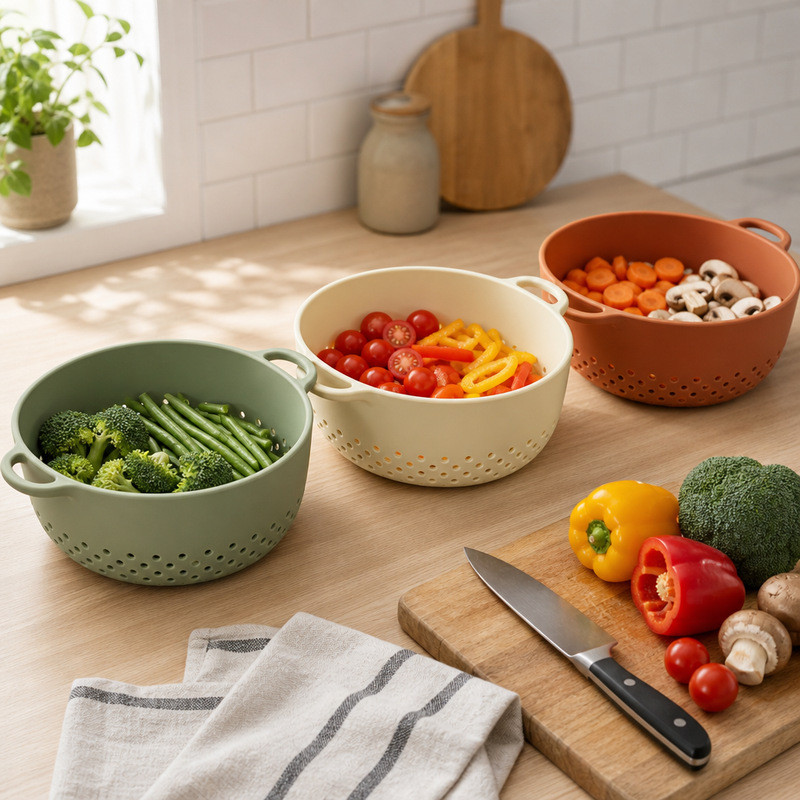
The photograph above shows the situation that most often exposes a weak base. Three different foods, three different densities, and a load that is nothing like evenly distributed. The basket on the right is carrying the heaviest contents in the smallest area.
When a sample is evaluated only with a neat, centred, uniform load, this case never appears. It is worth building an awkward load on purpose: a few dense items placed deliberately off centre, then a lift by both handles, then a set-down on a hard surface.
Would a Harder Silicone Compound Solve the Deformation Problem?
Sometimes it helps. It is rarely the whole answer, and it is worth understanding why before committing to a compound change that also changes how the product feels in the hand.
Higher Hardness Can Improve Resistance to Bending, but It Is Not a Complete Fix
A harder compound raises the stress needed to produce a given deflection, so a basket in a harder material will generally feel firmer. It will not, however, correct a base whose centre is a long way from any support, and it will not fix a handle joined through a sharp step. Hardness also does not describe everything: tensile strength, tear resistance, and compression set all matter, and they do not move together when hardness is adjusted.
It is worth knowing what the numbers on a datasheet actually measure. Hardness is indentation resistance, measured by durometer under ISO 48-4:2018; tensile strength and elongation come from a tensile test to ISO 37:2024. Both describe the material, and neither tells you how a base spanning 200 mm will deflect, because deflection is governed by geometry. That is the reason two suppliers can quote the same 70 Shore A and deliver baskets that behave differently.
Thicker Walls May Improve Support but Can Affect Flexibility and Weight
Thickness is a more powerful lever than hardness for bending, because stiffness rises steeply as a section gets thicker. That steepness is exactly why thickness is easy to over-apply. A wall that has been thickened to stop a flare may become difficult to squeeze, heavier in the hand, slower to cool after washing, and more expensive in material. It may also change how the part fills in the mould, which shows up later as dimensional variation rather than as an obvious defect.
Our article on uneven walls, stress whitening and cracking looks at the same trade-off from the durability side, and the conclusion transfers: uniform, well-transitioned sections usually outperform thick ones with abrupt steps.
Material and Structure Should Be Evaluated Together
The productive way to frame the decision is as four variables that move together: the intended load, the product dimensions, the wall and base sections, and the material options. Fixing three of them and negotiating the fourth is how most successful projects proceed. Fixing the geometry and then shopping for a compound that will make it work is how projects spend money on samples that never converge.
How Can Buyers Check Load Stability Before Mass Production?
Define the Intended Load and How the Basket Will Be Used
Write down what the basket is expected to hold, roughly how much it will weigh, whether the load is usually even or concentrated, whether the basket is carried by hand or left resting in a sink, and whether it will be used with hot water or placed in a dishwasher. That last point matters more than buyers expect, because warmth softens the material and makes a marginal section behave worse.
Inspect the Base, Sidewalls, Rim, and Handle Connections
A practical inspection sequence, in the order that problems usually appear:
- Base: does the centre drop, and does it drop evenly or twist to one side?
- Sidewalls: do the long sides bow outward, and does the rim move with them?
- Rim: does the opening stay roughly circular or oval, and does it recover after unloading?
- Handles: is there any whitening, thinning, or visible stretching where the handle meets the wall?
- Hole pattern: are the ligaments between holes stretching, and is the stretch concentrated near the base radius?
Test the Sample in Both Loaded and Unloaded Conditions
Observe during loading, immediately after unloading, and again the following day. Record what you see rather than what you conclude. There is no universal acceptance number for how much a basket may deflect, because a shallow fruit basket and a tall vegetable basket have different jobs; what matters is that the criteria are agreed in writing before samples are made, and that the same criteria are applied to every revision.
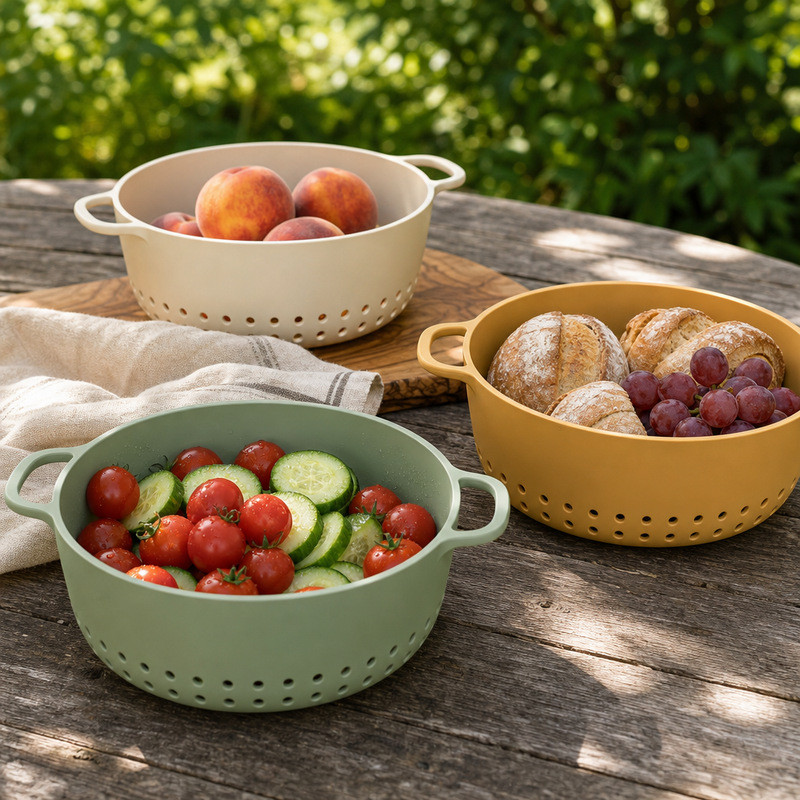
A basket used on a picnic table is often set down on an uneven surface, which means the load is carried by a few points of the base rather than by the whole of it. That local loading is harsher than a flat bench and it is a good way to find the weak area of a design quickly.
It also changes the drainage story. On a table, water has nowhere to go except through the holes and onto the wood, so a base that holds a shallow pool becomes immediately obvious to the user.
What Should Be Reviewed Before Opening a Custom Silicone Mold?
Before tooling, the review should confirm overall width, depth and height, the span of the base, wall thickness at several points rather than one, the rim section, handle position, and the drainage layout including ligament width. It should also confirm how those numbers change where features meet, because a wall that is 2.5 mm in the middle of a panel and 1.2 mm at the base radius is a different product from the drawing that says 2.5 mm.
The second question is whether the geometry can actually be moulded and demoulded. Openings, ribs, undercuts, and abrupt section changes all affect tooling design, material flow, and how consistently the part comes out of the press. A design that is elegant on screen can require a mould that is difficult to vent or difficult to strip, and those difficulties turn into variation across a production run rather than into a single obvious fault.
Resolving a structural problem at the drawing stage is almost always cheaper than resolving it by adjusting a finished mould. Once steel exists, every change competes with the cost of the tool, and teams start accepting a product that behaves slightly worse than intended. That compromise is the one worth avoiding.
How Can a Custom Silicone Manufacturer Help Reduce Design Risk?
The useful contribution from a manufacturer is not a promise that nothing will deform. It is a structured review: reading the drawing against the intended load, flagging sections that will not survive the way the product is carried, suggesting where stiffness is worth adding and where it is wasted, and agreeing on how the sample will be judged.
FromRubber has been moulding custom silicone parts in Dongguan since 2010, with two plants, in-house tooling, and a technical team that reviews drawings before a mould is cut. That review covers exactly the questions in this article: base span, section transitions, handle connections, hole layout, and the load the product is really expected to carry. If a design needs a change, it is better to hear it at the drawing stage. You can see the range of parts we produce on the custom silicone rubber parts page, and the review process is described under technical support.
Frequently Asked Questions
Why does my silicone draining basket sag in the middle?
Usually because the base spans a long distance without support and the section is not thick or curved enough to resist it. Concentrated loads and carrying the basket by its handles make it worse.
Should I use thicker silicone for a stronger draining basket?
Thicker sections help where the load path runs, and hurt where they make the product heavy or hard to squeeze. It is usually better to thicken selectively than to thicken everywhere.
Can drainage holes weaken a silicone basket?
They reduce the continuous material available to carry load, and they concentrate stress at the edges of each opening. Hole size and spacing matter as much as hole count.
Can a silicone draining basket be redesigned after the first sample?
Often yes, but the cost depends on which features change. Section and hole changes may be possible within the existing tool; changing the base profile or overall dimensions usually means a new mould.
What information should I send a manufacturer for a custom draining basket quote?
Dimensions, a drawing or 3D file, the intended contents and approximate load, the drainage requirement, any material preference, the estimated order quantity, and a reference sample if one exists.
Sources and further reading
- Uneven walls, stress whitening and cracking in silicone parts — how section transitions concentrate stress, which is the mechanism behind handle and hole-edge failures.
- Why a silicone cup loses its shape after repeated use — separating elastic recovery, creep and permanent set, the distinction used in this article.
- Rib design and sink marks in compression-moulded silicone — what happens on the reverse face when ribs are added to thin panels.
The observations above come from part and tooling reviews carried out on custom silicone projects at FromRubber. They describe general design behaviour rather than measured performance of a specific product; deflection and recovery should always be confirmed on your own sample against criteria you have agreed in advance.
Discussing a basket design?
Send the drawing, the intended contents, and how the product will be carried. We will tell you which sections we would change before tooling, and which ones we would leave alone.
- Email: nani@fromrubber.com or karl@fromrubber.com
- WeChat / WhatsApp: +86 18676210913
- FromRubber · Dongguan Bohao Electronic Technology Co., Ltd.
- Qiaotou Town, Dongguan, Guangdong, China
- IATF 16949:2016 · ISO 9001:2015 · ISO 14001:2015