Why Do StairClimber Silicone Keypad Quotes Vary by 3x? Materials, Molds, and Yield Explained
Send one stair climber silicone keypad drawing to three moulders and the quotes come back far apart, sometimes by a factor of three. The instinct is to assume two of them are marking up the job. That is rarely what happened. What usually happened is that three different parts were quoted, and the difference is written in the tolerance line, the cavity count, the secondary operations and the inspection plan rather than in the price column. Comparing the totals without comparing the exclusions is how a project buys the cheap quote and pays for it in rejections.
A quote is a specification with a number attached
The useful question is not who is cheapest. It is what each quote leaves out. A stair climber silicone keypad quote that does not name a tolerance class, does not name a hardness band, does not state whether a top coat is included and does not state how force is inspected is not a cheaper version of a complete quote. It is an unspecified one, and the moulder has priced the version of the job that is easiest to make.
That is why the first comparison should be done on the exclusions rather than on the totals. Two quotes for the same part that differ widely are usually separated by four lines: the tolerance class, the tool, the material documentation and the secondary operations. Yield and inspection follow on from those, and yield is where the rest of the gap lives.
Tolerance class is the first variable nobody reads
The ISO 3302-1 standard defines classes of dimensional tolerance for moulded rubber products, running from the fine class through to the coarse class, with the general commercial grade being the class most commonly applied. The classes are not close to each other. A keypad quoted to a fine class and a keypad quoted to the general commercial class will be inspected differently, will have different mould maintenance requirements, and will have different cavity layouts to hold the tolerance.
The same logic applies to the two properties that decide how the panel feels. Hardness is measured by ASTM D2240 or the ISO 48 equivalent, and quoting a band of plus or minus three points against a band of plus or minus five points is a different level of process control at the press. Actuation force on a silicone keypad is commonly handled with a tolerance of roughly twenty-five grams around the design target, and a quote that names one panel-wide target is not the same job as a quote that names a force band per key group and a release-force floor.
Compare five lines, not one. Put the quotes side by side against these five items before comparing totals: tolerance class and hardness band; force specification per key group including a release-force floor; cavity count and who owns the tool; which secondary operations are inside the price; and the inspection method and acceptance level. In most three-way comparisons, at least two of the five differ, and that difference alone accounts for a large part of the spread.

Geometry complexity moves the tool, and the tool moves the price
A keypad tool is not one price. It is a price per cavity plus the work that the cavity has to do. A simple domed key in a flat panel is straightforward to split and to polish. A key with an undercut, a moulded light window or a stepped flange needs a more complicated parting line, more inserts, or a second tooling operation, and the cost of that shows up once in the tool and then forever in the cycle time and the maintenance interval.
Published tooling ranges give a sense of the span. One supplier puts the expected tooling cost for a standard silicone rubber keypad between roughly £2,500 and £4,000, explicitly driven by complexity and number of cavities. A 2026 moulding cost guide gives the same message from the other end, with custom moulded rubber parts landing anywhere from a fraction of a dollar to over a hundred dollars per piece and single-cavity tooling starting in the high hundreds. The spread in tooling is the spread in geometry, not the spread in supplier margin.
Cavity count is where the volume curve lives
The second large variable is how many parts come off the press per cycle. Silicone keypads are normally compression moulded, and compression tooling is built as a matched set of plates where the cavity count is decided by the part size, the press size and the quantity the customer expects to buy. A single-cavity tool and an eight-cavity tool are different investments and produce different unit costs, and the crossover point depends on the order quantity rather than on the part.
This is the mechanism behind the familiar observation that the same keypad has a very different unit price at 500 pieces than at 50,000 pieces. Our own published guidance on custom silicone keypad minimum order quantities puts the range at roughly 500 to 3,000 pieces depending on whether a dedicated mould is required, and that range exists precisely because the tooling has to be amortised against a quantity. A quote that assumes a shared or existing tool is not comparable with a quote that includes a new dedicated tool, even when both are labelled as a price per piece.

Secondary operations are charged by the minute, not by the part
Everything that happens after demoulding has a time cost attached, and the time is set by the process rather than by the size of the part. Screen printing a legend adds a print step per colour plus a cure. Laser etching adds machine time per part, so a panel with four etched icons costs more in etching time than a panel with one, even though the moulding is identical. A polyurethane or epoxy top coat adds another pass and another cure, and design guidance for printed silicone keypads treats that coat as the mechanism that supplies the abrasion resistance rather than as a cosmetic extra.
This is where two quotes can diverge while both are technically correct. One prices a printed legend with no coat. The other prices an etched legend with a coat. The second is more expensive, and it is not the same product. The comparison only becomes meaningful once the secondary operations are listed line by line.
Material, documentation and colour
Two quotes for what looks like the same silicone can still differ on the compound. A specified commercial grade with a stated hardness band, a defined cure system and a documented colour match is not priced the same as an unspecified general-purpose grade bought on hardness alone. Colour adds a further variable, because a matched colour has to be verified on the finished part rather than on the raw compound, and re-matching after the first sample is a cost that lands either in the tool or in the unit price depending on who agreed to absorb it.
Documentation is the part buyers underestimate. If the keypad has to be supplied with material declarations, a hardness test record or an abrasion result, somebody is doing that work and tracking it per order. It is a small line on a quote and a large line in a supplier's overhead, and it is one of the first items to disappear when a quote is aggressively trimmed.
Yield and inspection: where the last of the gap hides
Once tolerance, tool, material and secondary operations are aligned between two suppliers, most of the remaining difference is yield and inspection. Yield on a silicone keypad is not a single number. It is the reject rate at the press from short shots, contamination and flash, plus the reject rate in the secondary operations from print registration or etch depth, plus the reject rate at final inspection from force and travel measurement.
Thin bridging webs, deep stipple textures and tight tolerance bands all reduce yield, and a supplier who has quoted a fine tolerance class and a deep texture has to price the yield that comes with them. The visible consequence on a factory floor is that the same physical part can be produced at two very different rejection rates, and the difference is absorbed either into the unit price or into the delivery schedule.
- Press rejects from bridging webs that are too thin, from flash on a flange, and from short shots in deep texture areas.
- Print and etch rejects from registration, ink adhesion and etch depth consistency across a multi-cavity plate.
- Assembly preload rejects when the flange geometry does not hold consistent compression across a multi-cavity tool.
- Force and travel rejects when a panel-wide force target is measured per key and the outer cavities sit at the edge of the band.

The specification you cannot see on the quote
The final variable does not appear on any quote and decides most of the after-sale cost: is force inspected on the assembled panel or on loose mouldings? A supplier who signs off on loose mouldings can be perfectly compliant and still ship a panel that feels wrong once it is screwed into a housing, because the preload was never part of the measurement.
That is the item worth paying for. On a stair climber silicone keypad, a quote that includes assembly-level force and travel verification is more expensive per unit than one that does not, and it is usually the cheapest line on the whole project once a single field complaint is priced in. When two quotes differ by a factor of three, this is very often the line where they differ.
What differs most often, in order
- The tolerance class and whether a hardness band is specified at all, which changes mould maintenance and cavity layout.
- Whether a new dedicated tool is included or an existing tool is assumed, which changes the amortisation entirely.
- Whether the legend is printed, etched or coated, which changes per-unit process time.
- Whether material documentation and colour matching are inside the price.
- Whether force and travel are verified on the assembled panel or on loose mouldings.
- Whether freight, packing and tool maintenance are in the unit price or excluded.
Case: three quotes for one stair climber panel, and none of them wrong
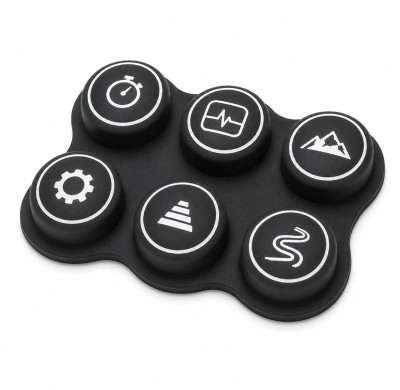
Symptom. An equipment maker received three quotes for a six-key stair climber keypad, spread by roughly a factor of three, all against the same drawing. Tendered as-is, the lowest quote won.
Measurement. When the quotes were compared line by line rather than by total, the three were describing three different parts. The lowest quote assumed the general commercial tolerance class, a single-cavity tool, a printed legend with no top coat, a panel-wide force target with no release-force floor, and inspection on loose mouldings. The middle quote added a fine tolerance class and a multi-cavity tool but kept the printed legend and the panel-wide force target. The highest quote added the etched and coated legend, a per-key-group force specification, and assembly-level verification.
Root cause of the gap. Not margin. Roughly half of the spread was the tool and its amortisation, a quarter was the secondary operations on a coated etched legend, and the remainder was the inspection and yield allowance that came with the tighter tolerance class and the assembly-level force check. Each quote was internally consistent with the specification it had silently assumed.
Outcome. The project was re-tendered with the five comparison lines written into the drawing, which made the quotes directly comparable and moved the decision from price to specification. The part that shipped used the middle tooling with the etched and coated legend and the assembly-level force check, at a unit price above the lowest quote and well below the highest.
What it suggests. A factor of three between quotes is almost always a factor of three between specifications. The work is to find out which lines differ before the order is placed, not after the first rejected lot.
FAQ
Why is a silicone keypad tool so expensive relative to the part?
Because a keypad tool is a matched set of cavity plates that has to produce consistent force, travel and sealing across every cavity, and it has to survive the temperature and pressure of compression moulding. Tooling for a standard silicone rubber keypad is commonly quoted somewhere in the range of a few thousand pounds for a simple part, rising with the number of cavities and the complexity of the geometry.
Is a cheaper quote always a worse part?
No, but it is a different specification until proven otherwise. A cheaper quote can be entirely correct if the application tolerates the commercial tolerance class, a printed legend and inspection on loose mouldings. The failure is not choosing the cheap quote, it is choosing it while believing it delivers the specification of the expensive one.
What single question closes most of the gap between quotes?
Ask where the force and travel measurement is taken. A supplier who verifies on the assembled panel has priced a different level of process control than one who verifies on loose mouldings, and the two answers cannot both be right for a part that has to feel correct in a housing.
Conclusion
A stair climber silicone keypad quoted at three different prices is usually three different specifications wearing the same part number. Put the tolerance class, the tool, the material documentation, the secondary operations and the inspection method on the drawing before the enquiry goes out, and the quotes converge to a spread that reflects real differences rather than assumed ones. FromRubber moulds custom silicone keypads and button panels for fitness and industrial equipment, including compression tools, printed and laser-etched legends, and assembly-level force verification, and quotes against a stated specification rather than an assumed one.
This article was written by the moulding engineering team at FromRubber, a custom silicone keypad and button manufacturer in Dongguan, China. We mould control panels for fitness, medical and industrial equipment. The line-by-line comparisons described here are the ones we use when we review a customer's existing drawing before quoting.
Related reading
Sources
- [1] ISO 3302-1:2014, Rubber — Tolerances for products — Part 1: Dimensional tolerances, classes M1 to M4 for moulded rubber products. https://www.iso.org/obp/ui/#iso:std:iso:3302:-1:en
- [2] Ejay Rubber, ISO 3302-1 tolerance M-classes for moulded rubber products, class definitions and common usage. https://ejayrubber.com/pdf/ISO%203302-1%20Tolerances%20M%20Classes%20for%20Molded%20Rubber%20Products.pdf
- [3] Zorge, DIN ISO 3302-1 rubber lexicon — four tolerance classes from M1 fine to M4 coarse. https://www.zorge.com/en/rubber-lexicon/din-iso-3302-1/
- [4] Diamond HMI, What does it cost to tool a silicone rubber keypad — expected tooling range and the effect of complexity and cavity count. https://www.diamondhmi.co.uk/what-does-it-cost-to-tool-a-silicone-rubber-keypad/
- [5] Engelhardt, Custom rubber molding cost: 2026 pricing guide — tooling from single-cavity upwards and the range of moulded part prices. https://meitu-engelhardt.com/custom-rubber-molding-cost/
- [6] CSI Keyboards, Intro to compression molding silicone for rubber keypads — matched top and bottom tool construction. https://csikeyboards.com/intro-to-compression-molding-silicone-for-rubber-keypads/
- [7] ASTM International, Standard Test Method for Rubber Property — Durometer Hardness, ASTM D2240-15(2021). https://www.astm.org/d2240-15r21.html
- [8] Epec Engineered Technologies, Rubber Keypad Design Guide — keypad design tolerances and force guidance. https://www.epectec.com/keypads/design/
- [9] Silicone Factories, Silicone screen printing vs laser etching for HMI keypads — matte polyurethane top coats and wear testing. https://www.siliconefactories.com/silicone-screen-printing-vs-laser-etching-keypads/
- [10] FromRubber, The real cost of a cheap industrial controls panel silicone keypad. https://www.fromrubber.com/blog/The-Real-Cost-of-Cheap-Industrial-Controls-Panel-Silicone-Keypad_b33673
- [11] FromRubber, What is the MOQ for custom silicone remote keypads — 500 to 3,000 pieces depending on dedicated tooling. https://www.fromrubber.com/f762588/What-is-the-MOQ-for-custom-silicone-remote-keypads.htm