What Makes a Good Control Silicone Button for Commercial Coffee Machines?
A commercial coffee machine rarely dies of a failed pump. It dies of a button that stopped answering. The COFFEE key that needs two presses at 7:40 a.m. The one that fires by itself when a barista wipes the panel down. The one whose legend has worn to a grey smudge after a year of sanitiser and steam. The control silicone button for commercial coffee machines is the cheapest part on the bill of materials and the only one that takes the full force of the cleaning routine, every single day.
Why does the button fail before the brew group does?
Look at what the button actually lives through. It is pressed with wet hands, with milk on them, sometimes through a cloth. It is sprayed, wiped and rinsed with a sanitiser that is alkaline, chlorinated or acidic depending on the site. It sits a few centimetres from a group head that releases steam and atomised coffee oil. Meanwhile the brew group gets a scheduled service and a lubricated rebuild.
The button gets nothing. It is assumed to be passive because it is only a piece of rubber. From a keypad engineering perspective, that assumption is where most of the trouble starts: a control silicone button is not a passive cover, it is a three-interface component, and all three interfaces are exposed.

Three interfaces, one molded part
The first interface faces the operator: the keytop, its graphics and its finish. The second seals the housing, because the same continuous silicone membrane that lets the keys flex is also the barrier that keeps liquid out of the electronics. The third closes the circuit underneath, where a conductive carbon pill, a metal dome or a tact switch meets the board.
On a beverage machine these three interfaces are coupled. Raise the keytop height to make it easier to find with a thumb, and you change how the skirt behaves when the panel is wiped. Change the legend from screen printing to laser etching, and you change how the surface takes a sanitising wipe. Nothing here is a single-part decision.
What do real commercial machines actually specify?
Manufacturers rarely publish keypad engineering data, but the service documentation is more revealing than the marketing pages. Reading the parts and support documents of machines already in the field shows three recurring approaches.
- Rancilio's Epoca Model S uses a silicone rubber button cover that presses directly onto the dosing control board and shields the membrane switch underneath from moisture and coffee grounds. The same catalogue entry notes that this keeps the tactile feel crisp. That is the whole design brief of a beverage keypad in one sentence.
- Rancilio's Classe 7 is documented with a soft-touch keypad and backlit icons, which moves the interface from a printed legend to a lit one and adds a light window to the stack.
- BUNN's Ultra-2 lists a membrane switch kit as a replaceable service part, which tells you how the industry treats the panel: a consumable, replaced on site, not a lifetime component.
Those three examples describe the same thing. The panel is a wear item that is expected to be sealed against a hostile environment and expected to be replaceable.
Actuation force is a cleaning parameter, not a comfort setting
Most force conversations in beverage equipment start from operator comfort, which is the wrong end. Published keypad design data puts typical actuation force for conductive silicone designs in the 60 to 200 gram range, with keytop travel of roughly 0.03 to 0.07 inches, and recommends a snap ratio of about 40% to 60% for a legible click. That gives an OEM a workable window.
Now add the cleaning routine. A cloth drags across the panel at an angle. A spray hits the keytop edge. If the button is at the soft end of the force range and has a shallow snap, a wipe can be enough to close the circuit. On a machine with an automatic cleaning cycle, an unintended press can start a rinse into a cup that was not there.
The wipe-down test. Before releasing a beverage keypad to production, check it the way the panel is actually used: press it with a wet finger, then drag a damp cloth across the panel edge-to-edge and log any false actuation, then press it again and confirm the return force still lifts the keytop fully. A keypad that passes a force test but fails a wipe-down test is not finished.
Travel deserves the same treatment. Longer travel improves tactile feel and is more tolerant of a thick-glove press, but published comparisons note that longer keytop travel reduces the cycle life of the force cone. The engineering answer is not to pick a side. It is to define the force-travel curve, including actuation force, contact force, return force and the snapping point, and to test that curve rather than a single peak number.
Where cleaning chemistry meets material selection
This is the part of a beverage keypad brief that gets written last and matters most. Silicone is chosen here for reasons that are not really about feel.
For food contact, the U.S. regulation for rubber articles intended for repeated use permits silicone polymers and sets extractive limits for repeated-use applications, which is the benchmark OEMs point to when a panel could contact the product stream. For equipment itself, the NSF food equipment standards family covers sanitation requirements for food equipment and for the materials used in it. In Europe, the hygiene and cleanability requirements for food processing machinery define what a washable surface has to be.
Two test methods convert all of that into something a supplier can be held to. Durometer hardness, measured by ASTM D2240 or its ISO counterpart, is the number behind the words soft or firm, and it is the number that should appear on the drawing. Compression set, measured by ASTM D395 or ISO 815-1, is what tells you whether a skirt that is squeezed into a housing groove for two years will still spring back, or will take a permanent flat and stop sealing.

Sealing is the interface that gets designed by accident
The skirt is usually the last thing drawn and the first thing to leak. A flat flange that simply sits against the housing depends on how hard the assembly screws squeeze it. A skirt with a defined interference and a proper compression groove is a control, not a hope.
A practical habit: measure the interference on the assembled machine, not on the drawing. Silicone mouldings shrink and the housing is rarely as flat as its CAD, so the seal is decided by the pair, not by either part alone. When a panel weeps after cleaning, this measurement settles the argument faster than any visual inspection.
Case: the brewer panel that passed force and failed the wipe-down
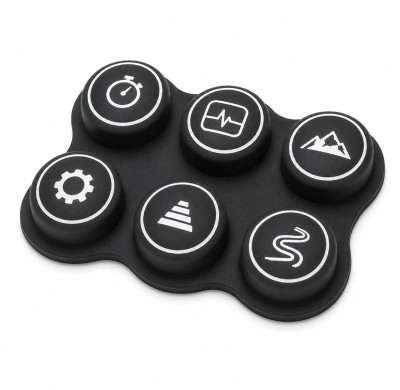
Symptom. A six-key panel for a counter-top beverage dispenser met its actuation force target on the bench, but the first pilot units logged unintended key activations during the end-of-day clean. Operators also reported that one key felt flat by the end of a shift.
Measurement. Force-travel curves were re-run on the assembled panel rather than on loose mouldings. The curves were within the target on the press axis, but a drag test across the keytop edge produced a partial collapse on two keys, and the return force at the end of the stroke was close to the contact threshold of the input circuit.
Root cause. Two separate issues had been hidden by testing the part instead of the assembly. The web around the two outer keys was thinner than the centre keys because of how the graphics area had been scaled, and the panel had a shallow flange seal that depended on screw torque, so the assembly preloaded the keys unevenly.
Change. Web geometry was balanced across the key row so that outer and centre keys produced comparable curves, the flange was replaced with a defined compression skirt, and the keytops were given a raised rim so that liquid runs off rather than collecting at the edge.
Verification. The reworked panel was re-tested as an assembly: force-travel curve per key, drag test across each key edge, return-force check at the end of stroke, then a heat-aged compression set check on the skirt material. That is the sequence we now run as standard on beverage machine keypads, and it is the reason the check order matters more than any single number.

The sequence that keeps a beverage panel out of the service call list
None of the individual checks in this article is unusual. What changes the outcome is the order, and doing them on the assembled panel rather than on the moulding: define the curve and the seal on the housing, choose the material against the real cleaning chemistry, and only then cut tooling.
Panels that come back to us for a second look almost always failed at the sequencing step rather than at the material step. The part was correct. The assembly was never specified.
What should be on the drawing for a commercial coffee machine keypad?
- Key-by-key function list, including which keys are pressed most often and which ones a cleaning cloth reaches first.
- Force-travel targets per key: actuation force, contact force, return force and the accepted snap ratio band.
- Hardness and compression set targets by test method, not by adjective.
- Sealing definition: skirt interference, groove geometry and the housing surface it seals against.
- Legend method and abrasion expectation, with the cleaning chemistry the panel will actually see.
- Assembly preload: how the panel is retained, at what torque, and which locating features set the key height in the fascia.
- Acceptance tests for the assembled unit, not just the moulding.
FAQ
Are silicone buttons suitable for machines that are cleaned with sanitiser every day?
That is the application silicone suits best, provided the compound and the legend method are chosen for the cleaning chemistry and the skirt is designed as a real seal. A silicone panel with a printed legend and a flat flange will not survive the same routine as a laser-etched panel with a defined compression skirt on the same machine.
Should a commercial coffee machine keypad use a conductive pill or a dome switch?
It depends on the board and the sealing requirement. Published comparisons note that conductive carbon pill designs allow longer travel and lower actuation force, while metal dome assemblies run higher force and shorter travel, and that a sealed dome assembly can be environmentally closed in a way a conductive pill cavity cannot. On beverage equipment, where the panel is washed, that sealing difference often decides it.
How soft should the buttons be?
Soft enough to seal and to feel, firm enough that a cleaning cloth does not operate them. In practice that means setting a force band and a return-force floor, then choosing the hardness that delivers the curve rather than choosing hardness first and measuring force afterwards.
What is the most common cause of a premature keypad failure on beverage equipment?
In our experience it is not material selection. It is specifying the keypad as a loose moulding and never testing the assembled panel. Almost every failure we look at is a curve, a seal or a preload that was defined by the housing, not by the keypad drawing.
Conclusion
A control silicone button for commercial coffee machines is a washdown interface with a switch inside it. Treat the force-travel curve, the sealing skirt and the food-contact material specification as three parts of one design, test them on the assembled panel, and the panel stops being the part that fails first. FromRubber moulds custom silicone keypads and buttons for beverage and appliance equipment, including sealed panels with icon or printed legends, and reviews force, travel and sealing data against the customer's housing and board before tooling is cut.
This article was written by the moulding engineering team at FromRubber, a custom silicone keypad and button manufacturer in Dongguan, China. We mould control panels for commercial beverage and appliance equipment. The checks described here are the ones we run on our own shop floor before a panel is released to production.
Related reading
Sources
- [1] Espresso Parts, "Rancilio Epoca Model S Dosing Circuit Button Cover", part reference R_1183 — silicone rubber button cover pressing onto the dosing control board and shielding the membrane switch from moisture and coffee grounds. https://www.espressoparts.com/products/rancilio-epoca-model-s-dosing-circuit-button-cover
- [2] Rancilio Group, "Classe 7" product documentation — digital display and soft-touch keypad with backlit icons. https://www.ranciliogroup.com/rancilio/classe-7/
- [3] BUNN, "KIT, MEMBRANE SWITCH ULTRA-2 BLACK", part number 32126.1004. https://commercial.bunn.com/32126.1004
- [4] Marco Beverage Systems, "Ecoboiler Service and Operating Manual" — front panel push button and cleaning instructions. https://lamarzoccousa.com/wp-content/uploads/2012/08/Ecoboiler-Service-and-Operating-Manual.pdf
- [5] Epec Engineered Technologies, "Rubber Keypad Design Guide" — travel, force, life cycle and contact resistance ranges. https://www.epectec.com/keypads/design/
- [6] J.W. Electronic Components, "Design guide for rubber keypads" — actuation force, snap ratio and stroke definitions. https://www.jw-electronic-components.de/pdf/Design%20guide%20for%20rubber%20keypads.pdf
- [7] U.S. Food and Drug Administration, 21 CFR 177.2600, "Rubber articles intended for repeated use". https://www.ecfr.gov/current/title-21/chapter-I/subchapter-B/part-177/subpart-C/section-177.2600
- [8] NSF, Food Equipment Standards portfolio (NSF/ANSI 2, NSF/ANSI 18, NSF/ANSI 51). https://www.nsf.org/nsf-standards/standards-portfolio/food-equipment-standards
- [9] ASTM International, "Standard Test Method for Rubber Property—Durometer Hardness", ASTM D2240-15(2021). https://www.astm.org/d2240-15r21.html
- [10] ASTM International, "Standard Test Methods for Rubber Property—Compression Set", ASTM D395-18. https://store.astm.org/d0395-18.html
- [11] BSI, "Food processing machinery. Basic concepts. Hygiene and cleanability requirements", BS EN 1672-2:2020. https://knowledge.bsigroup.com/products/food-processing-machinery-basic-concepts-hygiene-and-cleanability-requirements