The 50,000-Cycle Myth: Rethinking Meter Silicone Button Pad Durability Standards
Durability Standards
Somewhere in the history of handheld meter specifications, the number 50,000 cycles became the default life target for a silicone button pad. It is a defensible number for a consumer remote control - and a serious undersell for a professional instrument that is expected to work for a decade. The gap between what the number means and what meters actually need is the subject of this article: where the figure comes from, what cycle testing really measures, and how to write a durability specification that matches the product.
1. Where the 50,000-Cycle Handheld Meter Keypad Number Comes From
The 50,000-cycle figure is a carry-over from consumer electronics practice, where a device is pressed a few thousand times a year and replaced in three years. A handheld meter used by a field technician is a different economic object: it is an investment, expected to last 5–10 years, and its most-used keys - power, enter, the numeric pad - can see 10,000–20,000 actuations a year in heavy use. A ten-year meter pressing its ENTER key 15,000 times a year accumulates 150,000 cycles on one key alone; the full keypad sees far more across all keys.
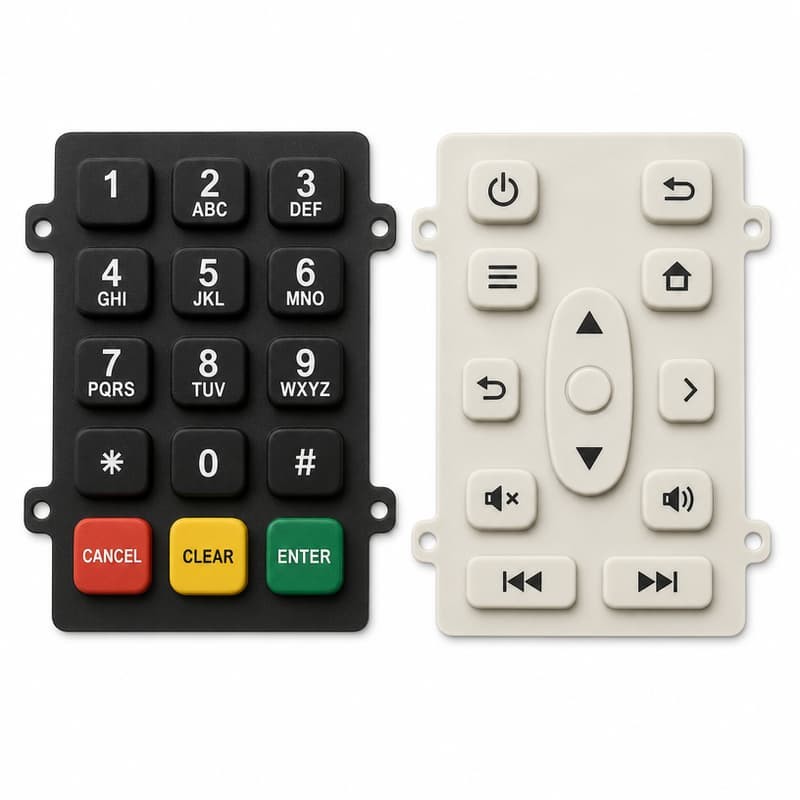
Published industry guidance on silicone keypad contact mechanisms puts realistic carbon pill life at 1–5 million cycles and typical conductive ink life at 100,000–500,000 cycles. Even the low end of that range is an order of magnitude above the 50,000-cycle myth. The gap matters because specifying 50,000 cycles tells the supplier nothing about the durability you actually need - and it permits material, contact and geometry choices that would never pass a million-cycle program.
Our guide to actuation cycles for industrial keypads frames the same question from the buyer's side.
2. What Cycle Testing Really Measures for a Meter Silicone Button Pad
A cycle test is not simply "press the key a million times". Done properly, it is a measurement of how the keypad's electrical and mechanical parameters drift over life. The test rig presses a key at a defined force and travel, at a defined rate (commonly 1–5 Hz), while periodically measuring contact resistance, actuation force and return travel. The pass criterion should be a drift limit - contact resistance below XΩ, force within ±Y% of initial - not merely "the key still works". A key that still conducts at 2Ω one day and 900Ω the next is a failure by any meaningful standard.
Three parameters define a meaningful cycle test:
- Test force and travel matched to the real actuation, including overtravel - most real-world wear happens in the overtravel zone.
- Monitoring points - measure at 0, 10k, 50k, 100k, 500k cycles, not just at start and end.
- Failure definition in writing - what resistance, force drift or return-lag value constitutes end of life.
Our analysis of the 0.1 mm tolerance that separates 1M from 5M clicks shows how a single geometric dimension shifts the life curve by millions of cycles.
3. How Contact Technology Changes the Durability Equation
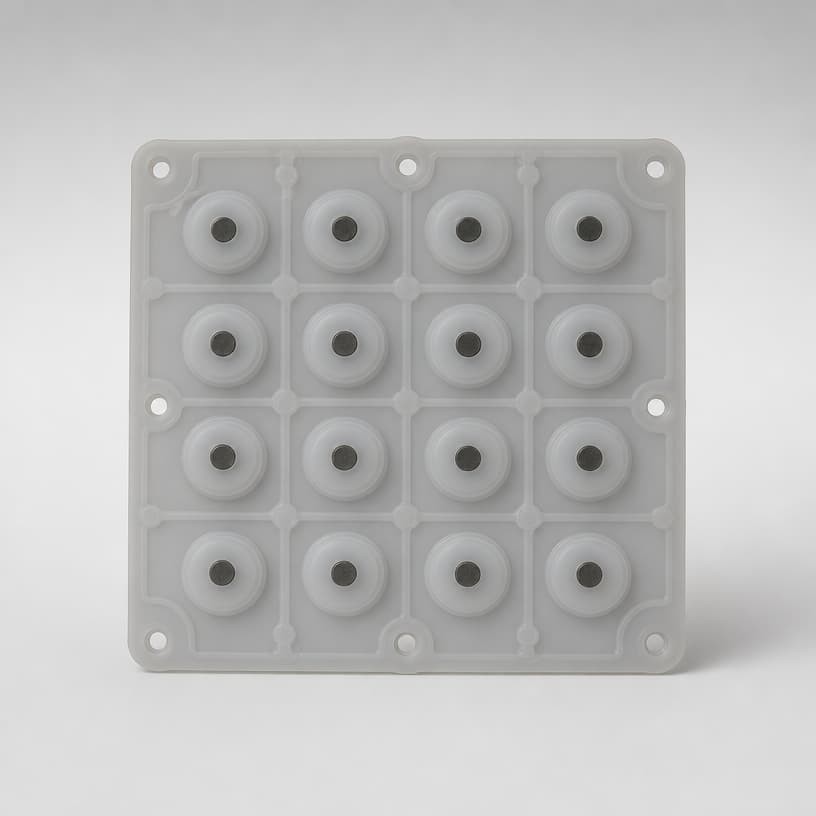
The contact system is the first durability discriminator. Carbon pills tolerate 1–5 million cycles with stable contact resistance against gold-plated pads; conductive ink systems wear much sooner; gold-plated domes extend life to 3–10 million cycles but add cost and assembly complexity. For a handheld meter, the practical decision is usually carbon pill (right-sized for 1–5M cycles) or gold contact (when the spec demands more). The durability spec should name the contact technology implicitly by setting the cycle target and drift limits - if the target is 1 million cycles, ink is out of the running from the start.
Mechanical durability follows the contact choice. Dome geometry, webbing thickness and material hardness set the force retention curve; a well-designed instrument keypad holds actuation force within ±15% of nominal through 500,000 cycles and remains usable to 1–2 million. The design rules that deliver this are covered in our durable tactile performance design guide.
4. Writing a Meaningful Durability Specification for Meter Keypads
A durability spec should fit in four lines. For a professional handheld meter, a defensible starting point is:
Cycle life: 500,000 actuations per key minimum, with continuous monitoring to 1,000,000 cycles.
Electrical: contact resistance ≤ 200Ω initial and ≤ 300Ω at end of life, measured at rated force.
Mechanical: actuation force drift ≤ ±20% of nominal; no sticking, no loss of return.
Test method: force/travel matched to real use, monitored at defined intervals, failure definition stated.
Compare that with "50,000 cycles minimum" and the difference is obvious: the second line of the four-line spec already tells the supplier more than the myth number ever did. For professional instruments that see daily use - like the internal resistance tester keypad program FromRubber documented at 500,000+ cycles of professional use - the four-line version is the norm, not the exception.
5. Case Study: Why a 500k-Cycle Internal Resistance Tester Keypad Passed
FromRubber worked with a battery tester manufacturer whose original specification asked for 50,000 cycles - inherited from a consumer product template. The tester was used eight hours a day by field engineers, and a keypad that died at 60,000 cycles would fail within eighteen months. The revised spec set 500,000 cycles with drift limits and gold-plated pads.
The engineering consequence was not cost - the keypad cost rose only a few percent - but design discipline: dome geometry was tuned for force retention, the webbing thickness was increased, and the material was changed to a high-strength grade with compression set below 15%. The prototype passed 500,000 cycles with contact resistance still under 150Ω and force drift under 12%. The tester now runs for years between service events, and the keypad design became the reference template for the company's whole instrument line.
6. Durability Testing Checklist for Silicone Button Pads
Set the cycle target from real use data (presses per key per year × design life), not a template number
Match test force and travel to actual actuation including overtravel
Monitor contact resistance, force and return travel at defined intervals
Write the failure definition into the spec before testing starts
Choose contact technology (pill / ink / gold) consistent with the cycle target
Require the supplier's raw test curves, not just a pass/fail statement
Sources and Further Reading
Durability figures draw on published industry material from LuphiTouch - Electrical Contact Mechanisms in Silicone Rubber Keypads, Google Patents - keypad durability prior art, and Diamond HMI - rubber keypad technical resources. Cycle test data reflects FromRubber validation records for instrument keypad programs.
Specify Durability That Matches Your Meter
FromRubber runs cycle testing with monitored drift data and helps instrument OEMs set realistic, defensible durability targets. Send your current spec for a review.
About FromRubber - FromRubber is a full-process silicone keypad and rubber button pad manufacturer for professional instruments, with in-house cycle testing, material qualification and reliability analysis.