Silicone Keypad for Handheld pH Meter: How to Design a Waterproof Keypad with Clear Tactile Feedback
The handheld pH meter on your line gets rinsed under a tap, used with gloves, splashed with buffer and dropped into a pocket. If the silicone keypad for the handheld pH meter is not sealed, the first rinse becomes a service call. If the keys feel dead through gloves, every calibration turns into a double-press lottery. The keypad is three components at once — the seal, the switch and the feel — and it fails all three before most other parts get a chance.
What Is a Silicone Keypad for Handheld pH Meter?
A silicone keypad for handheld pH meter projects is an input component, not the instrument. It is one molded silicone part: the keys, the base sheet that connects them, and usually the sealing lip around the edge. It sits between the operator and the PCB, and it does two jobs. Mechanically, it transfers the thumb press to a contact point on the circuit board. Electrically, it closes the switch under each key by pushing a conductive pill onto the PCB contact pads.
Get the hierarchy right and most later arguments disappear: the housing defines the opening, the PCB defines where the contacts are, and the keypad has to bridge both with a fixed geometry. A keypad drawn on its own, without the housing and the board, is a drawing of a rubber part — not yet a design.
The part between your thumb and the board
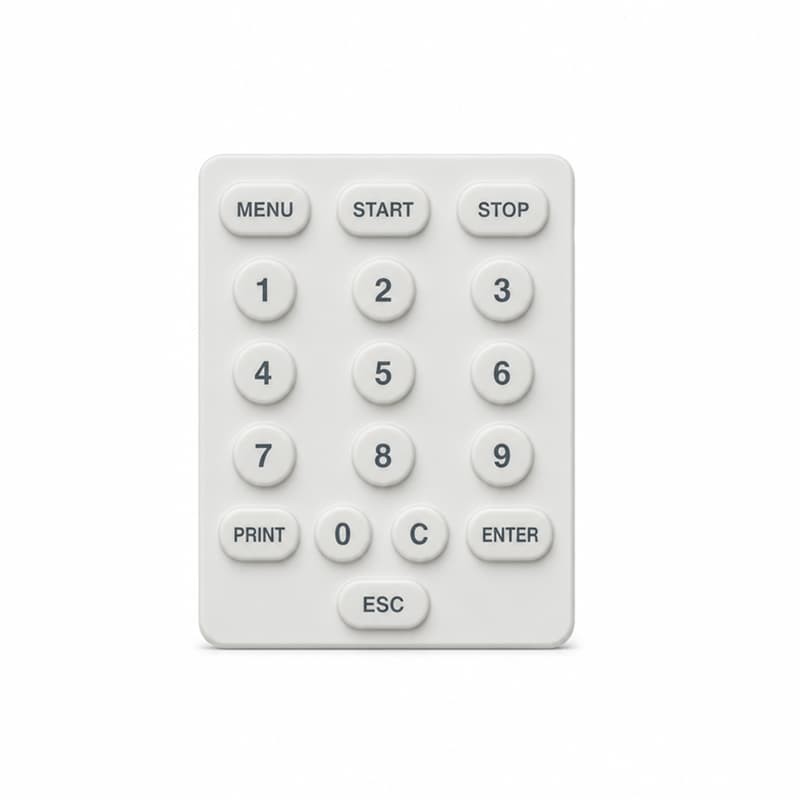
When we receive a keypad inquiry for a handheld instrument, the fastest way to explain what the customer is buying is to take the pad out of the meter. The keys are molded bumps on a continuous sheet; the sheet is clamped between the housing halves; the conductive pills on the key undersides sit directly above the PCB pads. Nothing else on the front of the meter moves — which is why the keypad carries all the abuse.
Why Does a Handheld pH Meter Need a Sealed Silicone Keypad?
A pH meter is not used in a clean room. Operators rinse the electrode and water runs over the housing; buffer solutions spill; the meter travels in a case, in a vehicle, in the rain. Every opening in the front of the housing is a potential entry point, and the keypad is the largest flexible opening there is. A keypad molded as one continuous membrane closes that opening by construction: the keys are bumps on the same sheet, not separate holes, so there is no path for water to follow through the key area itself.
What matters is the interaction between the pad and the housing. The perimeter of the keypad — the flat skirt outside the keys — is trapped between the housing halves or pressed against a boss, and that joint is where sealing is won or lost. Xylem's own ProfiLine literature describes the keypad of the 3110 series as a "100% waterproof and easy-to-clean keypad" and a "robust sealed silicone keypad" [1]. Note the careful wording: the rating belongs to the whole instrument (IP 67 on the product page [2], and IP 66/67 listed for the sealed keypad by the distributor [4]). A keypad does not carry an IP rating by itself; it has to be designed and assembled so the instrument can pass the rating.
The same interface discipline applies once the housing itself needs protection. Where a handheld unit is carried between counters all day, FromRubber molds a silicone case for the PAX A920 / A920 PRO on the same principle used here: cover the body, and leave the keypad, card slot and printer outlet exactly where the operator expects them.
Fewer keys, one continuous skirt
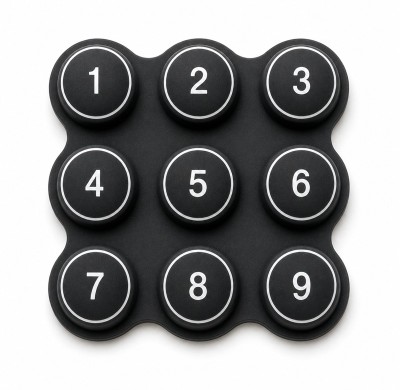
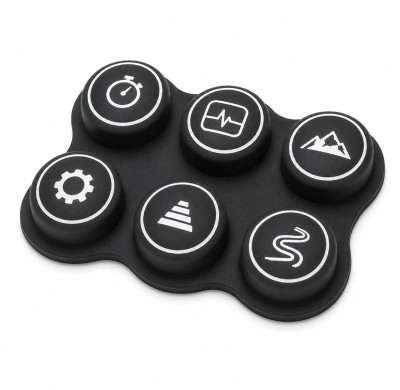
Look at the layout of a portable meter and you will usually see a handful of keys, not a full keyboard. A compact pad with a continuous sealing skirt around the whole layout is easier to seal than a dense array, because there is more flat rubber between the key area and the housing edge. That is a layout decision the instrument designer makes — and the keypad supplier has to hold the geometry.
What Can the WTW pH 3110 Tell Us About Handheld pH Meter Keypad Design?
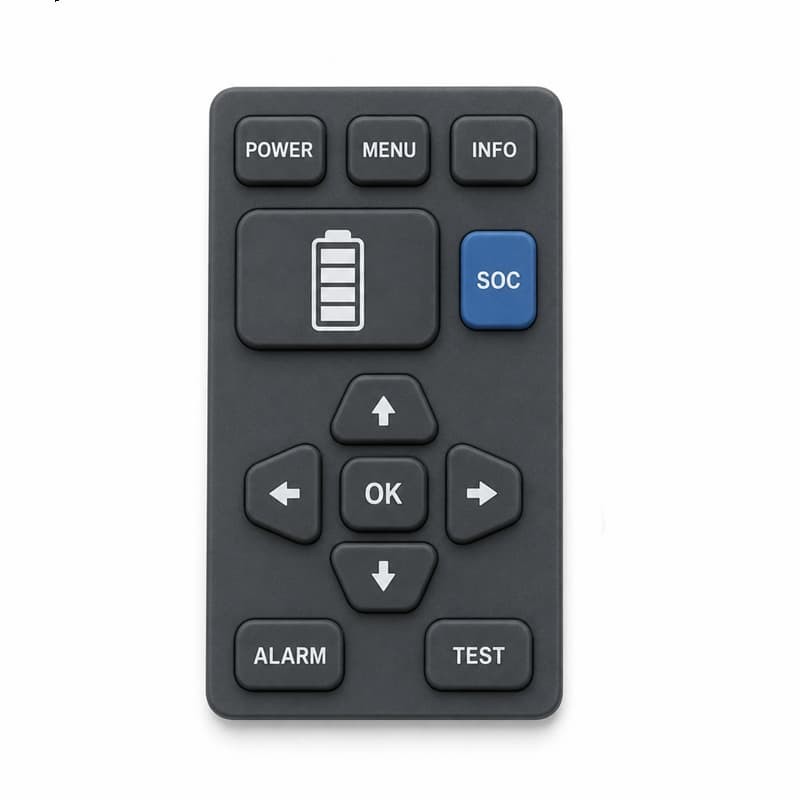
The WTW pH 3110 is useful here because its keypad is described in public product documentation, which is rare. What the documents actually say, without interpretation: the meter is waterproof to IP 67 [2]; the keypad is a clear design with only 6 keys [2]; it is described as anti-skidding and operable with gloves [2]; the brochure adds "keys with tactile feedback for error-free operation" [1]; the distributor page lists a "sealed silicone keypad" with protection class IP 66/67 and "tactile response offering clear operation" [4]; and the operating manual shows the meter is driven entirely through the keys, with short and long keystrokes mapping to different functions [3].
Everything beyond those lines is engineering interpretation, and it should be labeled as such. From a molding shop's point of view, the documented features translate into concrete requirements. Six keys mean each key gets a generous pitch, which leaves room for a robust web and a wide sealing skirt. "Anti-skidding" points to a surface treatment or texture on the key tops, so fingers keep their grip with wet or gloved hands. "Operable with gloves" sets a force and travel window that still gives a clear tactile step when the press is damped by glove material. None of these appear in the product photo; all of them are manufacturable choices that have to be specified.
A rinse-down case from our shop floor. An OEM asked us to quote a silicone keypad for a handheld analyzer that is wiped and sprayed after every shift. The first version of their drawing specified key dimensions and legends, but nothing about the perimeter seal or the force curve. We flagged three things before tooling: the pad's sealing lip had to be compressed inside a groove in the housing (the drawing had no groove), the assumed key travel left the carbon pill short of the PCB pad by roughly 0.3 mm once the real pad position was checked, and no actuation-force target existed for the ENTER key. We adjusted the web geometry, added the travel allowance for the actual pad position, and the production pad sealed and clicked as specified. The fix was not a new material. It was writing down the interface before cutting steel.
How Should Tactile Feedback Be Designed for a Silicone Keypad for Handheld pH Meter?
Tactile feedback is a force-travel curve, and the curve is mostly geometry. The key definitions come from the rubber keypad design guides: the actuation force F1 is the force that collapses the key web, the contact force F2 is the force at which the conductive pill touches the pad, and the snap ratio is (F1 − F2) / F1, with a recommended range of roughly 40–60% [5]. A higher snap ratio means a stronger click; pushed too high, the return force drops, which can lead to a slow return or key jamming [6]. For typical round keys of 10–15 mm, a common target is 80–150 g peak actuation force with that 40–60% snap ratio [8], and travel for measuring-instrument keypads usually sits in the 0.5–3.0 mm range [9].
Hardness matters less than most people assume. Shore hardness (measured per ASTM D2240 [10]) describes the compound, not the curve. Two pads at the same durometer can feel completely different because web wall thickness, rib geometry and the travel pocket dominate the feel. A handheld pH meter adds two constraints. First, gloves: a gloved press damps the tactile step, so the snap has to be clear enough to be felt through the glove. Second, temperature: silicone stiffens in the cold and softens when warm, and a pH meter often lives in the field — so the force envelope should state the temperature at which it must hold.
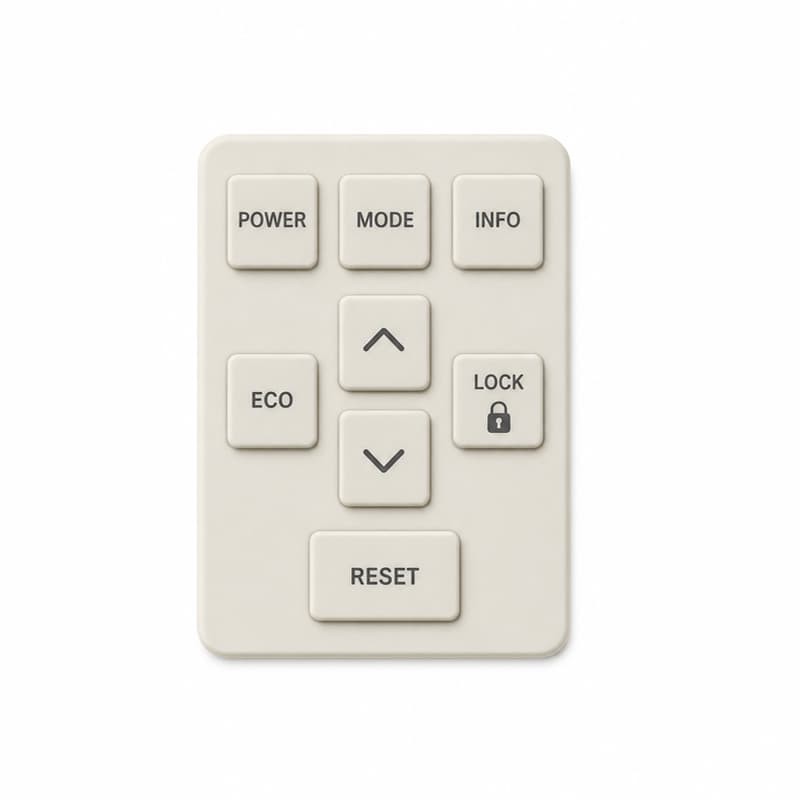
Where the click comes from
The tactile step happens when the key web snaps through its collapse point. In production, the important checks are per-key: every key on the pad, not just the largest one, should be measured on a force-travel tester, and the values should come back with the sample report. A pad whose keys feel different across the layout will be read by the operator as a broken meter, even if every key sits inside an absolute tolerance band.
How Does the Silicone Keypad Interface with the PCB?
Most silicone keypads for handheld instruments use conductive carbon pills molded onto the key undersides. When the key travels down, the pill presses two contact pads together on the PCB. The design parameters are contact resistance, alignment and overtravel. Carbon pills typically show 100–300 Ω contact resistance depending on carbon loading, pill thickness and contact pressure [7], which is plenty for the digital switching circuits inside a meter. The failure mode to design against is not resistance magnitude — it is intermittent contact: a pill that lands off-center, or a key with too little overtravel, gives an open or flaky switch that no firmware can fully mask.
Note where the keypad sits electrically. The pH measurement itself happens in a high-impedance front end — the glass electrode is documented as a source of roughly 10 MΩ to 1000 MΩ [11] — and the keypad switches belong to the control circuitry, not that measurement path. So a contact resistance of a few hundred ohms is irrelevant to the reading. What matters is that the switch closes reliably and stays closed for millions of presses. That is why the specification to write down is contact resistance plus cycle life at a stated force, not "use the most conductive pill available".
How Does a Silicone Keypad Manufacturer Develop a Custom Keypad for a Handheld pH Meter?
The development sequence we use for instrument keypads runs in a fixed order, because each step feeds the next:
- Drawing and model review. Check the 2D/3D data against the housing and the PCB layout before anything else.
- Key layout analysis. Key positions, pitch, and the space available for the sealing skirt.
- Force and travel targets. Set actuation force, travel and snap ratio per key type, at a stated temperature.
- Material selection. Compound, durometer range, and any compliance requirements for the application.
- Carbon pill and contact design. Pill position and size, matched to the PCB pad geometry it lands on.
- Mold development. Cavity design with shrinkage compensation for the chosen compound.
- Prototype testing. Force-travel measurement, electrical continuity, sealing fit in the housing.
- Mass-production control. In-process force and resistance checks, dimensional sampling, batch release.
What Design Information Should an OEM Provide to a Silicone Keypad Manufacturer?
The fewer rounds a project needs, the more information was sent in the first inquiry. For a handheld pH meter keypad, the package that produces a usable quote contains:
- Housing drawing or 3D model — the opening, the sealing groove, the wall that traps the pad.
- PCB layout — pad positions, heights and tolerances, so the pill geometry can be aligned.
- Key dimensions and spacing — key diameter, height, pitch, and the area for the skirt.
- Actuation-force requirements — target force, travel, snap ratio, and the temperature range.
- Electrical requirements — contact resistance, cycle life, and any ESD or insulation needs.
- Environmental requirements — temperature extremes, chemical exposure, cleaning method, target IP class of the instrument.
- Graphic and printing requirements — legends, colors, abrasion expectations.
- Annual or project volume — it decides tooling strategy and molding approach.
If some of these are still open, say so — a quote with assumptions written on it is more useful than a quote that silently guesses.
A practical check before you approve a keypad sample. Do three things: press every key type on the pad and compare the feel against the target curve, not against the previous sample; mount the pad in the actual housing and check the perimeter compression all the way around; and ask for the measured actuation force and contact resistance in writing with the sample report. If the numbers are there, the sample gate has stopped being a debate.
Common Silicone Keypad Design Mistakes in Handheld pH Meter Projects
Most failed keypad projects repeat the same six patterns:
- Designing the keypad independently from the housing, then discovering the seal does not close.
- Ignoring PCB tolerances — the pill lands beside the pad, and the key only works at one spot.
- Selecting hardness by "soft feel" instead of by the force curve the operator actually needs.
- Treating the sealing interface as a detail — no groove, no compression spec, no assembly check.
- Accepting inconsistent actuation force across keys on the same pad.
- Treating one good prototype as proof of mass-production consistency, without a batch drift allowance.
How to Choose a Silicone Keypad Manufacturer for a Handheld pH Meter
For a meter that has to seal, click and switch for years, supplier selection should be judged on capabilities that map to the failure modes above: engineering support that reviews your housing and PCB data; tooling capability with shrinkage control; material control with incoming compound checks; force testing on a load-cell rig, not by hand; electrical testing of contact resistance; prototyping that fits and seals in your actual housing; production consistency with documented batch release; custom printing and surface finishing; and OEM/ODM experience with handheld instrumentation. These are the checks we run at FromRubber for every instrument keypad we mold, and they are the same checks a buyer should verify before ordering from any shop.
Conclusion
Sealing, tactile feedback, electrical contact and manufacturing consistency are not four separate requirements on a silicone keypad for a handheld pH meter. They are one design: the same continuous silicone part that seals the housing has to click under gloves, close a switch on the PCB and hold its curve from batch to batch. The WTW pH 3110's documented keypad — six keys, sealed, tactile, glove-friendly — shows what a mature design looks like from the outside; the engineering underneath is where a custom silicone keypad manufacturer earns its place. When you source the pad for your next handheld instrument, start the conversation with the interface: housing, PCB, force curve, sealing groove. The part will follow.
This article was written by the molding engineering team at FromRubber, a custom silicone keypad manufacturer in Dongguan, China. We mold instrument keypads for handheld analyzers and field meters, and we describe the checks we apply on our own shop floor — from sealing geometry to force-travel release.
Related reading
Sources
- [1] Xylem Analytics Germany Sales GmbH & Co. KG, WTW, "ProfiLine Handhelds for pH, ISE, Dissolved Oxygen and Conductivity" brochure, 2021. https://www.xylemanalytics.com/File%20Library/Resource%20Library/WTW/04%20Flyers%20Brochures/ENG/WTW_999045US_ProfiLine-Handhelds_English_20210915_low2023.pdf
- [2] Xylem, "WTW ProfiLine pH 3110 Portable Meter" product page. https://www.xylem.com/en-ie/products--services/analytical-instruments-and-equipment/monitoring-sampling-instruments-sensors-equipment/handheld-meters-instruments/profiline-ph-3110-portable-meter/
- [3] WTW, "pH 3110 Operating Manual", BA 75791e/07. https://www.xylem.com/siteassets/brand/wtw/resources/manual/ba75791e07_3110_ph.pdf
- [4] Avantor (VWR), "pH/mV/°C Meters, Handheld, pH 3110 / 3210 / 3310, WTW" product page. https://ca.vwr.com/store/product/en/13030005/ph-mv-c-meters-handheld-ph-3110-3210-3310-wtw
- [5] Diamond HMI Ltd, "Rubber Keypad Design Guide". https://www.diamondhmi.co.uk/wp-content/uploads/2020/02/Diamond-HMI-Rubber-Keypad-Design-Guide.pdf
- [6] KPB Service, "Electrical Properties and Design Rules for Silicone Rubber Keypads". https://kpb-service.com/wp-content/uploads/2018/05/Rubber-Keypads.pdf
- [7] Jasper Electronics, "Silicone Rubber Keypad Design Guide: Complete Engineering and Manufacturing Reference". https://www.jasperele.com/news_detail/silicone-rubber-keypad-design-guide.html
- [8] Wetop Silicone, "Silicone Keypad OEM Guide — Design, Actuation, Compliance". https://wetopsilicone.com/guide/silicone-keypad-oem-guide/
- [9] LuPhiTouch, "Membrane & Rubber Keypads" design guide. https://www.luphitouch.cn/upload/file/20220801/rubber+keypad+design+guide.pdf
- [10] ASTM International, "Standard Test Method for Rubber Property — Durometer Hardness", ASTM D2240-15(2021). https://www.astm.org/d2240-15r21.html
- [11] Texas Instruments, "AN-1852 Designing With pH Electrodes". https://www.ti.com/lit/an/snoa529a/snoa529a.pdf