Rubber Keypad Degradation: Why Handheld Meter Performance Fades Before You Notice
Materials & Aging
Handheld meters are trusted for years, and their rubber keypads are expected to keep working quietly for the entire product life. In practice, rubber keypad degradation starts the day the meter ships: the elastomer slowly loses rebound, the surface oxidizes, and the tactile response fades a little every month. Users notice only when the meter starts feeling "old". This article explains the physics of that fade, the tests that quantify it, and the material choices that keep a handheld meter feeling new.
1. The Science of Rubber Keypad Degradation in Handheld Meters
A rubber keypad is a crosslinked silicone elastomer, and like all elastomers it is in a constant slow battle with entropy. Heat, oxygen, UV and repeated mechanical strain all attack the polymer network. The visible symptoms - softer feel, slower return, yellowing, surface tack - are downstream of molecular changes: chain scission (the network breaks) and additional crosslinking (the network over-hardens) proceed simultaneously, and whichever dominates determines whether the keypad goes soft or stiff first.
For a handheld meter, the practical question is not whether degradation happens - it always does - but whether it stays inside acceptable limits over the design life. That is a materials question, and it is answered with three properties measured at the specification stage: compression set, heat aging resistance, and hardness stability. Each maps to a real field symptom.
Our guide to compression set as the hidden killer of keypad reliability explains the first of these in detail - it is the property that decides whether a key returns at all after years of being pressed.
2. Compression Set: Why Your Handheld Meter Rubber Keypad Stops Rebounding
Compression set is the percentage of deformation an elastomer retains after being compressed for a defined time and temperature. A keypad with 10% compression set feels crisp after a long press; one with 40% feels mushy and slow to return. The standard test (ASTM D395 method B) measures a sample held at 25% compression for 22 or 70 hours at an elevated temperature - for keypad grades typically 100–150°C. Premium silicone keypad compounds hold compression set in the low-to-mid teens at 22 h/150°C; recycled or heavily extended compounds can double that.
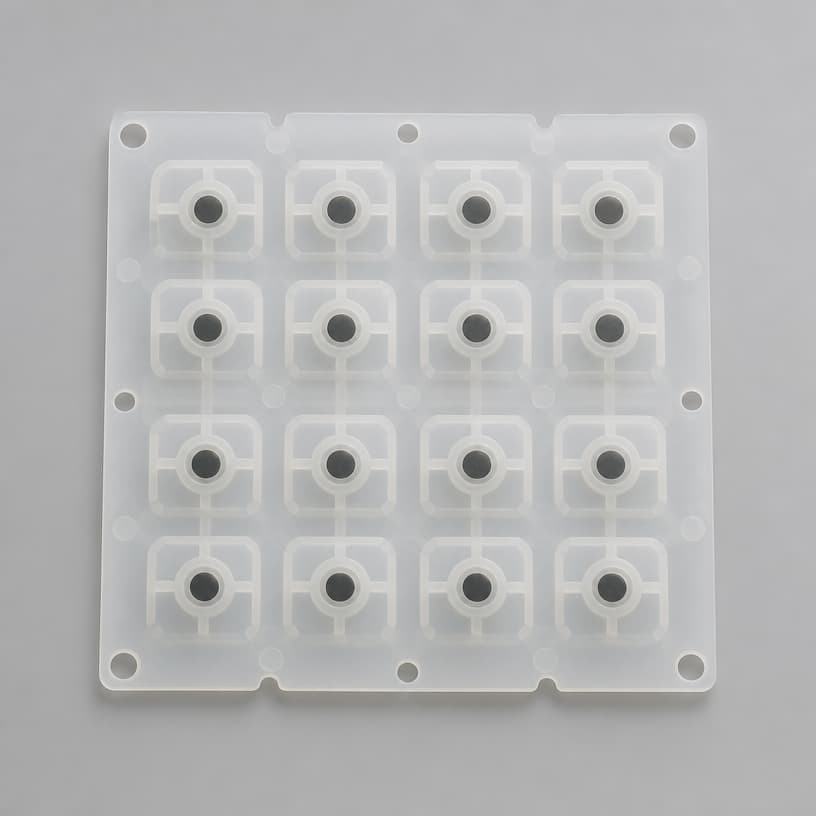
Field symptoms of compression set are easy to misattribute. A handheld meter whose keys feel "slow" or "dead" is often diagnosed as a contact problem when the real issue is the webbing no longer lifting the key away from the PCB. The distinction matters because the fix is different: contact fixes are electrical, while compression set is cured by material selection and geometry (thicker webbing, optimized dome design).
Supplier verification matters here, because compound quality varies widely. Our guide to verifying premium vs recycled silicone lists the practical checks - including asking for the raw compression set data sheet, not just a brochure claim.
3. Aging and Environmental Attack on Rubber Keypad Material
Beyond mechanical fatigue, the environment attacks the elastomer itself. Heat aging accelerates both chain scission and post-cure crosslinking; UV turns some formulations yellow and brittle; and ozone or chemical vapors attack the surface. For handheld meters the exposure profile is usually benign - a few years at room temperature with occasional sunlight - but two environments deserve explicit specification: hot storage (a meter left in a vehicle cabin can see 70–85°C) and chemical contact (solvents, oils and cleaning agents).
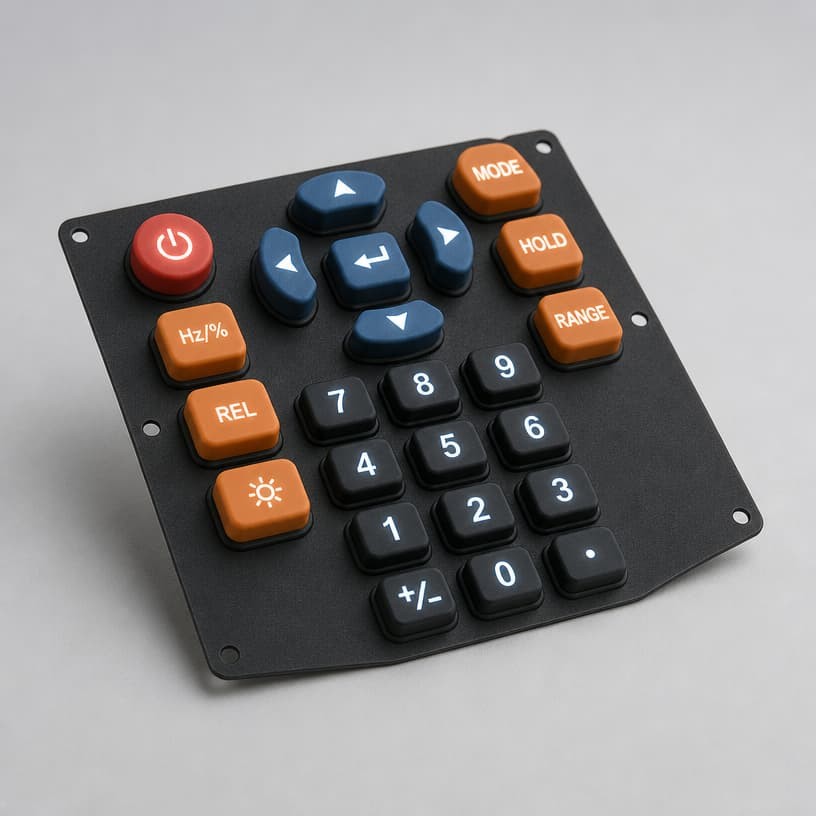
Yellowing deserves special attention because it is the most visible degradation and the hardest to reverse. Peroxide-cured and well-formulated compounds with high-purity fumed silica and premium masterbatch resist yellowing far longer than sulfur-cured or low-cost formulations. Our study on keypad yellowing and cracking breaks down how formulation choices - curing agent, filler, pigment stability - set the yellowing clock.
Instruments that run hot (power meters, motor analyzers) should reference our high-temperature keypad guide when setting the aging test temperature.
4. How Degradation Shows Up in Handheld Meter Performance
Degradation is not cosmetic - it changes electrical and mechanical performance in measurable ways. As the dome flattens, actuation force drops or becomes inconsistent; as the webbing loses tension, return travel shrinks; as the surface oxidizes, friction changes and the key can start sticking against the housing. Each of these shifts the metrology of the instrument: force drift changes the operator's muscle memory, and contact timing changes can even affect debounce margins. The meter still "works" - but its behavior is no longer what the specification promised.
Inspect a returned meter and the story is written on the keypad: surface gloss changes where thumbs press, legend wear concentrates on the most-used keys, and the pad height of frequently used keys measures shorter. Instrument repair shops see this pattern constantly - the spectrum analyzer keypad aging case is a textbook example of misdiagnosis: sticking keys blamed on electronics that were actually an aged silicone pad.
Quantify the fade, don't describe it. Measure actuation force and return travel on a returned unit and compare to the spec; a force drop of 30%+ or visible return lag is degradation, not use variation.
5. Case Study: Batch-to-Batch Compression Set Variation and Its Root Cause
A handheld vibration meter OEM noticed that units produced in one quarter returned for "soft keys" twice as often as units from the previous quarter - with no design change. FromRubber's material lab ran compression set tests on retained samples from both periods: the good batch measured 14% compression set (22 h/150°C), the problem batch 31%. The compound was nominally the same grade, but the supplier had quietly switched from peroxide curing to a cheaper catalyst system to save cost.
The fix was a compound spec lock: compression set ≤ 20% at 22 h/150°C, hardness 50–55 Shore A, with a certificate of analysis required on every lot. The OEM also added an incoming-material compression set spot check. The next two production quarters showed return rates back at the historical baseline. Material verification - not design change - solved the problem.
6. Slowing Rubber Keypad Degradation: Material and Design Choices
Specify compression set ≤ 20% (22 h/150°C) and require the datasheet on every lot
Choose peroxide-cured, UV-stabilized compounds for outdoor and hot-storage use
Add a heat-aging check (168 h at 125–150°C) to the validation plan, measuring hardness and force change
Verify material grade per lot - recycled or extended compounds degrade faster
Design webbing and dome geometry with compression set margin, not at the limit
Re-measure actuation force and return travel on returned units to track real-world fade
Sources and Further Reading
Material property background draws on published technical material from Dow silicone materials, Wacker Chemie silicone rubber resources, and UL Prospector material property database. Compression set and aging figures reflect FromRubber material qualification records for instrument keypad compounds.
Qualify Your Handheld Meter Keypad Material Properly
FromRubber can run compression set, heat aging and hardness verification on your current keypad compound - or supply a qualified instrument-grade compound with full test data.
About FromRubber - FromRubber is a full-process silicone keypad and rubber button pad manufacturer serving instrument OEMs, with in-house compounding control, molding and material testing for long-life applications.