How to Prevent a Silicone Makeup Brush Case from Stretching or Losing Its Shape
A silicone brush case rarely tears. It changes shape. It comes back from a trip with one side bowed out and the opening no longer round, and from then on the lid does not sit, the brushes lean, and the product looks old at six months. Nothing broke, so nothing gets returned — the customer just does not buy it again.
That slow deformation is a design problem, and it is almost never treated as one. Silicone makeup brush cases are usually specified by external dimensions, capacity and colour, with wall thickness left to the toolmaker. The result is a shell whose stiffness comes from the wrong place: thickness instead of curvature.
Why Can a Silicone Makeup Brush Case Stretch or Lose Its Shape?
How Can Thin-Wall Structures Lead to Excessive Deformation?
A thin wall fails in two different ways depending on how it is loaded. In tension it stretches and thins, which is why a case that is overfilled grows longer rather than wider. In bending it buckles locally — a small dent appears, and because the material is soft, the dent becomes a crease and the crease becomes the new shape.
Silicone has good elongation, so the tensile failure looks harmless for a long time. The bending failure is the one that shows up in photographs. It is also the one that is hardest to correct after tooling, because the fix is geometry rather than material.
Why Can an Oversized Opening Affect Shape Stability?
The opening is a ring, and the ring is what keeps the top of the case from closing in. Make it large relative to the body and the walls have less material to carry the load back into the base, so the case behaves like a tube with a slot in it.
That is why a case with a wide mouth feels flimsier than a narrow one at identical wall thickness, and why the rim usually needs its own local thickness even when the walls are kept thin for weight.
How Can Excessive Storage Capacity Change the Case Shape?
Overfilling is a specification failure, not a user failure. If the case is drawn for eight brushes and marketed as holding twelve, twelve will go in, and the wall will be held at a permanent strain for the whole life of the product.
Soft materials do not spring back from that. The case takes a set, and the set is what the customer sees. Capacity claims should be set from a loaded, closed, carried test rather than from a count of holes.
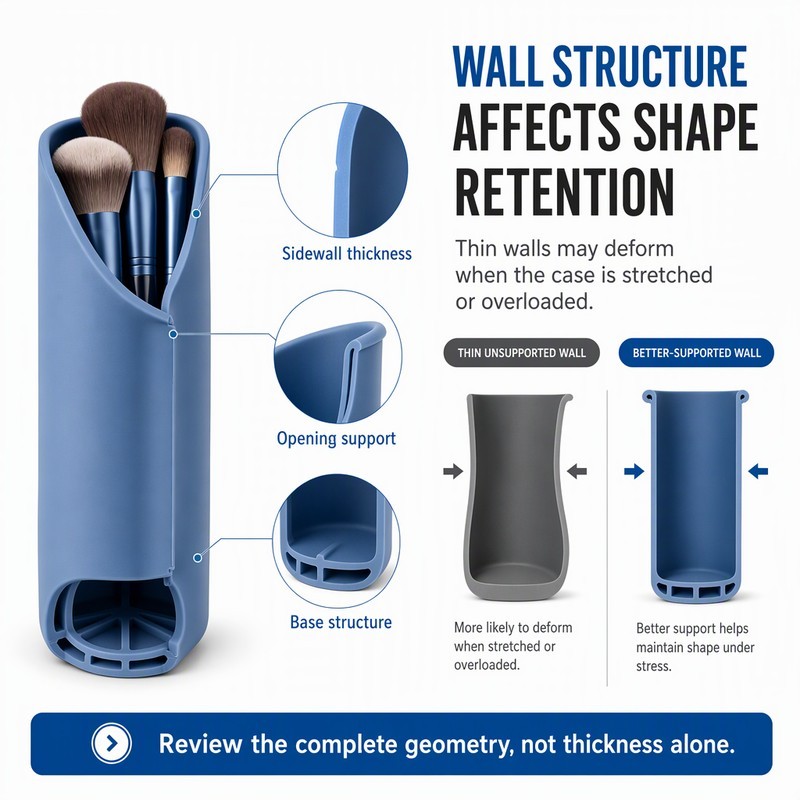
There is a cheap structural insight here that most case designs ignore. A flat panel carries a sideways load by bending, and bending stress rises with the square of the span. A curved panel carries the same load largely in membrane tension, which is far more efficient. A gentle outward bulge along the sidewall can therefore do more for dent resistance than adding half a millimetre of wall.
The catch is that the bulge has to be designed in from the start, because it changes the parting line and the demoulding direction. Our notes on how uneven walls cause stress whitening and cracking in silicone cases cover the same mechanism from the failure side.
How Should Wall Thickness Be Designed to Prevent Deformation?
Should the Entire Case Use the Same Wall Thickness?
No, and a uniform wall is often the reason a silicone makeup brush case feels simultaneously heavy and floppy. Different zones do different work: the base resists overturning, the sidewall resists bulging, the rim resists ovalisation, and the corners carry the transition between all three.
Uniform thickness is a manufacturing convenience, not a design principle. It is worth paying for local variation where the loads actually are.
Which Areas May Need Additional Structural Support?
Four: the rim, the base perimeter, the corner transitions and the area around any opening feature. The rim and base do the structural work; the corners and opening do the stress work.
Support does not have to mean thickness alone. A small rib, a rolled edge or a change in curvature all add stiffness without adding much mass, and all three are cheaper in material than a uniform thickness increase.
How Can Thickness Transitions Reduce Uneven Deformation?
By avoiding steps. A step in a soft wall behaves as a hinge: the thin side bends, the thick side does not, and the boundary between them takes all the strain. That boundary is where a crease forms first.
A gradual taper moves the strain over a longer distance and lowers the peak. It is the single most effective change we make to a failing case design, and it usually costs nothing at the tool — it is a drawing change, not a process change.
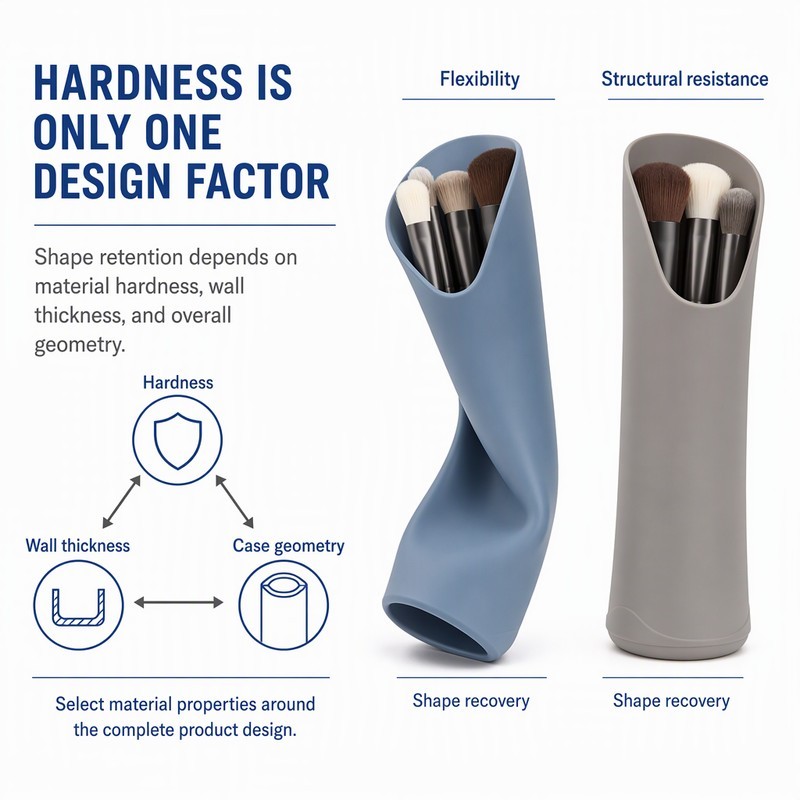
Hardness is the variable buyers ask about first and the one that explains least on its own. A firmer compound raises the force needed to deform the case, but it does not change where the case deforms, and it does not stop a crease forming at a step or a flat panel.
The three factors interact. Fix the geometry, then use hardness to set the feel, then check that the wall thickness is consistent enough for the hardness to matter at all. Our article on the hardness trap in silicone case design works through the same sequence in more detail.
How Do Silicone Hardness and Material Selection Affect Shape Retention?
Does Softer Silicone Always Make a Better Travel Case?
Softer silicone is easier to open, easier to squeeze into a bag and more pleasant to hold. It is also less able to hold a shape, more prone to taking a set, and more likely to show a crease after a week in a suitcase.
For a case that is carried rather than worn, the useful range is narrower than for a cover. A case that is too soft stops protecting the brushes, which was the point of the product.
How Can Silicone Hardness Influence Stretching and Recovery?
Hardness changes the stress at a given strain, so a harder compound stores more energy at the same deflection and returns more completely. It also resists compression set better, which is the property that determines whether the case is still the right shape after months of being packed.
But hardness cannot compensate for a section that is too thin. A hard compound in a 0.6 mm wall behaves like a soft compound in a 1 mm wall; the geometry dominates, and it dominates by a wider margin than most specifications assume.
What Should Brands Consider When Selecting Silicone Materials?
Four things: the strain the case will see when packed, the temperature it will see in transit, the cleaning regime, and the surface the brand wants. A case that will be wiped with alcohol needs a compound and a finish that tolerate it; a case that will sit in a hot car needs a compound that will not take a set at that temperature.
Those are material questions, but they are answered by geometry as much as by the compound. The relationship between thickness, load and service life is the same one we describe for thicker silicone in moulded vessels.
How Should the Case Structure Be Designed for Better Stability?
How Can the Base Structure Help the Case Maintain Its Shape?
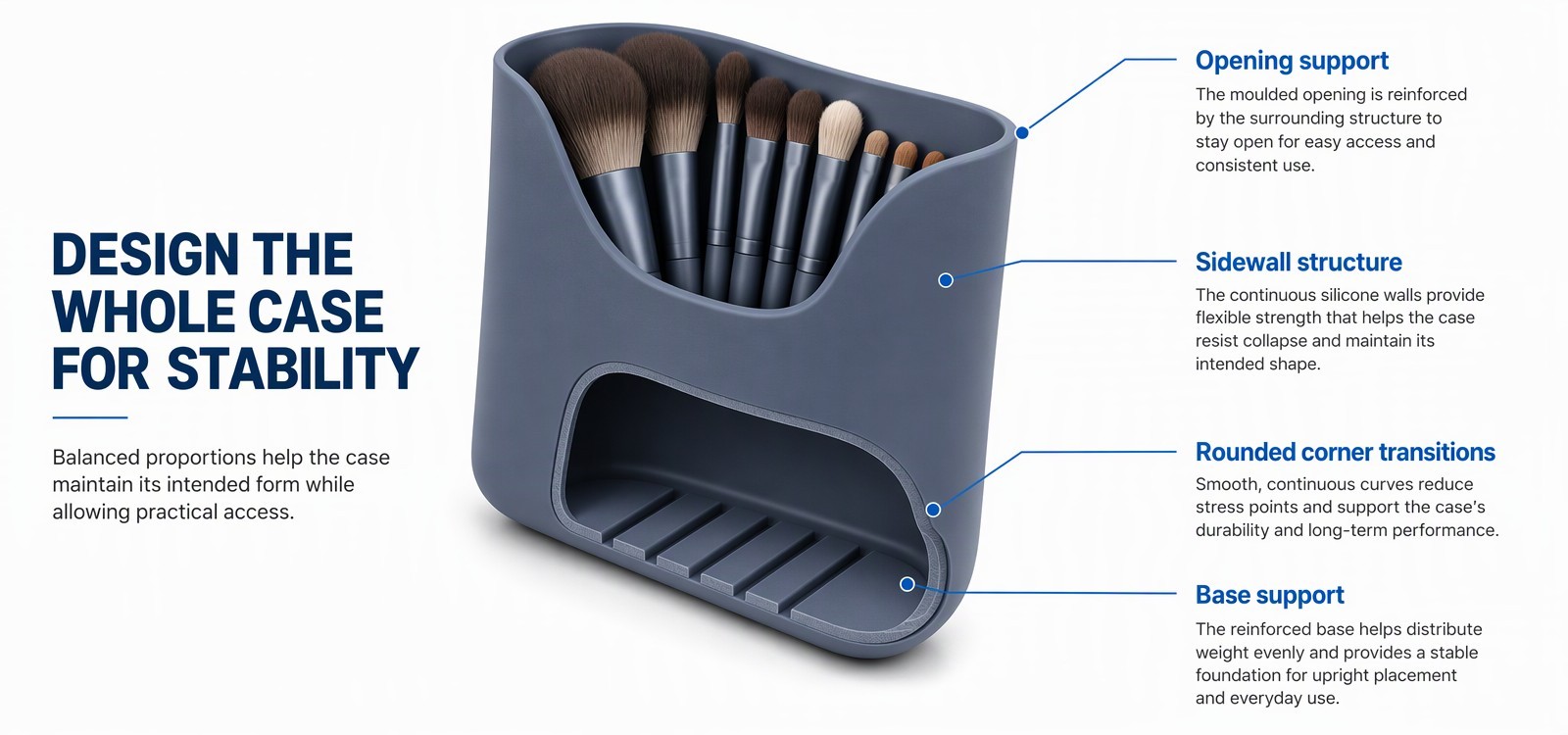
The base is a diaphragm. A flat base flexes and lets the walls splay; a base with a slight dome or a perimeter pad resists that movement and keeps the walls in line. The difference is visible immediately when the case is squeezed with the base on a table.
Base width matters too, but it is the shape rather than the area that does the work. A narrow base with a rolled perimeter is stiffer than a wider flat one at the same thickness.
How Should the Opening Be Designed to Balance Access and Support?
The opening needs a rim section that is locally thicker than the adjacent wall, tapering into it. That gives the ring enough material to stay round while keeping the wall thin enough to be soft where the user grips.
Where the opening is a long slot rather than a circle, the ends of the slot need generous radii. A slot end is a stress concentration and, in a soft material, the place where a tear starts after a few hundred openings.
Can Rounded Corners Improve the Structural Design?
Yes, and for two reasons at once. A radius spreads strain over an arc instead of a point, and it also lets the material flow during moulding rather than packing into a sharp cavity corner. Sharp internal corners in a compression mould are where you get short shots and where you get the flash line nobody can deflash cleanly.
The practical limit is that a very large radius reduces the usable internal volume at the corners. For a case holding brushes, that lost volume is usually acceptable.
How Should the Case Accommodate Different Makeup Brush Lengths?
By internal depth, and by where the brushes are allowed to rest. If the longest brush has to bend to fit, the case will bow at that point permanently. Either the case grows, or the brush set is split.
Internal features should locate the brush heads rather than clamp them. Clamping is what causes splayed bristles, and splayed bristles are the complaint that gets blamed on the case.
What Design Details Should Be Checked During Sample Development?
How Can Brands Evaluate Stretching Under Normal Handling?
Fill the case to its stated capacity, close it, put it in a bag for a day, then look at it empty. The stretch that matters is the one that remains after the load is removed, not the one that happens while it is carried.
A simple check that reproduces most of the problem: hold the case by the base and let it hang loaded for a few hours, then measure the opening in both directions. A difference of more than a hairline between the two axes is a warning that the rim is too weak for the length.
How Should Shape Retention Be Evaluated After Repeated Use?
Cycle the opening — open, load, close, empty — enough times that the material has had a chance to creep, then check the rim and the sidewall. If the case is designed for daily use, a few hundred cycles is a realistic proxy and can be done by hand in an afternoon.
It is worth doing this with the real brush set, because the widest ferrule is what loads the rim. A mandrel will not reproduce the way a brush bundle wedges the opening. Our note on testing a silicone case with real loads rather than estimates follows the same principle.
What Should Be Checked Before Approving the Final Sample?
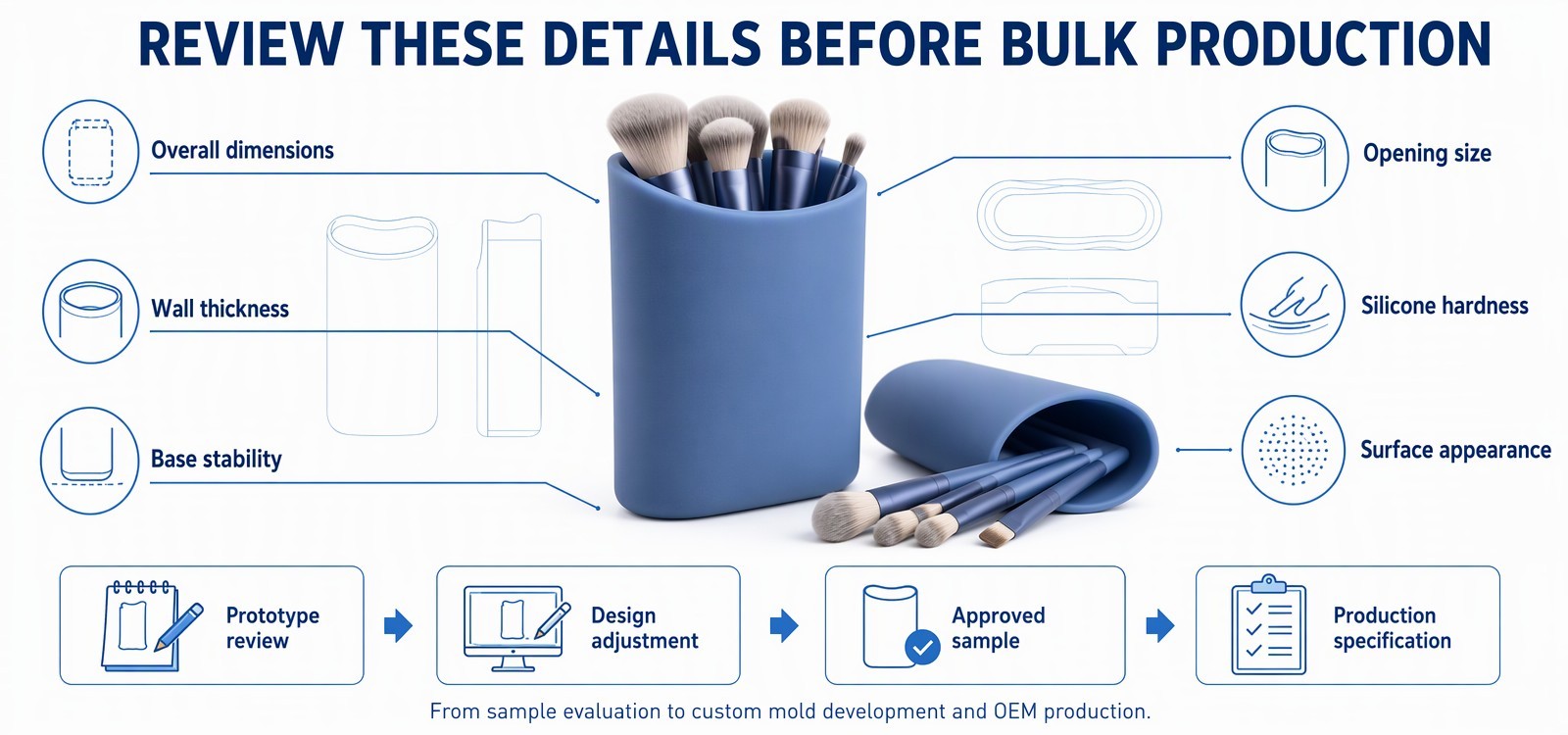
Dimensions in both the empty and loaded state, wall thickness at four points, opening size and roundness, hardness, base stability on a flat surface, surface appearance, and the packed assembly. Then a wash test, because a case that changes colour after the first clean has failed the only test the customer runs.
How Can Manufacturers Reduce Deformation Risks During Mass Production?
Why Does Mold Design Matter for Thin-Wall Silicone Products?
Because a thin wall is where the material arrives last and coolest. If the cavity fills unevenly, one side of the case is slightly thicker than the other, and the case will bow toward the thin side in use — a defect that is invisible on the bench and obvious after a week.
Gate position, cavity layout and the way the material is distributed before closing all affect that. It is a tooling decision that has to be made alongside the design, not after it. Our overview of the silicone manufacturing process sets out where in the sequence those choices get locked.
How Can Inconsistent Wall Thickness Affect Finished Products?
Three ways: different flexibility on opposite sides, different shrinkage, and different appearance after a few weeks of use. Shrinkage is the one that surprises people, because a case that measures correctly when cold can distort as it cools unevenly.
The compensation for that is calculated, not guessed, and it has to be done per section. Our guide to silicone shrinkage and mould dimensions covers the method.
Which Production Specifications Should Be Confirmed Before Bulk Manufacturing?
Approved drawings per colourway, the reference sample, dimensional tolerances at the four critical zones, the appearance standard under agreed lighting, and the packing configuration. A case is a product that is judged packed and carried, so the packing configuration belongs in the specification rather than in the logistics discussion.
What Should Brands Customize Early?
Which Customization Details Should Be Confirmed Early?
Overall dimensions, brush capacity as a tested number rather than a claim, opening structure, wall thickness at the four zones, hardness, colour, logo position and depth, surface finish, and packaging. Any of those left open becomes a tooling change later.
The one that most often comes back is capacity. A count of brush positions on a drawing is not a capacity; capacity is what fits with the case closed and carried.
Why Should Brands Work With an Experienced Silicone Product Manufacturer?
Because the failures in this product are geometric, and they are cheap to prevent and expensive to fix. A manufacturer who has seen a case bow toward its thin side will ask about wall consistency and gate position before quoting; one who has not will quote the drawing as sent.
FromRubber has been moulding custom silicone parts in Dongguan since 2010, with toolmaking, sampling and production in house, which is what makes it practical to change a wall section after the first sample rather than after the first container. If you are developing a brush case, send the drawing and the brush set — the loaded check is the first thing worth running. WhatsApp or WeChat: +86 18676210913.
Sources and further reading
- Uneven walls in silicone cases: stress whitening and cracking — FromRubber failure analysis.
- The hardness trap in silicone case design — FromRubber engineering article.
- Trade-offs of thicker silicone in a moulded vessel — FromRubber analysis of thickness and load.
- Choosing section thickness for a moulded part — FromRubber design guide.
- Silicone shrinkage and mould dimensions — FromRubber tooling guide.
- Testing a silicone case with real loads — FromRubber product test article.