How to Improve Angle Grinder Silicone Keypad Resistance to Dust and Abrasive Particles
When a grinder keypad starts looking tired after a few months, the instinct is to reach for a harder, tougher compound. On this tool that instinct usually makes things worse, and the reason is simple: two different problems are being described with the same word. Abrasion removes material from the keypad. Dust ingress puts material inside it. They are caused by different mechanisms, they are measured by different standards, and a compound change only touches one of them.
Two failures, one word
Abrasion is material loss. A hard particle slides across a rubber surface under load and cuts or tears away a small amount of it. That behaviour is measured by ISO 4649, which determines the resistance of rubber to abrasion using a rotating cylindrical drum, and by ASTM D5963, the equivalent method used for both vulcanised thermoset rubbers and thermoplastic elastomers. The test is useful, but it describes a flat specimen running against an abrasive sheet under a controlled normal load.
Dust ingress is a different event. Nothing is removed from the keypad; particles simply get inside the assembly and stay there, and their effect is felt through force drift, resistance instability and visual contamination rather than mass loss. IEC 60529 covers that side, dividing dust-related protection into IP5X, where dust may enter but not in a quantity that interferes with operation, and IP6X, where the enclosure is dust-tight and is tested under reduced pressure.
Reading a field complaint through those two lenses sorts the response immediately. If the key face has lost material, polished to a glaze, or changed colour, that is abrasion and the compound and surface finish are worth discussing. If the keys feel gritty, force has increased, or resistance has become unstable, that is ingress and no compound change will fix it.
Most of the wear on a grinder keypad does not happen where people look
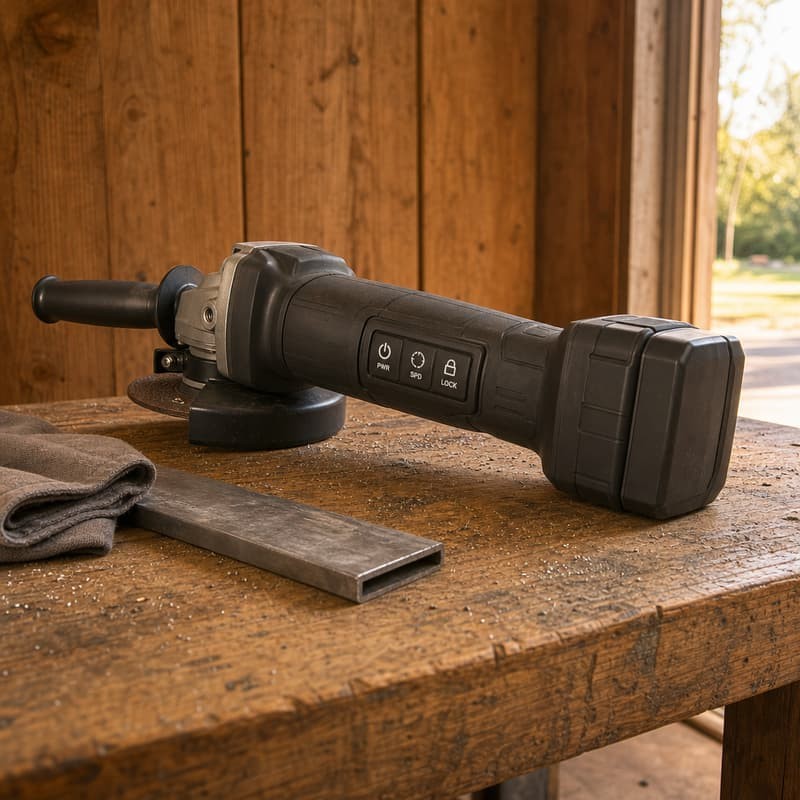
The key face is the part everyone photographs, but on a hand-held tool it is also the part with the least severe counter-face. It is contacted by a gloved thumb, which is soft and compliant and carries very little abrasive. The places that actually wear are less visible.
First, the key wall where it slides against the aperture edge in the housing. Every press moves that wall against a rigid plastic edge, and once grit is sitting on that edge the motion becomes a lapping action with the plastic acting as the backing block. Second, the flange edge, where settled dust collects and the panel micro-moves under the retention load. Third, the root of the web, which is where trapped particles are worked hardest because the deflection is largest there.
Why a flat-sheet abrasion figure tells you very little here
A drum abrasion test loads a flat specimen evenly. The real keypad loads its wall in shear against a plastic edge, at a pressure set by the press force, in the presence of angular particles of mixed size. The ranking of two compounds can therefore reverse between the test and the tool, because the test does not include the counter-face that does the damage. Where a programme has a genuine abrasion problem, the more useful experiment is a rigged test on the real key geometry running against the real housing material with representative dust, even if that test is not a standard one.
Harder silicone is usually the wrong lever on this tool
Raising hardness does increase resistance to cutting wear on a flat sheet, and that is where the instinct comes from. On an assembled grinder panel it changes three other things at once, and all three work against the goal.
A harder web raises actuation force, which fights with one-handed gloved use. A harder flange conforms less well to the housing surface, so the effective sealing gap grows rather than shrinks, which admits more particles instead of fewer. And a harder key is less able to deform elastically around a particle sitting on the sealing line or the contact pad. A softer key swallows the particle and keeps a seal; a harder key presses it into the material and holds the sealing line open by the particle's own thickness.
The counter-intuitive consequence is that a moderately soft, well-formed key can be more dust-tolerant than a hard one, provided the geometry does the sealing and the load path keeps press force away from the sealing line. Where a programme needs more force for glove feedback, it is generally better to get it from web thickness and contact element height than from hardness.
Surface finish does more than compound
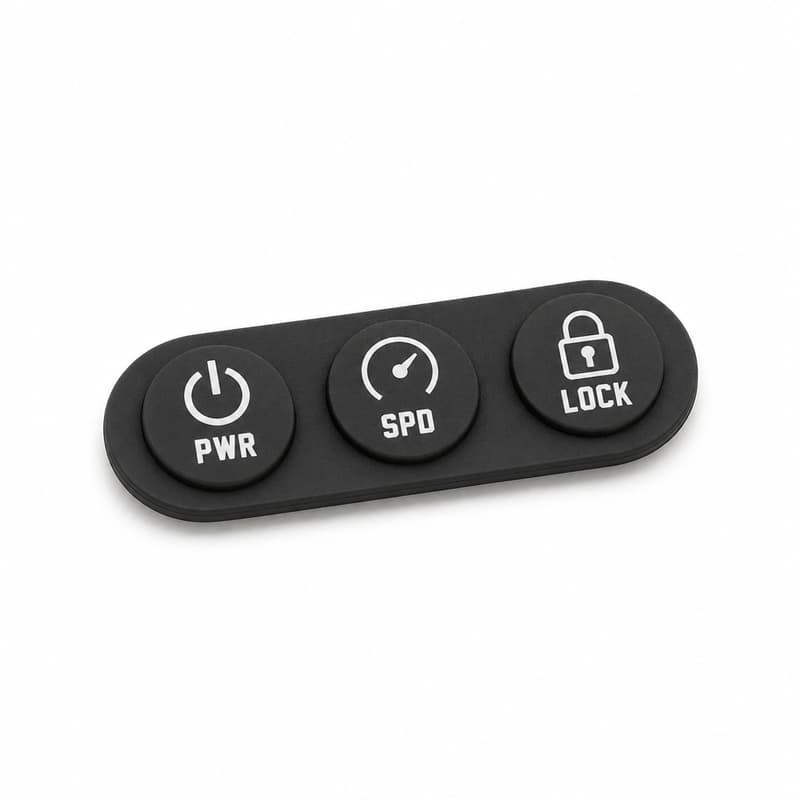
A polished silicone surface holds dust because it presents a large real contact area to each particle and gives it nowhere to sit except against the surface. A matte surface produced by mould etching breaks that contact into small high points, reduces the area available for adhesion, and lets particles sit in the texture rather than on a smooth slope. Matte texture also changes tactile feel, so the two decisions are worth making together rather than one at a time. There is a second effect worth checking: silicone surfaces can hold a static charge that draws fine dust toward them, and antistatic control is a separate variable from finish.
The counter-face decides how bad the dust is
The same keypad behaves differently in a metal shop and a concrete shop, and the difference is the particle rather than the tool. Cutting steel produces angular metallic fines. Cutting concrete produces a much finer, more abundant and more chemically aggressive dust, and the respirable fraction of it is a regulated workplace hazard in its own right. OSHA 29 CFR 1926.1153 Table 1 requires hand-held grinders used on concrete to be equipped with an integrated water delivery system that continuously feeds water to the grinding surface, which is a clear statement about how much fine dust the operation generates. Aluminium oxide grit shed from the disc itself is harder again.
Dust volume from the tool itself is measured in Europe under the EN 50632 series, which specifies the dust measurement procedure for electric motor-operated tools. That is about emitted dust as a workplace exposure question, but it is a useful proxy for what the panel on the same tool is breathing.
Because the particle mix changes, dust testing on one grade of material can mislead. ISO 12103-1 defines the particle size distribution and chemical content limits of Arizona test dust across several grades from fine to coarse. A design that survives the fine grade may fail on the coarse one, and the reverse is also possible where the failure mechanism is surface attraction rather than mechanical cutting.
Five changes that do more than a compound swap
- Take the sealing line out of the wear path: set the flange into a recess so the aperture edge no longer contacts the moving wall.
- Decouple force from sealing: one feature seals, a different feature sets the actuation force, so neither compromise is forced.
- Keep hardness moderate and put tear strength in the specification instead. A compound that resists tearing at the web root outperforms one that merely reads hard.
- Specify a matte mould finish with the texture depth called out, and confirm it survives the tooling's expected life.
- Provide a shed edge and a shallow exit channel so settled particles migrate away from the web and the contact area.
Perimeter is the number worth counting
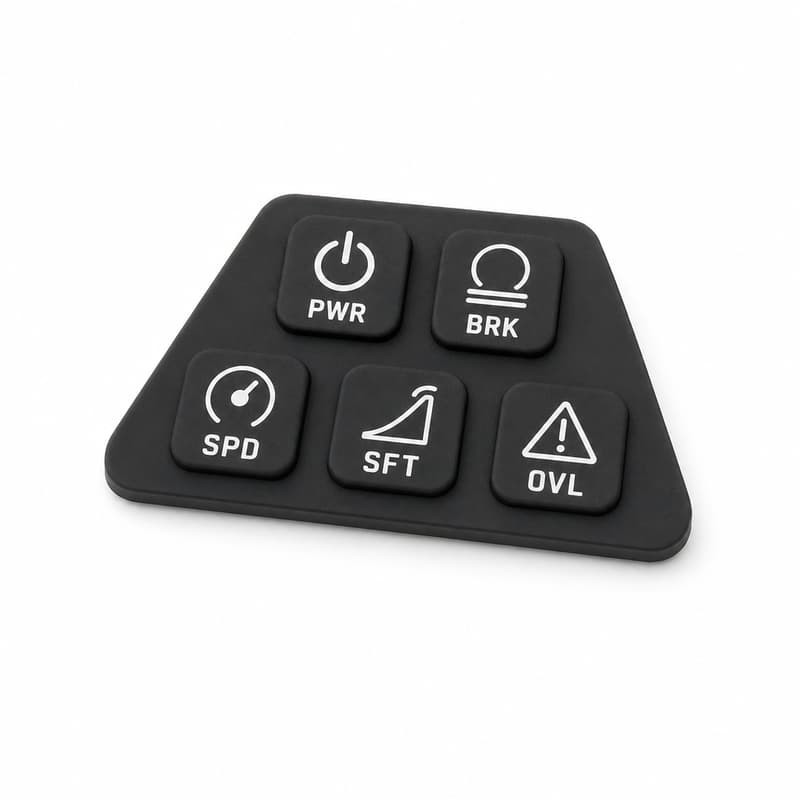
Given two panels with the same number of keys, the one with the shorter total sealing perimeter has fewer places for particles to enter and fewer opportunities for the flange to leave the housing surface. Trapezoid and clustered layouts reduce that perimeter, which is a genuine dust advantage rather than only a styling choice. The cost is legend space, and that trade is worth making deliberately: on a dusty tool, a slightly less generous legend is easier to live with than a sealing line that has grown by a third.
Make the test match the failure you are trying to prevent
Two tests carry most of the value, and neither is a flat-sheet abrasion figure.
The first is a stroke test on the assembled panel inside a dust chamber, so the keys are cycled while dust is present. Running one sample with the keys cycled and one with the keys static, in the same chamber on the same day, separates ingress from exposure. Repeat with one fine and one coarse grade of test dust to ISO 12103-1.
The second is a wear test on the real geometry, using the actual key wall against the actual housing polymer, with representative dust, measuring wall thickness and actuation force before and after. It does not need to be a standard method to be informative, and it will usually identify the aperture edge as the failure location before the key face.
A panel that got worse when it was made tougher
A grinder panel in a metal fabrication shop came back with two complaints at once: force had risen noticeably and dust was visible around three of the keys. The first response on the programme was to raise the compound hardness by five points on the assumption that abrasive dust was eating the part.
The measured result went the wrong way. Force rose, as expected, but the dust visibly entered faster than before. With the panel sectioned, the reason was clear. The harder flange had stopped conforming to a slight crown in the housing recess, so the sealing line was carrying contact on two edges instead of continuously, and the gap between those edges was the new dust path. Hardness had been bought at the cost of sealing.
The change that worked was a combination of three small ones. The flange height was reduced so it sat fractionally deeper under the aperture edge, taking the wall out of direct contact. A shed edge was added at the low side of the recess so settled material no longer collected against the panel. The compound went back to the previous hardness band but with an improved tear specification at the web root, because inspection had shown small nicks starting there. Force ended up where it started, and ingress dropped enough that a two-year service interval became realistic rather than aspirational.
What is worth carrying forward is the order of work. Two of the three effective changes were geometry, cost nothing in material, and would have been free if they had been in the first tool cut. The compound change was the only one that made things measurably worse, and it was the first thing anyone reached for.
The keypad supplies the sealing geometry, the web and the contact element, and it has to match the board it closes against. The circuit layout itself stays with the customer's electronics design, and FromRubber works to that drawing.
Questions that come up when abrasive dust is the problem
Does a higher abrasion figure on the datasheet mean better field life?
Not reliably, because the standard test uses a flat specimen against an abrasive sheet under uniform load, while the keypad wears in shear against a plastic edge with mixed particles present. A compound that ranks well on a drum test can rank poorly in the assembly if its tear behaviour at the web root is weaker.
Is a matte finish worth losing the smooth feel?
On a dusty hand-held tool, usually yes. Matte texture reduces the real contact area available for dust adhesion and gives particles somewhere to sit instead of sliding. If the tactile target is a polished feel, a protective top coat over a matte moulded surface is a workable compromise, provided the coating's own abrasion and chemical resistance are specified with a test method.
Can static charge really pull dust onto a keypad?
It can, particularly on a tool that is handled repeatedly in dry conditions and on surfaces that insulate well. A silicone part that builds and holds a charge will draw fine dust toward it. Antistatic treatment changes that behaviour, and it is a separate variable from hardness, finish and geometry, so it is worth checking before assuming a wear problem is mechanical.
FromRubber (Dongguan Bohao Electronic Technology Co., Ltd.) moulds custom silicone keypads, keypad strips and control panels for hand-held tools and industrial equipment, and reviews sealing geometry, mould texture and material specification against the housing the keypad will be assembled into. The technical notes above come from that review work and from the standards listed below.
Related reading
Sources
- [1] ISO 4649:2017, Rubber, vulcanized or thermoplastic - Determination of abrasion resistance using a rotating cylindrical drum device, two methods including the non-rotating and rotating specimen procedures. https://www.iso.org/standard/70325.html
- [2] Montech, DIN abrasion testing according to ASTM D5963 and ISO 4649, method description and scope for vulcanised and thermoplastic rubbers. https://www.montechusa.com/din-abrasion-testing
- [3] Smithers, ASTM D5963 / ISO 4649 abrasion resistance test method for thermoplastic elastomers and vulcanised thermoset rubbers. https://www.smithers.com/services/testing/standard/astm/astm-d5963-iso-4649
- [4] Castle Compliance, IEC 60529 ingress protection testing: IP5X dust-protected versus IP6X dust-tight, and the reduced pressure dust chamber method. https://castle-compliance.com/iec-60529-testing/
- [5] IEC 60529 dust test guide for IP5X and IP6X, covering test media, chamber conditions and the acceptance criteria that separate the two ratings. https://www.dgkingpo.com/iec-standard-60529-dust-test-ip5x-ip6x-explained/
- [6] ISO 12103-1:2016, Road vehicles - Test contaminants for filter evaluation - Part 1: Arizona test dust, particle size distribution and chemical content limits across graded test dusts. https://www.iso.org/standard/63386.html
- [7] OSHA, 29 CFR 1926.1153 Respirable crystalline silica, including Table 1 specified exposure control methods requiring hand-held grinders used on concrete to use an integrated water delivery system feeding water continuously to the grinding surface. https://www.osha.gov/laws-regs/regulations/standardnumber/1926/1926.1153
- [8] EN 50632 series, Electric motor-operated tools - Dust measurement procedure, general requirements for measuring the dust emitted by mains and battery powered tools. https://www.sis.se/en/produkter/environment-health-protection-safety/air-quality/stationary-source-emissions/ssen5063225/
- [9] ISO 815-1:2014, Rubber, vulcanized or thermoplastic - Determination of compression set - Part 1: At ambient or elevated temperatures. https://www.iso.org/standard/61761.html
- [10] Protective coatings for silicone keypads, a durability guide covering PU and matte and smooth top coats, their effect on legend readability, and the observation that laser-etched surfaces attract dirt more readily. https://siliconekeypadfactory.com/blog/protective-coated-keypad-guide/
- [11] Silicone keypad coating technologies covering abrasion resistance, chemical resistance, UV stability and tactile performance for demanding environments. https://siliconekeypadfactory.com/coating/
- [12] Epec Engineered Technologies, comparison of conductive and non-conductive rubber keypads, covering surface treatment and design options that affect service life. https://www.epectec.com/articles/conductive-and-non-conductive-rubber-keypad-comparison.html