How Does Dome Design Affect Two-Way Radio Silicone Keypad Response?
Two-way radio users press keys without looking. That single fact decides most of the keypad specification, and it is the reason a radio keypad that tests well on a bench can still be disliked in the field: the key registered, but the user was not sure it had.
Most of the discussion about radio keypads ends up at hardness. A key that feels heavy is blamed on a hard compound, and a key that feels vague is blamed on a soft one. Both diagnoses miss what the finger is actually reading. What the finger reads is a force curve: how much effort builds before the dome gives way, how far it gives way, and how quickly it pushes back. That curve is set mainly by geometry, and only then by material.
This article separates the two things that get confused in keypad reviews, crispness and effort, and shows where each one is decided.
Why Does Dome Design Matter in Two-Way Radio Silicone Keypads?
A conductive silicone keypad works as a spring with a deliberate instability. Press the crown and the dome resists, then passes a peak, then collapses onto the contact pad. That collapse is the click the user feels. Release it and the stored strain returns the dome to shape, which is the click the user hears.
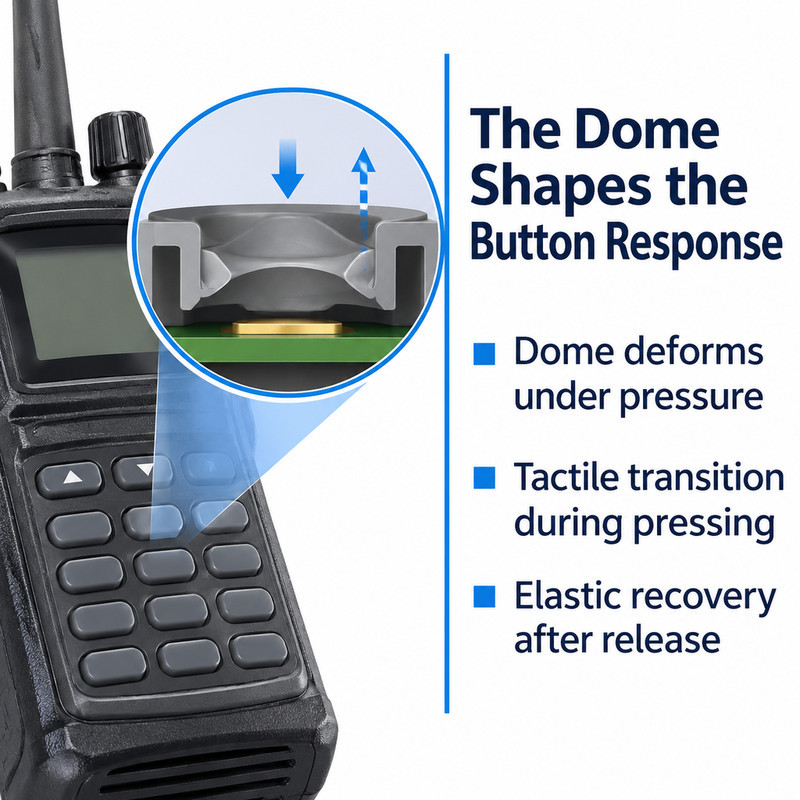
Dome design matters because that sequence is the only feedback channel the device has. There is no screen to confirm the press, the radio may be on a belt or in a pocket, and the user's hand may be gloved. If the collapse is not distinct, the user presses again, which is how a radio ends up transmitting twice or stepping past a channel.
Dome design also sets how long the keypad lasts, because the same geometry that produces a clean collapse also controls how much strain the material sees at the crown and at the wall junction.
How Does a Silicone Dome Generate Tactile Feedback?
Three events happen in sequence. As the crown moves down, the dome wall bends outward and the force rises to a peak. At a critical deflection the dome geometry can no longer carry the load in that shape, and it snaps through to a second, lower-force state. That snap is the tactile event. On release, the stored energy brings the dome back, and the speed of that return is the perceived rebound.
What the user calls "crisp" is the ratio between the peak force and the force needed to hold the dome collapsed. A high ratio gives a sharp break. What the user calls "heavy" is the absolute peak. Those are separate properties, and a key can be crisp and heavy at the same time, or light and mushy.
Why Do Two-Way Radio Buttons Need Consistent Response?
Because the radio is operated by feel, in sequence, often under time pressure. Consistent response lets the user build a mental map of the keypad, and that map is what allows operation without looking. One key that needs noticeably more effort than its neighbours breaks the map: the user slows down, looks at the keypad, or presses harder than necessary.
Consistency is also a service issue. A keypad where two keys feel different is reported as a defect even when both register correctly, and it is difficult to argue with, because the user's perception is accurate even if the measurement passes.
Which Dome Design Factors Affect Silicone Keypad Response?
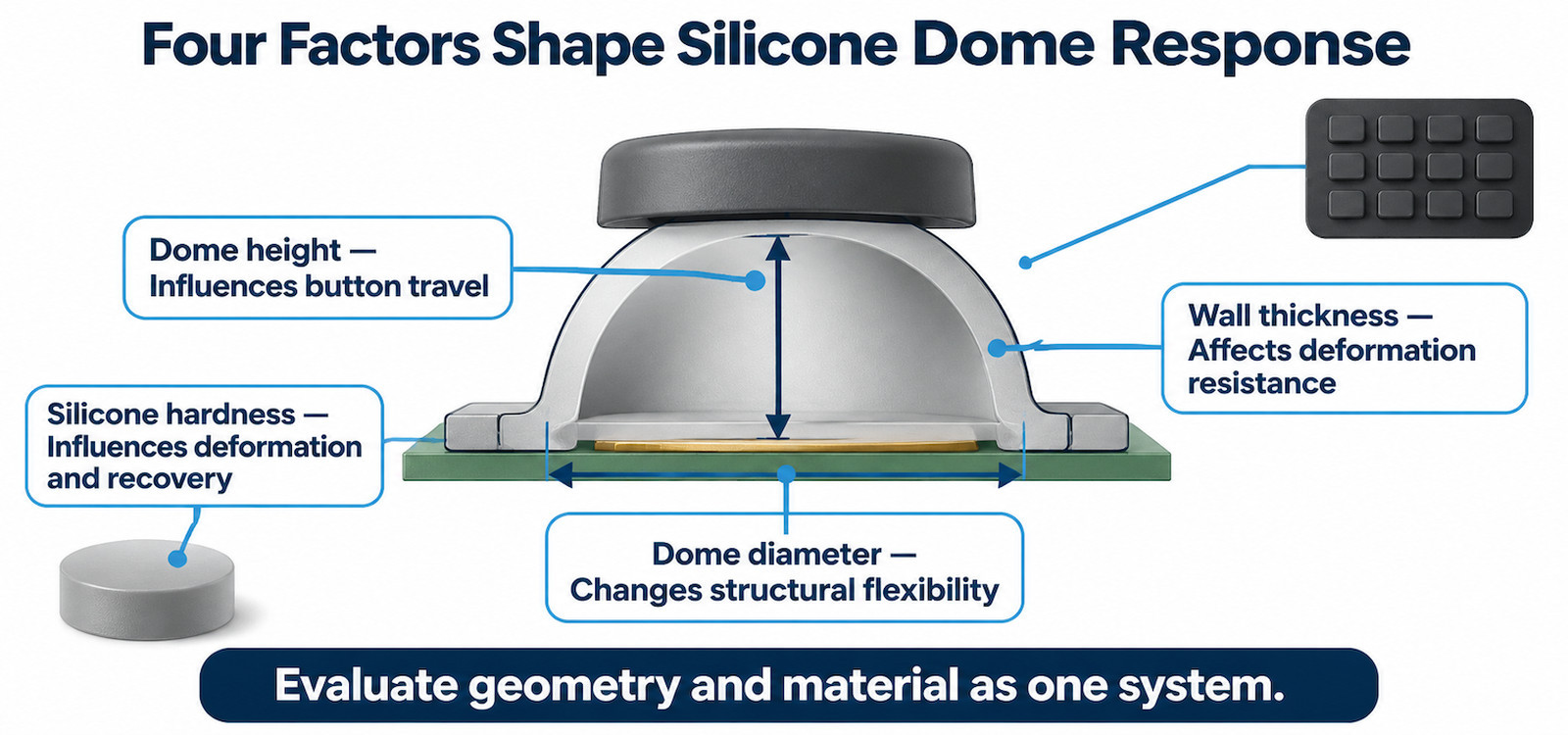
Four variables control the force curve: dome height, wall thickness, dome diameter and material hardness. They are usually discussed separately and specified separately, which is the source of most of the trouble.
How Does Dome Height Influence Button Travel?
Dome height sets how far the crown can move before the dome bottoms out, and it therefore sets the usable travel. A taller dome gives more travel and a softer initial rise, which can feel smooth but vague if the collapse point is far down. A shorter dome gives a quicker break but less margin, and if the enclosure preloads the keypad, a short dome may already be part way into its curve before the user touches it.
Height also interacts with the gap to the PCB. If the dome is taller than the gap allows, the keypad sits preloaded and the force curve starts above zero, which is a common reason for a keypad that feels stiff only after assembly.
How Does Dome Wall Thickness Affect Actuation Force?
Wall thickness is the strongest lever on peak force, because the wall is what resists bending. Thickening the wall raises the peak quickly. Thinning it lowers the peak but also lowers the force that holds the dome in its collapsed state, so the snap becomes less distinct and the return becomes slower.
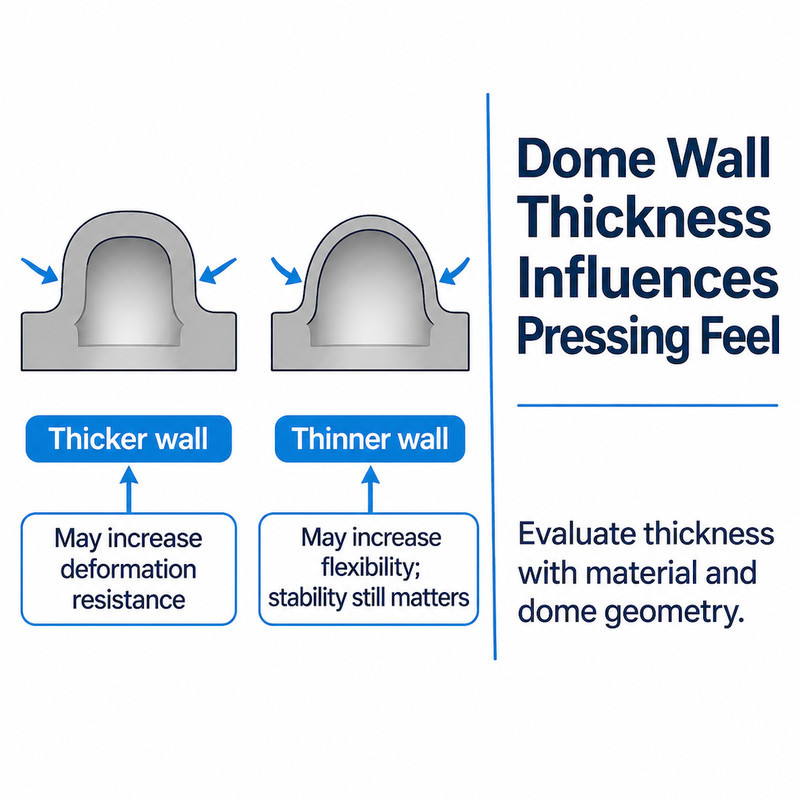
The useful way to think about it is that thickness changes the amplitude of the curve more than its shape. If the shape is wrong, thickness will not fix it. A key whose collapse is abrupt but too heavy has a shape problem at the wall-to-crown transition, not a thickness problem.
Thickness variation across a keypad is worse than thickness itself. A tool that produces 0.05 mm of variation between cavities will produce a row of keys that feel different, and no assembly adjustment can correct that, because the difference is in the part.
How Does Dome Diameter Change the Tactile Response?
Diameter changes how the load is distributed around the wall. A larger dome has a longer perimeter to carry the same force, so it deflects more easily and snaps at a lower force for the same wall thickness. A smaller dome is stiffer for the same wall, and it also reduces the contact area over the PCB pad, which affects registration.
Diameter should be evaluated with button diameter rather than on its own, because the visible key and the working dome are not the same feature. A 10 mm key can sit over a 6 mm dome, and the user's perception follows the dome, not the key.
How Does Silicone Hardness Influence Dome Performance?
Hardness scales the whole curve. A harder compound raises peak force and speeds the return; a softer compound lowers both. That sounds like a simple control, and it is the reason hardness is over-used as a fix.
The catch is that hardness also changes compression set and long-term recovery, so a compound chosen to fix a feel problem can create a durability problem. Hardness should follow the durability and sealing requirement, and geometry should be used to set the feel.
| Design factor | What it changes | If set too low | If set too high |
|---|---|---|---|
| Dome height | Usable travel before bottoming out | Short, abrupt break with little margin | Collapse arrives late and the press feels vague |
| Wall thickness | Peak actuation force | Mushy break and slow return | Heavy, tiring key under a gloved thumb |
| Dome diameter | Structural flexibility of the shell | Stiff for the same wall thickness | Snaps early; less contact area over the pad |
| Silicone hardness | Scaling of the whole curve | Creep under preload and slow recovery | High effort and a harder seal at the panel edge |
What Happens When Silicone Keypad Dome Geometry Is Poorly Designed?
Why Can Buttons Feel Too Hard or Difficult to Press?
Usually one of three causes: a wall that is too thick for the dome diameter, a dome that is too short and therefore already deep into its curve at rest, or a keypad that is preloaded by the enclosure. All three raise the force at the start of the press, which is what the user experiences as stiffness.
Hardness is often changed at this point, and it can mask the symptom while making the return slower. If the same key also has to survive a million presses, the softer compound may not be the better trade.
Why Can Buttons Feel Mushy or Lack Clear Feedback?
A mushy key is a key with a small snap ratio: the peak is not much higher than the holding force, so there is no clear break. That happens when the wall is thin relative to the dome diameter, when the dome is shallow, or when the crown is very compliant because the button top is thin.
Poor rebound produces the same complaint from the other direction. If the dome returns slowly, the user feels a soft release and may press again to confirm.
Why Can Different Buttons Have Uneven Response?
Three sources. Dimensional variation between cavities, uneven curing across a large keypad, and local differences in the web or backing structure around each button. On a radio keypad with a row of small keys, the middle keys are often the ones that feel different, because their webs connect to two neighbours instead of one.
Uniformity is a tooling and process question, not a design question, but it has to be specified as a requirement or it will not be inspected. The article on dome height tolerance and inconsistent button response walks through the same failure on a different instrument.
How Should Manufacturers Optimize Silicone Dome Design?
Optimization is a sequence, not a single change. Geometry first, hardness second, process control third. Reversing that order produces keypads that pass a bench test and drift in production.
How Should Dome Height, Diameter and Wall Thickness Be Evaluated Together?
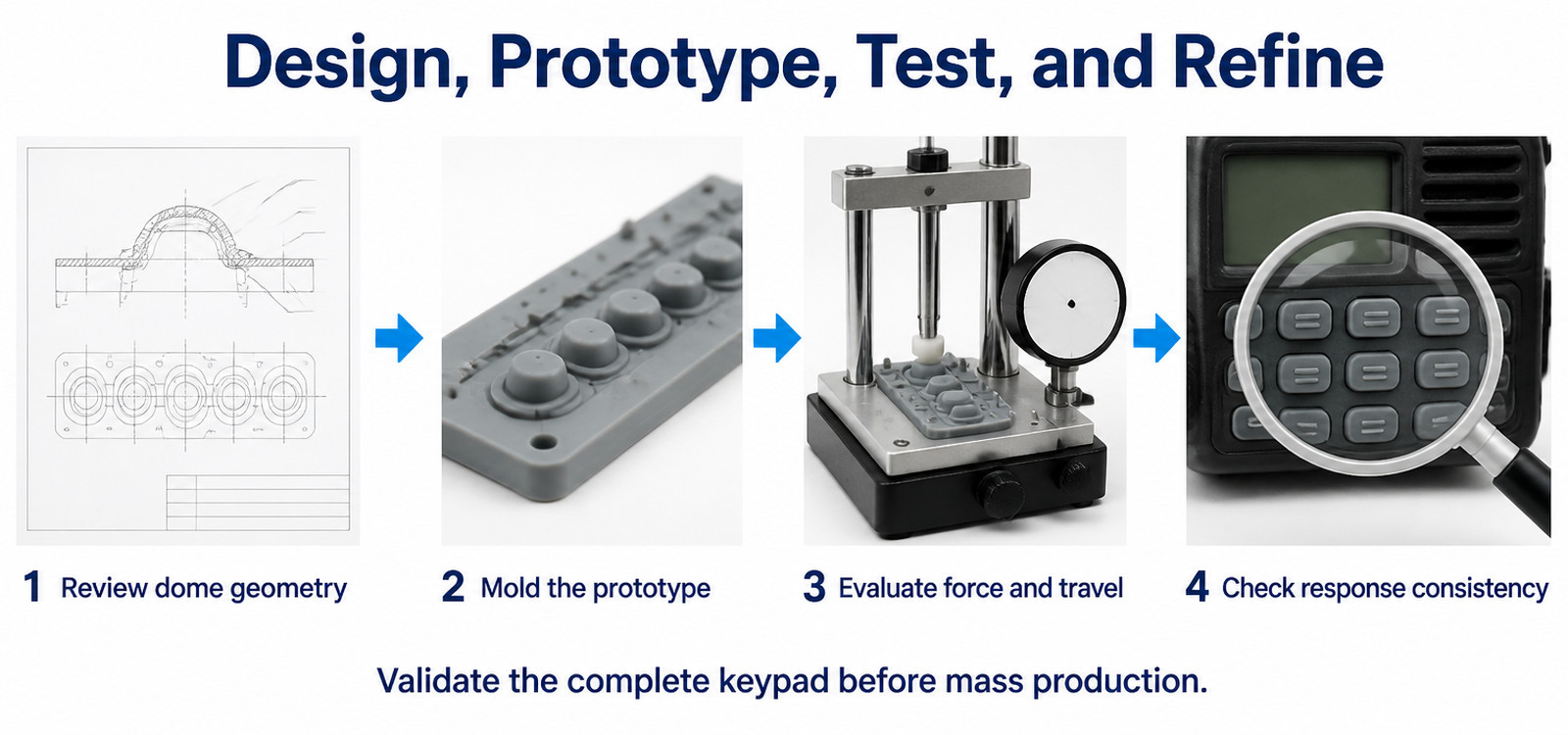
Start from the constraints the device imposes: the gap between keypad and PCB, the travel the switch or pad allows, the force the user should feel through a glove, and the number of presses the key must survive. Those four inputs define a working envelope. Then choose height, diameter and wall inside that envelope, and measure the resulting force curve rather than calculating it, because the curve depends on the transition radii as much as on the nominal dimensions.
Iterating on a set of three prototypes with different wall thicknesses will teach more than a month of simulation, and it is the fastest way to find where the snap becomes distinct.
How Can Prototype Testing Identify Dome Response Problems?
Five measurements cover the risk: peak actuation force, collapse travel, return force, rebound time, and the difference between keys across the keypad. Add a repeated-press run to see whether the curve changes with use, and test the keypad assembled in the housing, because preload moves the whole curve.
The measurement should be taken with the intended interface in place. Testing a bare keypad tells you about the dome; testing the assembled device tells you what the user will feel.
Why Is Mold Precision Important for Consistent Dome Performance?
Because the dome is a thin shell, and thin shells are sensitive. A small difference in wall thickness produces a visible difference in force, and cavity-to-cavity variation in a multi-cavity tool shows up as a keypad with a personality. Precise cavity machining, balanced runners and controlled cure are what turn a good design into a consistent part.
What Should You Provide When Customizing a Two-Way Radio Silicone Keypad?
Which Technical Specifications Help Define Dome Requirements?
Six inputs make the review concrete: button layout and dimensions, target actuation force or a sample key that feels right, required tactile character (crisp or smooth), silicone hardness or the durability target that drives it, expected press frequency and environment, and the PCB or switch interface including pad size and travel.
A reference sample is worth more than a written force target in most projects. If the customer can send a keypad whose feel is acceptable, the geometry review can start from a measured curve instead of an adjective.
How Can a Silicone Keypad Manufacturer Support Dome Development?
The support that matters is in the first two rounds: reviewing the dome section against the enclosure gap, proposing two or three wall options rather than one, and measuring prototypes on an assembled sample. After that, the work moves to cavity consistency and process control.
FromRubber moulds keypads and conductive inner keypads in the same plant, with 32 compression moulding machines and an in-house tool room, so a dome change can be tested against the existing cavity before a new tool is cut. The custom silicone rubber inner keypad page shows the construction that sits under the visible keypad, and the design and technical support page describes how a force curve review is usually run.
Questions Radio Designers Ask About Dome Response
Can we make the keys crisper without making them harder to press?
Yes, in most cases. Crispness is the ratio between peak force and holding force, and that ratio can be raised by adjusting the wall-to-crown transition and the dome diameter while keeping peak force roughly where it is. It is a geometry change, not a hardness change.
Why does the keypad feel different after it is installed in the housing?
Because the housing preloads it. If the gap between keypad and PCB is smaller than the dome height, the dome starts part way into its curve, so the first part of the press is already used up. The fix is usually a small change in the support ledge or the dome height, not a change in compound.
How many presses should a radio keypad survive?
It depends on the key and on the user, so the number should be agreed as a test requirement rather than assumed. The pressing method, the force and the inspection criterion all change the answer. This note on press cycles for a conductive silicone inner keypad explains how the figure is usually established.
Does a harder compound always give a better click?
No. It raises peak force and speeds the return, but it does not create a snap that the geometry does not have. On a shallow dome, a harder compound mostly makes the key tiring.
What the Finger Is Reading
Dome design is often treated as a detail of the keypad drawing. In a radio it is the primary user interface, and the difference between a keypad that is trusted and one that is pressed twice is measured in tenths of a millimetre of wall thickness and in the radius where the wall meets the crown.
The practical conclusion is to specify the force curve, not the compound. Once the curve is a requirement, the geometry review, the prototype measurement and the cavity inspection all point at the same target, and the keypad stops being a part that either feels right or does not.
Sources and notes. The force-curve description in this article follows standard engineering practice for snap-action elastomer domes; it is a design explanation, not a test report. Force, travel and ratio values are not quoted as specifications because they are set by the enclosure gap, the switch interface and the agreed validation protocol. Related FromRubber notes on radio keypad feel are linked above.
FromRubber, Dongguan Bohao Electronic Technology: custom silicone keypads and conductive inner keypads for handheld radios. Send a sample key that feels right, or the enclosure gap and target force, and we will review the dome section before tooling. WhatsApp and WeChat: +86 18676210913.
Published by the FromRubber keypad engineering team.