
Why Does a Mining Equipment Silicone Keypad Become Hard to Press?
A silicone keypad that becomes hard to press is usually reported as ageing, and it is usually something else. Operating force does not drift upward on its own after a set number of months. It rises because something changed around the button - debris accumulating in the gap, a housing that deformed, a web that took a compression set, or a return path that no longer has the travel it had when the machine left the factory. Treating it as a material problem sends the investigation to the wrong place and produces a new keypad with the same fault.
Four starting conditions, which need different responses
- Hard from the beginning. A design or assembly condition, present at first article.
- Hard after repeated use. Something accumulates or deforms with cycles.
- Hard after environmental exposure. Temperature, contamination or cleaning agents are involved.
- Only certain buttons. A local condition, not a panel-wide material change.
These four do not share a cause. Record which one you actually have before ordering a material change.
Design problem or service-age problem, decide first
There are two large families of cause, and they are separated by one question: was the force acceptable on the first article, and is a recorded first-article value available?
If the panel was stiff from the day it was commissioned, no ageing mechanism is involved. The geometry, the compression budget or the assembly pressure was already marginal, and the machine simply made it visible. If the force was measured and acceptable, and rose later, the cause lies in something that changes with time or cycles: compression set in the web, deformation of the enclosure, contamination, or movement of the keypad relative to the panel.
That distinction also decides who can fix it. A design problem belongs to the drawing; a service-age problem belongs to the environment, the assembly, or the maintenance routine. Assuming ageing first is the most common mistake in this kind of investigation, and it is worth noting that silicone does not have a fixed service life after which it hardens - compression behaviour depends on the conditions it experienced, not on a calendar.
Mechanical interference that builds up around the button
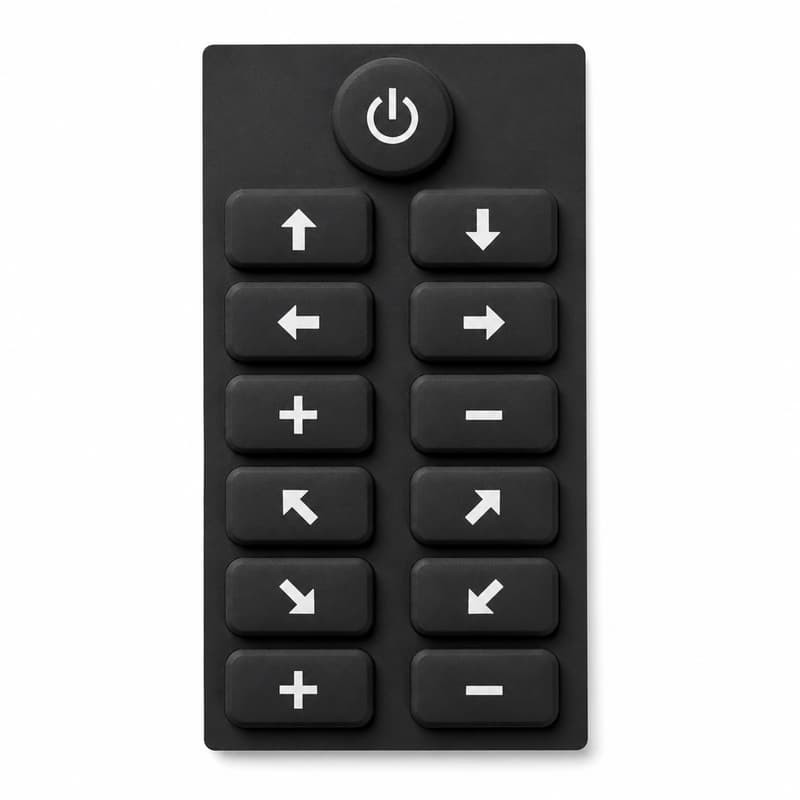
Before any material discussion, the physical space around the button has to be examined. Five conditions raise operating force without touching the compound:
- Housing deformation. A cover that has taken a permanent set, or a panel that has been straightened, changes the compression applied to the keypad.
- Dust and debris around the button. Material in the cap-to-opening gap adds friction, and on abrasive sites it also changes the surface it rubs against.
- Button rubbing against the panel. A cap that shifted laterally now contacts the opening wall through part of its travel.
- Keypad displacement. If the locating features were marginal, the keypad can move over time and change the clearance on one side of every button.
- Protective cover interference. A guard, boot or secondary shield that was fitted later can press on the panel face or on the key caps.
These are all verifiable with the machine stopped and the panel opened, and they are the first things to check because the evidence is physical: rub marks, compressed dust rings, polished contact patches on the panel. Where abrasive dust is the dominant contaminant, the countermeasures are structural rather than material, as set out in this note on improving silicone keypad resistance to dust and abrasive particles.
Environment: what it can and cannot explain
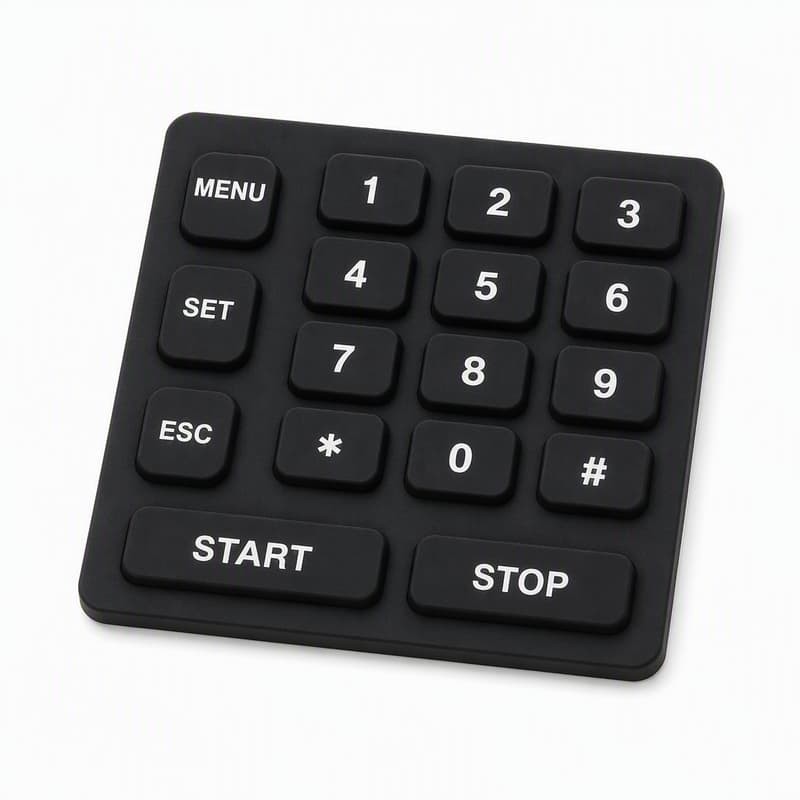
Environmental exposure is a real factor, and it is also the most frequently over-claimed one. The honest position is that these conditions can contribute, and that the effect has to be demonstrated rather than assumed:
- Temperature. It changes the stiffness of the compound, so a keypad can feel noticeably heavier cold and lighter warm. That is a reversible effect, different from a permanent rise in force.
- Oils and contaminants. Some fluids swell or soften silicone, some leave residues that change friction. Which fluid matters, so a compatibility question is specific to the fluid list on site.
- Cleaning agents. Repeated wiping with aggressive chemistry can change the surface of the caps and the friction in the openings.
- UV exposure. Relevant for panels that see direct sunlight; it affects the surface and the printed legends more than the bulk stiffness.
- Long-term compression. This is the one that most often produces a genuine, permanent change, and it is discussed below.
Ingress classification is the framework usually used to describe how well a panel keeps these agents out, and a keypad aperture is part of that enclosure. IEC 60529 defines the IP code and the test conditions behind it, so "IP65" is a claim about defined tests rather than a general statement about durability. Where conditions on a site exceed what the enclosure was classified for, the answer is usually a change to the enclosure or to the maintenance routine, not to the silicone.
Geometry and compression that were marginal from day one
If the panel never felt right, the cause is usually geometric. Two conditions matter most.
The first is the compression budget. Silicone is almost always installed under compression, and when the closed height was specified as a single nominal value, a unit that came in slightly thick starts life with the webs partly loaded. The operator then has to finish a deflection that has already begun, and the force at the switching point is higher than the design intended.
The second is the return path. Key wall thickness, web shape, key height and base thickness together decide how much of the stroke is used for return. A keypad with the right force curve but insufficient return travel will feel heavier over a shift even when the peak force is correct, because the finger is working against a web that never fully recovers between presses. Neither condition is visible in a force measurement taken on a bare keypad; both are visible in the assembled unit.
The geometry question has a second half that is easy to miss: the thin sections. A keypad frame is usually thinner than the buttons it carries, and the frame is what holds the button pattern. Where the frame is thin, clamping load deforms it before it deforms anything else, and the buttons beside it move with it. That produces the localised pattern - a row of buttons that all feel heavier together - rather than one isolated stiff key.
Compression allowance belongs in the same calculation. If the closed height of the housing leaves the base under load at rest, the frame is the part that absorbs that load, and every button mounted on it starts its stroke from a deflected position.
What happens to the return path over time
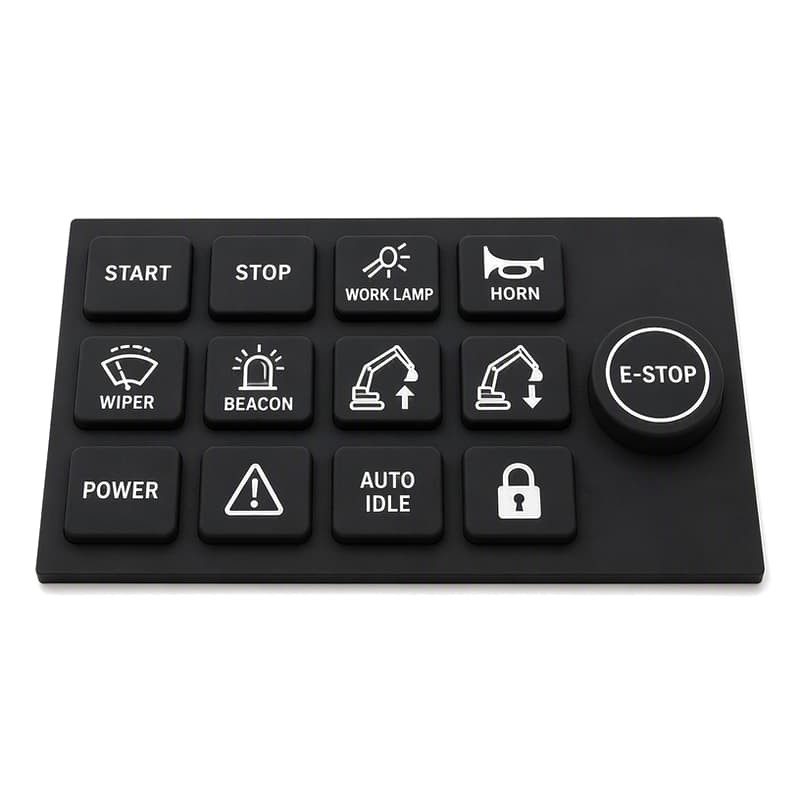
Four mechanisms to verify rather than assume
- Reduced return movement. Measure free height at rest against the first-article value, not against the drawing.
- Compression set. The web does not come back to its original height after prolonged compression.
- Local deformation. One region of the keypad has taken a shape that reduces clearance at specific buttons.
- Changed contact with the panel. A cap now touches the opening where it previously did not.
Each of these is measurable. Presenting them as possibilities is honest; declaring one without a measurement is not.
Compression set is the mechanism most worth understanding, because it is the one that produces a permanent force change without any visible damage. It is defined as the deformation remaining after a compression is released, and the relevant test conditions are set out in ISO 815-1:2019, which measures the ability of a rubber compound to retain its elastic properties after prolonged compression at constant strain. Where a keypad spends its life pre-compressed by housing pressure, a compound with higher compression set loses more of its free height, and the buttons it affects are the ones carrying the most load. Heat accelerates the same process, which is the practical reason heat resistance testing exists as a separate subject under ISO 188:2023.
Two related notes are worth reading alongside this section: a service case where a machine keypad changed feel after roughly 2000 hours and the mechanisms behind it, and the pattern where a keypad passes a million cycle test yet fails first during system ageing. Both describe how the environment the keypad lives in, rather than the keypad alone, decides the outcome.
Working out whether the keypad or the structure is responsible
- Inspect the installed keypad without disturbing it. Photograph the panel face for rub marks and dust patterns.
- Compare an affected button with an unaffected one on the same keypad, at the same panel temperature.
- Release external pressure where it can be released - loosen the fasteners in the production order and check whether the feel changes.
- Test the keypad movement independently, with the panel open and no clamping load, and compare with the first-article sample.
- Inspect for contamination, deformation and flash in the clearance zone, using magnification rather than eye alone.
- Compare the current keypads against a retained original sample, measured rather than judged by hand.
- Check material and dimensional records for the batch in service, including hardness and any post-cure data.
Step three is the most informative and the most frequently skipped. If loosening the fasteners restores the feel, the keypad has not changed: the enclosure has.
Design decisions that keep operating force stable
- Material selection matched to the fluid and temperature list for the machine, not only to a hardness figure.
- Hardness specified as a range with a named measurement method, so batch drift is detectable.
- Button geometry with enough return travel that the finger is never working against a loaded web.
- Compression design with a stated closed-height range, rather than a single nominal value.
- Dimensional control across the moulding, recorded rather than sampled by feel.
- Prototype function testing in the real enclosure, in the real temperature range where that is practical.
FromRubber, the brand of Dongguan Bohao Electronic Technology Co., Ltd., has moulded custom silicone keypads since 2010 and reviews compression, geometry and material as one decision, because operating force is the result of all three.
Frequently asked questions
Why does a silicone keypad become harder to press over time?
Usually because something around the button changed: debris in the clearance, an enclosure that deformed, a web that took a compression set, or a return path that lost free height. It is a set of mechanisms to verify, not a fixed ageing process.
Can compression set affect silicone button operation?
Yes. Compression set is the deformation remaining after compression is released, so a web with higher set loses free height and the button needs more finger travel to reach the same switching point.
Can temperature affect keypad feel?
It changes compound stiffness, so a panel can feel heavier when cold and lighter when warm. That effect is normally reversible, which is what separates it from a permanent force increase.
Can contamination make silicone buttons hard to press?
It can, when material collects in the cap-to-opening gap or leaves a film that raises friction. Abrasive dust is the most damaging variant, because it also changes the surfaces it works against.
How can long-term keypad performance be evaluated?
By testing the keypad inside its real enclosure, at the temperature range it will see, and by recording free height and operating force so that a later change can be measured instead of debated.
In short
A keypad that has become hard to press should be investigated as material, geometry, assembly, environment and service condition together - and in that order only when the first-article record justifies it. The single most useful thing a maintenance or engineering team can add to the panel file is a first-article record of operating force and free height, because everything afterwards becomes a comparison instead of an opinion.
Sources and standards referenced
- ISO 188:2023, Rubber, vulcanized or thermoplastic - Accelerated ageing and heat resistance tests. https://www.iso.org/standard/80468.html
- ISO 815-1:2019, Rubber, vulcanized or thermoplastic - Determination of compression set - Part 1: At ambient or elevated temperatures. https://www.iso.org/standard/74943.html
- IEC 60529:1989+AMD1:1999+AMD2:2013, Degrees of protection provided by enclosures (IP Code). https://webstore.iec.ch/publication/2452
Contact
FromRubber - Dongguan Bohao Electronic Technology Co., Ltd., custom silicone keypad manufacturer since 2010. Email: nani@fromrubber.com or karl@fromrubber.com. WeChat and WhatsApp: +86 18676210913. Website: www.fromrubber.com
Are you looking for a rubber and plastic product customization solutions manufacturer?
We can quickly provide customers with market analysis, technical support and customized services.Sign Up Out Newletter
