Electronic Level Silicone Keypad Durability Problems in Outdoor Measuring Equipment
Keypads on outdoor measuring equipment almost never fail on the day they are installed. They fail in the third or fourth season, when the operator notices that ZERO needs a firmer press than it used to, or that the printed legends have gone grey, or that the panel feels flatter than the machine next to it. By then the instrument is out of warranty and the failure is described as wear.
Why Electronic Level Silicone Keypad Durability Matters in Outdoor Equipment
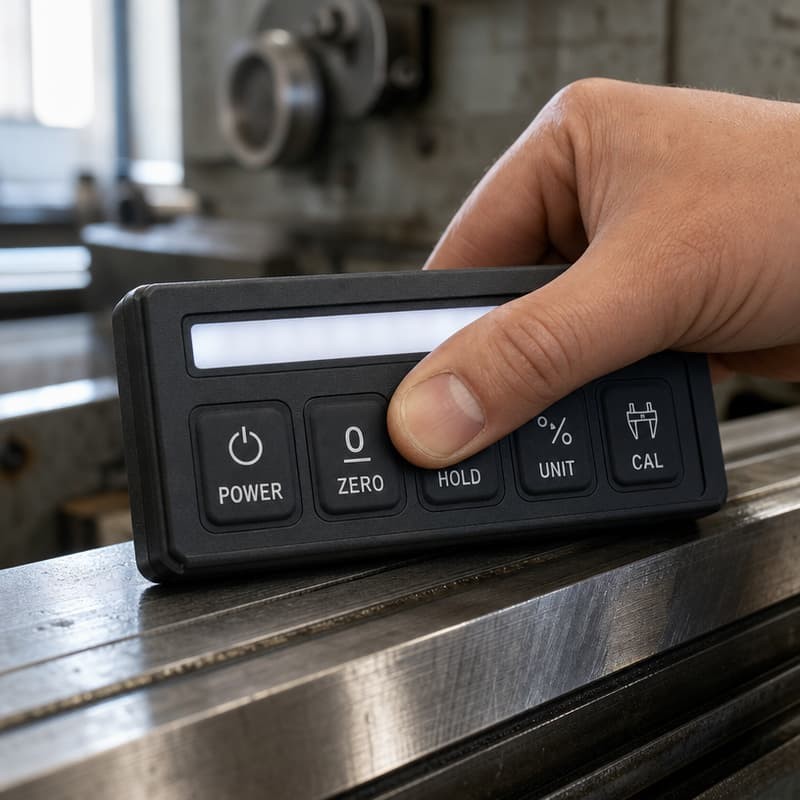
An electronic level used indoors is a gentle application. An electronic level used on a construction site is not. The same instrument may spend the morning on a wet kerb, the afternoon in the back of a pickup, and the evening in an unheated store room, with the keypad being pressed hundreds of times in between by someone wearing work gloves.
The operating conditions that drive keypad durability in this category are consistent:
- Construction sites — abrasive dust, impact, and hands that are not clean.
- Outdoor surveying environments — direct sun, rain, and large day-to-night temperature swings.
- Dust and dirt exposure — fine particles that migrate into any open joint.
- Moisture and humidity — condensation on a cold instrument brought into a warm vehicle.
- Temperature fluctuation — which changes both the silicone feel and the clearances around it.
- Frequent handheld operation — the unit is gripped while buttons are pressed, so force arrives at an angle.
- Repeated pressing of a few buttons — usage is rarely evenly distributed across the panel.
The keypad is usually the most frequently touched part of the instrument, and it is also one of the few parts that the user can judge without any tools. A panel that feels tired makes the whole instrument feel tired, regardless of what the sensor is doing.
Durability is not one property
An electronic level silicone keypad stays usable when several things hold at once: the material keeps recovering, the legends stay legible, and the contact resistance stays predictable. A keypad can meet a cycle-life figure and still fail this test, because cycle counting alone does not capture heat, UV, dust or cleaning chemicals.
Common Durability Problems in Electronic Level Silicone Keypads
Field returns cluster around three failure modes. They are often reported together, but they have different causes and different design answers.
Loss of Tactile Feedback After Repeated Use
The first complaint is usually about feel rather than function. The button still works, but the crisp snap has gone and the operator can no longer tell reliably whether the press registered.
- Material recovery — how completely the silicone returns to its original shape after each press.
- Structural fatigue — fatigue concentrated at the web and the button wall, where strain is highest.
- Changes in button elasticity — progressive softening in the compound itself.
- Uneven tactile response — where some buttons age faster because they are used far more often.
Compression set is the mechanism behind most of this. When silicone is held under compression for a long period — including simply being clamped inside a closed housing — it gradually loses the ability to return fully. Standardised test methods such as ASTM D395 and ISO 815-1:2019 exist to quantify exactly that behaviour, and the difference between materials shows up there long before it shows up in the field.
We examined the practical consequences in silicone keypad compression set and long-term reliability.
Surface Wear and Printed Character Damage
The second failure mode is visible. Legends lose contrast before the button stops working, and the operator then has to remember the layout.
- Printed legends fading — the ink or coating wearing through at the high points of the button.
- Surface coating wear — a matte or textured finish polishing into a gloss.
- Abrasion from gloves or tools — grit held in a glove acts like a fine abrasive.
- Repeated cleaning — solvents attacking the printed layer.
- Dust particles — which are both abrasive and, once embedded, hard to remove.
How long a legend lasts depends on the marking process selected and on the environment it is exposed to. Screen printing, laser marking, protective coatings and moulded legends are not interchangeable, and the abrasion test that predicts performance is different from the test that predicts electrical life.
We compared the available approaches in surface treatments for silicone keypads in aggressive environments and in screen printing wear and tape-test verification.
Reduced Button Response Over Time
The third failure mode is electrical and intermittent, which makes it the most expensive to diagnose. It is worth being clear that this is not automatically a silicone material problem.
- Silicone deformation — a plunger that no longer reaches the pad with consistent force.
- Conductive contact wear — carbon pills or conductive traces losing conductivity at the contact point.
- PCB contact contamination — residue, dust or oxidation on the pad itself.
- Structural misalignment — the plunger landing off centre so that contact area varies with press angle.
- Changes in compression — a housing that relaxes, or a gasket that takes a set, altering the whole stack.
Attributing every response problem to the silicone skips half the system. Contact reliability is a property of the pair — conductive contact and PCB pad — and the field failure rate for a given keypad design depends on which board it is fitted to.
Environmental Factors Affecting Electronic Level Silicone Keypad Performance
Dust and Fine Particles
Dust does not need a gap to cause trouble. It accumulates at button edges and in housing openings, then works its way along the button wall as the button is pressed. Once particles reach the plunger, they can lift the contact off the pad slightly, or sit between the contact and the pad and produce an unstable resistance.
The countermeasure is fit rather than material. A keypad that is properly retained against its housing ledge, with the button wall matched to the opening, moves far less abrasive material inside than a loose panel does. Conductive or anti-static properties of the silicone are relevant to dust attraction in some environments, which we covered in anti-static agents and dust attraction.
Moisture and Humidity
Moisture affects an outdoor keypad in two ways. Continuous exposure — rain, splashes, hose-down — is the obvious one. Condensation is the one that catches designs out, because it forms inside a sealed enclosure when a cold instrument is brought into a warm room.
- Outdoor humidity, which promotes slow changes in surface condition.
- Occasional water exposure from handling and cleaning.
- Condensation risk from temperature cycling in service.
- Sealing considerations for the button openings and the panel perimeter.
One point deserves emphasis: a silicone keypad is one element of an enclosure protection design. It does not, on its own, make an instrument waterproof, and a keypad marketed as if it does will be blamed for a leak caused by a screw boss or a display window.
Temperature Changes
Temperature changes affect an outdoor keypad in a way that is easy to underestimate. Silicone stiffens as it cools, so a panel that feels comfortable at 22 °C feels firmer at 0 °C, and the actuation force an operator experiences changes with the weather. Thermal expansion acts on the housing and the PCB as well, changing the compression of the stack.
Selecting the silicone compound for the expected operating conditions, rather than for the sample room, is the practical answer. Where a wide temperature range is specified, the material choice and the geometry have to be decided together, because a soft compound and a thin web can behave very differently at the cold end of the range.
Silicone Material Selection for Electronic Level Keypads
Material selection for an outdoor instrument is a set of trade-offs rather than a single best answer. The relevant properties are:
- Silicone hardness — the primary feel and force lever, measured under a standard method such as ASTM D2240.
- Elastic recovery — how quickly and completely the material returns after compression.
- Compression resistance — resistance to taking a permanent set while clamped in the housing.
- Temperature resistance — performance at both ends of the operating range, not only at the hot end.
- Surface durability — how the surface responds to abrasion and cleaning.
- Compatibility with conductive carbon contacts — the printed or moulded conductive element has to survive the same life as the base material.
Choosing hardness by tactile preference alone is a common shortcut, and it usually produces a panel that feels right in the office and wrong on site. The more useful sequence is to start from the operating environment, the expected pressing force with gloves, and the number of cycles the most-used button will see, and then select a hardness that satisfies those before optimising feel.
We compared material behaviour across silicone grades and their typical instrument applications in silicone keypad yellowing, cracking and aging resistance.
Structural Design Factors That Influence Keypad Service Life
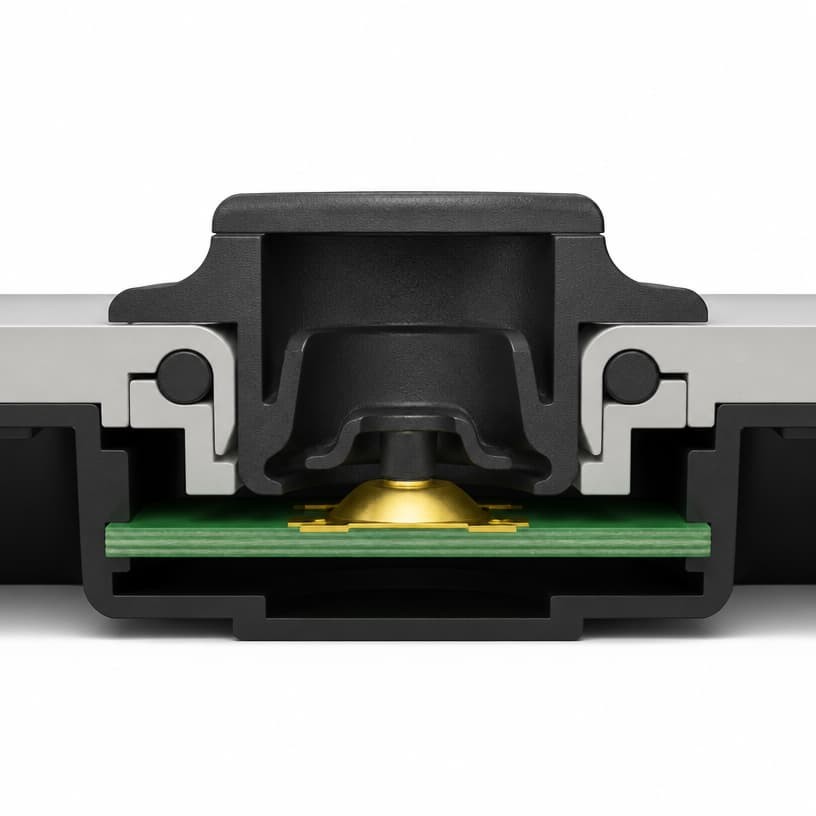
Material sets the ceiling on service life. Geometry decides how close the design gets to that ceiling, because structure determines where strain concentrates during each press.
The cross-section below shows the whole load path in one view: button cap, plunger, dome contact and board. Every fatigue mechanism discussed in this article happens inside that short distance.
Button Wall Thickness
The button wall controls both the force needed to press and how the button deforms. A wall that is too thick raises the actuation force and transfers more load into the base web, which increases fatigue in the surrounding material. A wall that is too thin buckles rather than moving cleanly, and the operator feels a vague press with no defined click.
Supporting Web Geometry
The web is where most of the bending happens, so it is where most of the fatigue accumulates:
- Web thickness — thin webs flex easily and fatigue earlier; thick webs last longer and stiffen the whole panel.
- Button spacing — closer buttons mean a shorter web and more force transfer between neighbours.
- Compression zones — areas designed to be compressed, kept away from areas that need to stay free.
- Stress concentration — sharp internal corners where strain has nowhere to spread.
Button Travel and Mechanical Stop Design
Travel that is longer than necessary is not a benefit. Every extra millimetre of movement is extra strain per press, and over a few hundred thousand cycles that difference becomes a different service life. The mechanical stop — the point where the housing physically prevents further movement — is what protects the keypad. If the housing allows over-travel, the silicone absorbs it as deformation, and the button is punished for a housing design decision.
The keypad structure and the housing's mechanical limits have to be designed as one system. This is the same interface question that shows up as sticking or pre-load, which we described in our note on gap clearance and keypad sticking.
Conductive Contact Reliability in Outdoor Electronic Level Keypads
For a conductive-pill design, the electrical path runs from the carbon pill through the PCB pad and back. In an outdoor instrument that path is exposed to two forces that indoor instruments rarely see: abrasive particles and condensation cycles.
- Contact surface condition — a polished pill surface contacts consistently; a contaminated one does not.
- Contact resistance consistency — variation between buttons is often more damaging than a uniformly high value.
- Carbon pill positioning — a pill sitting off centre shows contact behaviour that depends on press angle.
- PCB contamination — residue from assembly processes that only reveals itself after a few hundred cycles.
- Repeated actuation — the change in contact behaviour after sustained use, which is not the same as the change in feel.
Electrical reliability therefore depends on both the conductive silicone contact and the PCB switch design. A keypad supplier can control the pill, its placement and its hardness. It cannot control the pad finish, the mask opening, or whether the board was cleaned properly before assembly. Any durability claim that ignores this split is optimistic.
Surface Printing and Marking Durability Considerations
Marking method selection drives how long the legends stay readable. On a panel where five functions sit beside a display window, the two buttons an operator uses hundreds of times a month are the ones that will lose their legends first, even though all five were produced in the same printing pass.
The four options normally considered behave quite differently under abrasion and solvent exposure:
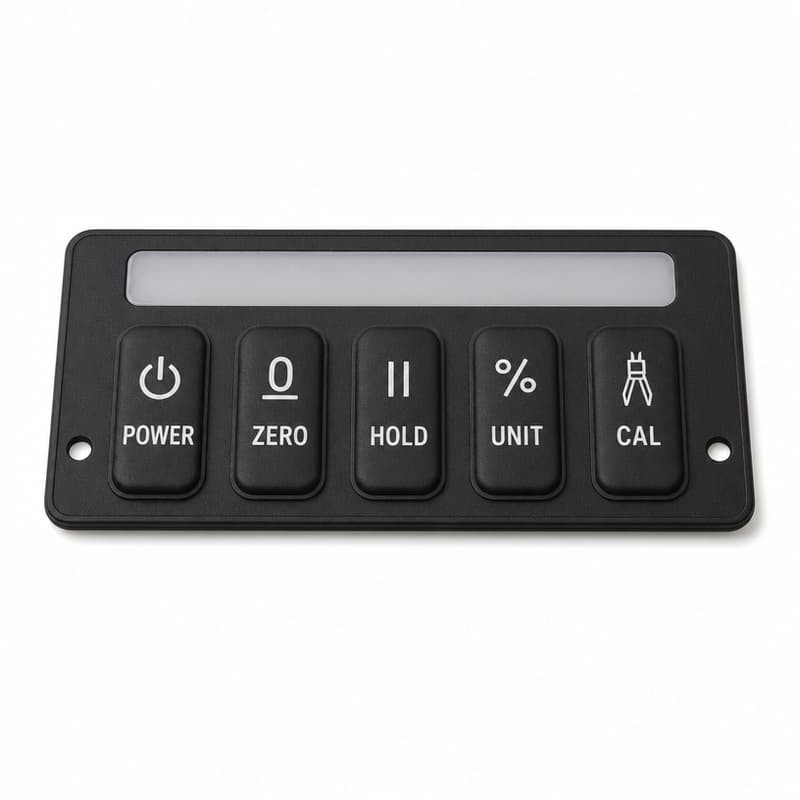
- Screen printing — good contrast and fine detail; the printed layer is the part that wears.
- Laser marking — alters the surface rather than adding a layer, so abrasion resistance differs from printing.
- Protective coatings — add a wear layer over the printing, at the cost of surface feel.
- Moulded legends — formed in the tool, so they cannot rub off, but they offer less contrast and constrain colour choices.
The right method depends on usage frequency, surface shape and environmental exposure together. A single high-use button on a panel with five occasional buttons is often worth marking differently from the rest, which is a design decision rather than a specification one. Placing the most-used function on a button that can carry a more durable marking is cheaper than upgrading the whole panel. The comparison between processes and the test used to verify them is in our note on silk printing wear and surface treatment verification.
How Prototype Testing Can Identify Durability Problems Early
Durability problems are cheapest to find before the instrument is qualified. The tests that actually reveal them are not complicated, but they have to be run on the assembled unit and under conditions that resemble the field.
- Repeated button pressing — concentrated on the high-use buttons, with periodic feel assessment rather than only continuity checks.
- Temperature exposure — including cold, because that is where force and feel change most.
- Humidity exposure — with the unit assembled, to catch condensation behaviour.
- Dust contamination simulation — to see where particles accumulate around button edges.
- Surface abrasion testing — for the legends that will be read every day.
- Visual inspection — recorded at intervals, because a photograph of legend condition over time is more useful than a pass or fail at the end.
- Electrical contact testing — measuring contact resistance across the panel, not only whether each button switches.
Test conditions should reflect the actual application requirements. A cycle-count figure produced at laboratory temperature and moderate humidity tells you how the material behaves under ideal conditions; it does not predict how the same keypad performs on a site in February.
Questions Electronic Level Manufacturers Should Ask Before Custom Keypad Production
These are the questions that separate a keypad quotation that will survive field use from one that only satisfies a drawing.
- What is the expected operating temperature range, including the cold end?
- How frequently will the most-used button be pressed over the instrument's life?
- Will users wear gloves, and if so, what type?
- Is the instrument used in dusty environments, and is dust abrasive or conductive?
- Will the keypad be exposed to moisture, and will it be cleaned with solvents?
- Are printed legends required, and what contrast is needed in low light?
- What is the expected button lifetime in cycles, per button rather than per panel?
- Does the PCB use carbon pill contacts or metal dome switches, and who is responsible for the pad finish?
These questions are not a formality. They determine hardness, web geometry, marking process and the test programme, and the answers usually change at least one of those four.
Conclusion
Durability of an electronic level silicone keypad in outdoor equipment is the result of five things working together: material selection, structural design, surface treatment, environmental exposure and PCB compatibility. Weakness in any one of them determines the service life, because the keypad is only as durable as its least robust interface.
The practical message is that durability problems are far easier to prevent at the design stage than to correct after mass production. Compression set, legend wear and contact drift are all measurable before tooling approval, and all three are expensive to address once the moulds exist and the units are in the field.
If you are specifying a keypad for an outdoor instrument, send us the operating conditions along with the drawings. FromRubber manufactures custom silicone keypads and buttons to customer drawings, and the material and structural recommendations we make are based on the environment the instrument will actually see rather than on a bench test at room temperature.
References and Standards Cited
- ASTM D573, Standard Test Method for Rubber — Deterioration in an Air Oven. https://store.astm.org/d0573-04r19.html
- ASTM D1149, Standard Test Methods for Rubber Deterioration — Cracking in an Ozone Controlled Environment. https://store.astm.org/d1149-18.html
- ASTM G154, Standard Practice for Operating Fluorescent Ultraviolet (UV) Lamp Apparatus for Exposure of Nonmetallic Materials. https://store.astm.org/g0154-16.html
- ISO 4892-3:2024, Plastics — Methods of exposure to laboratory light sources — Part 3: Fluorescent UV lamps. https://www.iso.org/standard/83802.html
- ASTM D395, Standard Test Methods for Rubber Property — Compression Set. https://store.astm.org/d0395-18r25.html
Related reading
FromRubber is the trading name of Dongguan Bohao Electronic Technology Co., Ltd., a custom silicone keypad manufacturer producing compression-moulded and LSR silicone keypads, buttons and seals to customer drawings. We do not manufacture PCBs or instrument housings; contact reliability figures in this article refer to the keypad side of the interface only.