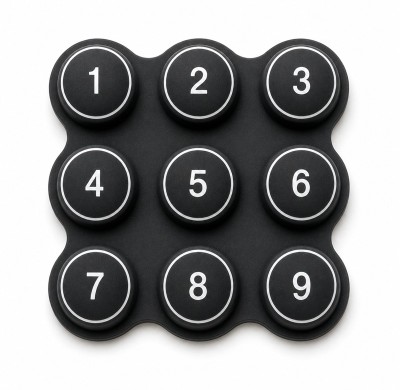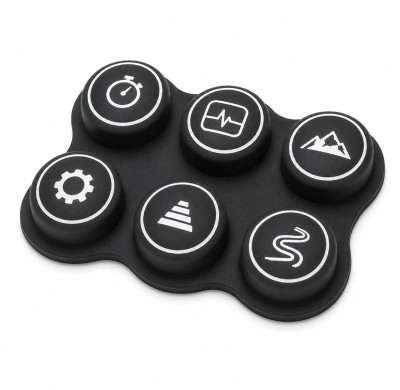
Why are soft silicone buttons suitable for commercial beverage equipment?
Ask three suppliers why soft silicone buttons are used on commercial beverage equipment and you will get three versions of the same answer: because they feel nice. That answer is not wrong, it is just useless in a project review. Softness on a beverage panel is not a comfort decision. It is the parameter that buys travel, seals the fascia, and quietly decides whether a cleaning cloth can start a brew cycle by accident.
Why does beverage equipment still use soft silicone buttons when touchscreens exist?
It is worth being honest about the direction of the market instead of pretending nothing changed. The premium bean-to-cup segment has largely moved to glass touchscreens, and manufacturers document those machines as touch interfaces with on-screen fields rather than physical keys. That is a real shift, and on a machine where the operator is standing still and looking at the display, glass works.
The equipment that keeps physical soft silicone buttons is the equipment where that assumption breaks: machines cleaned with a hose-adjacent routine, machines operated while the operator is doing something else, machines sold into sites where a cracked or delaminated screen is a shutdown. On those panels a soft silicone button wins for three reasons that have nothing to do with comfort. It seals, it can be felt without being looked at, and it can be replaced as a single moulded part.

Sealing comes free with the softness
A soft silicone panel is a continuous membrane. The same material that lets a keytop flex also spans the gaps between keys and forms the skirt that presses against the housing. There is no second gasket to assemble and no seam to leak at, which is why a washable panel and a soft panel tend to be the same thing.
This is also why a firmer panel is not simply a stiffer version of the same product. Push the hardness up and the membrane that was doing double duty as a seal becomes harder to compress into the housing groove, so the seal depends more on assembly preload and less on the material.
What does "soft" actually change inside the switch?
Start with the two competing architectures, because they respond to softness in opposite ways. Published comparisons of conductive and non-conductive rubber keypads give the numbers. A conductive design, where a carbon pill moulded under the keytop closes onto exposed interdigitated tracks on the board, typically runs an operate force of about 60 to 200 grams with keytop travel of roughly 0.03 to 0.07 inches. A non-conductive design, where the rubber simply pushes a metal snap dome, runs a much higher operate force, in the region of 240 grams up to about 2,000 grams depending on the dome, and the travel is limited by the dome to around 0.022 inches or less.
That difference explains the guidance the same source gives on hardness. Conductive designs want a low-durometer, softer rubber so that the force cone can flex repeatedly without tearing or cracking, because the cone is the spring. Non-conductive designs are described as able to use, and better served by, a firmer silicone, because the dome is the spring and the rubber only has to transmit the push.
So softness is not a property you choose for its own sake. In a conductive beverage panel it is a requirement of the mechanism. In a dome-based panel it is mostly a sealing and feel choice.
The force budget: where softness helps and where it costs
A soft panel spends its softness on three things, and there is only a fixed amount to spend.
- Travel. Softer webs allow a longer stroke, and longer stroke is more forgiving for a finger that is wet, gloved or arriving at an angle.
- Sealing. A softer skirt conforms to a housing that is never as flat as its CAD model, so the seal survives real assembly tolerances.
- Cycle life of the cone. The cone has to flex millions of times. Design guidance recommends a snap ratio of roughly 40% to 60%; below that band the key loses its tactile signal even though it may last longer.
What softness does not buy is return force. And return force is the parameter that gets forgotten on beverage panels.
Specify a return-force floor, not just an actuation-force target. A key that actuates at a pleasant light force must still push the operator's finger back off the contact at the end of the stroke. If the return force collapses, the panel does not fail on the bench. It fails in service, as a key that registers twice, or a circuit that stays closed after the operator's hand has moved on.

Why icon legends and soft panels go together
Beverage panels are increasingly laid out with icons instead of words, partly for multi-language markets and partly because there is less printed area to abrade. That suits a soft panel, because soft compounds and thick ink layers behave differently under a sanitiser wipe.
The trade-off is flexibility. A printed word can be changed between builds with a new screen. An icon is a tooling change, or at minimum a mould-surface change. Decide early which keys are likely to be re-named.
Where softness stops being an advantage
Soft is not automatically better, and the failure modes are specific. Excessive softness on a beverage panel produces a vague actuation point, accidental activation during cleaning, a slow or incomplete return, and keys that rock when pressed off-centre. Published design literature notes that tendency for the keytop to rock or wobble when pressed off centre, and it is worse on tall, soft keytops with a thin web.
There is also a food-safety dimension that has nothing to do with force. A very soft panel with narrow gaps between keytops collects liquid in the valleys, and a soft surface that flexes under a cloth is harder to wipe clean than a flat one. On a machine that has to be cleaned to a documented standard, that is a specification problem, not a comfort problem.
Case: soft keys, correct force, wrong return
Symptom. A beverage dispenser panel built with a deliberately soft compound met its actuation-force target on every key, but the site reported a key that occasionally registered twice on a single press, and one key that "felt tired" after an eight-hour shift.
Measurement. Force-travel curves were recorded per key on the assembled panel. Peak actuation force was inside the band. The curve after the snap was the problem: the return segment of two keys was shallow, and the force at the moment the pill left the board was marginal.
Root cause. The softness had been applied uniformly across the panel, but the keys were not uniform. Two keys sat over a housing rib, which added preload and flattened their return curve. The compound was chosen for feel, and no return-force minimum had ever been written into the drawing.
Change. Web thickness and the skirt height around the two affected keys were adjusted so that preload no longer dominated the curve, and a return-force minimum was added to the specification alongside the actuation band.
Verification. The revised panel was checked over its full stroke on the assembly, at low temperature as well as ambient, because a soft compound stiffens when cold and that moves both ends of the curve. No single force number would have caught this. The curve did.

Designing for the hand that actually presses it
Beverage panels are pressed by a hand that is busy. That has consequences the drawing can capture: wider key spacing so a thumb cannot straddle two functions, a keytop shape that resists rolling under an angled press, and a distinct snap so the press is confirmed without looking.
It also argues for testing with the accessory the site actually uses. If operators wear gloves, test with gloves. The force that feels light to a bare fingertip can be close to the upper limit of a comfortable press through a nitrile glove.
How should softness be written into a specification?
- Name the architecture first: conductive pill closing onto board tracks, or a non-conductive actuator over a dome switch. The architecture sets the achievable force and travel window.
- Set hardness by test method and scale, referencing ASTM D2240 or the ISO indentation hardness method, rather than using the word soft.
- Define the whole force-travel curve: actuation force, contact force, return force minimum, and accepted snap ratio band.
- Add compression set as a separate requirement, using ASTM D395 or the ISO compression set method, so the skirt is not allowed to take a permanent flat.
- State the cleaning chemistry and the wiping method, then test the assembled panel with them.
- Require the legend method and its abrasion expectation to be recorded, and confirm it against the sanitiser actually used on site.
- Verify at low and high temperature, because the curve of a soft compound moves with temperature.
FAQ
Are soft silicone buttons suitable for equipment that is cleaned with sanitiser every day?
Yes, and that is often why they are chosen, because the same soft membrane that flexes also seals the housing. The condition is that the compound and the legend method are matched to the cleaning chemistry, and that the skirt is designed as a real compression seal rather than a flat flange.
Does a softer button mean a longer-lasting button?
Not by itself. Softness is required in a conductive design so the force cone can flex repeatedly without tearing, but design guidance also notes that a longer stroke reduces the cycle life of the cone. Softness and life are linked through the geometry, not directly to each other.
Can a soft panel be sealed well enough for a washdown area?
A continuous silicone membrane is the sealing element, which is an advantage over a separate gasket. Published comparisons also point out that a non-conductive dome assembly can be environmentally sealed in a way that an open conductive pill cavity cannot, so the architecture affects how far the sealing can be taken.
What force should be specified for a commercial beverage panel?
Published data puts typical conductive silicone designs between roughly 60 and 200 grams and dome-based assemblies considerably higher. That range is a starting point, not a target. The right number comes from the panel geometry, the operator's accessory and the cleaning method, and it should be specified as a curve rather than a single figure.
Conclusion
Soft silicone buttons for commercial beverage equipment work because softness is spent on three things the application needs: travel, sealing and a cone that survives repeated flexing. The failure mode is never softness on its own, it is softness without a return-force floor, without a defined snap ratio, and without a test on the assembled panel. Specify the curve, name the architecture, and test it wet. FromRubber moulds soft silicone control panels for beverage and appliance equipment, and reviews force-travel data, sealing geometry and cleaning exposure against a customer's housing and board before tooling is cut.
This article was written by the moulding engineering team at FromRubber, a custom silicone keypad and button manufacturer in Dongguan, China. We mould soft silicone control panels for commercial beverage and appliance equipment.
Related reading
Sources
- [1] Epec Engineered Technologies, "Rubber Keypad Comparison: Conductive & Non-Conductive Construction Differences" — operate force, travel, durometer and sealing differences between conductive and non-conductive keypads. https://www.epectec.com/articles/conductive-and-non-conductive-rubber-keypad-comparison.html
- [2] Epec Engineered Technologies, "Rubber Keypad Design Guide" — travel, force, life cycle and contact resistance ranges; carbon conductor and silicone insulator hardness. https://www.epectec.com/keypads/design/
- [3] J.W. Electronic Components, "Design guide for rubber keypads" — optimum actuation force, minimum return force, snap ratio and stroke definitions. https://www.jw-electronic-components.de/pdf/Design%20guide%20for%20rubber%20keypads.pdf
- [4] Rancilio Group, "Classe 7" product documentation — soft-touch keypad with backlit icons. https://www.ranciliogroup.com/rancilio/classe-7/
- [5] Franke, "A600" operating instructions — glass touchscreen interface with on-screen selection fields and a monitor screen cleaning section. https://www.manualslib.com/manual/1248613/Franke-A600.html?page=17
- [6] Marco Beverage Systems, "Ecoboiler Service and Operating Manual" — front panel push button and cleaning instructions, including the warning not to use a water jet or spray. https://lamarzoccousa.com/wp-content/uploads/2012/08/Ecoboiler-Service-and-Operating-Manual.pdf
- [7] U.S. Food and Drug Administration, 21 CFR 177.2600, "Rubber articles intended for repeated use". https://www.ecfr.gov/current/title-21/chapter-I/subchapter-B/part-177/subpart-C/section-177.2600
- [8] NSF, "Manual Food and Beverage Dispensing Equipment", NSF/ANSI 18, and related food equipment standards. https://www.nsf.org/nsf-standards/standards-portfolio/food-equipment-standards
- [9] ASTM International, "Standard Test Method for Rubber Property—Durometer Hardness", ASTM D2240-15(2021). https://www.astm.org/d2240-15r21.html
- [10] ASTM International, "Standard Test Methods for Rubber Property—Compression Set", ASTM D395-18. https://store.astm.org/d0395-18.html
- [11] ISO, "Rubber, vulcanized or thermoplastic — Determination of compression set — Part 1: At ambient or elevated temperatures", ISO 815-1:2019. https://www.iso.org/standard/74943.html
- [12] BSI, "Food processing machinery. Basic concepts. Hygiene and cleanability requirements", BS EN 1672-2:2020. https://knowledge.bsigroup.com/products/food-processing-machinery-basic-concepts-hygiene-and-cleanability-requirements