What Handheld Meter Engineers Overlook When Specifying a Silicone Keypad
Handheld Meter Keypad Engineering
Every handheld meter ships with a silicone keypad, yet the specification is usually the last document anyone reads before tooling starts. The result is predictable: a keypad that works on the bench and misbehaves in the field. This guide walks through the specification points that handheld meter engineers most often overlook - contact system, actuation force, legend durability and tolerances - with the numbers that matter and the questions to ask your silicone keypad manufacturer before the mold is cut.
1. Handheld Meter Silicone Keypad Specs That Decide Field Reliability
The specification sheet of a handheld meter silicone keypad is not a paperwork exercise - it is the contract that determines whether the product survives dust, sweat, temperature swings and years of thumb presses. Four specification domains separate a reliable keypad from a recall: the contact system, the mechanical feel, the legend and surface finish, and the dimensional tolerances. Each of them fails in a different way, and each failure mode is visible only after the meter has left the factory.
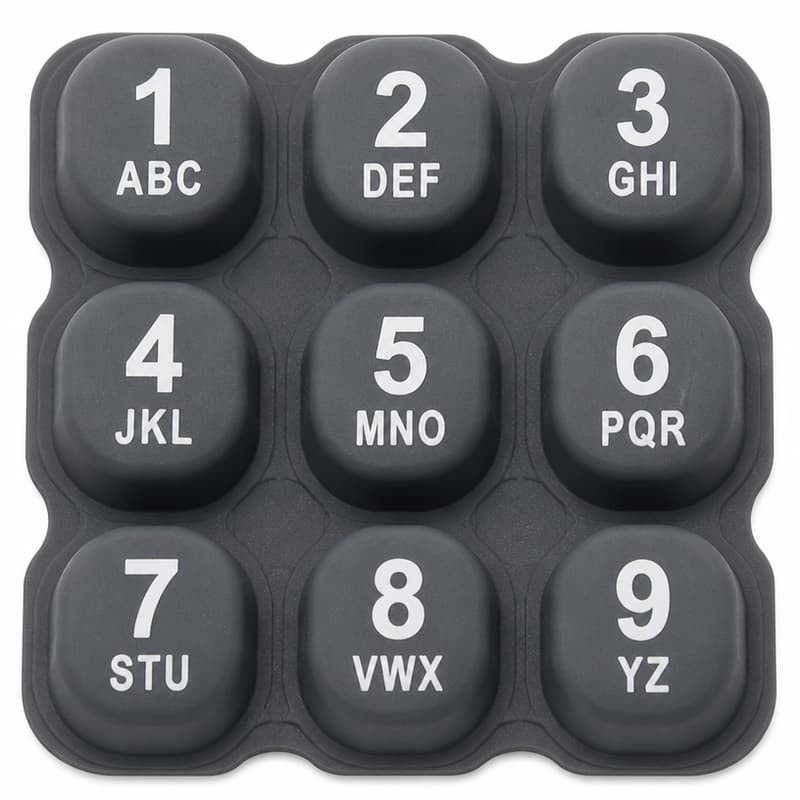
Start with the operating environment, not the drawing. A data logger that rides in a technician's toolbox sees compression loads, oil mist and 60°C interiors; a laboratory meter sees solvents and alcohol wipes. The same silicone keypad drawing can be a ten-year product in one environment and an eighteen-month failure in another. Write the environment down before you write the spec.
Our own project records at FromRubber show that instrument OEMs who define the environment first cut keypad-related field returns by roughly half - because the material, contact and legend choices all follow from that single decision.
2. Specifying the Contact System: Carbon Pill vs Conductive Ink in Meter Keypads
The contact system is the highest-risk specification on any handheld meter keypad, and it is the one engineers most frequently leave to the supplier's default. Industry data published by LuphiTouch puts the conductive carbon pill at roughly 85% of all production keypads - and for good reason: a carbon-loaded silicone pill delivers 10–200Ω contact resistance at 150–250 gF actuation, tolerates 1–5 million cycles, and bonds chemically with the keypad body during molding. Conductive ink is the flexible alternative, but silver-loaded inks carry a real risk of silver migration under DC bias in humid conditions, and carbon inks sit at 50–500 Ω/sq.
Three specification rules follow:
- Specify gold-plated PCB pads (ENIG or hard gold) when using carbon pills. Against bare copper, carbon pill contact resistance climbs as the copper oxidizes and switching becomes intermittent. ENIG adds roughly $0.02–0.05 per keypad - the cheapest insurance in the whole product.
- Specify the dry-circuit reality. Battery-powered handheld meters scan keys at microamp levels. If the circuit is truly dry (below ~20 mV / 10 mA), carbon-based contacts are marginal; gold-on-gold contacts are the reliable choice.
- Specify the target contact resistance and its drift limit, not just "conductive". A good acceptance criterion is contact resistance below 200Ω initially and below 300Ω after rated life.
3. Actuation Force and Travel: The Handheld Meter Keypad Specs Most Often Under-Specified
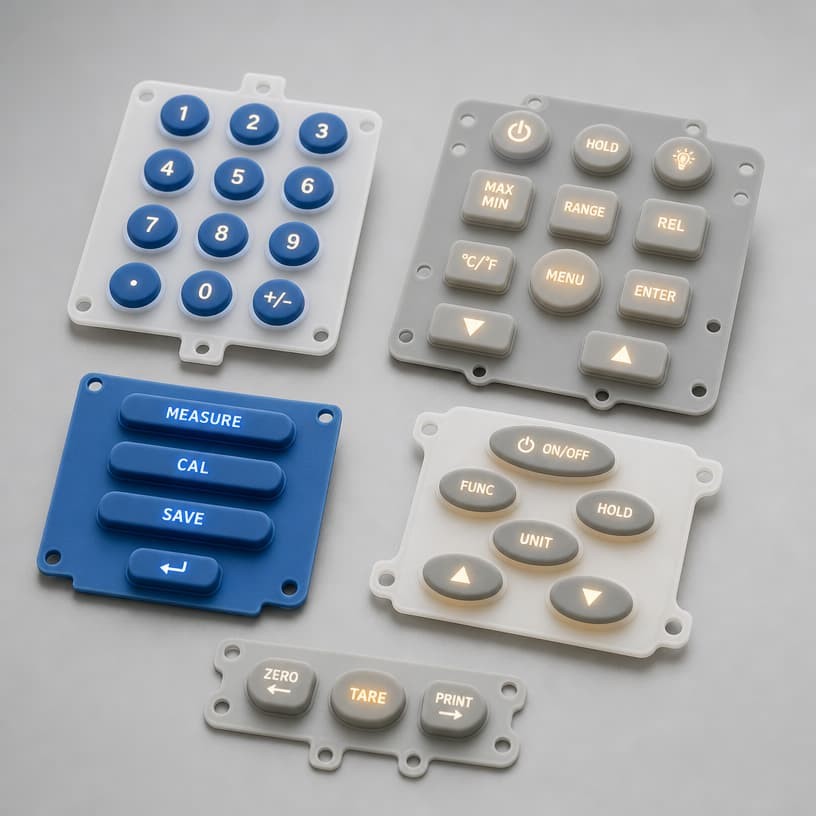
Handheld meter engineers specify electrical performance in detail and then leave feel to chance. But actuation force is a reliability spec, not a cosmetic one. A keypad that needs 300 gF is a thumb-fatigue problem on a meter used eight hours a day; one that needs 100 gF invites accidental presses when the meter is carried in a pocket. The common band for instrument keypads is 150–250 gF, and the batch-to-batch variation should be held to roughly ±30 gF - larger swings make production meters feel inconsistent, a complaint that shows up immediately in distributor feedback.
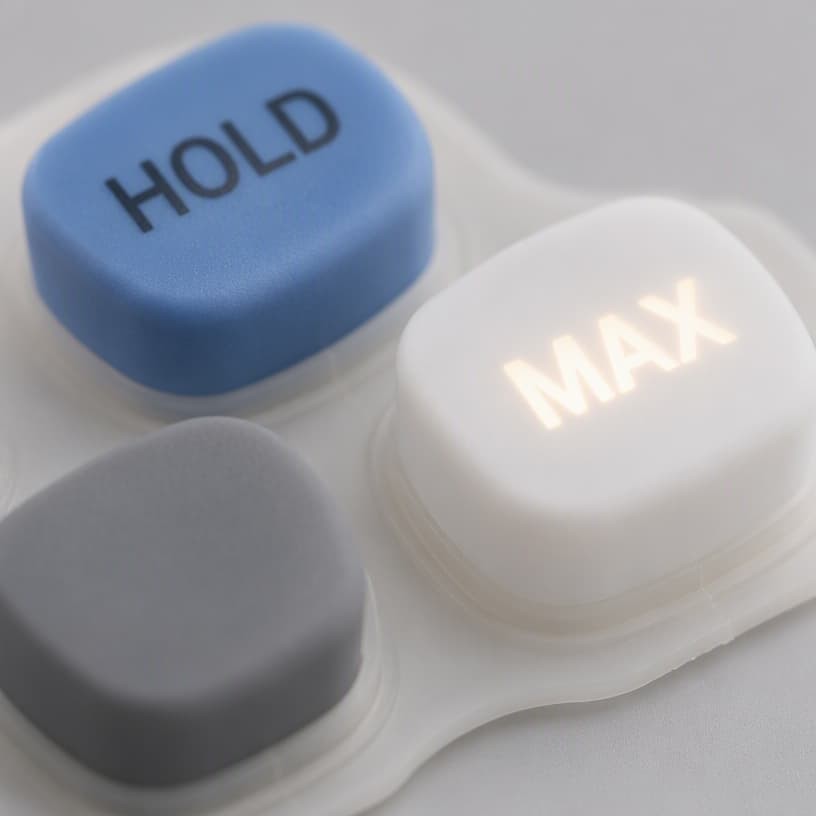
Travel (typically 0.3–1.0 mm for instrument keypads) interacts with the snap ratio of the dome design. Specify both force and travel together, and require the supplier to hold them across production batches. Related discussions on actuation force ranges and on batch tactile consistency cover the acceptance criteria in more depth.
And because force is measured at room temperature, add a cold-condition check: at −20°C a silicone keypad's force can rise 30–50%. If the meter will be used outdoors in winter, the specification must state the force range at the operating temperature, not only at 23°C.
4. Legend Durability, Surface Finish and Tolerance Specs for Meter Keypads
Legends on handheld meter keypads fail in public: worn numerals on a calibration meter undermine trust in the reading itself. Specify the legend process and its abrasion test explicitly. Screen-printed legends on standard silicone survive a few hundred thousand presses but can wear with aggressive cleaning; laser-engraved or laser-etched legends go deeper into the material and are the right choice when alcohol wipes or gloved thumbs are part of the routine. Ask for the 3M tape test and a defined rub count as acceptance criteria.
Surface finish and tolerance are the quiet spec items. A glossy finish shows fingerprints and micro-scratches; a fine matte texture hides them and improves grip under sweat. Tolerances on key-to-key pitch and pad height should reflect what assembly actually needs - the honest range for molded silicone keypads is about ±0.1 to ±0.3 mm depending on feature, and over-specifying to ±0.05 mm inflates tooling cost without improving function. The trade-off is explained in our analysis of instrument silicone keypad tolerances and of ±0.1 vs ±0.3 mm accuracy.
5. Case Study: A Spec Review That Caught a Handheld Meter Keypad Failure Before Tooling
A handheld pH/conductivity meter OEM approached FromRubber with a drawing that specified a carbon pill keypad, but the PCB layout used bare copper pads with a 0.4 mm gap. A standard production run would have shipped a meter whose keys worked for six months and then became intermittent as the copper oxidized - the exact failure pattern documented in our contact resistance study.
The fix was a specification conversation, not a redesign: switch the pads to ENIG (the PCB house quoted an extra $0.03 per board), and change the acceptance criteria from "works at shipment" to "contact resistance below 200Ω after 100,000 cycles". The tooling was still on the drawing board, so the change cost nothing but a meeting. Had the keypad gone to production first, the correction would have meant a new mold, a PCB revision and a field retrofit.
6. A Handheld Meter Silicone Keypad Specification Checklist
Define the field environment (temperature, moisture, chemicals, cleaning) before anything else
State contact type (carbon pill / conductive ink / gold dome) and PCB pad finish (ENIG preferred)
Set contact resistance target and drift limit, with the test method named
Specify actuation force and travel at operating temperature, with batch tolerance
Choose legend process against the cleaning and abrasion regime
Set realistic tolerances (±0.1–0.3 mm) and review them against tooling cost
Require a tooling-validation sample approved against the written spec
Sources and Further Reading
The technical figures in this article draw on published industry material: LuphiTouch - Electrical Contact Mechanisms in Silicone Rubber Keypads, Diamond HMI - rubber keypad technical resources, Google Patents - silicone keypad prior art, and Dow silicone materials. Engineering estimates specific to this article reflect FromRubber project records for instrument keypad programs.
Specify Your Handheld Meter Silicone Keypad With Confidence
FromRubber supports instrument OEMs from specification review through tooling validation and mass production. Send us your drawing or current spec and we will return a DFM and cost review.
About FromRubber - FromRubber is a full-process silicone and rubber keypad manufacturer for industrial instruments, medical devices and handheld electronics, covering mold making, molding, printing, backlighting and testing under one roof.