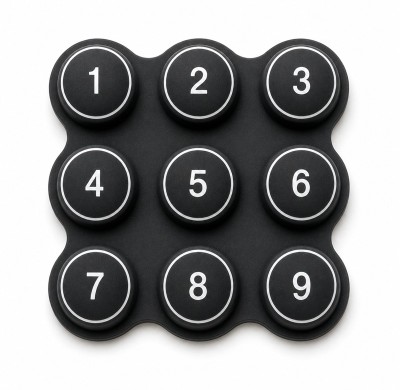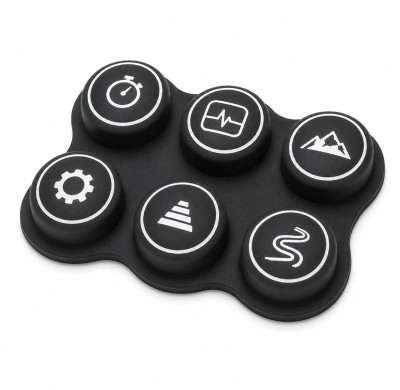
Treadmill Silicone Keypad Materials: A Comparison of Conductive and Non-Conductive Designs
"Silicone keypad" is not a specification. Two consoles can wear keypads made from the same compound, moulded on the same press, and behave completely differently in a gym, because one closes a circuit with a carbon pill and the other only pushes a metal dome. The difference is not which one is better. It is that the two architectures demand opposite things from the rubber, and one of them can be sealed while the other, by design, cannot.
Why the material question starts at the drive board, not at the mould
Most material discussions start with hardness and stop there. That skips the parameter that actually decides whether a keypad survives a commercial gym: the input threshold of the board underneath it.
Published data on conductive rubber keypads describes a pattern that matters more than any datasheet headline. A brand new pad has a switch resistance well under 50 ohms, and that resistance rises over time and use as contamination degrades the surface of the conductive pill. The same source notes that an intermittent contact appears once the pill is coated with non-conductive contamination, and that setting the switch circuit threshold higher, in the range of 1,000 to 10,000 ohms, slows that deterioration in service.
Read that twice. The failure is not the pill breaking. It is the pill getting slowly dirtier while the board keeps a tight threshold that was inherited from a bench test. The material decision and the circuit decision are the same decision, made by two different people who never meet.

Conductive design: the rubber is the switch
In a conductive keypad, a semi-conductive pill or puck is pre-moulded from a mixture of carbon particles and silicone rubber and is permanently attached to the underside of each keytop during the final moulding operation. When the key is pressed, that pill closes against exposed interdigitated conductors on the printed circuit board.
There is no separate switch component. The rubber is the switch, which means the rubber's electrical properties are part of the circuit specification, and its mechanical properties are part of the switch's life.
Non-conductive design: the rubber is an actuator
A non-conductive keypad does no switching at all. It functions as a mechanical actuator that pushes against a switch mechanism such as a metal snap dome, and published comparisons state plainly that it has no impact on closed circuit resistance. The dome carries the electrical duty, and the silicone only transmits the force and provides the feel and the sealing.
That separation is why the two architectures want opposite rubber. Conductive designs are advised to use a low-durometer, softer rubber so that the force cone can flex many times without tearing or cracking, because the cone is doing the mechanical work of the switch. Non-conductive designs can and should use a firmer silicone, because the dome is doing the work and the rubber only has to push it.
The sealing consequence nobody puts in the comparison table
This is the point where the material comparison stops being academic. Published guidance notes that a conductive design's switch cavity cannot be sealed by design, and that there are no viable options to eliminate the contamination problem by sealing the switch cavity. The same source notes that a non-conductive assembly with a sealed dome switch can be environmentally sealed and can eliminate intermittent switch operation.
For a treadmill this is not a small print issue. Console keypads live with sweat, drink spill, and spray cleaner. If the architecture allows the switching cavity to be closed, the contamination mechanism that raises contact resistance is mostly removed from the equation. If it does not, the design has to be robust to contamination instead, which is a different engineering job.
Ask the architecture question before the material question. Sealed dome actuator or open conductive cavity? Everything downstream changes: the compound hardness, the achievable travel, the travel limit, the force window, the board threshold and the service strategy. Two keypads can look identical on a panel and be different products.

Where the two architectures diverge in numbers
The published comparison puts the gap in plain figures. Conductive operate forces sit in the region of 60 to 200 grams with typical keytop travel of about 0.03 to 0.07 inches and an effective operating point near 90% of travel. Non-conductive dome assemblies run operate forces of roughly 240 grams to 2,000 grams depending on the dome, with travel limited to about 0.022 inches or less by the dome, and an effective operating point near 60% of travel with dome collapse at around 70%.
That is not a difference of degree. It is a different feel, a different travel budget and a different stroke reserve, and it changes how the key should be drawn.
Hardness and resistivity: the numbers that belong on the drawing
Once the architecture is fixed, the material specification becomes concrete. Published physical property data for rubber keypads lists a carbon conductor at a Shore A hardness of 65 plus or minus 5 with a volume resistivity below 5 ohm per centimetre, and a silicone insulator at Shore A 30 to 80 plus or minus 5 with a volume resistivity of the order of 10 to the 15th ohm per centimetre. Those are the numbers a drawing should carry, with hardness measured by ASTM D2240 or the equivalent ISO indentation hardness method, and compression set specified separately by ASTM D395 or the ISO compression set method.
Moulding route belongs on the same drawing. Most moulded rubber keypads are produced by low-pressure compression moulding, with a smaller number of moulders using a higher-pressure liquid injection moulding process. The route affects achievable tolerance, web definition and, in practice, how uniform the force-travel curve is across cavities.
| Design decision | Conductive carbon pill | Non-conductive with dome switch |
|---|---|---|
| What closes the circuit | Carbon pill moulded to the keytop, closing onto board tracks | Metal snap dome actuated by the keytop |
| Rubber's role | Switch and spring | Actuator, seal and feel |
| Rubber hardness direction | Softer, so the cone can flex repeatedly without tearing | Can be firmer, since the dome carries the work |
| Typical operate force | About 60 to 200 grams | About 240 to 2,000 grams depending on dome |
| Typical travel | About 0.03 to 0.07 inches keytop travel | Limited to about 0.022 inches or less |
| Effective operating point | Near 90% of travel including over-travel | Near 60% of travel, dome collapse near 70% |
| Sealing the switch cavity | Cannot be sealed by design | Can be environmentally sealed |
| Contamination behaviour | Resistance rises over time and use as the pill surface degrades | Intermittent operation from contamination described as eliminable when sealed |
| Board threshold sensitivity | High: threshold setting changes service life | Lower: contact resistance is set by the dome |

The housing is part of the material choice
A keypad that sits recessed into a textured console is preloaded differently from one bonded to a flat fascia. Where the housing adds preload, a softer compound in a conductive design starts further up its own stroke, and with a long travel that can push the operating point uncomfortably close to the mechanical limit.
The practical fix is not to change the compound first. It is to change the retention, the rib layout or the skirt height so the pad is held without being squeezed, then re-check the curve on the assembly.
Case: the same design specified two ways on one console
Symptom. A treadmill console family used a conductive keypad for the main speed cluster and a dome-based assembly for the incline cluster. Two years into service the incline keys were reliable, while the speed keys had begun to need firmer presses to register.
Measurement. Returned speed pads showed contact resistance that had risen well above the level of a new pad, with a visible film on the pill surfaces. The board's input threshold had been carried over unchanged from the original bench validation.
Root cause. The speed cluster was an open conductive cavity in a console that lives with sweat and spray. The incline cluster, being a sealed dome assembly, had removed that mechanism from its own design space. The comparison had been made on force and feel, and the sealing difference had not been treated as a specification item.
Change. Two changes were made rather than one. The board threshold for the speed cluster was widened to tolerate contamination-driven resistance rise, and the keytop skirts around the speed keys were re-profiled to reduce the path by which debris reaches the pill cavity.
Verification. The revised pads were measured as assemblies at three points: new, after an environmental exposure sequence, and after a cycle run, with resistance recorded at each stage. That three-point record is now the release criterion we apply to conductive console keypads, because a single new-part measurement tells you nothing about year two.
How to choose between the two designs
- Look at the board first. What input threshold can the circuit tolerate, and can it be widened without affecting other inputs?
- Ask whether the switching cavity can be closed. If it can, a sealed dome actuator removes the dominant contamination mechanism.
- Check the travel budget against the key functions. A console that needs a long, soft stroke for blind operation is a conductive conversation; a compact cluster with a crisp, short press is a dome conversation.
- Match rubber hardness to the role: softer where the cone is the spring, firmer where the dome is.
- Specify hardness, volume resistivity and compression set by test method, not by adjective.
- Decide the operating point explicitly, then design the cone or the dome pocket around it.
- Verify on the assembly at new, after environmental exposure, and after cycling.
FAQ
Are carbon pills or metal domes better for a treadmill keypad?
Neither is better in the abstract. A carbon pill design allows a longer travel and a lighter press and puts the switching function in the moulding. A metal dome assembly runs a higher force over a shorter travel, keeps the closed-circuit resistance out of the rubber's hands, and can be environmentally sealed. Published comparisons make the sealing difference explicit, and on a console exposed to sweat and spray that is often the deciding factor.
Why does a conductive keypad sometimes need a harder and harder press?
Because the contact resistance of the pill rises as its surface is contaminated, and the board's threshold is fixed. Published data describes new pads at well under 50 ohms with resistance increasing over time and use, and notes that setting the circuit threshold higher, in the range of 1,000 to 10,000 ohms, slows the deterioration in service.
What hardness should a treadmill keypad be?
It depends on the architecture. Published property data lists a carbon conductor at Shore A 65 plus or minus 5 and a silicone insulator across Shore A 30 to 80 plus or minus 5, and the design guidance for conductive pads leans toward the softer end so the force cone can flex repeatedly without cracking. Hardness should be written with the test method alongside it.
Does the moulding process change keypad performance?
It can. Most moulded rubber keypads are made by low-pressure compression moulding, with a smaller number produced by higher-pressure liquid injection moulding. The route affects tolerance and web definition, and web definition is what sets how consistent the force-travel curve is from cavity to cavity.
Conclusion
Treadmill silicone keypad materials are chosen by answering an architecture question first: is the rubber the switch, or is it an actuator pushing a dome. That decision fixes the hardness direction, the travel budget, the operating point, whether the switching cavity can be sealed, and how sensitive the design is to the board's input threshold. Choose it deliberately, put hardness, resistivity and compression set on the drawing by test method, and verify the curve on the assembly rather than on a loose moulding. FromRubber moulds both conductive and non-conductive silicone keypads for fitness and industrial equipment, and reviews material, geometry and electrical data together before tooling is cut.
This article was written by the moulding engineering team at FromRubber, a custom silicone keypad and button manufacturer in Dongguan, China. We mould conductive and non-conductive silicone keypads and control panels for fitness, medical and industrial equipment.
Related reading
Sources
- [1] Epec Engineered Technologies, "Rubber Keypad Comparison: Conductive & Non-Conductive Construction Differences" — pill construction, operating points, travel limits, hardness direction, sealing capability and contamination behaviour. https://www.epectec.com/articles/conductive-and-non-conductive-rubber-keypad-comparison.html
- [2] Epec Engineered Technologies, "Rubber Keypad Design Guide" — carbon conductor and silicone insulator hardness, volume resistivity, life cycles, contact resistance and moulding notes. https://www.epectec.com/keypads/design/
- [3] ASTM International, "Standard Test Method for Rubber Property—Durometer Hardness", ASTM D2240-15(2021). https://www.astm.org/d2240-15r21.html
- [4] ISO, "Rubber, vulcanized or thermoplastic — Determination of hardness — Part 4: Indentation hardness by durometer method (Shore hardness)", ISO 48-4:2018. https://www.iso.org/standard/74969.html
- [5] ASTM International, "Standard Test Methods for Rubber Property—Compression Set", ASTM D395-18. https://store.astm.org/d0395-18.html
- [6] JASPER, "Conductive Carbon Pill Resistance in Silicone Rubber Keypads" — failure modes mapped to pill position, contamination, pad defects, web damage and preload. https://www.jasperele.com/blog/silicone-keypad-carbon-pill-resistance/
- [7] Life Fitness, "Elevation Series Engage & Inspire Consoles Service Manual" — membrane switch keypad architecture and keypad fault diagnosis. https://coloradocardio.com/wp-content/uploads/2022/01/Life-Fitness-Discover-Engage-Inspire-Service-Manual.pdf
- [8] ASTM International, "Standard Specification for Treadmills", ASTM F2115-25. https://store.astm.org/f2115-25.html