Sweat Corrosion in Wearable Silicone Keypads: Coating and Legend Adhesion Failure Under Artificial Perspiration Testing
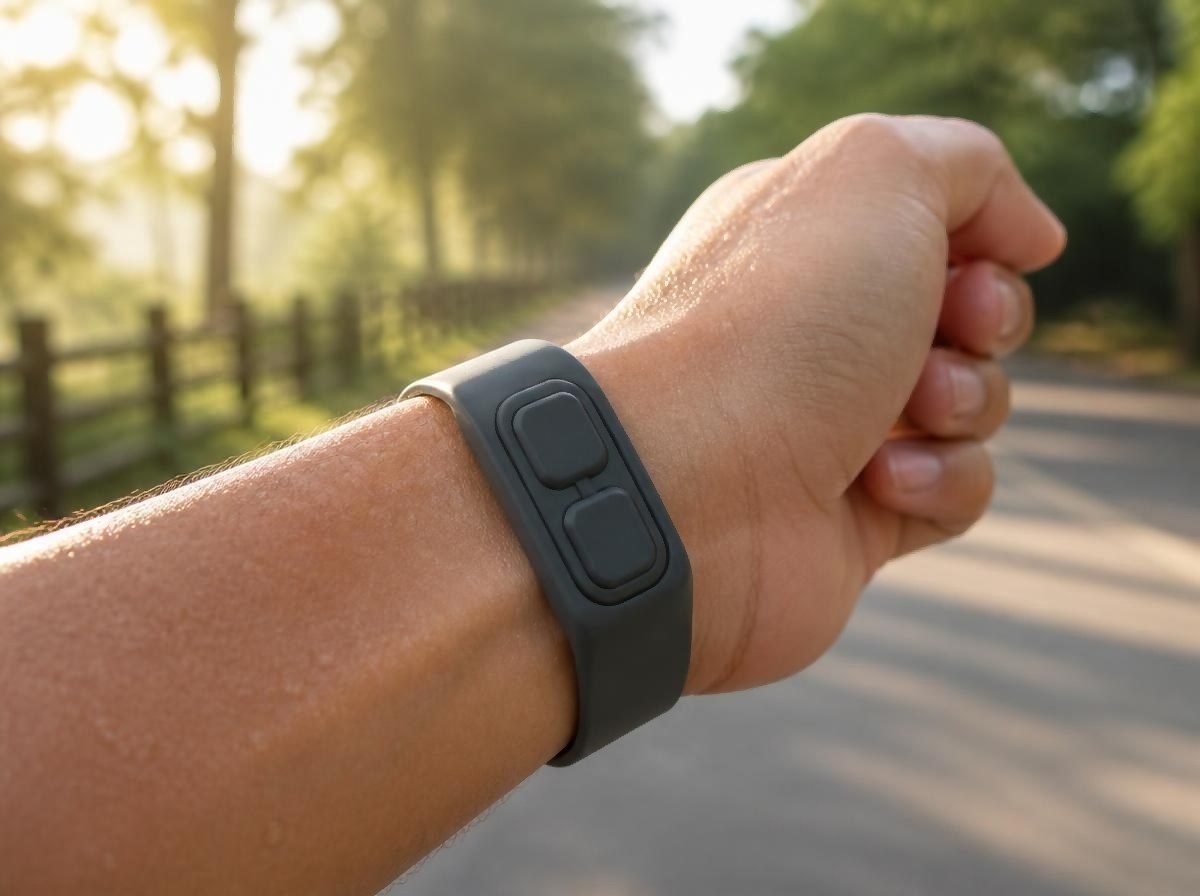
The silicone body comes back from the lab intact, so the test is recorded as a pass — and three months later the field returns start arriving because the printed legends have rubbed off the wearable keypad and the surface coating is lifting at the edges. Wearable interfaces fail at the interfaces between materials, not in the middle of the rubber. Once a part spends its life against skin, sweat and friction, the question stops being “does the silicone survive” and becomes “does the whole surface stack survive together”.
Sweat is not water, and that changes the test
The first mistake in wearable qualification is treating perspiration as a mild form of water immersion. Artificial perspiration solutions are formulated to reproduce a chemically more aggressive environment than pure water, and the well-known colour-fastness method ISO 105-E04 exists precisely because the reaction of a material to sweat is not predicted by a water soak. On a wearable, that chemistry arrives together with skin oils, sunscreen residues, cosmetic products and repeated wiping or rinsing. The result is a chemically loaded, mechanically loaded, frequently disturbed surface.
What actually happens to the keypad surface
Surface contamination plus repeated contact
Sweat leaves a deposit. That deposit holds salts and organic residues against the surface, and it is repeatedly smeared by the finger that is pressing the key. Add the friction of a wrist band moving against clothing, plus whatever cleaning routine the user follows, and the surface sees a combination of chemistry and abrasion that a static immersion test does not reproduce. A sample that passes a soak can still fail once rubbing is added.
The silicone surface itself is part of the problem
Silicone elastomers are low-surface-energy materials, and that is exactly why they feel pleasant against skin and why they are difficult to bond to. A coating or an ink has to form a durable bond to a surface that is actively resistant to bonding. There is a second effect that makes this worse over time: low-molecular-weight siloxane species in the compound are mobile and are known to migrate to the surface, and research on silicone rubber has characterised this migration behaviour in detail. A migrating surface layer is a weak boundary layer sitting directly under whatever you have printed or coated.
Why the coating lifts
Surface energy and adhesion. Adhesion depends on the coating being able to wet and chemically or physically anchor to the substrate. On untreated or inconsistently treated silicone, the coating sits on top rather than bonding into it, and sweat finds the interface first.
Inconsistent surface treatment. Most silicone adhesion problems in production trace back to treatment variability rather than treatment absence. If a primer is applied by hand, or a plasma or flame treatment is done on parts that have cooled for different times, the surface condition varies from part to part and from batch to batch. The average looks acceptable; the tail of the distribution fails in the field.
Coating compatibility. A coating qualified on one silicone compound does not automatically transfer to another. Cure system, pigment, mould release residue and additive package all change how the coating bonds. The coating has to be evaluated against the exact compound and the exact moulding process.
Mechanical flexing. A wearable key is a moving part. Every press stretches the surface, and every cycle strains the coating at the point where the key meets the base. A coating that is flexible enough for a flat pad may crack at the key wall simply because the strain is concentrated there. Edge lifting on a key is a geometry-and-coating-stiffness problem as much as an adhesion problem.
Why the printed legends fade
Printed legends fail by a different route, and it is worth separating the mechanisms because the fix is different for each:
- Fading usually points at the ink itself or at colour ageing, not at adhesion. The print is still there but has lost intensity.
- Cracking is a flexibility mismatch: the ink is stiffer than the substrate and fractures under repeated strain.
- Peeling is an adhesion failure at the ink-to-silicone interface, often initiated at an edge.
- Abrasion is mechanical removal from the outside, driven by friction and cleaning.
- Loss of adhesion without visible damage is the hardest to catch, because the legend looks fine until it transfers onto a wipe or a finger.
Contributing factors overlap heavily: ink-to-substrate compatibility, cure completeness of the ink, surface preparation before printing, repeated flexing, sweat chemistry, and cleaning cycles. Where the print is applied over a coating, a further interface is added, and the failure can occur between any two layers.
Running an artificial perspiration test that means something
Use a recognised perspiration formulation and a documented procedure, then keep the comparison honest:
- Record the initial appearance of the whole part under fixed lighting and fixed camera settings.
- Record the initial legend condition at magnification, including edges of the print.
- Apply the artificial perspiration solution to the specified exposure condition, on the specified areas, at the specified duration.
- Hold temperature and humidity to the test specification and log them.
- Remove and clean samples the same way every time. Inconsistent cleaning introduces more variation than the test itself.
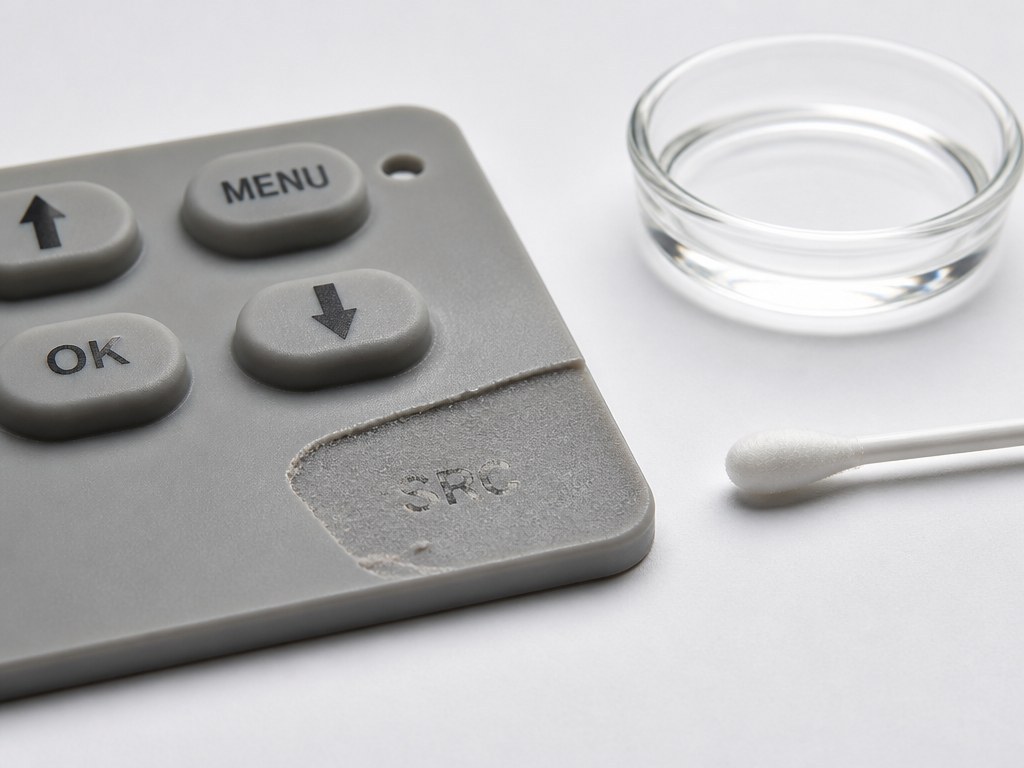
- Assess coating adhesion — ideally with a cross-hatch or peel assessment on a moulded flat area, plus a visual edge check on the keys.
- Assess legend integrity: colour retention, edge lifting, cracking, and rub resistance.
- Add a rubbing or abrasion step where the end use involves repeated contact, because the combination of chemistry and rubbing is where wearables actually fail.
- Compare before and after side by side, on the same fixture, rather than assessing the after state in isolation.
Keep one unexposed sample from the same moulding batch as the reference for the whole programme. It converts every judgement from an opinion into a comparison.
Improving adhesion without guessing
Control the surface before you control the coating
Mould release contamination is the most common single cause of a coating that will not bond. Confirm the release agent used, confirm that it is compatible with the subsequent printing or coating step, and confirm that any post-mould cleaning actually removes it. Surface cleanliness is easier to standardise than surface energy.
Select the coating and ink against the real compound
Test the ink and the coating on the production compound, in the production cure state, with the production mould release. Where improved bonding to liquid silicone rubber is required, adhesion promoters and surface modification are established approaches, and published work on promoting adhesion between addition-cured liquid silicone rubber and other substrates shows how much the result depends on matching the treatment to the specific system rather than applying a generic primer.
Treat surface treatment as a process, not an afterthought
Whichever method is used — primer, plasma, flame or chemical etch — it needs a defined time window, a defined condition, and a measurable check. A treatment that is validated on a sample and then applied at production speed with a different dwell time is a different treatment.
Validate on the finished keypad, not on flat sheets
This is the step that decides whether the programme works. Flat cured sheets do not reproduce key-wall strain, moulded edge geometry, gate or parting-line effects, or the thickness distribution of the finished part. Test the part the customer will receive.
Common wearable keypad failure patterns
| Failure | Likely cause | What to check first |
|---|---|---|
| Legend fading | Ink or colour ageing | Ink chemistry against the actual compound, plus UV and sweat exposure |
| Coating peeling | Adhesion failure at the substrate | Mould release residue and surface preparation consistency |
| Edge lifting on keys | Flexing stress concentrated at the key wall | Coating thickness and flexibility versus key geometry |
| Cracking across the print | Ink too stiff for the substrate strain | Ink elongation versus the strain at the key crown |
| Uneven appearance across the panel | Inconsistent treatment or moulding | Treatment window and mould condition consistency |
| Legend transfers onto a wipe | Loss of adhesion without visible damage | Cure completeness of the ink and primer coverage |
What to specify before tooling
- Expected sweat exposure: continuous skin contact, or intermittent during exercise only?
- Cleaning method and frequency, including any solvent or alcohol wipe the user manual recommends.
- Expected pressing cycles over the product life, and the strain that implies at the key wall.
- Required legend durability, expressed as a test method and a pass level rather than as “durable”.
- Coating type and thickness, or an explicit decision not to coat.
- Surface finish of the moulding, because it affects both feel and bonding.
- Required appearance after ageing — a permitted colour shift, not just “no change”.
- Which environmental tests the finished part must pass, and on which geometry.
Doing this in production
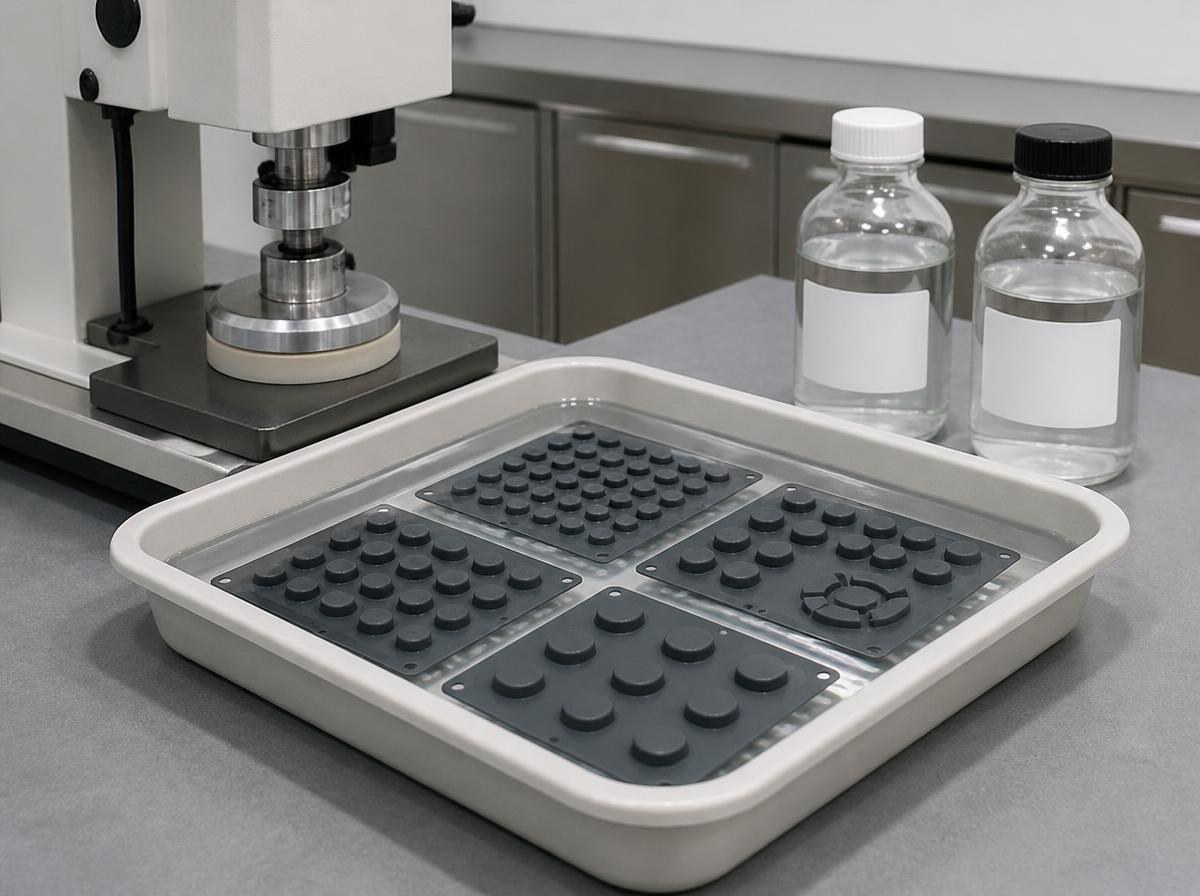
Sweat resistance is a system property, so it has to be developed as one. On wearable and hand-held silicone parts at FromRubber the workflow that holds up is to fix the mould release and surface preparation first, then qualify the ink and coating on the production compound in the production cure state, and finally run the perspiration and rub assessment on moulded keys rather than on flat coupons.
FromRubber moulds custom silicone rubber parts — keypad panels, gaskets, seals and technical mouldings, with printing, coating and laser-machined legends handled in-house. We do not make the wearable devices, housings or electronics our parts are fitted into. What we can do is run the surface stack as one qualification and hand over the comparison on finished parts.
What to take away
On a wearable silicone keypad, the silicone body is usually the part that survives. The failures happen at the ink-to-silicone interface, the coating-to-silicone interface and the coating edge at the key wall — and each of those is decided by surface preparation, material matching and geometry rather than by the rubber itself. Test the whole stack on finished parts, include rubbing as well as chemistry, and write the acceptance level down before the first sample goes into the chamber.
References
- Characteristics of Small-Molecule Migration of Silicone Rubber, Polymers 2022, 14(13):2519 — https://pmc.ncbi.nlm.nih.gov/articles/PMC9268812/
- Promoters for Improved Adhesion Strength between Addition-Cured Liquid Silicone Rubber and Low-Melting-Point Thermoplastic Polyurethanes — https://pmc.ncbi.nlm.nih.gov/articles/PMC8838879/
- Physiology of sweat gland function: the roles of sweating and sweat composition in human health — https://pmc.ncbi.nlm.nih.gov/articles/PMC6773238/
- ISO 105-E04, Textiles — Tests for colour fastness — Part E04: Colour fastness to perspiration (referenced as the established artificial perspiration formulation)
Related reading on this site: improving glove-friendly operation on silicone rubber buttons, sealing challenges for dust and moisture protection, the custom silicone rubber parts range, and the custom silicone rubber keypad range. If your wearable keypad needs printing or coating qualified against sweat and rubbing, send the surface specification to nani@fromrubber.com or karl@fromrubber.com, or reach us on WeChat / WhatsApp at +86 18676210913. FromRubber — custom silicone rubber parts, Dongguan, China.