
Silicone Lick Mat Thickness: Where Brands Overdesign
The number on the drawing that decides how the product feels
The brief says 3 mm. The sample arrives, and it behaves like a tile: it does not drape over the edge of the sink, it does not follow the curve of a bowl, and when a dog stands on one corner the whole mat tips up at the other end. Nobody asked for a rigid product. The 3 mm was chosen because it sounded substantial, and because a thicker mat feels like more material for the money.
Thickness is the least examined decision in silicone lick mat development and one of the most consequential. It sets how the mat handles, how it sits on a surface, how deep a groove can be cut into it, how much material goes into each unit, and how the suction cups behave when pressed. It is also the number most often specified before anyone has described what the product has to do.
What follows is an argument for treating thickness as a set of local decisions rather than a single figure, and for recognising the places where extra silicone buys nothing.
Why silicone lick mat thickness needs to be settled early
The base decides how the mat handles
A lick mat is handled constantly: lifted off the floor, rinsed, shaken, stacked, carried in a bag. A thin base flexes and follows the hand; a thick base resists and pushes back. Neither is wrong, but the choice should come from how the product is used rather than from how it photographs.
The base and the pattern compete for the same material
Groove depth is measured from the top surface, and it removes material from the section. A 4 mm base with a 2.5 mm groove leaves a 1.5 mm floor under that groove. The nominal thickness of the mat is unchanged, but the behaviour at that location is now governed by 1.5 mm. This is why two mats with the same quoted thickness can feel completely different.
Intended use should come first
A mat that sits on a kitchen floor and stays there has different requirements from one that is carried to a café, pressed into a bowl, or rolled for storage. Stiffness, flatness and weight all follow from that sentence, and all three are set by thickness.
Where silicone gets added without a reason
An oversized base makes a flexible product harder to use
Increasing base thickness is the simplest way to make a product feel more substantial, and the easiest way to lose the flexibility the product was supposed to have. Bending stiffness rises steeply with thickness — for the same material and shape, a plate that is twice as thick is roughly eight times as stiff. A small change in the number on the drawing is a large change in the hand.
Tall ribs on a thick base double up
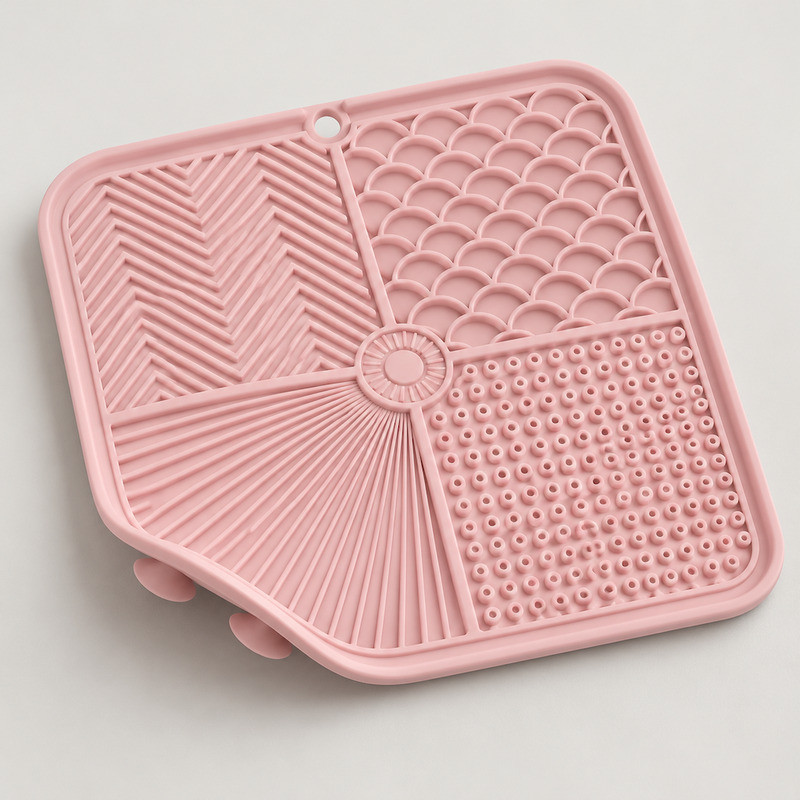
A raised pattern already adds local stiffness, because the walls act like small beams. Put that pattern on a thick base and the mat becomes rigid in two directions at once. If the design needs prominent ribs, the base underneath them usually needs less material, not more.
A heavy rim is rarely needed all the way round
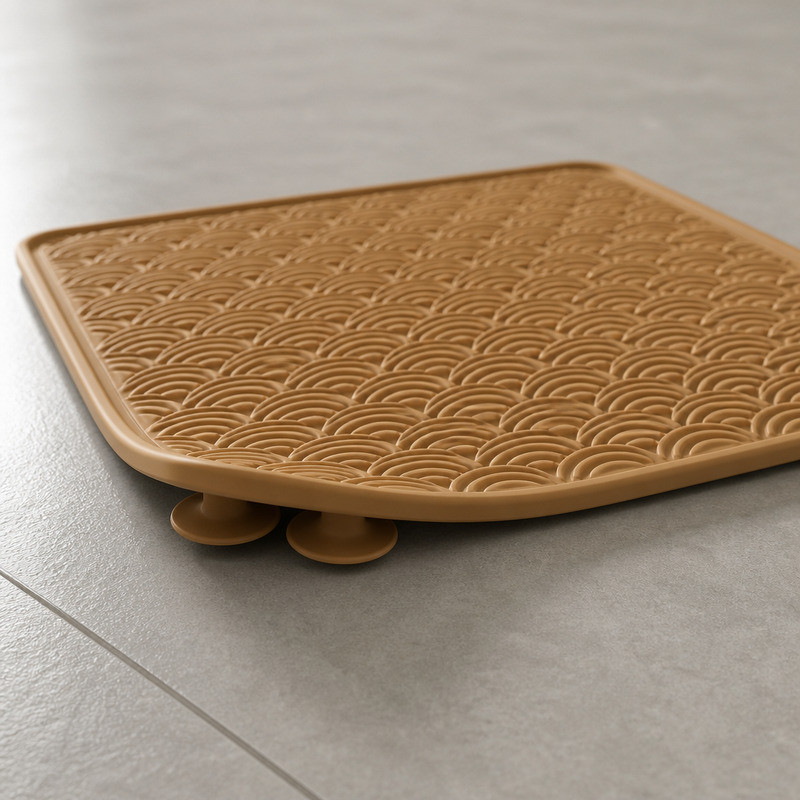
Rims exist for handling, for containing food, or for appearance. Where they exist for handling, the added material only needs to be where hands go. A continuous thick border around a light mat adds weight and stiffness at the perimeter, which is exactly where a mat needs to conform to a surface.
Cups designed apart from the base
Suction cups are often drawn on the underside after the top has been finalised. Each cup adds a local boss, and each boss changes the stiffness of the film around it. Designing the cup and the base together makes it possible to keep the mat flexible in the middle and firm where the cups need support.
Thin has its own failure modes
A thin base may not hold its shape
Below a certain thickness, a mat stops lying flat and starts behaving like a sheet: it curls at the corners, folds when lifted and refuses to stay put. Where the product needs to present a flat feeding surface, that is a functional failure, not a cosmetic one.
Deep grooves can consume the floor
The deeper the pattern, the more the remaining floor matters. A groove that leaves less than about a fifth of the base beneath it creates a hinge line, and hinge lines are where mats tear or crease. This is a geometry check, not a materials problem.
Thin sections near the cups need their own review
A cup surrounded by very thin material deforms when pressed, which can lift the neighbouring cup. A cup surrounded by thick material cannot be pressed down far enough to expel air. The zone around each cup is a small design problem in itself, and it is usually the last one to be checked.
Choosing a thickness that matches behaviour
Start with the required behaviour, in plain words
Three sentences are enough to start: should the mat lie flat or conform, should it bend easily when lifted, and does it need to hold its shape when carried. Each answer moves the silicone lick mat thickness, and none of them require a number at the outset.
Review the structure as a whole
The base, the grooves, the rim and the cups form one section. A drawing that specifies only an overall thickness has not specified the product. Cross-sections at the deepest groove, through the rim and through a cup tell a manufacturer far more than a single dimension.
Compare samples under the same conditions
If the right thickness is uncertain, mould two versions and test them the same way: lift from a corner, drape over an edge, press a cup, roll for storage. Judging two samples in different lighting on different days produces a preference, not a result.
Document the critical thicknesses
Some regions need a tolerance, others do not. Marking which ones matter lets the toolmaker concentrate on the sections that affect function, and lets inspection measure the right thing.
More material is not the same as more product
Adding silicone is easy to justify in a meeting and hard to justify in a section drawing. Most silicone lick mat thickness arguments are really arguments about a single area, dressed up as a decision about the whole part. The question to ask of any thickened area is what it does: does it resist a load, hold a shape, protect an edge, or provide material for a groove? If the answer is none of those, the material is there for appearance, and appearance can usually be achieved with geometry instead.
The reverse is also true. Cutting thickness indiscriminately produces a mat that folds, curls and feels cheap, and the saving is invisible to the customer while the failure is obvious. The efficient design is the one that meets the requirement with the least material in the places that do not need it, and enough material in the places that do.
Thickness transitions deserve a mention here. An abrupt step from a thick rim to a thin base creates a stress concentration and a moulding challenge at the same time, because the material arriving at a thin section after a thick one does not fill it under the same local pressure. Published work on mould filling shows how strongly local cavity pressure governs whether a section is reproduced as drawn (Evens et al., Micromachines, 2022). A gradual transition costs a little more tool work and removes both problems. Food-contact documentation is separate from all of this but belongs in the same review: repeated-use rubber articles in the United States fall under 21 CFR 177.2600, which addresses the compound rather than the section.
A thickness review checklist
Nine questions that are worth answering before a tool is cut.
| Question | Where it usually surfaces |
|---|---|
| What handling behaviour does the product need — flat, draping, rollable? | Sets the base thickness before any pattern is drawn. |
| Does the mat need to conform to a surface, or stay flat on its own? | Decides whether the perimeter can stay thin. |
| How deep is the deepest groove relative to the base beneath it? | Cross-section through the deepest feature. |
| Do the raised patterns make the overall profile bulkier than the concept requires? | Section through the tallest rib, not the base. |
| Does the rim need to be heavy around the entire perimeter? | Compare the rim thickness with where hands actually grip. |
| Are suction cups part of the design, and were they drawn with the base? | Underside view plus the surrounding film thickness. |
| Have the thinnest and thickest sections been reviewed together? | Two cross-sections, side by side. |
| Were samples of different thicknesses compared under the same conditions? | Same lift, drape and press test on both samples. |
| Are the critical thicknesses documented on the drawing? | Inspection plan, before production release. |
The list identifies questions to resolve. It is not a specification, and the answers depend on the product, the compound and the tooling approach.
What to send to a manufacturer
The most useful package is small: a 3D model or dimensioned drawing, the overall size, the intended food and cleaning method, the handling requirement, and any fixed dimensions such as bowl diameter or cup size. Add the target market, because it determines which material documentation is needed.
Where thickness is still open, say so. A manufacturer who is told that the base is negotiable can propose a section that meets the behaviour requirement with less material; a manufacturer who is told that 3 mm is fixed can only work around it.
It also helps to say which failure would be worse: a mat that curls, or a mat that feels flimsy, or a mat that will not sit flat in a bowl. That single sentence often resolves the thickness question faster than any calculation.
How FromRubber reviews thickness
A thickness review is easier to run on a cross-section than on a specification sheet, because the sheet carries one number and the section carries the consequences. FromRubber, the trading name of Dongguan Bohao Electronic Technology Co., Ltd., produces moulded pet products in Dongguan, Guangdong, China — lick mats, feeding mats and bowls — and starts from the section: the floor under the deepest groove, the wall at the top of a rib, the transition into the rim, and the material around each cup.
The output of that review is a set of specific observations — this floor is thin for the groove depth, this rim adds stiffness where the mat needs to conform, this cup boss is isolated from the base — rather than a single recommended figure. Sampling then confirms the behaviour on a physical part. Tooling runs through mould making and silicone moulding, with the wider range listed under pet supplies and the process described in the service process overview.
Where a brand has already committed to a thickness, the review works with that constraint and looks for the places where the section can still be improved without changing the nominal figure.
If the comparison is between suppliers rather than sections, two existing lists on the site use the same evidence-first approach: lick mat manufacturers for pet brands and custom silicone pet feeding manufacturers.
Thickness questions buyers ask most
How thick should a silicone dog lick mat be?
There is no single answer. It depends on the size of the mat, the depth of the pattern, whether the product needs to conform to a surface, whether cups are included, and the size of the animal. A large mat with deep grooves needs more material under the grooves than a small mat with a shallow texture.
Does a thicker mat last longer?
Not automatically. Durability depends on the compound, the geometry, the loads and how the product is used. A thick mat with a sharp internal corner can fail sooner than a thinner mat with a well-eased transition.
Can a lick mat be too thick?
Yes. Beyond a certain point the mat stops draping, becomes heavy to lift and will not seat on a curved surface. It also uses more material without adding function, which affects cost and shipping weight.
Should the suction cups be the same thickness as the base?
They serve different purposes, so they usually should not be. The cup needs a wall that can deform and recover; the base needs to carry load between cups. Treating them as one thickness is one of the common causes of weak or inconsistent suction.
Does reducing thickness lower the manufacturing cost?
Material use is one input, but tooling, cycle time, geometry and inspection also drive cost. A thinner section that creates moulding problems can cost more overall than a slightly thicker one that runs cleanly.
Sources and further reading
- U.S. Code of Federal Regulations, Title 21, Section 177.2600, "Rubber articles intended for repeated use". View the regulation
- Evens T. et al., "Comparing the Replication Fidelity of Solid Microneedles Using Injection Compression Moulding and Conventional Injection Moulding", Micromachines 13(8):1280, 2022. Read the paper
Stiffness scaling described here is a general property of plate bending. The appropriate thickness for a specific product has to be confirmed against its own geometry, material and use case.
Decide the behaviour, then the millimetre
If the thickness is still open, describe how the mat should feel and where it will be used. That is enough to start a section review, and it is usually more useful than a target number.
Email: nani@fromrubber.com or karl@fromrubber.com · WeChat and WhatsApp: +86 18676210913
Discuss a custom lick mat