Top 10 Silicone Lick Mat Manufacturers for Pet Brands and Product Developers
The first samples look right. Then the reviews arrive: the peanut butter will not come out of the corners, the suction cups hold on glass but not on the tile in the bathroom, and after three months the mat has curled at one edge. None of these are material failures. They are geometry failures that were locked in when the mould was cut.
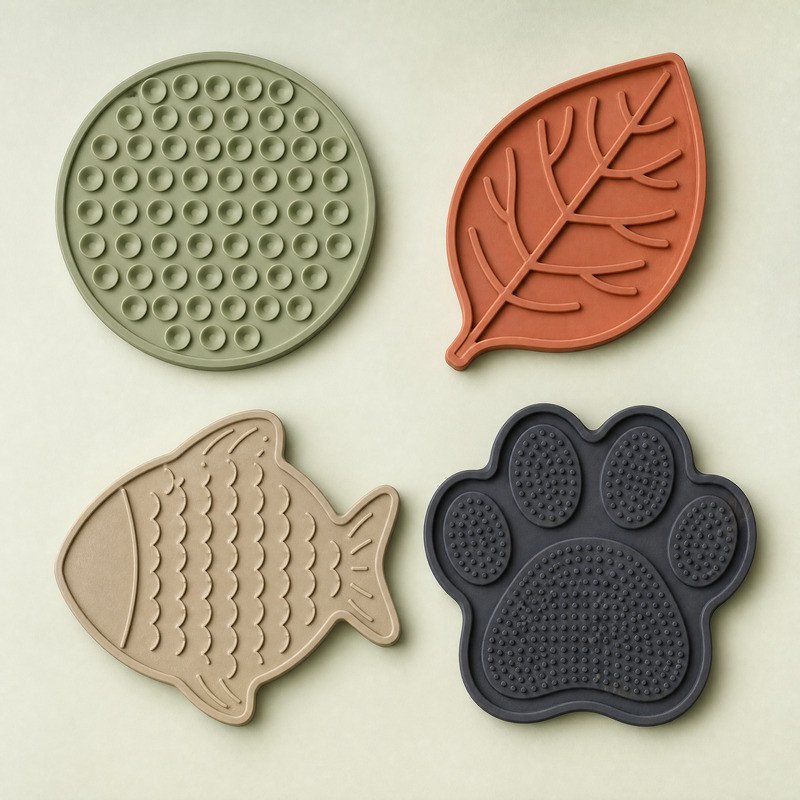
A lick mat is often described as a flat piece of silicone with a pattern. Functionally it is a shallow mould with a cleaning problem attached. The pattern has to hold food, release food, survive a dishwasher and still demould at the end of every cycle. This comparison of silicone lick mat manufacturers looks at companies that publish mat work, and at the design decisions a buyer should settle before paying for steel.
What Makes Lick Mat Tooling Different From a Bowl
A bowl is a single deep cavity. A lick mat is a field of hundreds of small features sharing one thin base. That changes the physics of the tool.
Texture density drives fill pressure
Ribs, pockets and honeycomb walls must fill before the compound starts to cure. Dense patterns with narrow gaps need higher pressure and better venting; otherwise the tops of the ribs round off and the mat looks soft rather than crisp.
Every rib is a demoulding feature
Vertical ribs release cleanly. Ribs with undercuts, mushroom tops or negative draft tear at the root. The pattern can look beautiful in CAD and be impossible to strip from the cavity without damage.
The base is thin, so flatness is fragile
A large mat with a 2–4 mm base warps if the two faces cure at different rates. Flatness has to be measured on the finished part, not assumed from the tool.
Cleaning is a moulding specification
Internal radii, draft on pocket walls and spacing between ribs decide whether a sponge reaches the bottom. A 0.5 mm radius is a design decision with a customer-service consequence.
Buyer Criteria That Actually Predict a Good Mat
Texture and pattern customisation
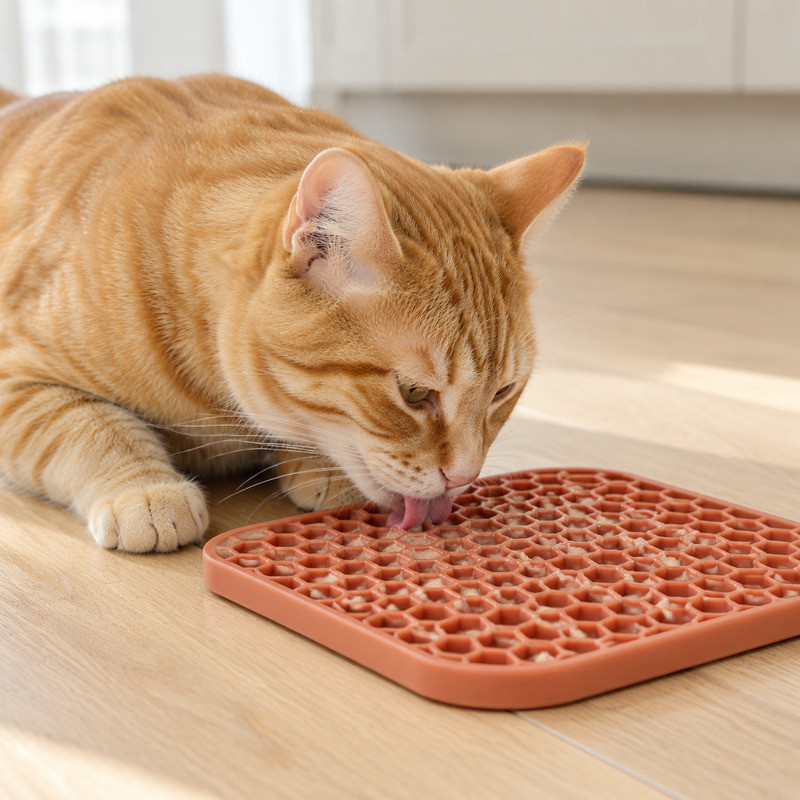
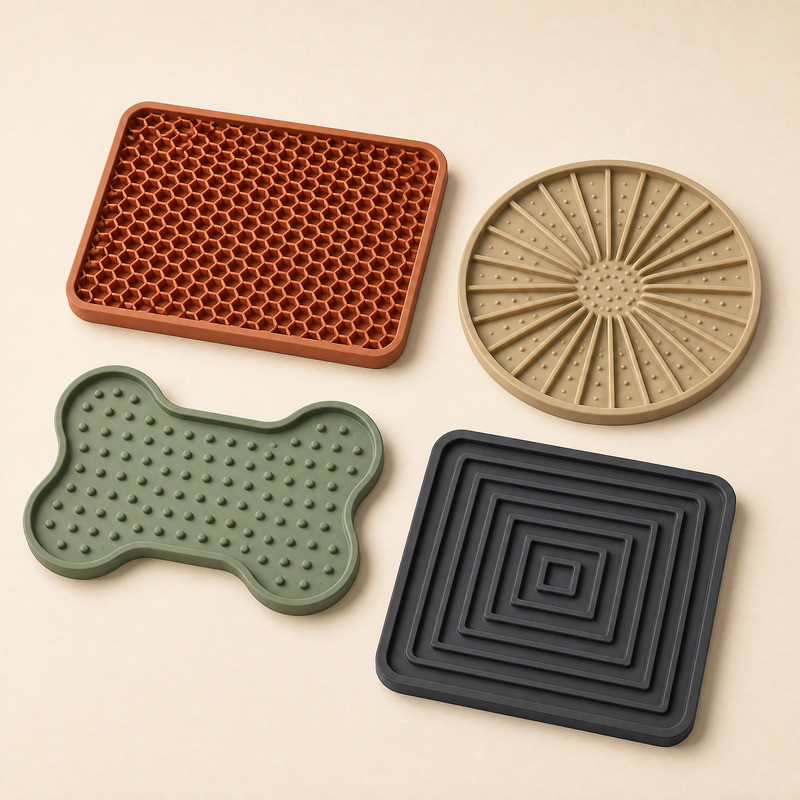
Raised ribs, pockets, honeycomb cells and mixed zones are all feasible. The useful question is not "can you do honeycomb" but "what rib height and spacing do you recommend for the food my customer uses". Thin liquids need shallower pockets; thick pastes need deeper cells with wider openings.
Shape and footprint
Corner geometry matters more than outline style. Sharp corners concentrate stress and tear first. Rounded corners cost nothing in tooling and add months of product life. Footprint should follow the feeding location: crate tray, floor, bath wall, freezer container.
Suction and floor retention
Suction works on non-porous, smooth, clean surfaces. On textured tile, matte laminate or carpet it does not. A suction array can also lift the mat's centre and reduce contact elsewhere. Test on the surface the customer will actually use, with food load.
Material and hardness
Softer compounds are easier to press food into and harder to clean out. Harder compounds hold shape and resist tearing but feel less compliant. There is no universal hardness; the correct value follows texture depth, mat thickness and the animal's size.
Mould development and sampling
Approve texture geometry, dimensions, underside features and packaging together. A mat approved without its retail sleeve may not fit the sleeve after the final wall adjustment.
Private-label branding
Moulded logos are durable but consume usable surface. Printed logos are flexible but wear. The logo zone should be designed into the pattern from the start, not added inside a licking area.
Scoring Method
- Direct lick mat evidence — 30%. A dedicated mat product or programme, not a general pet page.
- Texture, shape and structure customisation — 25%. Published ability to change pattern and geometry.
- Mould development and sampling — 20%. Tooling process, DFM or sample approval steps.
- Private-label branding and packaging — 15%. Logo, colour and retail packaging.
- B2B production and documentation — 10%. Order terms, material references, export support.
Scores run 0–5 and are weighted. Public pages were reviewed on 20 October 2026. General silicone capability earns no points in the first criterion; that is why some large factories sit below smaller specialists.
Comparison Table: Silicone Lick Mat Manufacturers Compared
| Company | Direct mat evidence | Texture options | Shape / size | Tooling and sampling | Score |
|---|---|---|---|---|---|
| Dongguan Prosper Silicone | Dedicated custom lick mat page | Groove depth, radii, multi-zone | Custom outline and edge | In-house mould shop, 5–7 day prototype claim | 4.40 |
| JOYI Silicone | Dedicated lick mat OEM page | Multiple licking patterns | Bone, paw, logo shape, custom | Mould making and 7-step process | 4.25 |
| Naike Silicone | Dedicated custom lick mat page | Honeycomb, rib, pocket, mixed | Footprint and corner control | DFM review and sample plan published | 4.15 |
| Dongguan Kaiwei Silicone | Large and double-layer lick mats | Slow feeder textures | Size options | OEM sampling support | 3.80 |
| Landpion | Multiple mat SKUs with dimensions | Several published patterns | 150×150 to 246×146 mm listed | OEM/ODM workflow stated | 3.70 |
| Pawseed Pet Products | Several mats in pet catalogue | Pattern and colour customisation | Custom dimensions | Prototype and mould opening | 3.65 |
| Guangdong Yumingsheng (YMS) | Slow feeder and enrichment mats | Multi-pattern tooling described | Custom shape | In-house tooling and prototyping | 3.60 |
| FromRubber | Pet articles; no standalone mat catalogue | Moulded texture capability | Custom geometry | In-house mould shop, 32 presses | 3.55 |
| NEWTOP Custom Silicone | Lick mat and lick bowl listed | Custom moulding | Not specified | Prototyping stated | 3.40 |
| ZXRubberPlastic | Lick mats listed in pet range | Multiple textures stated | Size options | Drawing- or sample-based OEM | 3.25 |
Design Decisions That Decide Cleaning and Cost
Texture depth versus removal
Deep pockets hold paste and resist removal. Shallow patterns release easily but empty too fast. A mixed-zone mat — deep cells in one area, shallow ribs in another — often serves both a fast eater and a slow licker without changing material.
Rib spacing and sponge access
Gaps narrower than a sponge bristle are effectively uncleanable by hand. Widening spacing by a millimetre can cost some surface area and save the product's rating.
Draft angle on cell walls
Every pocket wall needs draft. Without it, the part drags on ejection, the base stretches, and the mat curls. Draft also helps food release.
Mat thickness and edge profile
Thin edges are the first place a determined dog grips and tears. A slightly thicker perimeter, or a rolled edge that sits flat, reduces the failure mode without stiffening the whole mat.
Suction layout, not suction count
More cups do not mean more grip. Placement relative to the mat's centre of mass and the animal's pull direction matters more. Cups near the edge resist lifting; cups at the centre resist sliding.
Packaging that does not bend the mat
A mat rolled into a small carton takes a set. If retail packaging requires a fold, design the fold line into the mat rather than letting the carton decide it.
The Ten Manufacturers, Reviewed
1. Dongguan Prosper Silicone Product Factory
The most product-specific lick mat page among those reviewed. Prosper describes in-house silicone and plastic mould departments, prototype samples in 5–7 days, MOQ from 50 pieces on selected stock moulds, and a DFM approach that adjusts groove depth, draft angle, internal radii and edge thickness. It also states plainly that no silicone mat is chew-proof, which is a more useful answer than a guarantee.
Mat fit: texture-led designs where cleaning geometry and edge tearing are the main risks.
Confirm: capacity behind the low MOQ and the pet range beyond mats.
2. JOYI Silicone (Dongguan Joyi New Material)
A dedicated OEM lick mat page lists shape (logo, bone, paw, custom), texture, size, Pantone colour and logo via emboss, print or engraving. The process is published step by step, including 3D drawing, mould making at roughly 15 working days, sampling, production, trimming and inspection. Suction and dishwasher-safe claims appear as product features.
Mat fit: private-label mats for retail and e-commerce ranges.
Confirm: which mat textures have existing moulds; the suction test method.
3. Naike Silicone
Treats the lick mat as a specification problem: texture architecture, dimensional and functional validation, floor interface, material and colour, logo treatment and retail packaging are separated into control points with an approval basis for each. It notes that drawings are helpful but not mandatory, and that retention depends on surface, loading and cleanliness rather than a universal grip figure.
Mat fit: buyers who need a documented approval chain before tooling release.
Confirm: production scale and MOQ; the site quotes per project.
4. Dongguan Kaiwei Silicone Technology
A Dongguan silicone producer with a small pet category that includes a large lick mat and a double-layer slow feeder mat with suction. The site states factory-direct supply, custom colour, size, logo and packaging, and FDA/LFGB compliance. Product depth is narrower than the specialists above, which is reflected in the score rather than treated as a defect.
Mat fit: straightforward large-format mats within a broader silicone order.
Confirm: texture options beyond the listed SKUs; mould ownership.
5. Landpion
Publishes a dimensioned catalogue with several lick mats — 246×146×6 mm, 195×170×12 mm, 211×211×17 mm and smaller formats — plus slow feeder inserts. For a buyer comparing footprints, the published dimensions are genuinely useful. Manufacturing detail is thinner: the catalogue establishes product range more clearly than production method.
Mat fit: buyers who want to benchmark dimensions before designing a custom mat.
Confirm: in-house production versus sourcing; custom tooling beyond catalogue modification.
6. Pawseed Pet Products Co., Limited
Lists several lick mats and lick-and-feed formats alongside bowls and toys, with OEM/ODM support covering prototype, mould opening, logo and packaging. The Dongguan address is published. Mat-specific engineering detail is lighter than its catalogue breadth.
Mat fit: mats developed as part of a multi-category pet range.
Confirm: texture customization limits and the cleaning test used before approval.
7. Guangdong Yumingsheng (YMS)
Describes slow feeder and enrichment mats within a broader pet programme, and states multi-pattern tooling for a single mat family. Its strength is the combination of solid silicone and liquid silicone processes with in-house tooling, which matters when a mat includes a rigid insert or a two-material base.
Mat fit: mats that combine silicone with another material or need a multi-cavity family.
Confirm: the specific mat textures already tooled; MOQ per pattern.
8. FromRubber (Dongguan Bohao Electronic Technology)
FromRubber does not publish a standalone lick mat catalogue, so it scores below the specialists despite deeper tooling. Its pet supplies page sets out market context rather than a product list. What it documents is the part of the problem that specialists often subcontract: an in-house mould shop, 32 presses across two plants, multi-colour moulding, printing and laser engraving, and technical notes on parting line and flash control.
For mats, the practical relevance is tooling capacity and order structure. The company states it runs pet silicone orders from 1,000 pieces upward and allocates small or large presses according to part size and volume, which allows a brand to validate a mat design at modest volume before committing to a multi-cavity tool.
Mat fit: thick-section mats, multi-colour mats or mats bonded to a rigid base.
Confirm: current mat tooling experience and the flatness measurement method.
9. NEWTOP Custom Silicone
Lists a silicone rubber lick mat and a lick bowl within a wide pet catalogue, with OEM/ODM and prototyping stated. The site does not publish a factory address, and mat-specific specification detail is limited to the product listing.
Mat fit: a mat alongside bowls, toys and collars in one order.
Confirm: factory location, texture capability, MOQ.
10. ZXRubberPlastic
Lists lick mats within a silicone, rubber and plastic pet range, with multiple textures, suction cups and custom logo, size and packaging. The company states OEM/ODM from samples, drawings or ideas and 40+ years of experience, but the pages reviewed do not confirm a manufacturing site or mat-specific tooling.
Mat fit: early-stage sourcing and catalogue comparison.
Confirm: plant location, in-house moulding, and whether mat patterns are owned or sourced.
Lick Mat Problems to Resolve Before Mass Production
- Food trapped in tight corners. Increase internal radii and widen channels; validate with the actual food, not water.
- Suction that works only on glass. Test on the target surface with food load and a pulling force that mimics the animal.
- Texture too shallow to engage. Rib height below roughly the depth of the food layer does nothing. Match depth to viscosity.
- Texture too complex to demould. Undercuts and mushroom ribs tear at the root. Simplify before cutting steel.
- Mat curls after washing. Uneven cure or insufficient draft. Check flatness after three wash cycles, not on delivery.
- Torn edges. Thin perimeter plus a determined chewer. Thicken the edge or add a rolled rim.
- Thickness varies across the mat. Uneven pressure on a large cavity. Ask for a thickness map at five points.
- Colour drift between batches. Set a tolerance and measure under a defined light source.
- Logo eats the licking area. Move branding to a perimeter zone designed for it.
- Packaging bends the mat. Design the carton around the mat, not the reverse.
Material claims deserve the same scrutiny as geometry. FromRubber's note on food-grade silicone and FDA/LFGB testing explains why a "food grade" statement and a test report are not the same document. Its guide to branding a moulded pet feeding product covers logo placement and colour approval on feeders, and the same rules apply to mat tooling.
Buyers comparing mat geometry with other feeding formats can also review the custom silicone rubber parts range to see how wall sections and moulded textures are specified across part families.
How to Write a Lick Mat Brief
- Target animal, size range and supervised-use scenario.
- Mat dimensions, outline and corner radius.
- Texture pattern or a reference sample, with intended food type.
- Desired rib height, cell depth and spacing.
- Underside requirement: flat, textured, suction array or hybrid.
- Silicone grade, hardness range and surface feel.
- Logo artwork, position and process.
- Colour references and tolerance.
- Cleaning method and temperature the product must survive.
- Packaging format, order quantity and target market documentation.
Frequently Asked Questions
What should I look for in a silicone lick mat manufacturer?
Direct mat evidence, texture engineering experience, a documented sampling step and a cleaning validation method. A factory that can explain why a rib needs draft is more useful than one that offers unlimited patterns.
Can a lick mat be manufactured in a custom shape?
Yes. Footprint, corner radius and edge profile can be tooled, subject to draw ratio and demoulding. Sharp internal corners should be rounded to reduce tearing.
Can manufacturers develop proprietary licking textures?
Yes, and the texture is usually the buyer's intellectual property. Put ownership of the pattern and the tool in writing before the mould is cut.
What affects lick mat tooling costs?
Mat size, texture density, number of cavities, surface finish and whether the tool needs inserts or a two-material construction. Dense fine patterns cost more to cut and more to run.
Can silicone lick mats have custom suction features?
Yes, but suction performance depends on surface, cleanliness and load. Approve the layout against the intended surface rather than a laboratory plate.
What material documentation should buyers request?
The compound data sheet, hardness, and the test relevant to the market — for example 21 CFR 177.2600 in the United States, Regulation (EC) No 1935/2004 in the EU, and the German LFGB where applicable.
How can I compare manufacturers before ordering bulk quantities?
Send the same brief and the same reference sample to three suppliers. Compare the DFM comments, the proposed texture dimensions, the sampling plan and the quoted tooling separately from the unit price.
Choose the Manufacturer for the Mat You Are Actually Making
Lick mats reward specificity. A supplier who has solved cleaning geometry for a honeycomb cell will make a better mat than a larger factory treating it as another flat part. Ask for the reasoning behind the pattern, then check it against the food your customer will use.
FromRubber moulds custom silicone and plastic components in Dongguan, with in-house tooling and small-batch to bulk production. Buyers with a mat drawing, texture reference or sample can send it to nani@fromrubber.com or karl@fromrubber.com for a feasibility review. WeChat and WhatsApp: +86 18676210913.
Sources and Research Notes
- Manufacturer product and process pages cited inline, reviewed 20 October 2026.
- 21 CFR 177.2600 — Rubber articles intended for repeated use.
- Regulation (EC) No 1935/2004 on food contact materials.
- Lebensmittel- und Futtermittelgesetzbuch (LFGB).
- FromRubber references: parting line and flash control, food-grade silicone testing.
Scores are editorial and based on public pages. They do not represent audited production performance.