Silicone Label Manufacturers in Guangdong, China for Outdoor Apparel: Seven Suppliers Compared
The shell passes the spray test and the logo still lifts
Most outdoor branding failures are not material failures. The silicone itself is fine. What fails is the interface between a cured silicone element and a coated, calendered, laminated or otherwise engineered piece of fabric that was never designed to accept a pressure-sensitive bond in the first place.
The confusion usually starts with a sentence in a specification: "waterproof label for waterproof jackets". Silicone is hydrophobic, so the label material resists water. That says nothing about whether the label stays attached to a 20-denier ripstop shell for forty wash cycles, or whether it survives the flexing at a hem, or whether the seam tape underneath it survives a 160 degree press. Material water resistance and assembly-level performance are two different test questions, and outdoor programmes live or die on the second one.
This article compares manufacturers of silicone labels and patches for outdoor apparel in Guangdong, China: jackets, rainwear, shells, softshells, hiking apparel and insulated midlayers. It does not compare garment factories, and it does not compare suppliers whose silicone evidence turns out to be a PVC badge with an outdoor-sounding product name.
The short version: the fabric finish decides the bond, not the fabric name. Two polyester shells with the same construction but different durable water repellent treatments can behave completely differently under the same press settings, and the only way to know which one you have is to press a trial on a production offcut and test the finished garment through its real care cycle.
How the comparison was built
The same six-criterion framework is used here as in the rest of this series, and it is published before the list so the scoring can be checked rather than accepted. For outdoor apparel the middle criterion carries the most weight, because a general garment-label capability tells a technical-apparel buyer very little on its own.
| Criterion | Weight | What counted as documented evidence |
|---|---|---|
| Verified manufacturing location in Guangdong, China | 20 | A stated production address or factory location inside Guangdong. A sales office or a registration address was not counted as the same thing. |
| Verified silicone label or patch manufacturing | 25 | A page that names silicone as the material and describes the construction: moulded, screen printed, embossed, heat transfer or liquid silicone. |
| Relevance to outdoor and technical apparel | 25 | Published wording linking silicone products to jackets, outdoor wear, shells or comparable technical garments. Where that wording is absent, the criterion scores accordingly and the profile says so. |
| Documented customisation and production process | 15 | Disclosed thickness, relief, dimensions, colour referencing, backing or attachment options, and any stated press or wash conditions. |
| Public quality-control and testing information | 10 | Named certification systems, in-house laboratories or equipment, or test descriptions with numbers attached. |
| Availability of clear official product and company information | 5 | Pages that identify the producing entity and the product, and evidence that the entity is corroborated beyond its own website. |
Criteria, weights and scoring bands applied identically to every company in this article
Two limits apply to everything below. The scores are an editorial reading of public material collected in October 2026, not an industry ranking and not a factory audit. And a supplier that calls a product waterproof, durable or suitable for outdoor use earns no extra credit for the adjectives; only testable statements and named methods move the score.
Seven suppliers at a glance
| Company | Guangdong location stated | Silicone label or patch evidence | Outdoor or jacket wording | Score |
|---|---|---|---|---|
| Hongcheng (Guangzhou Hongcheng Textile Co., Ltd.) | Humen Town, Dongguan | Injection-moulded, embossed, printed and heat-transfer silicone labels | Outerwear wording covers jackets, coats, hoodies and activewear; outdoor use addressed directly | 90 |
| FromRubber (Dongguan Bohao Electronic Technology Co., Ltd.) | Dongguan | Moulded raised silicone layer; heat-transfer and label ranges | Dedicated silicone patch pages for jackets and for outdoor gear | 89 |
| Shenzhen Liantai Printing Co., Ltd. | Shenzhen | 3D embossed and textured silicone patches, iron-on and sew-on | Jacket wording appears on one product title; the rest is uniform, teamwear and footwear | 78 |
| Dongguan Victorygen Haberdashery Ltd. | Shatian Town, Dongguan | Silicone heat-transfer printing and 3D moulded silicone labels | Jackets named in a blog passage rather than in a product specification | 73 |
| Dongguan Baiyee Technology Co., Ltd. | Gaobu Town, Dongguan | Moulded and screen-printed silicone labels with published size and thickness ranges | Not found; base materials include elastic and PU leather | 70 |
| DG Triangle New Material Technology Co., Ltd. | Humen, Dongguan | Silicone heat transfers as core material; moulded and screen-printed 3D | Not found; published usage covers hats, shoes, handbags and swimwear | 69 |
| Guangdong Crown Tree Label Co., Ltd. | Xiqiao Town, Foshan | Moulded silicone line; silicone heat-transfer and printed labels | Not found; hats, bags, luggage and shoes are the published applications | 68 |
Silicone label capability with outdoor-apparel relevance, Guangdong, October 2026
Reviewed but not ranked. Guangzhou Kunshuo publishes the most explicit silicone-to-jacket guidance found in this research, including sew-on bonding advice for denim, canvas and jackets, but the page carries neither a manufacturing location nor a printed legal entity name, so the Guangdong requirement could not be verified. Qinghan Label lists jacket patches inside a silicone range with no location published. Guangzhou Wangli publishes outdoor and tactical clothing wording around silicone heat-transfer labels, but its business registration dates from March 2025 and no factory claim appears. Doylabel combines PVC and silicone under one heading and describes no silicone construction. The reason for each exclusion is recorded so a reader can disagree with the judgement on the evidence rather than on the conclusion.
The seven profiles
1. Hongcheng (Guangzhou Hongcheng Textile Co., Ltd.) — 90
Humen Town, Dongguan · hongcheng-label.com
Location 20 · Silicone evidence 25 · Outdoor relevance 25 · Customisation 10 · Quality documentation 7 · Official information 3
Hongcheng states a factory in Humen Town, Dongguan and a monthly capacity figure, and presents itself as a manufacturer that integrates development, production, processing and design. Its silicone label range covers injection-moulded, embossed, printed, heat-transfer, brush-dot and multi-colour constructions, which matters for outdoor work because the construction decides how much heat and pressure the label demands. Outdoor relevance is explicit: the published application wording covers jackets, coats, hoodies and activewear, and the site addresses outdoor use directly rather than leaving it to inference.
Quality documentation is the weaker half of the profile. SGS and OEKO references are stated along with an unusually specific equipment list that includes a water-washing testing machine, a salt-spray testing machine and a high and low temperature humidity chamber — the three chambers a technical-apparel buyer would want to see. But no thickness or relief figure is published, no minimum order or lead time appears, and the certification references are claims rather than downloadable documents.
Verify before tooling: the polymer and thickness behind your artwork, and whether the salt-spray and wash chambers can produce a report for the delivered batch.
2. FromRubber (Dongguan Bohao Electronic Technology Co., Ltd.) — 89
Dongguan, Guangdong · fromrubber.com
Location 20 · Silicone evidence 25 · Outdoor relevance 25 · Customisation 10 · Quality documentation 5 · Official information 4
FromRubber publishes this comparison and manufactures in the same category, so the same criteria and the same evidence bar apply to it. The company has produced custom silicone parts in Dongguan since 2010 and publishes separate pages for silicone patches for jackets, silicone labels for outdoor gear and custom heat-transfer patches, with a patch service-process page and a certificate download area.
Two honest notes about the position. First, its outdoor score rests on its own application pages, which is the most complete source of information about a company's own product and also the least independent. Second, its quality documentation score is deliberately low here because named certification systems and number-bearing test conditions were not corroborated from a second source in this research; a certificate download page exists, but the reader should open it and judge. The profile is factual, not a recommendation, and no preference was applied in scoring.
Verify before tooling: the certificate documents themselves, plus press settings validated on your shell fabric rather than on a flat swatch of the same yarn.
3. Shenzhen Liantai Printing Co., Ltd. — 78
Shenzhen, Guangdong · liantaiprint.com
Location 18 · Silicone evidence 24 · Outdoor relevance 14 · Customisation 11 · Quality documentation 9 · Official information 2
Liantai describes itself as a printing manufacturer established in 2004 and based in Shenzhen, producing 3D embossed silicone patches with customisable thickness typically between 0.5 mm and 2 mm, plus textured and tatami-based constructions and iron-on or sew-on attachment. Published property claims include resistance to abrasion, stretching, ultraviolet light and extreme temperatures, and colour matching is quoted against PMS references with samples offered from stock.
The outdoor score is where the profile falls short of the capability. Jacket wording appears on a single product title referencing a baseball jacket logo; the bulk of the application language is uniform, teamwear, sportswear and footwear. The quality folder is the strongest of the independent companies, naming ISO 9001, Sedex, SGS and FSC and stating a wash-durability range of 30 to 50 washes without publishing the temperature, detergent or cycle definition behind the figure. The company acknowledges in its own material that a durable-performance claim needs the conditions attached, which is a reasonable position and an incomplete answer.
Verify before tooling: the plant address behind the Shenzhen office, and the exact wash conditions used for the durability claim on coated or laminated fabric.
4. Dongguan Victorygen Haberdashery Ltd. — 73
Shatian Town, Dongguan · heat-transferprinting.com
Location 15 · Silicone evidence 22 · Outdoor relevance 18 · Customisation 9 · Quality documentation 7 · Official information 2
Victorygen runs a silicone heat-transfer programme with glossy, matte, soft rubber and tatami-backed constructions, states that all sizes and colours are customised, and offers heat-seal or sewn attachment with a stated low minimum. Jacket and outdoor relevance exists but sits in a blog passage about dressing up work or school uniforms, casual clothing and jackets rather than in a product specification — useful context, weaker evidence.
Two structural facts hold the score down. The published contact address is a room number in an office building while the company history refers to a different town, so the plant address is not established by the site, and the site carries two different entity names, a Dongguan haberdashery company and a Hong Kong enterprise company. ISO 9001 and wash-fastness claims are stated without numbers, and no dimension or thickness table is published for the silicone range.
Verify before tooling: which entity invoices and which plant produces, plus the validated press window for a coated shell rather than a cotton blend.
5. Dongguan Baiyee Technology Co., Ltd. — 70
Gaobu Town, Dongguan · baiyeelabels.com
Location 20 · Silicone evidence 25 · Outdoor relevance 0 · Customisation 13 · Quality documentation 8 · Official information 4
Baiyee is the most traceable of the smaller operations here: a labelled factory address in Gaobu Town, Dongguan, a business registration number and a stated founding year of 2017. Its moulded silicone range distinguishes flat, cambered, wedge, wavy and twill surface types and its screen-printed range covers 2D, multi-colour and 3D options. It publishes the most specific numbers of any company in this article: size and thickness bands, a thickness spread from roughly 0.2 mm to 5 mm depending on construction, Pantone colour referencing, backing fabrics including elastic, neoprene, microfibre and PU leather, minimum quantities between 1,000 and 2,000 pieces, and a stated wash test of 10 to 20 cycles at 60 degrees Celsius with a 2.5 hour cycle time.
The outdoor score is zero because neither jackets nor outerwear is named anywhere on the site, and that is a documentation gap rather than a capability judgement. The stated wash conditions are unusual for this group because they come with numbers, and they are the kind of figure a technical-apparel buyer can actually challenge. Base materials include elastic and PU leather, which is a hint about flexible substrates rather than evidence of coated-shell experience.
Verify before tooling: whether the published wash cycle matches your garment care instruction, and the relief height achievable on your artwork rather than the catalogue range.
6. DG Triangle New Material Technology Co., Ltd. — 69
Humen, Dongguan · dgtriangle.com
Location 20 · Silicone evidence 24 · Outdoor relevance 0 · Customisation 14 · Quality documentation 8 · Official information 3
DG Triangle treats silicone as its core material rather than as an add-on, with a 3D heat-transfer programme covering moulded, high-raised, textured, tatami, glitter and NFC constructions, and it states a factory of roughly 3,000 square metres in Humen, Dongguan with 18 printing tables in one description and two factories with 21 tables in another.
It is also the only company here that publishes a complete application recipe: a press condition of 160 degrees for 20 seconds at 3 to 4 kilograms, and a washing resistance statement of 60 degrees for 40 minutes repeated more than ten times, with minimum orders of 3,000 to 5,000 pieces and lead times of 3 to 15 days. Those numbers earn the highest customisation score in the article. They are claims rather than reports, the site describes the business as manufacturing and trading, and outdoor or jacket wording does not appear at all — the published usage list runs to hats, shoes, handbags, swimwear and banners.
Verify before tooling: which factory runs your order, and whether the wash figure was measured on a coated or laminated fabric rather than on cotton jersey.
7. Guangdong Crown Tree Label Co., Ltd. — 68
Xiqiao Town, Foshan · gddsc.com
Location 20 · Silicone evidence 25 · Outdoor relevance 0 · Customisation 10 · Quality documentation 9 · Official information 4
Crown Tree publishes a full street address in Xiqiao Town, Nanhai District, Foshan, documents a factory move from Dongguan in 2023 and states around 10,000 square metres of production area. Its silicone heat-transfer range and silicone printing range cover 3D textured, hollowed-out and temperature-variable labels, and a mould silicone production line appears in the equipment list. Quality documentation is the most concrete of the seven: ISO 9001:2015, BSCI and OEKO-TEX Standard 100 are named, and tests run through a stated physical laboratory.
What keeps the score at the bottom of this list is application evidence for outdoor apparel. The published usage line names garments, handbags, luggage, shoes and hats; outerwear, jackets and technical fabrics do not appear, and no numeric thickness or relief figure is published. On capability alone this profile would sit higher, which is exactly why the scoring framework has to be applied consistently rather than adjusted to match how good a company looks.
Verify before tooling: whether the in-house laboratory can test a moulded construction on a coated shell, and the relief limits for your artwork.
Where an outdoor label actually fails
The profiles answer who can make the part. The five decisions below answer whether the part holds, and every one of them is decided by the buyer's specification rather than by the supplier's catalogue.
The finish controls the bond, not the fibre
Two shells can carry identical fibre content and behave differently under the same press. A durable water repellent treatment, a silicone softener, an anti-static finish or a fluorocarbon-free alternative all change the surface energy of the fabric, and a low-surface-energy surface is harder to bond to. That is why "can you bond to polyester" is the wrong question and "can you bond to this coated, finished, specific roll" is the right one.
The practical consequence is procedural. Ask for the trial press to be run on a production offcut from the actual roll — not a lab swatch of the same yarn — and judge the result on the fabric surface as well as on the bond. A successful peel test with a scorched or glazed finish is still a rejected garment. This site's note on why silicone patches peel off polyester after washing works through the same failure sequence from the production side.
Heat does things inside a laminated shell that you cannot see
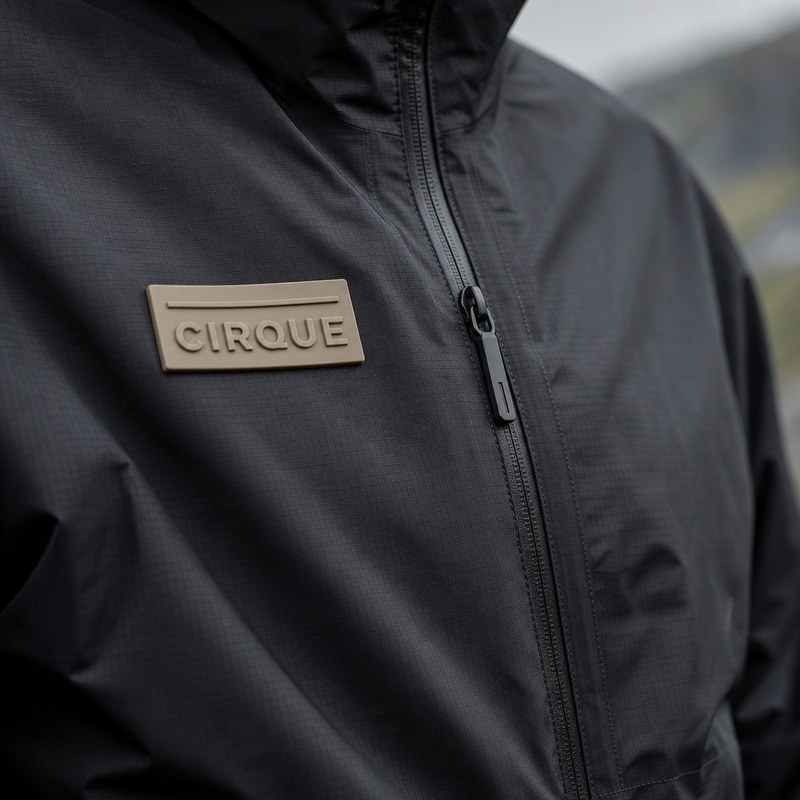
A three-layer laminate is a stack of materials with different melting behaviour. The face fabric, the adhesive layer and the membrane each respond differently to a press, and seam tape is usually the most sensitive element in the assembly. A press setting that produces an excellent bond on the face fabric can also distort tape underneath, and the garment then fails a waterproof test for a reason that has nothing to do with the label.
This is why the press window belongs in the specification as a range rather than a single figure, and why the validation garment should be a complete shell rather than a panel. Where the label must sit near a zip, a hem or a taped seam, the position itself becomes a manufacturing variable. The interaction between temperature, dwell and pressure is covered in this site's article on how pressing temperature affects a silicone heat transfer label, and the verification method is set out in how to check adhesion after pressing.
Stretch panels and seam stacks are where edges lift
Outdoor garments are built from panels that move at different rates. A stretch woven at the hem, a softshell with mechanical stretch across the chest, a sleeve where the fabric is doubled over an elbow seam: each one loads the label edge differently in wear. Edge lift is rarely a bonding-quality problem; it is a geometry problem, because a stiff label on a panel that stretches by ten per cent will always be fighting the fabric at its perimeter. Thinner constructions, rounded corners and smaller footprints reduce the stress concentration, and placing the label away from seam intersections removes the second failure point.
Garment care is a bonding specification, not a footnote
The care label in a technical garment is effectively a test plan. A recommended wash at 30 degrees on a gentle cycle with no fabric softener and a line dry describes a far milder regime than a 60 degree wash with a tumble dry, and a supplier cannot claim durability without knowing which regime applies. Fabric softener is the detail most often missed: it deposits a film on the surface that compromises many adhesive systems, and it is the reason two identical garments from the same factory can behave differently after six months of consumer use.
Write the standard, temperature, detergent, cycle count and drying method into the specification, define what counts as a failure, and use a named method so the result can be repeated. ISO 6330 covers domestic washing and drying procedures, ISO 105-C06 covers colour fastness to laundering, and ISO 5077 covers dimensional change after washing.
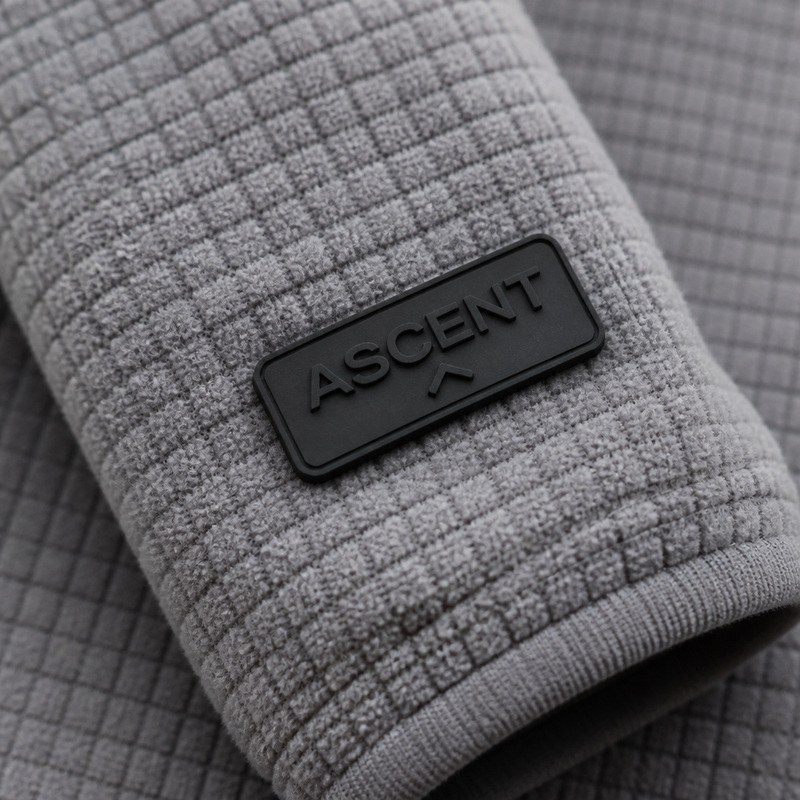
Most disputes in outdoor programmes are really about which of those numbers matter most, and that argument is usually standing in for a bond that was never tested through the actual care cycle. On fleece-faced and brushed fabrics there is a third variable: surface texture. A grid fleece presents a raised pattern that the adhesive has to bridge, so a construction that reads clean on a flat shell can look uneven on a brushed midlayer, which is a lamination and pressure question rather than a material question.
Relief and colour have to work at the distance the garment is seen
Outdoor branding is usually read at two metres or more, in poor light, in motion. That changes what matters: contrast and silhouette beat fine detail, and a label whose relief is too shallow disappears against a dark shell in overcast conditions. Where the label also has a functional role — pulling a zip, marking a hem, identifying a size run on a multi-size product — legibility survives only if the smallest stroke and counter are checked at the intended viewing distance rather than on a screen at 400 per cent zoom. The limits of small moulded detail for logos are discussed in this site's note on losing fine detail on small clothing logos.
Specification checklist for an outdoor silicone label
Fabric composition, weight and finish
Include the coating or finish type, not just the fibre. If the finish is confidential, ask the mill for a bonding note or send a production offcut with the enquiry.
Position on the garment
Name the panel, the distance to the nearest seam and zip, and whether the panel stretches. Position is a manufacturing variable on outdoor garments.
Artwork at final size
Check minimum stroke, minimum gap and the smallest counter at the actual label size, and state the intended reading distance.
Dimensions, relief and total build height
Three separate numbers. Relief drives appearance, total build height drives stiffness, and suppliers often quote only one.
Attachment route and press window
Decide between heat application and sewing against the panel, then require a validated press range rather than a single setting. See heat transfer silicone labels and durable sew-on silicone patches for the two construction families.
Care cycle defined as a test
Standard, temperature, detergent, cycle count and drying method, plus the failure definition. Garment care instructions and the test plan should be the same document.
Colour reference and surface finish
A named colour system for the compound, plus the expected finish — matte, glossy or textured — since a gloss finish on a matte shell reads as a repair.
Sample approval on the assembled garment
Approve on a complete shell after the label has cooled and after one care cycle, and keep one signed reference sample with each party.
Common sourcing mistakes in outdoor programmes
Buying the adjective, not the method
"Waterproof label" describes the material, not the assembly. Ask for the test method and the conditions behind any durability statement.
Testing on a flat swatch
A flat offcut tells you about the adhesive. It tells you nothing about seam tape, curvature or edge lift on the finished shell.
Ignoring the fabric finish
DWR treatments, softeners and anti-static finishes change surface energy. The same label can hold on one roll and fail on the next.
Approving before a care cycle
Most bonding failures appear after the first or second wash. Approve after one full care cycle, not before it.
Assuming thickness equals durability
A thicker label is stiffer, not automatically stronger. On stretch panels it is often the faster route to edge lift.
Forgetting who owns rework
On a laminated shell, a failed press can damage a garment that costs more than the label. Agree the rework route in writing before production.
Frequently asked questions
Are silicone labels suitable for waterproof jackets?
The silicone element itself handles water well, but that is not the question that matters. Suitability depends on whether the adhesive system, the fabric finish and the press window produce a bond that survives the garment's care cycle, and that can only be established by testing the assembly.
Can a silicone heat-transfer label bond to a water-repellent fabric?
Often yes, but the treatment is the variable. Some DWR finishes and low-surface-energy coatings make bonding considerably harder, and the difference between two nominally identical shells is real. Test on the actual roll and treat a successful result as valid for that roll, not for the fabric name.
What should be tested before approving a label for a technical shell?
Bond integrity after the garment's real care cycle, colour fastness to rubbing on exposed edges, dimensional stability of the label, and the condition of any seam tape or membrane in the pressed area. ISO 105-X12 defines the rubbing test, and the washing and dimensional methods are referenced above.
Is a thicker silicone label more durable on outdoor gear?
Not necessarily. Thicker constructions are stiffer and store more stress at the edges when the panel flexes, which is a common cause of edge lift on shells. Relief height and compound hardness usually matter more than thickness.
Should an outdoor label be sewn or heat applied?
Laminates and coated shells generally favour heat application, because stitching punctures the membrane and creates a leak path that has to be re-taped. Heavy canvas, denim and workwear constructions tolerate sewing well. See custom patch constructions for how the two routes differ in tooling and finish.
What information should a buyer send with the enquiry?
Fabric composition and finish, panel and position, artwork at final size, required dimensions, relief and build height, attachment route, care specification, colour reference and expected volumes. A production offcut of the actual fabric removes most of the guesswork. The silicone patch FAQ collects the same questions from the production side.
Closing notes
For outdoor apparel the useful unit of analysis is not the label, it is the label-plus-fabric-plus-care-regime assembly, and most of the variables are controlled by the buyer's own specification rather than by the supplier's catalogue. A short trial press on a production offcut, one full care cycle and a named test method will tell you more than any durability claim on a website.
Information in this comparison was collected from company websites and the cited standards in October 2026 and is limited to what those companies publish. Certifications, capacities, test results and customer relationships were not independently audited, and no supplier is endorsed. Confirm current product scope, the manufacturing entity and delivery capability directly before placing a production order.
About this comparison
It was compiled by FromRubber, a manufacturer of custom silicone labels, silicone patches and silicone heat-transfer elements in Dongguan, Guangdong, working with apparel, headwear, footwear and bag programmes on artwork review, tooling and sampling. FromRubber appears in the table above because the same eligibility rules qualify it, and it is identified here as the publisher.
Technical questions about a specific project — substrate, relief height, tooling or sampling — can go to nani@fromrubber.com or karl@fromrubber.com. WeChat and WhatsApp: +86 18676210913.
Sources
- ISO 6330:2021 — Textiles: domestic washing and drying procedures for textile testing
- ISO 105-C06:2010 — Textiles: colour fastness to domestic and commercial laundering
- ISO 105-X12:2016 — Textiles: colour fastness to rubbing
- ISO 5077:2007 — Textiles: determination of dimensional change in washing and drying
- ISO 48-4:2018 — Rubber, vulcanized or thermoplastic: determination of hardness by durometer method
- FESPA — a printer's guide for heat presses
- European Commission — REACH restrictions on substances in articles
Related reading on this site: why silicone heat-transfer labels peel on polyester, why patches separate after heat pressing, silicone patches compared with embroidered patches, and the series review of silicone heat-transfer patch manufacturers for sportswear.