
Silicone Gaskets for Water Filter Housings: How to Prevent Leakage at the Connection
A water filter housing has an unusual sealing problem: the joint that leaks is the joint the customer opens. Most industrial seals are compressed once, by a machine, at a known torque, and never touched again. A filter housing cap is closed by a person, in a kitchen or a utility room, sometimes with wet hands, often after watching a thirty-second video. The gasket that was validated in the factory is then installed a few times a year by someone who has never seen the drawing.
That single fact explains most of the leakage complaints that reach a filter brand. The seal is not failing because the silicone is wrong. It is failing because the design assumed a level of assembly care that does not exist in the field.
The other thing that makes filter housings awkward is that three different sealing principles can appear in one product. The cap-to-body joint is usually axial, squeezed between two flat faces. The cartridge stem is often a radial seal, where the rubber is compressed against a bore. A threaded collar may use either, depending on whether the thread is meant to carry the load or only to hold the parts together. Each of those needs a different gasket section, and mixing them up is the most common reason a replacement gasket that "looks the same" still leaks.
When a brand tells us a housing leaks only after a cartridge change, or only on the units sold in one market, we usually find the answer in the groove geometry rather than in the compound.
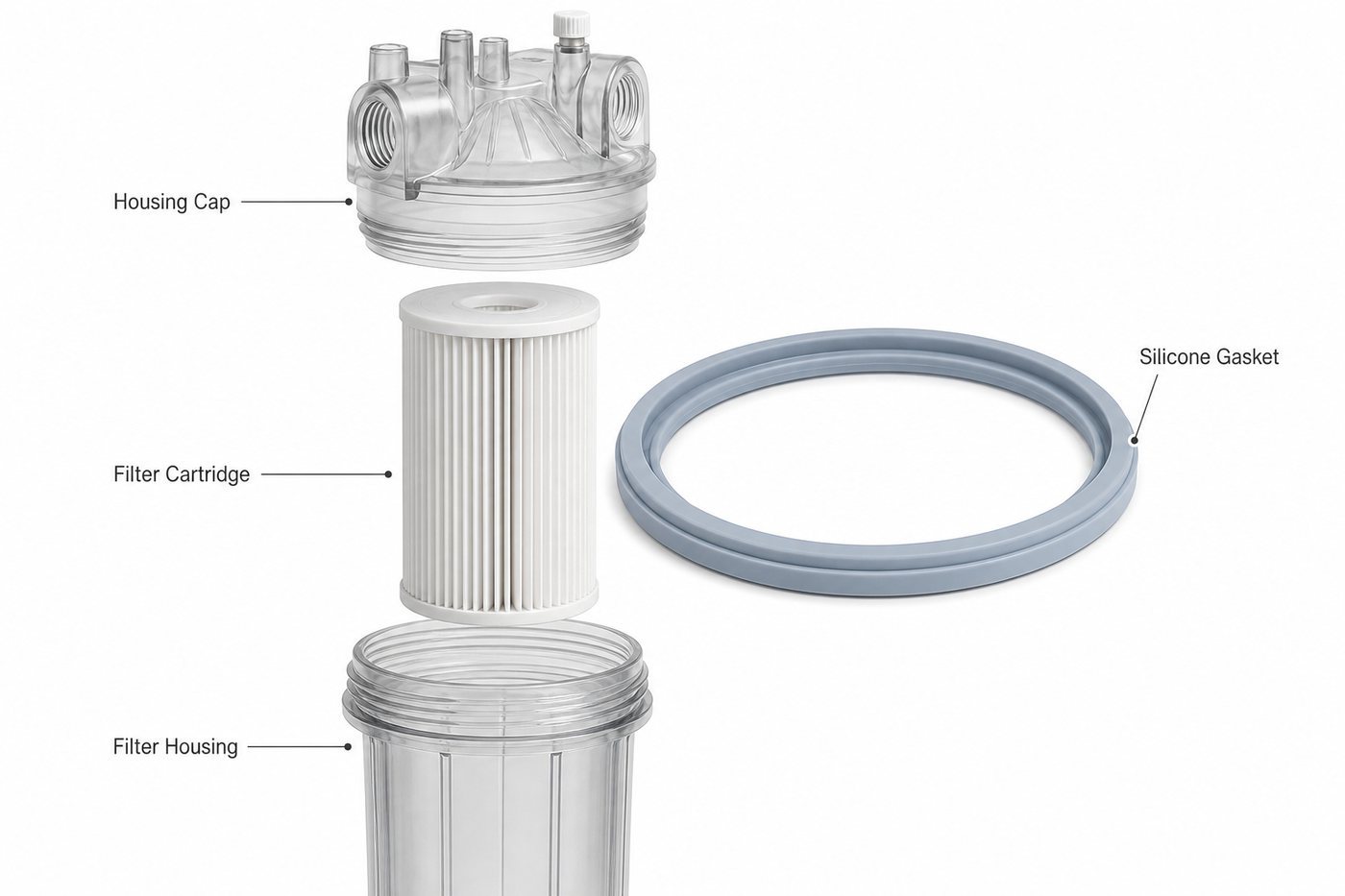
Where leakage usually starts in a water filter housing
Three locations account for almost every complaint, and each has a different root cause. Treating them as one problem is why the same gasket gets redesigned three times without fixing anything.
At the cap joint, the failure is usually dimensional rather than material. If the cap bottoms out on a shoulder before the gasket reaches its working compression, the seal is held by whatever residual squeeze the moulding tolerance allows, and the unit will pass a static test at low pressure and weep at line pressure. The other classic is a gasket that sits in a groove deeper than the cap can reach, so the top face of the gasket never touches the mating surface at all.
At the cartridge stem, the problem is more often the inner diameter. A gasket that is slightly too large will not stay centred while the cartridge is pushed in, and it deforms into the water path. Slightly too small and it stretches onto the stem, thinning its section exactly where it needs to seal.
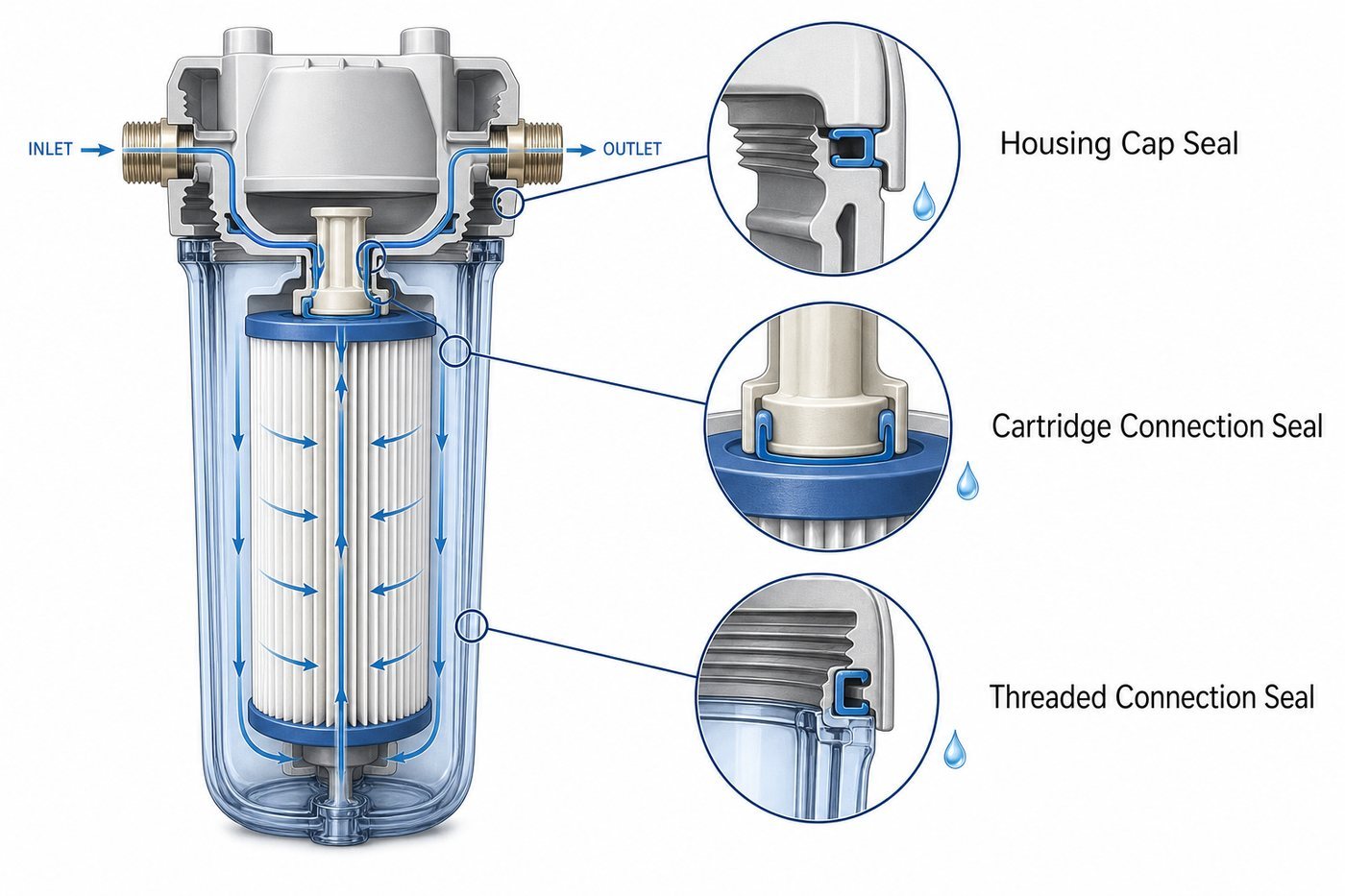
Leakage between the housing cap and the main body
This is an axial joint, and axial joints are decided by how far the two faces travel towards each other. The variables are the depth of the groove, the thickness of the gasket, and whether the cap has a hard stop. If the hard stop is reached before the gasket is compressed, torque is being applied to plastic threads instead of to rubber. Checking the assembled gap with a strip of soft solder, or simply measuring the gasket thickness before and after a dry assembly, tells you whether the joint is actually compressing anything.
Leakage around the filter cartridge connection
Cartridge connections are usually radial, and radial seals need a controlled squeeze against a bore, not against a face. The groove has to be wide enough to accept the section when it is compressed and deep enough that the rubber is not sheared by the cartridge lip during insertion. A lead-in chamfer on the bore is not cosmetic; without one, the gasket is damaged on the way in and the leak starts at the first cartridge change rather than at the factory test.
Leakage at threaded and rotating connections
A thread does two jobs at once: it holds the parts together and it resists the rotation that tightening creates. If the gasket sits in a groove that is too wide, tightening drags it round, and a twisted gasket leaks along the spiral. This is why a ring that works perfectly when fitted by hand on a bench can fail on a production line where the cap is spun on with a tool. Designing the groove to grip the gasket, rather than merely contain it, is what prevents that.
| Interface | Sealing principle | What sets the compression | Typical field failure |
|---|---|---|---|
| Cap to body | Axial, between two flat faces | Groove depth against gasket thickness, plus the hard stop | Cap bottoms out before the gasket is squeezed |
| Cartridge stem | Radial, against a bore | Bore clearance and the section's radial squeeze | Ring stretched thin, or pinched during insertion |
| Threaded collar | Axial or radial, depending on the design | Thread travel and how firmly the groove holds the ring | Ring twists as the cap is turned |
Why a new gasket sometimes makes the leak worse
When a housing leaks, the instinct is to order a replacement gasket in a softer compound or a thicker section. Both changes can move the failure rather than remove it.
Gasket thickness or cross-section that does not match the groove
A groove has a finite volume. If the gasket section is too large for that volume, the rubber has nowhere to go when the cap closes: it either prevents the cap from seating, or it extrudes into the water path and eventually tears. If the section is too small, the cap reaches its stop before any squeeze is generated. The useful calculation is the fill ratio, the cross-sectional area of the gasket against the cross-sectional area of the groove. It is a simple area comparison, and it catches most of these problems before a tool is cut. The same reasoning explains why changing section height rarely fixes a joint that was already over-filled, which is covered in this note on gasket thickness and compression.
Inner diameter and poor positioning
Inner diameter is not a cosmetic dimension on a filter gasket. It is what centres the seal on the cartridge or the spigot. An oversized ring drops out of position during assembly and gets pinched; an undersized ring stretches, which reduces its section height and its available compression. Both look fine on a bench and fail under pressure. If the ring has to be held in place while the cap is fitted, the design should include a locating bead, a groove lip or a slight interference fit, not a note in the manual.
Over-tightening and deformation
Hand-tight plus a quarter turn is the instruction on most housings, and it exists because the gasket only needs a defined compression, not maximum torque. Beyond that point the rubber is being asked to behave like a metal washer: it extrudes, takes a permanent set, and in extreme cases the ring is cut by the groove edge. A gasket that has been flattened into the groove will not recover when the cap is opened next season, which is why so many leaks appear on the second cartridge change rather than the first.
Choosing silicone for a water filter gasket
Most filter housing gaskets in service are solid silicone, and for good reasons. But solid is a starting point, not a specification.
Why solid silicone holds dimensions better
A solid section resists compression set, holds a moulded inner diameter, and does not absorb water if the surface is damaged. In a housing that is opened and closed repeatedly, holding the inner diameter is the property that keeps the seal centred. Sponge has its place in large static gaps, but a serviceable filter joint is not one of them. The comparison is set out in more detail in solid versus sponge silicone gaskets.
Hardness and long-term sealing
Hardness determines how much force it takes to compress the section and how much force the section pushes back with over time. A softer compound seals at lower torque, which suits a hand-tightened cap, but it also sets faster and extrudes more easily into the gap. A firmer compound resists extrusion and holds its shape but demands a cap that can generate the load. The relevant long-term measure is compression set under the actual service temperature, because a gasket that has taken a set has stopped being a spring, even if it still looks intact.
Material suitability for water contact
This is where generic statements cause trouble. Silicone is not automatically suitable for drinking water contact. Suitability depends on the compound, the cure system, extractables, and the approval route required in the destination market, and those are confirmed by testing the actual material, not the polymer family. If the housing is sold into a regulated drinking water market, the material approval has to be settled before the tool is cut, because changing compound later can change shrinkage, hardness and colour.
Designing the gasket around the groove
The groove is not a detail on the gasket drawing. In a filter housing the groove and the gasket are one decision, and they are usually drawn by two different people at two different times.
Three dimensions have to agree: the groove width, the groove depth and the gasket section. Width decides how much the rubber can spread when compressed; depth decides the squeeze; the section decides both the force and the fill. When a housing leaks after a cartridge change, the fill ratio is the first thing we calculate, because it explains the behaviour without any guesswork about compound.
A gasket that fills too much of the groove volume will hold the cap off its seat and extrude at pressure. One that fills too little will not reach the mating face at all. Between those two failures there is a working range, and it is set by the housing, not by the rubber.
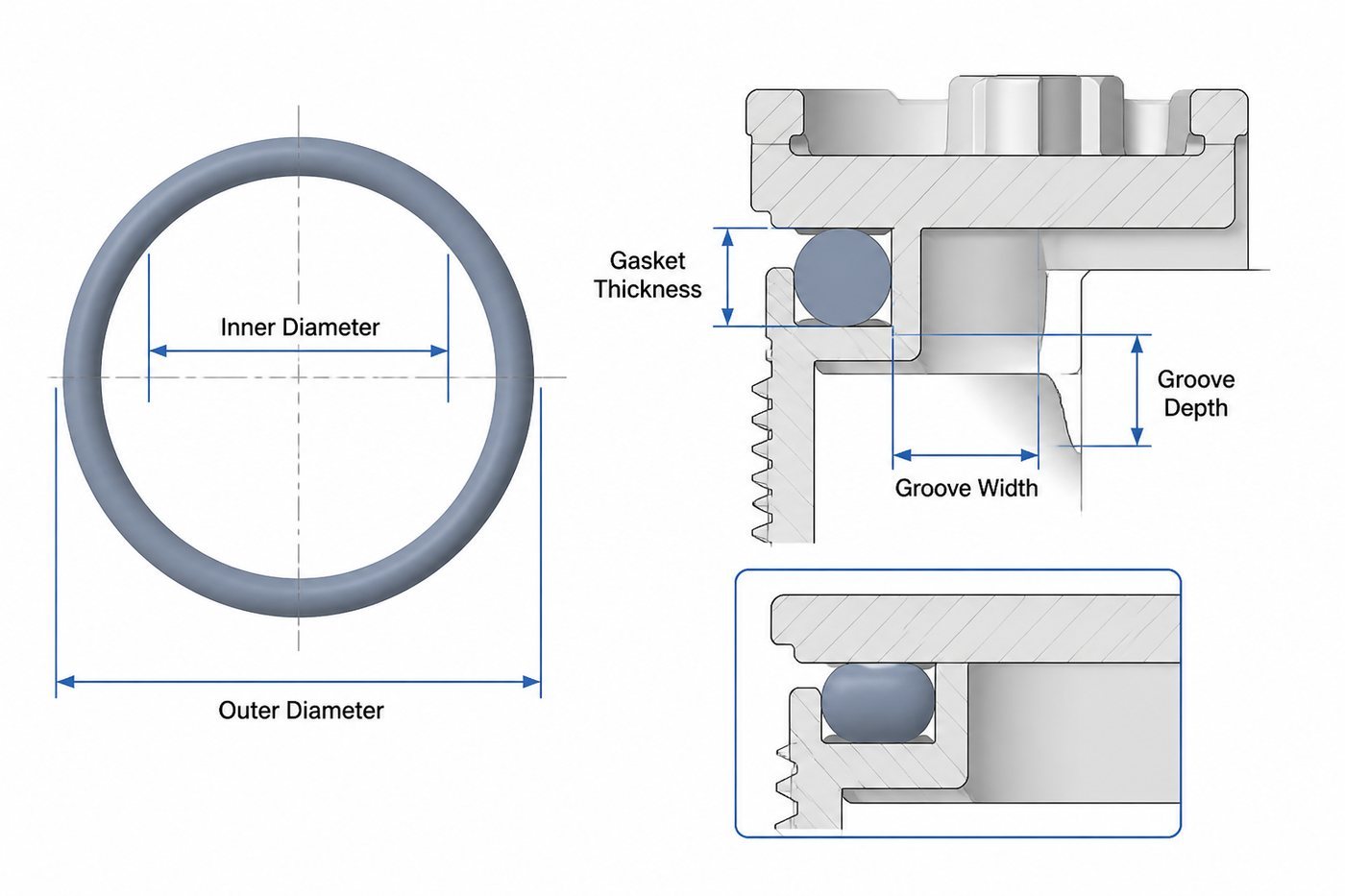
Matching the gasket to the groove
Start from the groove, not the ring. Measure the groove width and depth on the real moulded part, because both are affected by shrinkage and by the draft angle on the walls. Then choose a section that leaves room to displace. If the housing has a hard stop, check that the stop is reached after the gasket is compressed, not before. A simple dry assembly with marking compound on the gasket face will show you the contact band, and its width tells you more than any calculation done on nominal dimensions.
Designing the contact surface
Radial seals want a smooth bore and a lead-in chamfer. Axial seals want a flat land wide enough to contain the compressed section, with no sharp edge that can cut it. Both want the surface finish called out: a moulded plastic face with a visible weld line across the sealing land will leak regardless of the gasket, and polishing that area in the tool is a cheap fix compared with a field recall.
Preventing twist and displacement during installation
If the gasket can rotate in its groove, it eventually will. A groove slightly narrower than the section, a small locating tab, or a moulded bead that sits into a matching recess all remove the freedom to twist. The other practical measure is a chamfer or radius on the mating part so the gasket is guided in rather than pushed in. These are small tooling changes, and they matter most in exactly the situation that causes complaints: a customer fitting a replacement ring without a torque wrench.
What to send with a custom gasket enquiry
The difference between a quotation and a useful engineering answer is usually the information below. Without it, a supplier can only quote a ring that matches a drawing, not a ring that will seal.
- 2D drawing with the groove dimensions, not only the gasket dimensions.
- 3D file of the housing or cap where available.
- One housing and one cartridge sample, ideally a production unit rather than a prototype.
- Required hardness and any material approval the destination market demands.
- Water temperature in service, including any hot-water or sanitising cycle.
- Line pressure and how it is tested.
- How the joint is assembled: by hand, by tool, with or without lubrication.
- Expected service life and how many times the housing will be opened.
From drawing to production
Reviewing a filter gasket drawing means checking three things before any tooling decision: whether the fill ratio works, whether the hard stop allows compression, and whether the inner diameter can be held in production. All three can be answered from the drawing and a sample, and all three are cheaper to answer before cavity one.
Sampling then has to include an assembly trial on the real housing, not just a dimensional report. A gasket can measure perfectly and still leak because the cap bottoms out, and that only appears when the parts are put together and pressurised.
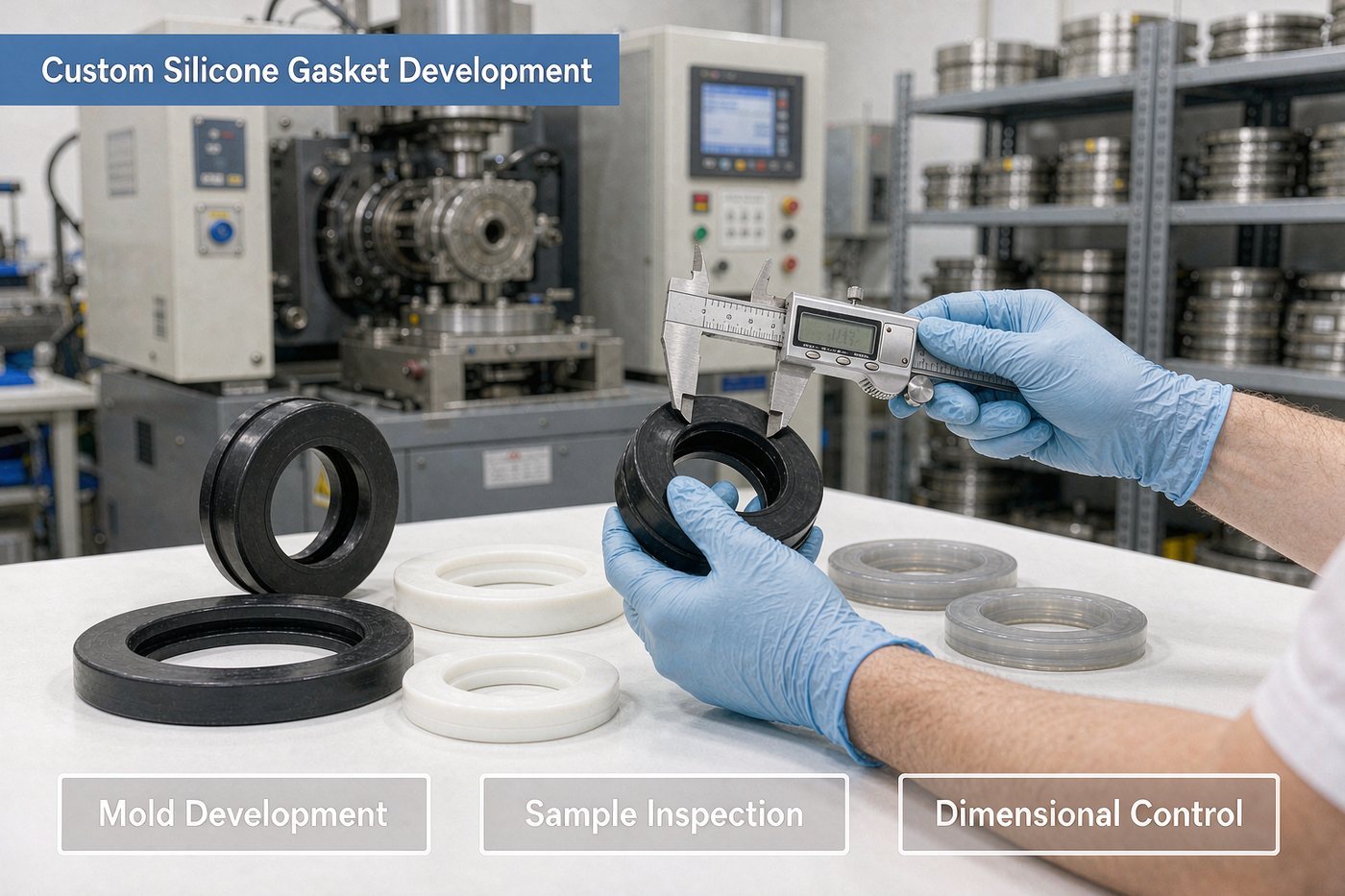
What production has to control
On a filter gasket the critical dimensions are thickness, inner diameter and outer diameter, in that order of effect on sealing. Flash on the sealing face is a leak path, so trimming has to be specified rather than assumed. Batch-to-batch hardness drift is the quiet one: a compound that cures slightly differently still passes a dimensional check and seals differently at the same torque.
Working with FromRubber on filter housing seals
FromRubber makes custom silicone components from drawings and physical samples, including flat gaskets, moulded rings and profiled seals for water treatment hardware. Tooling is built in-house in a CNC shop with 7 machines, and production runs on 32 compression moulding machines, 30 vacuum hydraulic presses and 2 flat-bed presses, across two plants, which is what allows a groove-fit change to be trialled on a sample instead of argued about on a drawing. Moulded parts are inspected at the press and again before packing. The company has developed more than 6,500 custom projects and holds over 7,200 moulds in stock, which matters on a retrofit: an existing ring size is often already tooled. Filter gaskets sit within the custom silicone seals range.
If a housing is leaking only after a cartridge change, send the groove dimensions, one housing and the assembly instructions your customer receives. That combination usually identifies the cause faster than another round of compound trials. Drawings and samples can be submitted through the inquiry page, or discussed on WhatsApp and WeChat at +86 18676210913.
Common questions from filter brands
Can I replace an O-ring with a flat gasket in the same groove?
Only if the groove is redesigned. An O-ring seals radially against a bore or a wall; a flat gasket seals axially between two faces. Putting a flat ring into a radial groove leaves the sealing surface unloaded, and the joint will weep under pressure even though it fits neatly.
Why does the housing leak only after the first cartridge change?
Usually because the original gasket was compressed beyond its recovery limit during factory assembly, or because the replacement ring was twisted during fitting. Both are visible: a gasket with a flat, glossy band and no resilience has taken a set, and a twisted ring shows a diagonal crease.
Does a softer gasket seal better on a hand-tightened cap?
It seals at lower torque, which helps, but it also extrudes and takes set sooner. The better answer is usually to give the cap a proper compression stop so the gasket is compressed by geometry rather than by how hard the customer turns it.
How tight should the cap be?
Enough to reach the designed compression, and no more. If the design has a hard stop, the stop defines it. If it does not, the gasket section and the thread pitch define it, and that value should be in the assembly instruction rather than left to feel.
What is the most common cause of a replacement gasket leaking?
A section that is dimensionally close but functionally different: same inner diameter, different cross-section, or the same size in a compound that is harder than the original. Replacement parts live or die on the section, not on the diameter.
The seal in a filter housing is the part that gets handled most and specified last. It is compressed by a person, in a hurry, on a joint that has to come apart again. Designing for that reality means treating the groove, the hard stop and the gasket as one system, and accepting that a softer ring is not a substitute for a joint that never compresses properly.
If you are developing a new housing or fixing one that leaks in the field, the groove dimensions and a production sample are the two things worth preparing first.