Rubber Grommet for Firewall Wire Harness: How Does the Fit Work?
The harness went in clean at the prototype stage. Volume build starts, three months later a grommet is found pushed halfway out of the firewall with the harness pulled tight against the sheet metal. Nothing on the drawing changed. What changed was that the opening, the panel thickness and the harness diameter were never toleranced against each other in the first place.
Short answer
A firewall grommet has to satisfy three fits at once: the opening, the panel thickness and the harness. Each one is a separate dimension with its own tolerance, and the grommet only stays put when the worst case of all three still leaves the groove clamped and the bore closed. Most field failures come from one of the three being specified on its own.
The Three Interfaces a Firewall Grommet Has to Satisfy
Grommets for cable pass-throughs are often specified from a single number — usually the hole size. On a firewall that approach fails, because the grommet is doing three jobs at once and each one loads the profile in a different direction.
| Interface | Grommet dimension involved | What goes wrong when it is wrong |
|---|---|---|
| Grommet to firewall opening | Groove diameter, outer diameter | Too small a groove and the part cannot be fitted by hand; too large and it never grips the sheet |
| Grommet to panel thickness | Groove width | Thin panel and the grommet rocks; thick panel and the edge cuts into the groove floor |
| Grommet to wire harness | Inner diameter, wall thickness | Oversized bore lets the harness move; undersized bore compresses the bundle and stresses the insulation |
Treat the three as a tolerance stack rather than three separate checks. A grommet that passes each interface at nominal dimensions can still fail when the opening is at its upper limit, the sheet at its lower limit and the harness at its lower limit all in the same vehicle.
Fitting the Groove to the Firewall Opening
The firewall opening is usually punched or laser-cut, and it is rarely as round or as clean as the drawing suggests. Two numbers matter: the opening diameter and the groove diameter.
Where the groove diameter is only marginally larger than the opening, the lip has to fold back a long way before the sheet reaches the groove. That raises installation force and puts the lip under strain at exactly the point where it is thinnest.
Where the groove diameter is much larger than the opening, the grommet fits easily but has nothing to grip. The sheet sits loose inside the groove, and any pull on the harness translates into rocking rather than into sealing load.
The useful working range sits in a fairly narrow band: enough interference that the groove walls press on the sheet at the extremes of both tolerances, and not so much that a hand fit becomes a tool fit. On a stamped opening, that band has to absorb the crown of the punched edge as well as the dimensional tolerance.
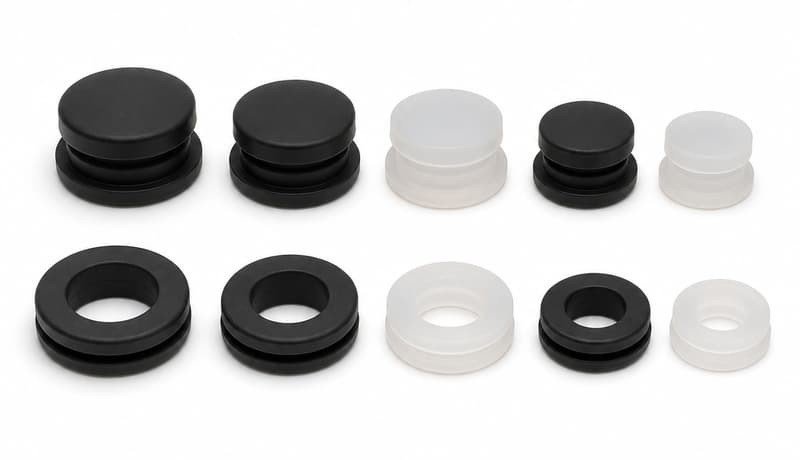
Fitting the Groove Width to the Firewall Thickness
Firewall gauge is one of the least consistent dimensions on a vehicle. Layers, reinforcement patches, seam sealant and paint film all change the local thickness, sometimes within the same panel.
When the groove is wider than the panel
The grommet is not clamped. The sheet can slide within the groove, so the harness load is carried by friction alone. Under vibration the part can walk out of the opening — the failure mode that shows up as a grommet found hanging on the harness.
When the groove is narrower than the panel
This is the more damaging case. The panel edge bottoms out on the groove floor and then continues, which stretches the lip around a corner tighter than its natural fold and forces the flange away from the sheet face. The visible symptom is a grommet that will not sit flat; the hidden symptom is a lip that has already been yielded before the part saw any service load.
A practical rule for a variable-thickness panel: size the groove for the thickest local section, and let the lip take up the difference on the thinner areas. Lip compression is recoverable. Groove bottoming-out is not.
From the moulding floor
Firewall parts are the ones where we push hardest on measurement before tooling. A drawing that gives us the opening diameter, the sheet thickness range and the harness diameter with its tolerance is usually enough to fix the groove and the bore on the first sample.
A drawing that gives us only the opening diameter means we are guessing at two of the three fits. Where a customer cannot supply the harness figure, we ask them to send a cut length of the finished harness — with the sleeve, tape and connectors in place — rather than the wire specification.
Fitting the Bore to the Wire Harness
The harness is the least controlled of the three interfaces. A "6 mm harness" is a nominal figure; the actual outside diameter depends on conductor count, insulation wall, whether the bundle is taped or sleeved, and how tightly it is bundled at that point.
An undersized bore forces the bundle through, compressing the insulation and putting a permanent hoop stress on the grommet wall. An oversized bore is quieter during assembly and much more expensive later: the harness is free to move, and every movement wears on the bore edge rather than being absorbed by the elastomer.
The bore should close on the harness without squeezing it. In practice that means measuring the bundle at the point where it passes the firewall, on a finished harness, including tape and sleeve — not at the point where the individual wires are still loose on the build board.
Why one grommet rarely covers a range of harnesses
Harness diameter at a pass-through varies far more than the wire list suggests. Adding a sleeve, a section of convolute tubing or a connector body can move the effective diameter by several millimetres. Where two harness variants share a firewall opening, the right answer is usually two grommet variants rather than one compromised bore — the second tool is cheaper than the field returns.
How the Grommet Actually Keeps the Harness Off the Sheet Metal
Electrical equipment enclosures on vehicles are classified by their resistance to dust and water ingress under the IP code, and the relevant definitions live in IEC 60529 and, for road vehicles specifically, ISO 20653 (both listed below). A grommet is one of the barriers that make those ratings physically possible at a pass-through: without it, the opening is an open path from the engine bay into the cabin or the electronics bay.
Two mechanisms do the work, and they are often confused with each other.
- Edge coverage. The lip wraps the cut edge of the opening, so no sharp metal contacts the harness. This is a mechanical barrier and it depends on the lip staying wrapped — which depends on the groove staying clamped.
- Sealing contact. Where a rating has to be held, the bore and the flange faces close against the harness and the sheet. This is a contact seal, and it depends on the grommet staying compressed in the right directions.
A grommet can provide excellent edge coverage and poor sealing, or the reverse. Specifying it for "IP protection" without saying which of the two the design relies on is how a part ends up correct on one count and wrong on the other.
Why a Firewall Grommet Moves or Comes Out
Movement is almost never a single cause, but these are the ones worth checking in order:
- Oversized opening — the groove cannot grip at the upper tolerance, so the part is only held by friction.
- Wrong groove dimensions — a groove that is too shallow or has no defined shoulder gives the sheet nothing to seat against.
- Panel thickness mismatch — the part fits at nominal and rocks at the tolerance extremes.
- Harness pulling force — a harness routed without strain relief turns every vibration cycle into a pull on the grommet.
- Vibration — sustained small-amplitude movement works the groove loose, especially in a soft compound that takes a compression set.
- Installation — a lip that was rolled or twisted during fitting never seats properly, and the part starts service already displaced.
- Insufficient retention geometry — a shallow flange and a thin groove wall, which is a design choice rather than a defect.
Compression set belongs on that list too. A compound that loses its elastic recovery in service will loosen in a groove even where the dimensions were correct from the start — which is why ISO 815-1 compression set testing is worth specifying for firewall parts.
Specifying a Firewall Wire Harness Grommet
Send these ten figures and the part can be designed on the first pass instead of the third:
- Firewall opening diameter, with the tolerance and the method used to make the hole.
- Panel thickness at the opening, as a minimum and maximum.
- Harness outside diameter at the pass-through, measured on a finished assembly.
- Harness diameter tolerance, including tape, sleeve and connectors.
- Grommet outer diameter, if there is a clearance limit around the opening.
- Grommet inner diameter, or the required squeeze on the harness.
- Groove width and groove diameter, where the shape is already defined.
- Material, chosen against the local temperature and fluid exposure.
- Hardness range, set from the harness duty rather than a house default.
- Temperature requirement, continuous and peak, at the pass-through.
Where the design is still open, items one to four are the ones that must be settled first, because they define the fit.
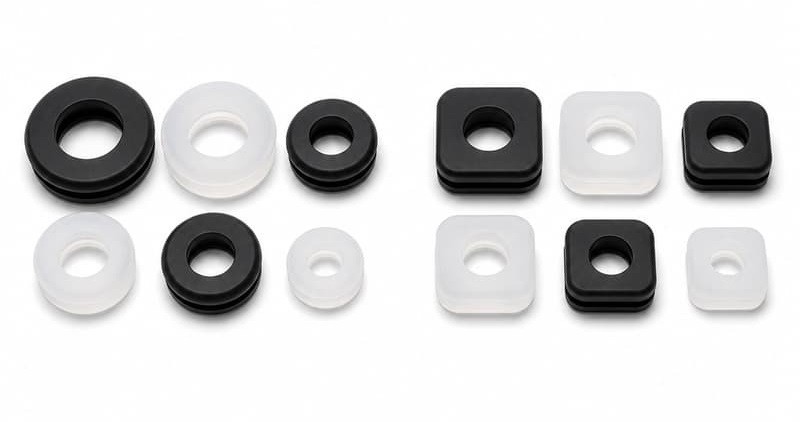
Matching a Custom Grommet to a Specific Harness
Custom development for firewall parts follows a fairly predictable sequence, and most of it is measurement rather than tooling.
Start from the finished assembly, not the component drawings. Measure the opening and the sheet at several positions, measure the harness at the pass-through, and note how the harness is routed on either side — a harness that leaves the grommet at a sharp angle loads the bore differently from one that runs straight. Then fix the groove first, because that is the fit that decides whether the part stays in place, and the bore second.
Sample parts should be fitted under the same conditions as production: same panel gauge, same harness, same routing. A trial fit on a flat plate with a loose bundle of wires proves the material and nothing else. Where the vehicle-side conditions are not available, a gauge plate at the minimum and maximum sheet thickness is enough to show whether the groove works across the range.
Compounds for firewall service usually need a wider temperature window than a general-purpose part, so material selection is worth doing before the profile is frozen rather than after. Changing compound after tooling means re-verifying the fit, because a different polymer at the same nominal hardness will deflect differently.
What to Take From This
A firewall grommet is a three-body fit. The opening, the panel thickness and the harness each carry a tolerance, and the part only holds when the worst case of all three still leaves the groove clamped and the bore closed on the bundle.
Measure the three interfaces on real parts, design the groove for the thick end of the panel range, and keep the bore matched to the finished harness rather than the wire list. Doing that before tooling is what separates a grommet that lasts the life of the vehicle from one that is found hanging on the harness.
Sources
- ISO 20653:2023, Road vehicles — Degrees of protection (IP code) — Protection of electrical equipment against foreign objects, water and access. https://www.iso.org/standard/76116.html
- IEC 60529:1989+AMD1:1999+AMD2:2013 CSV, Degrees of protection provided by enclosures (IP Code). https://webstore.iec.ch/en/publication/2452
- IEC, Ingress Protection (IP) ratings — explanatory page. https://www.iec.ch/ip-ratings
- ASTM D2000-18(2024)e1, Standard Classification System for Rubber Products in Automotive Applications. https://store.astm.org/d2000-18r24e01.html