
How to Match a Rubber Grommet to Panel Thickness and Hole Size
Two panels can share exactly the same hole diameter and still need two different Rubber Grommet part numbers. The hole sets how much the groove has to squeeze. The sheet thickness sets how much groove there is to squeeze with. Treat them as separate checks and the fit window collapses; treat them as one pair and the whole selection becomes a great deal more predictable.
Why Panel Thickness and Hole Diameter Must Be Matched Together
A grommet is held in place by a mechanical arrangement with four parts: the hole, the sheet thickness, the groove, and the flange. Remove any one of those from the conversation and the remaining three cannot tell you whether the part will hold.
The reason is that the hole and the thickness act on different aspects of the same groove. The hole diameter controls how far the groove wall is pushed inward. The panel thickness controls how much of the groove wall is in contact with the sheet in the first place. Correct hole diameter with the wrong thickness gives you a groove that closes on nothing. Correct thickness with the wrong hole gives you a groove that closes but cannot grip.
So a correct hole diameter alone does not guarantee a correct installation. It only removes one of two independent constraints.
How Panel Hole Diameter Determines Rubber Grommet Fit
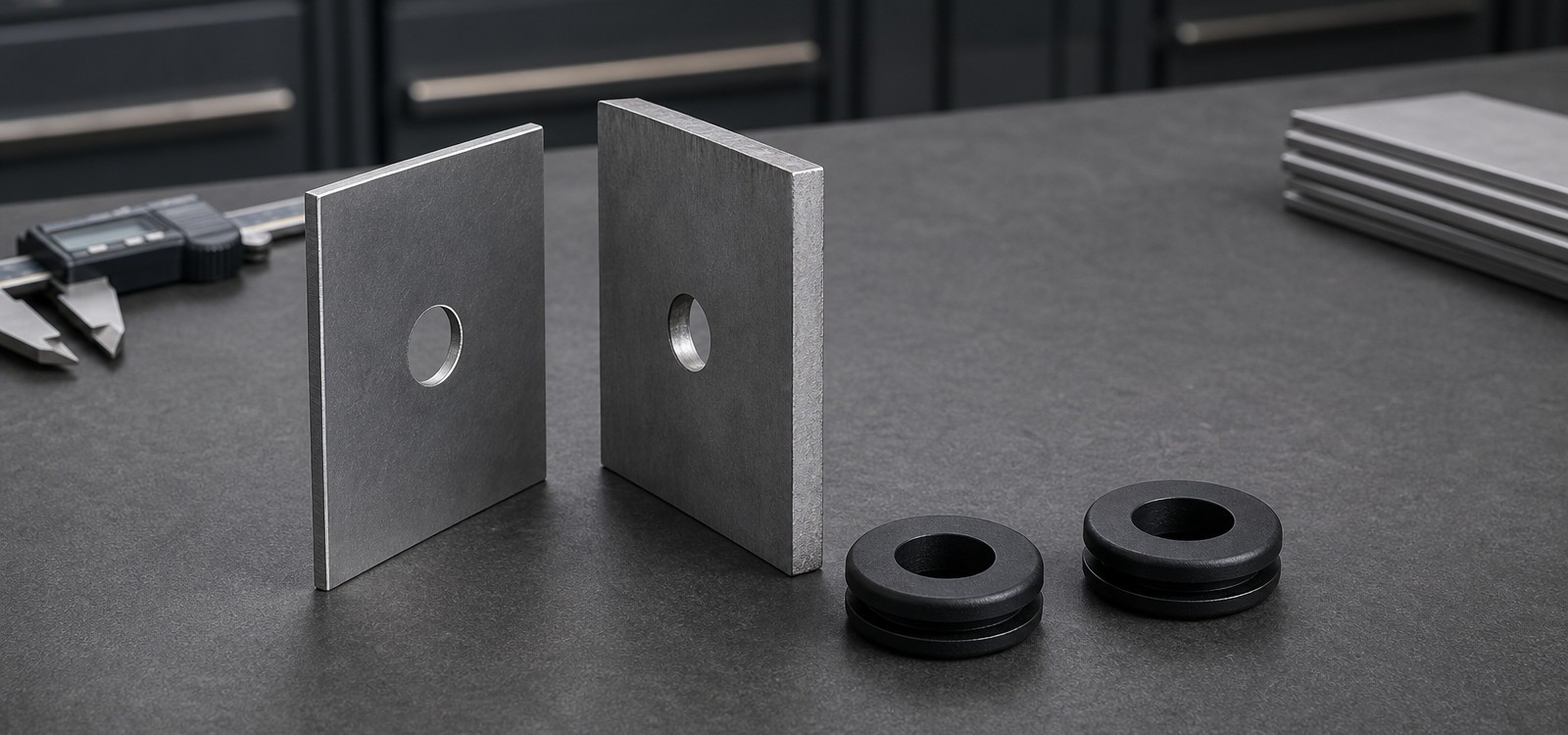
Four dimensions interact at the hole.
- Hole diameter — the wall the groove grips, and the dimension that sets the interference
- Outer diameter of the grommet body — the part that has to pass through the hole during installation
- Flange diameter — the bearing face, and the only element resisting the part being pushed through the hole
- Installation clearance — the margin that lets the body deform enough to go in without being stretched beyond its elastic range
Oversized holes
The groove no longer develops interference against the wall. What remains is friction and the flange resting on the panel face, and friction alone does not survive vibration or cable movement. The part usually stays in place until something disturbs it, which makes the fault appear intermittent and hard to reproduce.
Undersized holes
Installation force rises sharply and the rubber is left under continuous strain after seating. A part installed this way often holds well for a short period and then relaxes, because the elastomer has been asked to sit outside the deformation range it was designed for. On thinner sheet, an undersized hole also risks distorting the panel itself around the opening.
The practical rule: size against the upper end of the real hole range, not the nominal drawing value. A tool that produces a spread of hole sizes will fail at the top of that spread first.
Measure the thickness where it matters
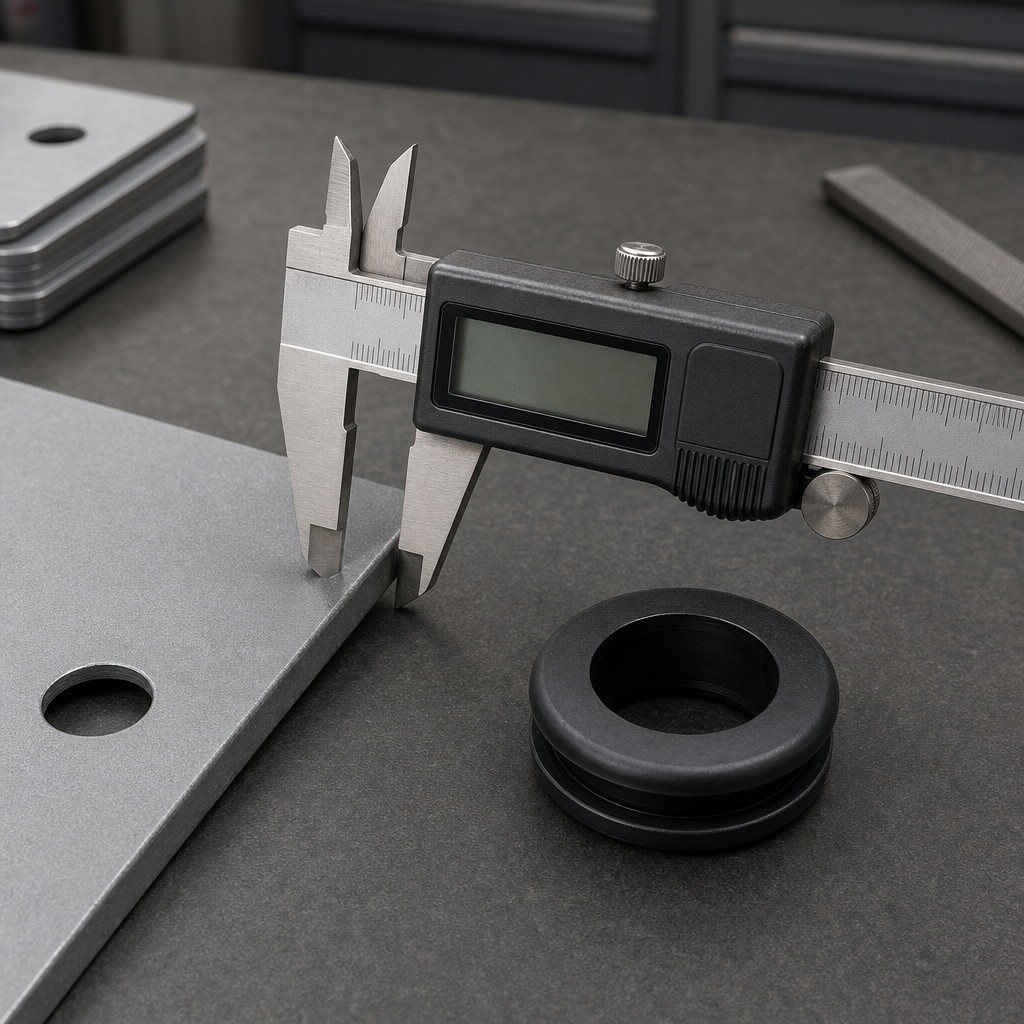
Panel thickness is almost never uniform. Formed, drawn, coined and welded areas all differ from the flat sheet, and the material immediately around a hole is frequently not the same thickness as the drawing's nominal value.
Measure at the hole edge, on the parts you actually have, and record the range across the batch. That range — not the nominal number — is the input the groove has to be designed against.
How Panel Thickness Determines the Grommet Groove
Thickness does not change the groove's diameter. It changes how much of the groove does any work.
The groove width has to accommodate the sheet with a small amount of deflection, so the rubber presses on both faces of the panel. That deflection is the whole source of retention. The groove depth decides how far the groove wall wraps around the hole wall, which is what stops the part rotating and what keeps the seal line continuous. Flange seating then transfers the panel's reaction back through the flange, which is where the part stops being pushed through.
This is why two panels with identical hole diameters but different thicknesses may need different grommet designs. The hole asks for the same interference in both cases, but the thickness asks for a different groove width, and a groove tuned for 1 mm sheet is not the same moulding as a groove tuned for 3 mm sheet.
The pair, not the average. When a specification quotes a single thickness, treat it as a range. Thickness tolerance on sheet metal is cumulative with hole tolerance, and if both drift to the same side of nominal the fit window can close entirely while every individual dimension remains in specification.
Rubber Grommet Matching Example
One worked case, presented as an example only. Actual dimensions depend on the panel, cable, material and application requirements.
Application: a flat machined bracket on a piece of industrial equipment, one cable passing through.
- Panel hole, measured: 18.9 mm to 19.1 mm across the batch
- Panel thickness, measured at the hole edge: 3.0 mm, with a forming allowance bringing the practical range to 2.9 mm to 3.1 mm
- Cable outer diameter: 8.2 mm
How an engineer would evaluate it: the groove width is set to grip a 3.0 mm sheet with slight deflection at the bottom of the range and without over-compression at the top. The groove diameter is set against the 19.1 mm upper hole limit so the largest holes in the batch still develop interference. The bore is set slightly under 8.2 mm so the jacket is held without visible stretch. The flange is then checked against the hole to confirm it still covers the edge and leaves a usable bearing face.
Change the thickness range to 1.2 mm and every one of those decisions changes, even though the hole is identical.
What Happens When the Groove Width Does Not Match the Panel?
Groove too narrow
- Installation becomes a force problem and may require tooling that damages the flange
- The rubber is over-compressed and stays that way
- Long-term compression set reduces the preload the groove can generate
- Thin sheet can bow around the opening as the over-compressed rubber pushes outward
Groove too wide
- The groove closes on the sheet without any preload, so retention depends on friction
- The grommet can rotate or shift laterally with cable movement
- Pop-out becomes likely under vibration, often months after the build rather than immediately
- The seal line, if the part is doing any sealing, is not continuous
Hole Size Tolerance and Panel Manufacturing Variation
The nominal hole on a CAD model is a target. The hole in production is a distribution, and which process makes it changes the shape of that distribution.
- Punching — fast and repeatable, but the punch wears and the hole size drifts upward over tool life; the burr side adds a raised lip that the groove must pass over
- Drilling — good roundness, but the hole is rarely perfectly perpendicular and a hand-held drill can produce an oval opening
- Laser cutting — accurate and consistent, with a small heat-affected zone and a taper that varies slightly through the thickness
- Stamping — combines forming and piercing, so the hole can be produced in an area where the material is already thinned
- Deburring — changes the effective thickness right at the hole edge, which is exactly where the groove sits
Two consequences follow. First, the hole tolerance and the thickness tolerance accumulate, so the part must be designed against their combination rather than against either alone. Second, the drawing the grommet is developed from should describe the production condition — including the deburring operation — rather than the idealised model. Designing from nominal CAD dimensions alone is one of the most reliable ways to produce a grommet that fits the prototype and not the production run.
Rubber Grommet Fit for Thin Sheet Metal
Thin sheet deserves a note here because it compresses the fit window from the thickness side rather than the hole side. With very little material for the groove to engage, retention leans almost entirely on flange bearing and on groove preload, and the sensitivity to hole variation rises because there is less rubber in contact to average out the inconsistency. A hole that varies within tolerance on 3 mm sheet can be entirely outside the usable range on 0.8 mm sheet.
That scenario has its own set of failure patterns, which are covered separately in the silicone product applications knowledge base alongside the rest of our panel and cable pass-through material.
Rubber Grommet Dimension Checklist
Before requesting a part, these are the values that determine the answer.
- Hole diameter, with the production tolerance and the direction of tool wear
- Panel thickness at the hole edge, expressed as a range
- Cable or bundle diameter, measured on the finished assembly
- Groove width, matched to the thickness range
- Groove depth, matched to the requirement for rotational resistance
- Flange diameter, checked against edge coverage and bearing area
- Material, including any specification the part has to satisfy
- Durometer, chosen for retention and installation method together
- Environmental requirements, including temperature and fluid exposure
When to Use a Custom Rubber Grommet
A standard part is the right answer when the hole and the thickness both sit comfortably inside a catalogue range. It stops being the right answer when the two dimensions no longer overlap.
- Very thin panel, where groove engagement is marginal for any standard groove width
- Unusual hole diameter, especially a size that falls between standard steps
- Multiple cables sharing one opening, which needs a multi-hole or slotted profile
- Tight assembly space, where overall grommet height has to be reduced
- Special retention requirements that a plain flange and groove cannot deliver
- Non-round openings, where the flange and groove have to follow the aperture shape
Openings that are not round
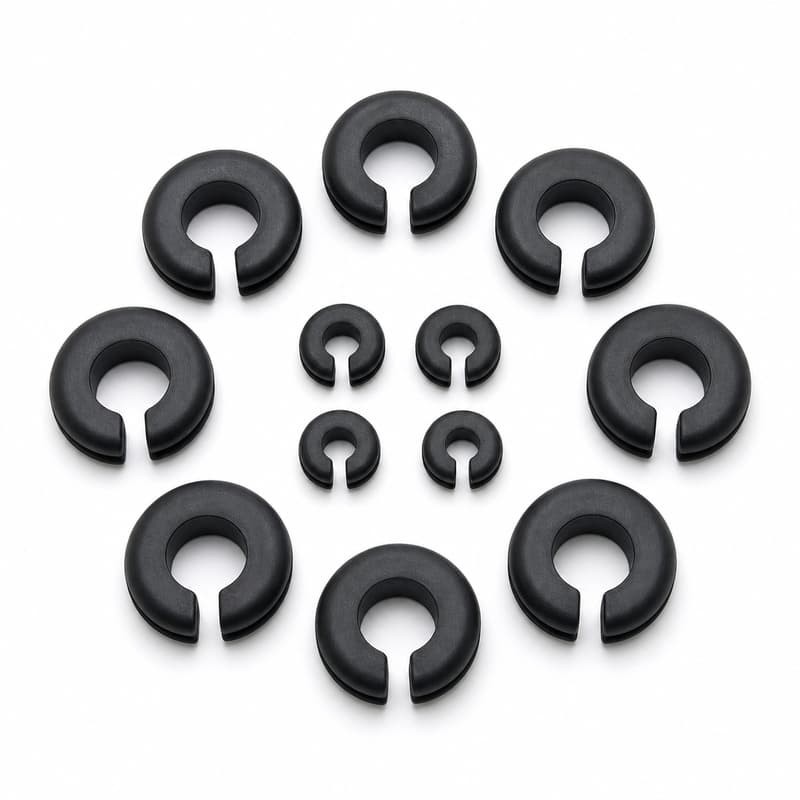
An oval or side-entry opening changes the problem from a diameter match to a shape match. A round grommet pressed into an elongated hole compresses at the ends and leaves the long sides unloaded, so the part is held on two arcs instead of a full circumference.
Where the aperture already exists, the flange and groove have to follow it. That is a normal custom profile rather than a compromise, and it usually produces a better result than forcing a round part into a non-round opening.
Information to Provide for Custom Grommet Design
Dimensional work on a custom profile goes quickly when the following are available.
- Panel drawing, or a dimensioned sketch of the opening
- Hole dimensions with tolerances, plus a note on how the hole is produced
- Panel thickness at the hole edge, as a range
- Cable outer diameter, including any sleeve, conduit or connector that must pass through
- A section drawing of the intended installation, which shows how the groove is expected to sit
- Installation direction and access, so the flange and body shape work with the assembly sequence
- Application environment, including temperature range and any fluid exposure
Frequently Asked Questions
Does panel thickness affect grommet size?
It affects groove width directly and therefore the size of the part as a whole. Two panels with the same hole and different thicknesses normally need different groove widths, which means two different part numbers. The hole diameter alone does not determine the grommet.
How close should the grommet groove be to panel thickness?
Close enough that the rubber has to deflect slightly to seat, and no closer. The deflection is what generates retention; remove it and the part sits loose, overdo it and installation force and compression set become the problem. There is no single allowance that suits every geometry, because the correct value depends on the groove depth, the flange and the material.
What happens if the hole is slightly oversized?
A little oversize reduces interference and therefore grip, but the part may still be serviceable if the flange provides enough bearing area and the cable is not loading the grommet sideways. A lot of oversize removes the interference entirely and the grommet becomes a loose insert. The useful check is whether the groove still presses on the hole wall, which can be felt by hand on a seated part.
Can one grommet fit several panel thicknesses?
Within a limited range, yes — a groove designed with enough depth can accommodate a spread of thicknesses as long as the preload at the thin end is still adequate. The range is narrower than most people expect, and it should be confirmed on the actual panels rather than assumed. Where the range is wide, two part numbers are usually cheaper than one compromise.
Can a Rubber Grommet be custom moulded?
Yes. Groove width, groove depth, groove diameter, bore, flange diameter, overall height and profile can all be set for a specific panel and cable combination, with material and durometer selected at the same time. That is the normal route when the hole and the thickness fall outside what a standard part can cover.
Sources
- ISO 2768-1:1989, General tolerances — Part 1: Tolerances for linear and angular dimensions without individual tolerance indications. https://www.iso.org/standard/7748.html
- ISO 3302-1:2014, Rubber — Tolerances for products — Part 1: Dimensional tolerances. https://www.iso.org/standard/62492.html
- ASTM D2000-18, Standard Classification System for Rubber Products in Automotive Applications. https://www.astm.org/d2000-18.html
About this guide
FromRubber is the export brand of Dongguan Bohao Electronic Technology Co., Ltd., a manufacturer of custom moulded silicone and rubber components. Matching a groove to a measured panel is the first step in most of the custom grommet enquiries we handle, and it usually leads straight into profile design, material selection, durometer choice and prototype tooling rather than into a catalogue lookup.