Molded vs. Printed Silicone Labels: Differences in Detail and Appearance
A buyer sends two files for quotation. Both are the same logo, both are described as "silicone label, 30 mm". One comes back as a raised two-colour moulding that feels like a small rubber badge. The other comes back flat, with the same logo sitting almost level with the surface but reproducing a line weight the first one could not hold. Neither supplier was wrong. The two quotes were for different ways of putting an image onto silicone, and the difference shows up long before the price does.
Moulded and printed silicone labels create visual information by different means. Moulding forms the physical shape of the label and can produce raised, recessed or textured features. Printing adds graphic elements or colour onto a surface. Those are two ways of making marks, and they are not mutually exclusive product categories: a silicone label can combine moulded geometry with printed graphics where the material system and the production process support that construction.
What a Moulded Silicone Label Actually Is
A moulded label gets its appearance from the tool. The logo is part of the geometry of the part: raised lettering, recessed channels, three-dimensional shapes, a defined outline, stepped or textured surfaces where the tooling supports them. Because the mark is the material, its characteristics are governed by the same variables that govern any small moulded elastomer part — feature width and depth, spacing, mould geometry, material behaviour and how the part releases from the tool.
Silicone for these parts is supplied as heat-cured rubber, liquid silicone rubber or a room-temperature-vulcanising system, and which family is used affects flow, cure behaviour and the finest detail a tool can hold. ISO 3302-1:2014 sets the dimensional tolerance classes and values for moulded, extruded and calendared solid rubber products, and rubber-moulding design guidance commonly suggests 1 to 3 degrees of draft where it can be included. Both describe the tool, not the artwork, which is why a moulded label is usually worth evaluating when the design depends on physical relief, on the feel of a tactile surface, or on a silhouette that is itself part of the identity. It also means the design has to survive the constraints of the mould. A feature that is too narrow relative to its depth, or a gap that is too tight, is a tooling problem as much as a design problem.
What moulding does not automatically deliver is sharper detail or longer life. Those depend on the geometry, the material, the tool and the process, which is why a well-made printed label can outperform a poorly specified moulded one.
What a Printed Silicone Label Actually Is
A printed label carries graphic information applied to the silicone surface by a compatible printing system. Depending on the process, the result can include fine graphic lines, flat areas of colour, small symbols and lettering, and colour contrast that does not require every element to sit at a different physical height. Detail that relies more on graphic definition than on relief is often a natural fit for printing.
What is achievable depends on the printing technology, the ink or coating system, the surface preparation and treatment, the substrate and the curing process. Those variables are not interchangeable between suppliers, and a print specification that works on one silicone surface is not automatically transferable to another. It should also not be assumed that every printing method suits every silicone surface — surface energy, treatment and cure behaviour all have to be compatible with the ink system being used.
Comparison 1: Fine Lines and Small Text
The two methods approach fine detail from opposite directions. In a moulded label, a fine line is a thin wall of material that has to fill, cure and release without leaning or tearing, and its legibility depends on feature width, depth, spacing and the geometry of the surrounding tool. In a printed label, a fine line is ink deposited onto a surface, and its legibility depends on line definition, how much the ink spreads, the condition of the surface and the resolution of the printing process.
Neither method is automatically superior for a small logo. A design with two or three thin elements and generous spacing may mould cleanly; the same design with ten thin elements packed into the same area may print more reliably. The variables that decide the answer are the actual artwork, the finished dimensions and the selected process, and those have to be reviewed together.
The example shown here is a moulded construction, and it is a useful one to look at because every visual element in it is a physical line. The ring silhouette, the arrow, the two triangles and the nested square have no flat colour fill to fall back on. If a line becomes uneven along its length, or if two lines that should be separate come together, the mark stops reading as the mark.
A printed version of the same four marks would carry the same geometry with a different set of constraints. The line work would be limited by ink definition rather than by wall thickness, and the marks would sit essentially level with the surface instead of standing off it.
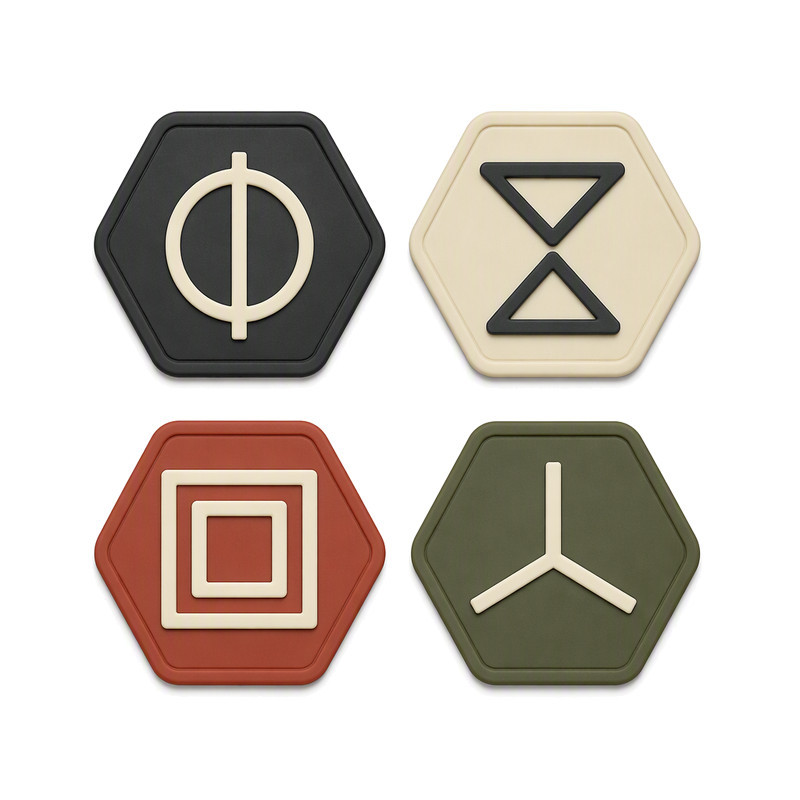
Moulded line-art marks: every visual element is a physical raised line, so legibility depends on wall geometry.
Comparison 2: Raised, Recessed and Flat Appearance
Moulded features create genuine height differences, and that has consequences beyond appearance. Height produces shadow, which is what makes a raised mark read from an angle; it produces tactile relief, which is part of how a label is perceived in the hand; and it changes local thickness, which affects how the label integrates with the garment or product it sits on.
Printed graphics generally create visual contrast on the surface without necessarily changing the underlying geometry of the label. That keeps the profile flatter, which is often desirable on close-fitting or contact surfaces, and it allows graphic complexity to increase without increasing relief.
The two are not mutually exclusive. Printed graphics can be applied to a moulded label where the construction allows it, which is the basis of the hybrid approaches discussed further down. What matters at this stage is recognising that "raised" and "printed" answer two different questions, and a brief that asks for both at once is asking for a hybrid construction.
Comparison 3: Colour and Graphic Complexity
The two routes handle colour differently, and the difference is structural rather than cosmetic. In a moulded construction, colour is usually a property of the material, so colour segmentation may require specific material arrangements, tooling arrangements or assembly steps, and each colour boundary becomes a physical interface that has to be placed and held. In a printed construction, multiple colours can be produced through successive printing steps or other compatible methods, depending on the process, which changes how registration behaves and where the constraints sit.
Two things remain common to both: registration and consistency. Registration is about whether colour areas land where they were intended. Consistency is about whether they land in the same place on the next part and the next shipment. Both need an agreed colour reference, and both become harder as the details get finer relative to the size of the label, because a fixed positional variation becomes a larger proportion of a smaller feature.
Neither method supports more colours or lower cost as a general rule. The answer depends on the design, the material system and the production route.
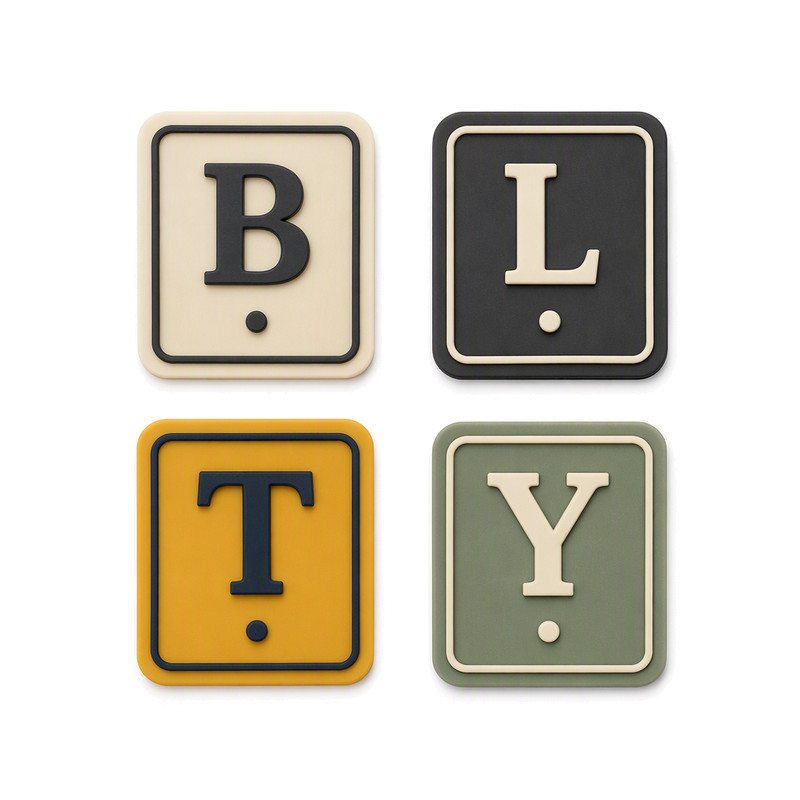
Two-colour moulded monograms: the frame and the letter are both formed in the tool, so the colour boundary and the boundary of the part are the same edge.
Two-colour moulded work is a good place to see the difference between a colour boundary and a graphic edge. Here the contrast is created by two materials meeting inside one part, and the boundary between them is also a physical edge that has to be formed cleanly.
A printed equivalent would place colour on a surface that could stay geometrically simple, which changes what can be corrected later and what cannot. If the boundary drifts in a moulded part, the correct response is tooling; in a printed part, it is usually process.
Comparison 4: Surface Texture and Visual Finish
Texture can come from the tool or from the coating. A moulded label can carry a deliberate surface texture created in the tool, which changes how it scatters light and how it feels. A printed label can present a smooth, matte or glossy appearance depending on the ink or coating system and the finishing process used.
Finish affects legibility more than most buyers expect. A matte surface scatters light and tends to render fine raised lines as gentle tonal steps, which can be enough to make a thin element readable. A glossy surface produces specular highlights that may pick out a fine line beautifully at one angle and erase it completely at another. Confirm the intended finish on a physical sample, because lighting and digital mockups both change how a surface effect appears.
Comparison 5: Durability and Wear Considerations
Durability belongs to the complete construction, not to the name of the process. For moulded features, the relevant questions are how raised areas wear against whatever rubs them, how exposed the edges are, and what the design geometry does to concentrate stress. For printed features, the relevant questions are how well the printing bonds to the silicone surface, whether curing was complete, and how the printed layer behaves under rubbing, flexing and cleaning.
The intended use matters as much as the method. Washing or cleaning conditions and the attachment method both influence performance, and so does the position on the product: a label on a chest panel and a label on a heel receive different treatment in ordinary use.
It is worth being precise about what should not be claimed here. Moulded labels do not always outlast printed ones, and printed detail does not always wear off quickly. Both statements describe outcomes that depend on the construction, the material, the process and the conditions, and either can be made to fail by the wrong specification.
Comparison 6: Flexibility, Thickness and Product Integration
Moulded relief changes local thickness and, at the extremes, local stiffness. Printed detail can preserve a flatter profile. Overall flexibility, however, depends on more than the process: label dimensions, the silicone formulation, the construction and the attachment all contribute, and a large flat label can be less compliant in practice than a small moulded one.
This is where the choice usually becomes application-specific. A structured, raised external logo suits a panel with room around it; a flatter label suits a close-fitting or contact surface. A design that works on a bag front will not automatically transfer to a sock cuff, a shoe tongue or a sleeve hem, and the substrate should be named in the brief before the method is chosen.
Moulded vs Printed Silicone Labels at a Glance
| Comparison factor | Moulded silicone labels | Printed silicone labels | What buyers should verify |
|---|---|---|---|
| Fine lines and small text | Limited by wall width, depth and spacing; thin walls can lean or tear on release | Limited by ink definition, spread and printing resolution | The thinnest line and the smallest text at final size, reviewed with the intended process |
| Three-dimensional relief | Relief is inherent: raised, recessed and stepped surfaces are formed by the tool | Relief is not created by printing; the profile can remain essentially flat | Whether relief is actually required by the design or the product |
| Colour complexity | Colour is usually a material property, so boundaries are physical interfaces | Multiple colours can be applied in successive steps or other compatible methods | Colour count, agreed colour reference, and how the boundary is expected to behave |
| Surface appearance | Texture can be created in the tool; matte or textured surfaces scatter light | Finish depends on the ink or coating system and the finishing process | The physical sample under the lighting the product will be seen in |
| Thickness and flexibility | Relief changes local thickness, and can affect local stiffness | Details can be added without changing the underlying geometry | Behaviour on the actual substrate, especially where it curves or flexes |
| Abrasion and wear | Raised areas and exposed edges take contact directly | Bonding, curing and compatibility govern how the printed layer behaves | The finished construction under the conditions the product will meet |
| Production consistency | Consistency is driven by tool condition, material and process control | Consistency is driven by process control and surface preparation | The master sample, acceptance criteria and how batches are retained for comparison |
| Design and tooling considerations | Geometry must suit the mould: feature proportions, spacing and release | Artwork must suit the ink system and the surface it is applied to | A design review before tooling, and confirmation that the route suits the artwork |
When to Consider a Moulded Silicone Label
- Raised or recessed branding is central to the design rather than incidental to it.
- The logo depends on physical shape, a tactile surface, or a clearly defined silhouette.
- The design needs a moulded outline or a structured dimensional appearance.
- The artwork can be adapted to the geometry the tool can actually produce.
Even in these cases, the fine features, dimensions and application requirements should be reviewed before feasibility is confirmed, because the same drawing can produce different answers from different tooling.
When to Consider a Printed Silicone Label
- The design relies on graphic contrast rather than on relief.
- Fine visual elements are important to the identity of the mark.
- The artwork contains several graphic details that do not need to sit at different heights.
- A flatter appearance is preferred for the application.
Actual print feasibility depends on the compatible ink system, the surface treatment, the label material and the conditions the product will be used in. Those four are decided together, not selected independently.
Curved lettering is a useful final example, because it combines several of the factors above at once. The word follows an arc, the letters sit at a consistent height, and a centre motif is enclosed by the same part boundary. In a moulded construction, the arc and the letters are formed together, which means the tool has to reproduce a continuously changing orientation of each stroke.
The design also shows why the printed alternative is not simply a downgrade. A printed version could hold the same arc with different line constraints, and it could do so without the raised profile — a real advantage for a label that has to sit quietly against a surface.
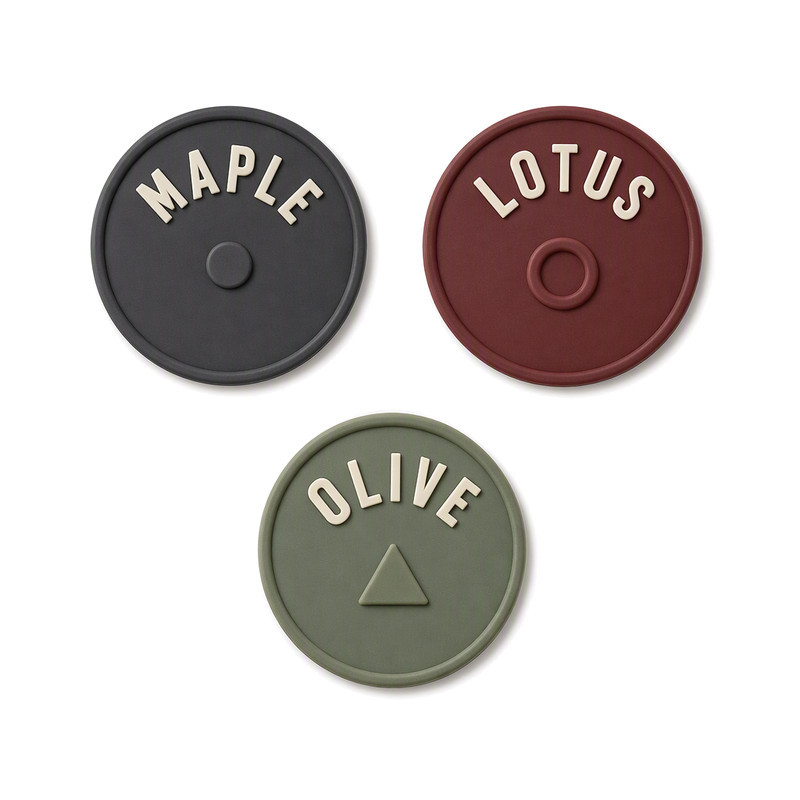
Arced moulded lettering: the arc and the letters are formed together, so the whole arrangement is a tooling decision.
Can Moulded and Printed Features Be Combined?
Hybrid designs can combine moulded geometry with printed graphics where the construction is technically feasible. A raised logo with printed colour accents, or a moulded outline with printed lettering, are the usual examples, and they exist because the two processes answer different needs in the same part.
Combining them adds considerations rather than removing them. Material and process compatibility has to hold across both routes. Registration between physical features and printed features has to be controlled, because the two are produced in separate steps and can drift relative to each other. Additional inspection requirements follow, along with the need to validate the sample under the intended conditions. Not every hybrid combination is feasible or economical, and the decision should come from a design review rather than from the appeal of the idea.
Questions to Ask Before Choosing a Production Method
- Does the logo need physical relief at all, or would contrast do the same job?
- How small are the thinnest lines and the smallest letters, in millimetres, at final size?
- How many colours are genuinely required?
- What overall thickness and flexibility are acceptable for this product?
- What fabric or product surface will carry the label?
- How will the label be attached?
- What abrasion, washing or cleaning conditions should be expected?
- Which details must still be clear after use, rather than only when new?
- Can the manufacturer provide a representative sample for the route being proposed?
- What inspection criteria will be used to approve production?
Questions Buyers Ask Most
What is the difference between molded and printed silicone labels?
A moulded label gets its appearance from the shape of the part, formed by a tool, so raised and recessed features are part of the geometry. A printed label gets its appearance from ink or coating applied to a surface, so graphic detail can be added without changing the underlying shape.
Are molded silicone labels always 3D?
No. Moulding creates physical geometry, but that geometry does not have to be pronounced. A moulded label can be relatively flat with only shallow relief, and the amount of height is a design decision rather than a property of the process.
Are printed silicone labels better for small text?
Not as a general rule. Printing removes the wall-thickness constraint, but it introduces its own limits around ink definition, spread and surface condition. Whether printing performs better for small text depends on the artwork, the finished size and the specific printing system.
Can silicone labels combine molding and printing?
They can where the material system and processes are compatible. Hybrid constructions usually need extra attention on registration between the moulded and printed features, additional inspection, and validation on the intended substrate.
Which type of silicone label is more durable?
Neither type wins by default. Durability is a property of the complete construction: the geometry, the material and formulation, the bonding or curing, the attachment method and the conditions of use. Either route can be specified well or badly.
How do I choose a silicone label method for clothing or footwear?
Work from the application backwards. Decide what the mark has to do, what surface it will sit on, how it will be attached and what conditions it will meet, then evaluate which route satisfies all of those. Relief requirements and the smallest detail in the artwork are usually the two factors that settle the choice.
Choosing by What the Label Has to Do
Moulded labels create physical geometry; printed labels create graphic features; and hybrid approaches can combine the two where the construction allows. None of those statements identifies a better product, and the comparison only becomes useful once the application is fixed. The right choice follows from the appearance the brand wants, the detail the artwork contains, the thickness the product can carry, the substrate it will sit on, the attachment method available and the wear conditions it will meet.
FromRubber works on custom silicone labels and silicone patches on both moulded and printed routes, and reviews artwork and application requirements when assessing which production approach suits a project. Where the design includes fine line work or several colours, it is worth sending the file at its intended final size together with the substrate, the attachment method and the expected care conditions, so the route can be assessed against the real constraints rather than the general case. Artwork and requirements can be submitted through the FromRubber inquiry form, by email to nani@fromrubber.com or karl@fromrubber.com, or by WeChat and WhatsApp on +86 18676210913. Related reading on this site includes how small a small silicone logo can be on clothing, keeping thin lines visible in a small silicone logo, and the multi-colour silicone, screen printing and mould making capability pages.
Sources
- What is silicone rubber? Heat-cured, liquid and room-temperature systems — Elkem Silicones
- ISO 3302-1:2014 — Rubber: Tolerances for products, Part 1: Dimensional tolerances, ISO
- Draft Angle Guidelines for Injection Molding — Protolabs
- Designing for Rubber Molding: Tolerances, Shrinkage, Parting Lines and Draft Angles — Panova